Vol 1, No 4
189521 articles15 imagesItalian
Articles in this issue
- General Directorate notice: from 1 June the T.C.C.I.'s offices move to Via Gabrio Casati 2 (corner Via Dante); the Cremona section reports weekly social rides, the latest a two-day trip to Lake Garda, and plans two new vice-consulates at Piadena and Casalmaggiore; the Legnano section completes a run to Varese; and talks with the Touring Club de Belgique and Touring Club de France toward an international touring federation are well advanced, with reciprocal member benefits already agreed in principle. Signed by Direttore Generale Giulio Venino.
- Programme for the Milan section's first organised outing, 12 May 1895: muster at 5am at the Porta Volta barrier, departure 5:30, refreshment stop at Seregno (6:45), Erba (8:00), lunch at Lecco (9:30), and return to Milan via Merate and Monza from 2pm; entries close 10 May at the central office with a 2-lire deposit, open to T.C.C.I. members and candidates presented by a member under Article 82 of the Statute.
- A short office notice: the T.C.C.I.'s Via Rovello offices are open 9am-noon and 2-6pm every day except holidays, and members needing information are asked not to linger so as not to disturb staff.
- Minutes of four Council sittings (27 March, 3, 10 and 17 April 1895): accepting the resignation of Naples consul Randolfo Noris, approving Capo Sezione Comfort Tarra's new circular to hotelkeepers and Bertarelli's report on paid advertising for the Guida, a contract with Mazzolari, and a request that railways provide secure bicycle storage rooms; discussing new premises for the outgrown Via Rovello office, approving hotel warning-plaque designs, adopting accountant Daverio's bookkeeping scheme, declining to discuss Cav. Johnson's personal proposal to merge the T.C.C.I. with the U.V.I., and appointing further consuls on Ricordi and Gorla's recommendation.
- The editors warn members admitted after 15 February that back numbers of the Rivista Mensile cannot be supplied, as the edition is sold out; new members are entitled only to the Bollettini published after their own admission, since print runs cannot anticipate future enrolment.
- The General Consulate's fourth list of appointments approved across the Council's late-March/April 1895 sittings: Paul Grüssner as head consul for Vienna/Wiener Neustadt, new consuls including Arturo Cortese (Genoa), Pietro Baragiola (Como) and Giacomo Douglas Scotti (Piacenza), and numerous vice-consuls; it also records Randolfo Noris's resignation from Naples and appeals to consuls along the Milan-Rome cycling route to assist participants.
- Roads Section head L. V. Bertarelli announces that the club's long-promised Guida-Itinerario is nearly typeset and will appear free to all members by the end of May, its print run capped near current membership since a reprint would be prohibitively costly; the guide will record each road's length, class, place names, distances, altitudes, population, hotels, mechanics and postal/telegraph/rail/carabinieri facilities, and lists scores of planned routes across Italy from Milan-Verona-Trieste and Genoa-Ventimiglia-Rome to Alpine crossings and the length of the peninsula.
- The Cremona section's petition to the mayor to lift the ban on cyclists passing under the city's toll arches (archi daziari) succeeds: the Giunta agrees to let cyclists pass freely through the city gates, the section's first and most successful initiative.
- The club reports slow but ongoing efforts with railway stations and municipal administrations to secure proper bicycle storage rooms, urging consuls and vice-consuls everywhere to keep pressing the case even where officials seem unreceptive.
- Responding to numerous letters from consuls and members about violence against cyclists, especially in the Milan and Bergamo areas, the club says it is studying countermeasures while asking cyclists themselves to set an example of restraint, since many existing grievances stem from riders' own negligence or recklessness. Signed by Capo-Sezione Strade L. V. Bertarelli.
- The Provincial Deputation's 21 March ruling grants T.C.C.I. cyclists a licence to use the western pedestrian avenue of the Milan-Monza road, conditional on machines narrow enough to pass between the posts, a bell to warn pedestrians, front lamps at night, and exclusion from the eastern avenue between Sesto San Giovanni and the Rondò di Monza, reserved for pedestrians alone. Signed by Legal Section head Avv. Ignazio Dell'Oro.
- The Comfort Section, run by C. Tarra, publishes its updated list of hotels offering reduced rates to members on presentation of the membership card, spanning Aosta, Argegno, Arona, Baveno, Chiavenna, Como, Crema, Cremona, Forlì, Gallarate, Melegnano, several Milan hotels, Savona, Vigevano and Voghera, with detailed meal and room tariffs for each.
- Milan member Guido Olivieri's letter to the club highlights the unpredictability of customs duties, deposits and varying opening hours at border crossings for cyclists; the Movement Section, under engineer Alberto Riva, is gathering information from Italian and foreign customs offices to publish an accurate guide, and invites other members to send their own experiences.
- The Technical Section, headed by Enrico Luzzato, lists discounts secured for members at Rome cycling firms: Adolfo Tornei's velodrome (repairs, hire and lessons), Tito Agostinelli (repairs and own-make machines), and Tomei Adolfo's dealership offering reduced prices on Humber, Crescent, Remington, New Howe, Bianchi, Orio & Marchand and Columbia bicycles.
- Romeo Carugati's Scientific Section opens the touring season with practical advice on buying and maintaining a machine, favouring known, well-proven brands over cheap ones, tangent spokes, and avoiding over-oiling, treating tyres monthly with a dilute phenic-acid solution, and carrying a small repair and medical kit (praising the T.C.C.I. Medical Section's purpose-made pouches); it also reviews novelties seen at Milan's international cycling exhibition, including La Métropole's chainless Acatène bicycle, Prinetti's untested lever multiplier, Frischenschlager's double-compensation hub, and an English pneumatic brake.
- The Library column reviews Justus Perthes's eleven-sheet Mayr's Atlas des Alpenländer as the best long-distance touring map for Italy and its Alpine neighbours despite missing roads and sparse altitudes, and the Istituto Geografico Militare's cheaper 1:1,000,000 six-sheet Carta economica dell'Italia; it thanks the journal La Bicicletta for donating its Annuario del Velocipedismo, with fifteen route maps by cartographer Patrucco, and offering its plates to Bertarelli's forthcoming Guida, and thanks the Touring-Club de France for copies of its 1895 Annuario. Signed by librarian T. E. Magnasco.
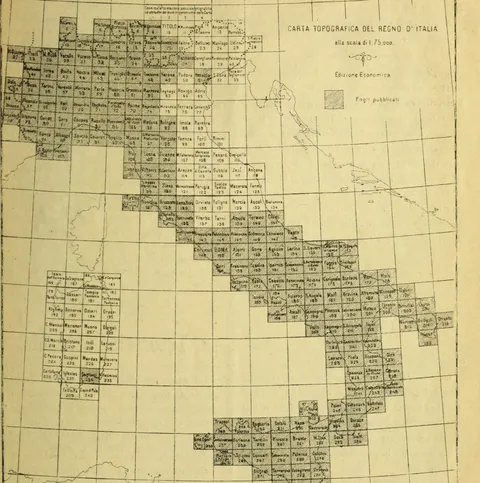
- For new members who missed issue No. 2, the editors reprint its map notice: a 30 percent Istituto Geografico Militare discount on sheet maps, ordering instructions, and a recommendation of the 1:75,000 topographic survey of the Kingdom of Italy (No. 11, 277 sheets), with contour lines at 50-metre intervals and extensive spot heights useful to cyclists.
- The Chancellery, run by A. G. Bianchi, covers several member-service notices: Statute copies available on written request; badges at 1 lira for members and 1.50 for the Consular Corps, newly struck from a die donated by Cav. Federico Johnson; membership cards already dispatched to paid-up members; member Vittorio Ferrari's withdrawal from supplying free card covers after manufacturers' quotes proved too high, with the Council seeking an alternative; and smaller, more elegant new tricolour tassels from the Faliva firm at 30 centesimi.
- Under Article 13 of the Statute, the club lists candidate members enrolled between 20 March and 20 April 1895, several hundred names across Milan and towns including Biella, Genoa, Vicenza, Bergamo, Verona and Rome, with occupations from industrialists and engineers to mechanics, students and hoteliers, who will be deemed admitted if no objection is received within eight days.
- An unofficial note on the Prima Passeggiata Ciclistica Milano-Roma: of 28 entrants in the first category and 36 in the second, 20 and 25 respectively are T.C.C.I. members, and two of the first category's three team captains are club Council members, L. V. Bertarelli (Roads Section) and Carlo Tarra (Comfort Section), alongside Cav. Johnson and Verona vice-consul Dott. Luigi Bellini Carnesali among the second category's captains.
- Avv. I. Dell'Oro reports progress toward an international touring federation, an idea that seemed utopian only a few years ago: full reciprocal rights (hotel facilities, consular, medical and legal service on presentation of the card) are already established with the Touring Club de Belgique, reciprocity with the French touring club is nearly settled, and talks with the English and German touring associations look equally promising, raising hopes that Europe's cyclists will soon stand under one flag.
Images in this issue 15 pictures from 32 pages
Illustrations 1
 (opens in a new tab)
 Emblema del Touring Club Ciclistico Italiano
Maps 1
 (opens in a new tab)
 Carta Topografica del Regno d'Italia alla scala di 1:75.000, Edizione Economica, quadro d'unione dei fogli
Mastheads 2
 (opens in a new tab)
 T. C. C. I., Rivista Mensile del Touring-Club-Ciclistico Italiano - (opens in a new tab)
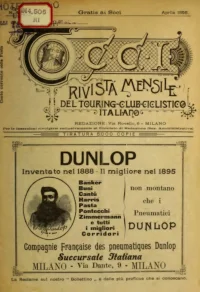
T. C. C. I., Rivista Mensile del Touring-Club-Ciclistico Italiano (N. 4, Aprile 1895)
11 advertisements
 (opens in a new tab)
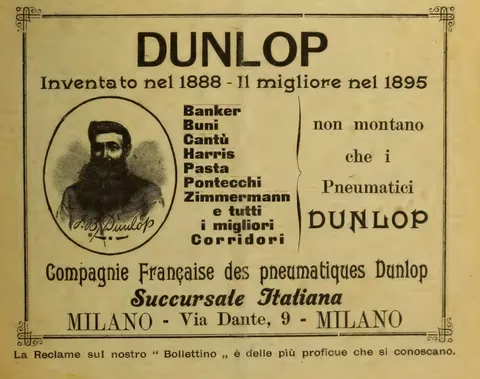
 Dunlop, Compagnie Française des Pneumatiques Dunlop, Succursale Italiana 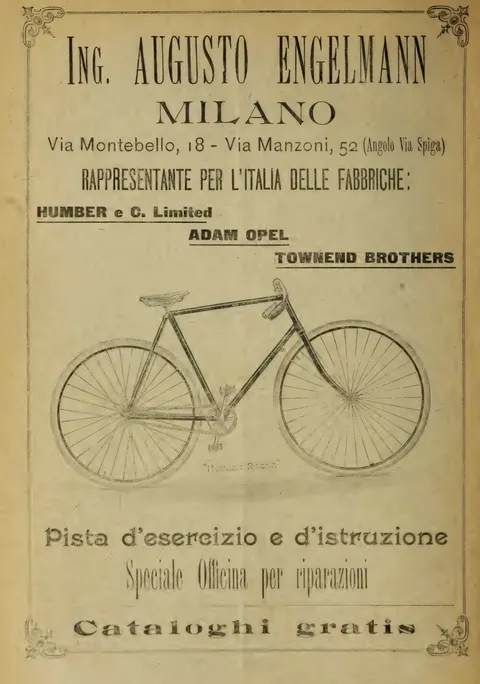 (opens in a new tab)
 Ing. Augusto Engelmann, Milano, Agente per Humber, Adam Opel, Townend Brothers 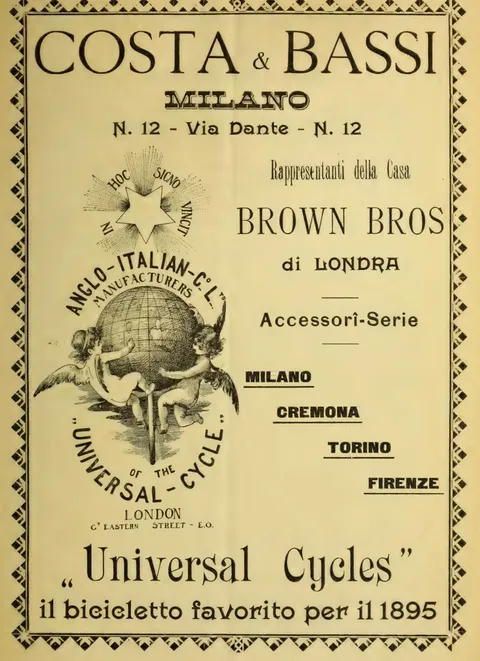 (opens in a new tab)
 Costa & Bassi, Milano, Rappresentanti di Brown Bros di Londra, 'Universal Cycles' 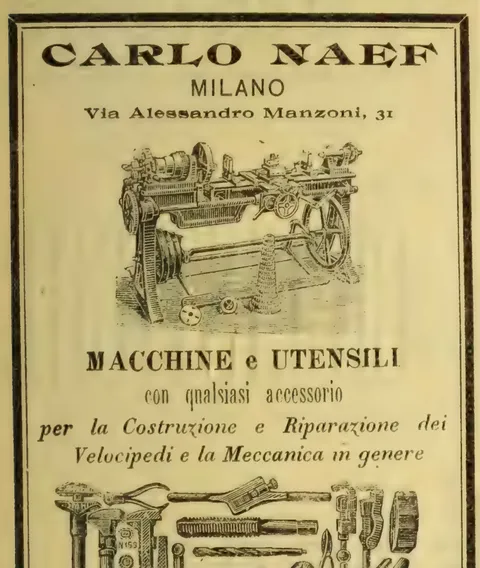 (opens in a new tab)
 Carlo Naef, Milano, Macchine e Utensili 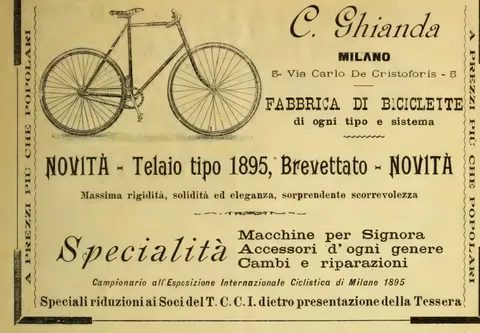 (opens in a new tab)
 C. Ghianda, Milano, Fabbrica di Biciclette 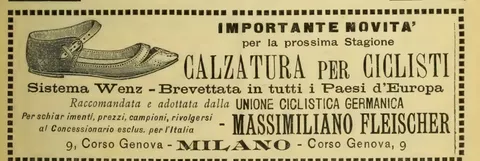 (opens in a new tab)
 Calzatura per Ciclisti, Sistema Wenz, Massimiliano Fleischer, Milano 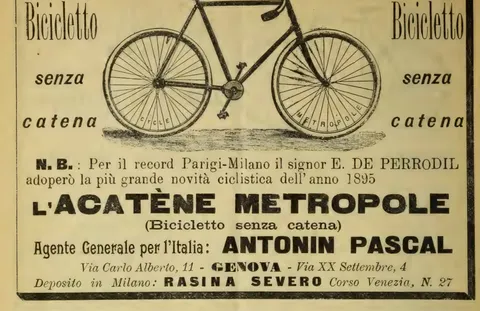 (opens in a new tab)
 L'Acatène Metropole, Bicicletto senza catena, Antonin Pascal (Genova) 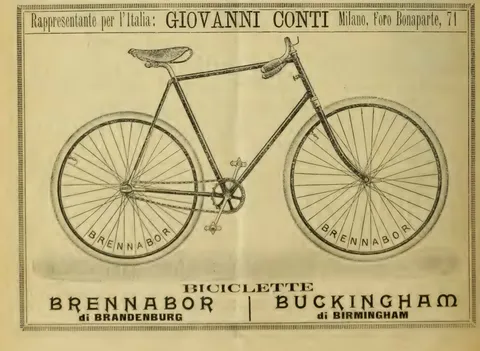 (opens in a new tab)
 Biciclette Brennabor (di Brandenburg) e Buckingham (di Birmingham), Giovanni Conti, Milano 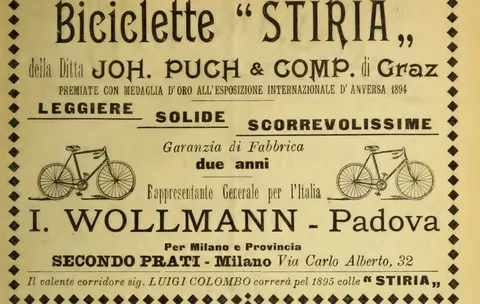 (opens in a new tab)
 Biciclette Stiria, Joh. Puch & Comp. di Graz, rappresentante I. Wollmann (Padova) 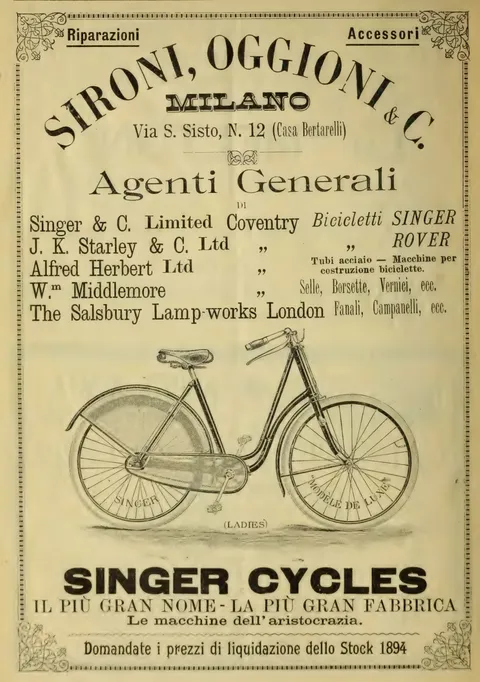 (opens in a new tab)
 Sironi, Oggioni & C., Milano, Agenti Generali, Singer Cycles 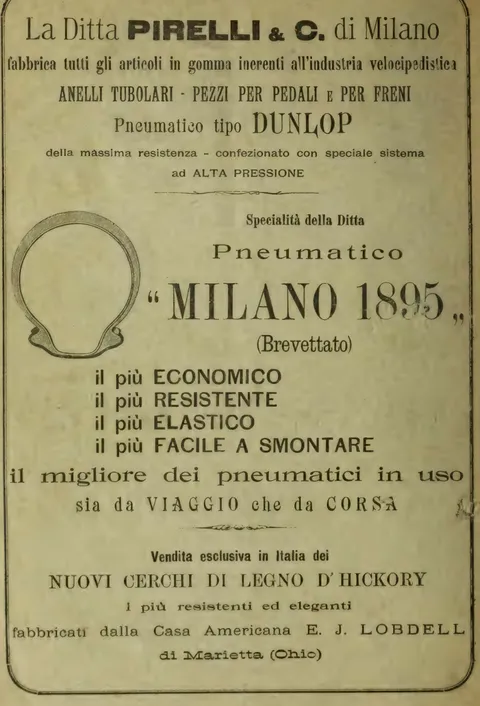 (opens in a new tab)
 La Ditta Pirelli & C. di Milano, Pneumatico 'Milano 1895'