Vol 1, No 9
189511 articles12 imagesItalian
Articles in this issue
- The General Directorate lays out proposed amendments to the T.C.C.I.'s statute ahead of the 9 November 1895 extraordinary assembly, covering the Council's composition (Article 26), postal voting and assembly business (Articles 66-67), how the club's capital may be invested (Article 88), and a new Chapter II bis letting whole cycling societies join in a body for a discounted 2-lire entry fee paid in three instalments.
- Notice convening an extraordinary members' assembly for 9 November 1895 to vote on the proposed statute changes and fill vacant offices; ballots must be returned unsigned, stamped with a 2-centesimo stamp, to the Direzione Generale at 2 Via Gabrio Casati, Milan, with the count starting at 8pm on the 9th in rooms open to all members.
- The Council explains its ballot-security measures: watermarked paper bearing the T.C.C.I.'s initials, stamped on the evening of 19 October by a commission of the auditors Forlanini and Fioroni together with delegates Riva and Poisa, with the stamp broken immediately afterward and any lost-ballot duplicates reissued only against a formal declaration.
- The Milan section's consular corps programs a 13 October 1895 outing to Lugano by the Ferrovia Nord, departing Milan at 5:10am, meeting at the Caffè Marinoni in Como, with customs formalities at Chiasso handled by the consular corps and lunch at the Birreria Walter in Lugano; the participation fee is 3.50 lire.
- Minutes of five Council sittings in September 1895 dominated by a financial scandal: Councillor Citterio is found to have withheld membership dues and taken petty cash without vouchers (about 422 lire short, 200 already repaid) and resigns, while Guicciardi, president of the "Milano" cycling society, resigns after failing to pass on 360 lire owed to the Touring; Bianchi, the club's chancellor and director of "La Bicicletta," also tenders his resignation and is asked to withdraw it.
- Road-guide supplement describing the Adda gorge at Paderno, where the Società Edison is tunnelling to harness the river's 26-metre fall for electricity to light and power Milan's trams, the colossal iron railway-and-road bridge, and Bergamo's two-tier old and new towns linked by a funicular, with the Cappella Colleoni and Santa Maria Maggiore singled out in the upper city.
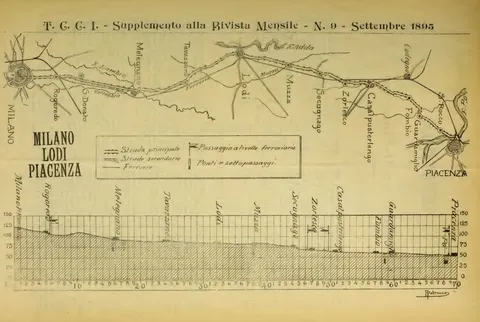
- Road-guide supplement tracing the route from Porta Romana past the Miani e Silvestri wagon works and the 1515 "Battle of the Giants" battlefield at Melegnano to Lodi's Bramante-designed Incoronata church, then across the Po by a rough pontoon bridge to Piacenza's Piazza Cavalli with its bronze Farnese equestrian monuments and the Palazzo Farnese.
- Road-guide supplement for the Lodi-Crema-Brescia road, noting Crema's 1400s cathedral, the 1524 conference at Offanengo between the Constable of Bourbon and the Marquis of Pescara, Soncino's early Hebrew printing press of about 1473, the Manzoni-commemorated 1427 rout of the Visconti by Carmagnola at Maclodio, and Brescia's Piazza Maggiore with its Savonarola monument, recommending the local polenta e uccelletti.
- Road-guide supplement through the Parmesan-cheese country around Casalpusterlengo and Codogno to Pizzighettone, where Francis I was held prisoner after the Battle of Pavia, and on to Cremona's Piazza Maggiore with its Pordenone-painted Cathedral, 1197 Baptistery and 121-metre Torrazzo tower, recommending the city's torrone and mostarda.
- The eighth list of Consular Corps appointments approved across the Council's September sittings: Nicolò Spada becomes Chief Consul for the Venice section, with new Consuls named for Turin, Pavia, Como, Venice, Udine, Bologna, Reggio Emilia, Sassari, Cagliari, Vienna and Trento; Pietro Baragiola resigns as Como's Consul and Alberto di Bassecourt resigns as Venice's Chief Consul on moving away.
- General buying advice warning members not to be swayed by racing victories, since professional riders switch machines mid-race and manufacturers build special racing models unlike those sold to the public; followed by testimonial letters to the Milan Singer agents Sironi, Oggioni & C. from Carlo Tarra, the T.C.C.I.'s own Comfort-section chief, praising his prize Singer machine from the 400km Corsa Nazionale, and from Prince Cesare Hercolani of Bologna ordering a second luxury model.
Images in this issue 12 pictures from 30 pages
Illustrations 1
 (opens in a new tab)
 Emblema del Touring Club Ciclistico Italiano
Maps 3
 (opens in a new tab)
 Milano-Lodi-Piacenza 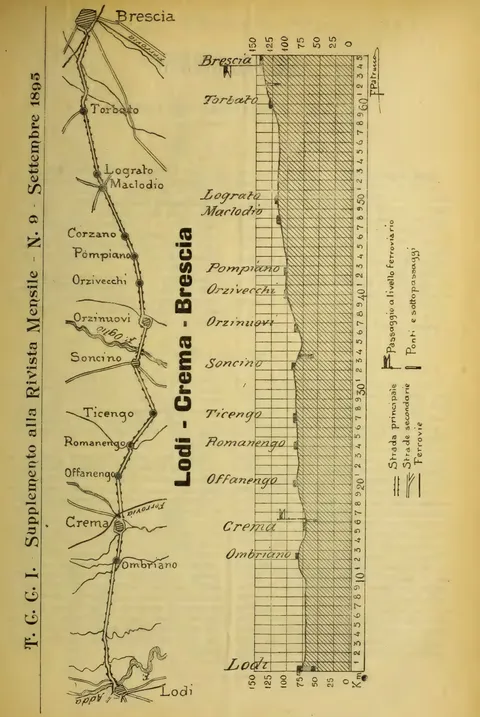 (opens in a new tab)
 Lodi-Crema-Brescia 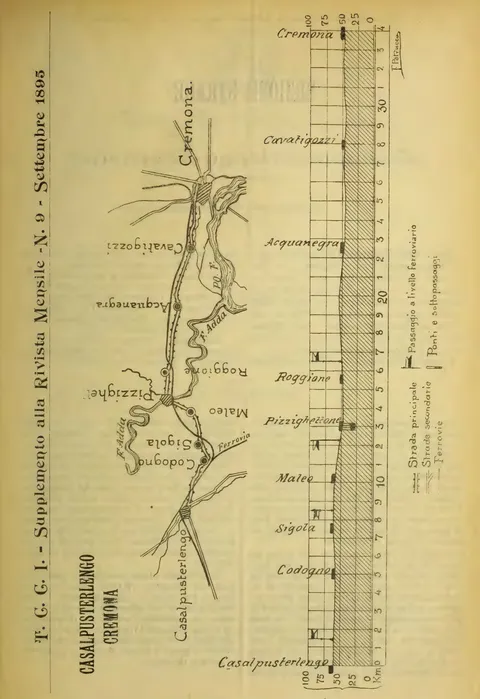 (opens in a new tab)
 Casalpusterlengo-Cremona
Mastheads 2
 (opens in a new tab)
 T. C. C. I., Rivista Mensile del Touring-Club-Ciclistico Italiano (N. 9, Settembre 1895) - (opens in a new tab)
T. C. C. I., Rivista Mensile del Touring-Club-Ciclistico Italiano (N. 9, Settembre 1895)
6 advertisements
 (opens in a new tab)
 Dunlop, Compagnie Française des Pneumatiques Dunlop, Succursale Italiana 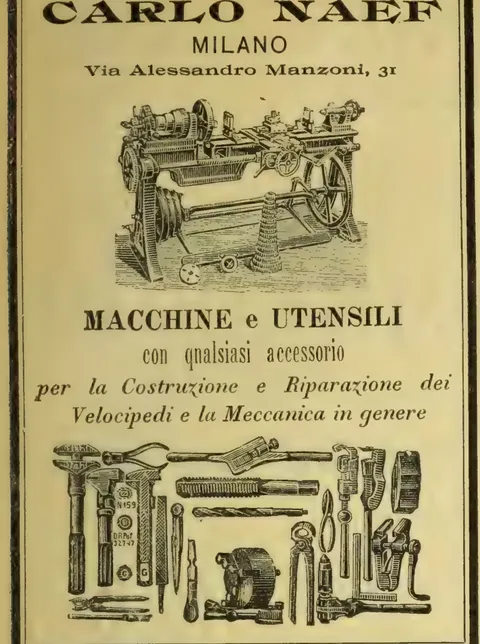 (opens in a new tab)
 Carlo Naef, Milano, Macchine e Utensili 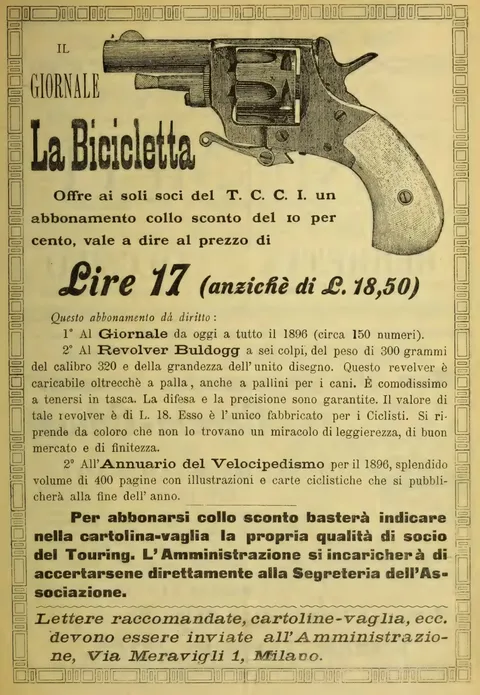 (opens in a new tab)
 Il Giornale La Bicicletta, abbonamento con Revolver Buldogg in omaggio 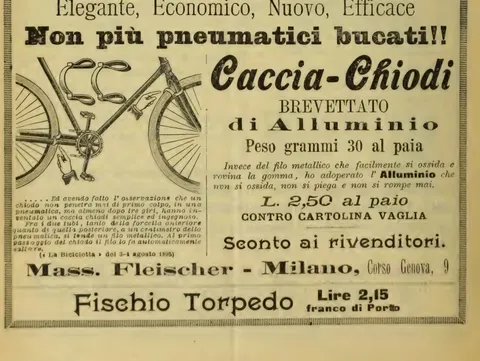 (opens in a new tab)
 Caccia-Chiodi brevettato di Alluminio, Massimiliano Fleischer, Milano 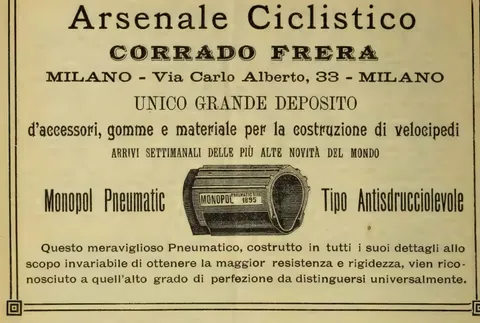 (opens in a new tab)
 Arsenale Ciclistico Corrado Frera, Milano, Monopol Pneumatic 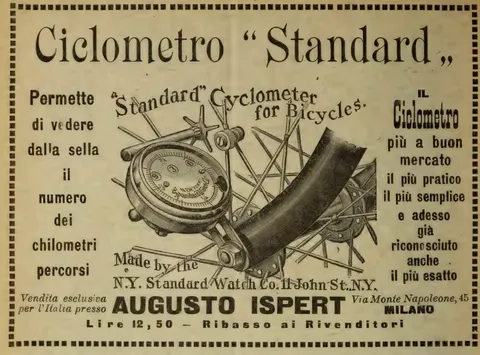 (opens in a new tab)
 Ciclometro Standard, Augusto Ispert, Milano