Rivista Mensile del Touring Club Italiano, Vol 10, No 11
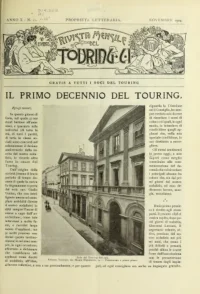
Articles in this issue
- Director-General Federico Johnson's address for the club's tenth anniversary, written for its 42,000 members, opening with the dead — secretary Giovanni Lorenzi and chief consul Giuseppe Ricordi. He credits vice-director Alberto Riva, L. V. Bertarelli for the guidebooks, secretary Federico Guasti, treasurers Riccardo Venegoni and Alessandro Barutta, and chief consul Piero Gavazzi, comparing himself to a conductor taking applause meant for the whole orchestra.
- Banner opening a section-by-section survey of the Touring's administration, which rests on division of labour: members elect a Consiglio direttivo of eighteen to twenty-four, which chooses the general management — Federico Johnson, Alberto Riva, Innocenzo Vigliardi-Paravia and Alfredo Zaffaroni — and assigns each councillor a section.
- The treasury section: Riccardo Venegoni was the first treasurer from the Council's election on 9 December 1894 until 20 April 1899, setting up the account books, and was succeeded by cavaliere maggiore Alessandro Barutta, still in office.
- Originally the "Cancelleria" under A. G. Bianchi, who advertised the club's badges and handlebar tassels in the February 1895 Rivista; Angelo Provasoli took over in November 1895 and Arato Ardenghi in June 1898. The section runs the roadside repair boxes — a hundred given by Federico Johnson in 1895, now 267 across Italy.
- Librarian T. E. Magnasco began by procuring Istituto Geografico Militare sheets and Baedeker and Joanne guides for members, and a gift of maps from Giuseppe Novlan of Gorizia started the collection. Guido Olivieri took the post in April 1899, followed briefly by prof. Giuseppe Fumagalli of the Brera library and then Vigliardi-Paravia.
- The consular corps, which spread the club across Italy and abroad. Chief consul Giuseppe Ricordi announced the first consulates at Venice, Genoa, Castiglione d'Intelvi, Cremona, Codogno, Nizza Monferrato, Senigallia and Verona; ing. Piero Gavazzi succeeded him in March 1896 with Oreste Gorla as his assistant.
- L. V. Bertarelli's roads section and its publications: the 1896 Guida delle Strade di Grande Comunicazione, then the regional guides to Lombardia (re-issued 1904 in three volumes costing L.30,000 to set up), Lazio, Veneto, Piemonte, Umbria, Emilia, Toscana, Marche and Campania, with print runs and prices. Also the route Monografie, the 57 road Profili begun in 1895, and the 1:500,000 maps made for the club by the Istituto Geografico Militare.
- The accounting section, created on 13 November 1895 and entrusted ever since to ragioniere Piero Moro, who also supervises the office staff.
- Founded by avv. Ignazio Dell'Oro to keep members abreast of cycling law and defend them in court; after his May 1895 proposal a solicitor was appointed in every province, and over 300 lawyers now act free of charge against hostile magistrates and vexatious circulation laws. Led in turn by Dell'Oro, Ermanno Albasini Scrosati, Cesare Agrati and, from March 1904, Bernardo Garbati.
- The medical service planned by dott. R. Segrè and dott. G. Forlanini: some 600 affiliated doctors — the club's "Croce Rossa" — plus affiliated pharmacies with marked signs, first-aid packets and bags for cyclists and motorists, and accident insurance. Headed since Segrè's resignation by dott. Piero Favari.
- Originally the "Sezione Comfort", set up to win reduced hotel tariffs for members holding the club card; hotels were graded in three categories from January 1895 and 335 are now affiliated. Directed by Carlo Tarra, then A. Marelli (awarded a gold medal on resigning in 1901) and, since October 1901, cav. Lorenzo Bertolini.
- The travel and customs section, first mentioned in March 1895 when ing. Alberto Riva wrote on customs deposits for trips abroad; passed to O. Fioroni, then Stanislao Parboni, and on Parboni's move to the new customs section to avv. Federico Guasti.
- Split off in 1901 under rag. Stanislao Parboni, it won concessions from the Direzione generale delle gabelle: temporary import of bicycles, the triptyque document for cars, and deposit exemption entering France, Switzerland, Belgium, Russia and Austria — worth L.100,000 to members in 1904 alone.
- Created in 1901 when the club dropped "Ciclistico" from its name, run first by Johnson and now by dott. Gildo Guastalla. It set up petrol and lubricant depots at road junctions three years ago, since replaced by around 300 affiliated dealers bound to sell to members at agreed prices, and it houses the Unione Automobilistica Italiana.
- Reciprocity with foreign clubs: talks with the Touring Club de France and de Belgique announced by Giulio Venino in April 1895, agreements with the Danish club and the Allgemeine Radfahrer Union, and the founding of the Ligue Internationale des Associations Touristes at the Luxembourg congress of 1898. Cesare Agrati, Alberto Riva and Luigi Cuneo Vidal represented Italy at the Paris, Bologna, Amsterdam and Vienna congresses.
- The publicity section, created for avv. Federico Guasti after he gave up the secretaryship on 23 October 1901, with warm thanks to the Italian press, which the club says never once refused to print its communiqués.
- The two abolished sections. The Sezione Scientifica under Romeo Carugati, then Ferdinando Bezzi, was renamed Sezione Meccanica in 1899 under ing. Carlo Vanzetti; the Sezione Tecnica, listing dealers, makes and repairers, was run by Enrico Luzzatto, Vanzetti and cav. Giacomo Binaghi. Both were wound up once the Rivista and Annuario absorbed their work.
- The photographic section that still does not exist: dott. Pietro Favari floated it in 1898 and the Council voted L.5,000 in 1899, and there followed the Bologna consulate's 1899 photo contest, the 1902 national competition, articles by Nico Barbieri and prof. Rodolfo Namias, and an archive with some 10,000 illustrated postcards collected on A. G. Bianchi's suggestion.
- Councillors who head no section: dott. Ettore Candiani, who works on foreign visitors; comm. ing. Giovanni Silvestri, named by the minister of public works to the commission that drafted the motor-circulation regulations; ing. Emilio Gola on road improvement; and dott. Mario Badini.
- The three auditors elected yearly by the general assembly to check inventories, balance sheets and cash: ragionieri Attilio Soffredi (since 1895), Romeo Riva (1897) and Gino Turrini (1899). All club offices are unpaid.
- The road-improvement commission, formed in July 1904 under conte Febo Borromeo with Bertarelli, ing. Giuseppe Chiodi and ing. Massimo Tedeschi of the journal Le Strade as vice-presidents. It traces the campaign back to Bertarelli's 1895 approaches over the Milan-Monza avenue and the corso Vittorio Emanuele, and the 1899 prize essay on road maintenance won by engineers Biadene, Lo Gatto and Rabbi; two new competitions offer L.2,800 for a provincial road monograph and L.1,600 for a roadmen's manual.
- The signpost commission. From Bertarelli's October 1895 proposal and the first hundred posts paid for by the club, Alberto Riva and Johnson, through a lull while the L.I.A.T. standardised symbols, to the commission named in May 1903 under cav. Augusto Massoni. Nearly all 69 provinces backed it, over L.13,000 was raised and about 500 new-pattern signs went up in under a year, with signing under way in Milano, Pisa, Venezia and Roma.
- The hotel-improvement commission chaired by cav. ing. Giannino Ferrini, aimed not at grand city hotels but at modest inns in provincial towns and Alpine valleys. It has circulated thousands of copies of the pamphlet Il Touring agli albergatori and is organising a permanent display of furniture and fittings for small hotels at the club's premises.
- Banner introducing the account of the club's publications other than the road guides — the Rivista, the Annuario and the works sold rather than given to members.
- History of the magazine from its 16-page first issue of January 1895, five of them advertising, produced by the editorial committee of A. G. Bianchi, Romeo Carugati and T. E. Magnasco. It passed to Guasti as editorial secretary, then Lorenzi and Bertarelli, the Agrati-Favari-Olivieri committee, Favari alone from December 1899, and prof. Ottone Brentari from October 1900; the first portrait was of the dead Lorenzi in 1898.
- The yearbook, first compiled by the roads section in 1896 as a 104-page complement to the guides, then by A. Cesare Marelli for 1897-1900 and Guido Olivieri for 1900. It grew to two volumes in 1902 and three in 1903, and 696 pages in 1904, when the office also produced the 547-page Annuario dell'Automobilismo.
- Why the new Guida della Lombardia, Attraverso l'Italia and the railway guides are sold at cost rather than posted free: the L.6 subscription must stay low, and no foreign touring club gives its members as much. The first three railway guides sold so well that six more are in production.
- The first club outings: a 65 km Cremona-Codogno-Piacenza run on 31 March 1895 organised by professors Cottarelli and Nigherzoli, and the Milan consulate's first ride on 12 May 1895, open to men and women members and to candidates introduced by a member, followed by outings from Legnano to Varese and plans for Lodi and Gallarate.
- The long-distance cycling marches: Milano-Roma in May 1895, organised by Federico Johnson, then Milano-Venezia, Roma-Milano in 1897 and the memorable Milano-Torino of 26 June 1898 ridden by 275 cyclists in four squads led by Bertarelli, Gavazzi, Johnson and Tarra. Later rides went to Sardinia and Sicily under on. Attilio Brunialti and on. Giuseppe di Scalea, and over the battlefields under dott. Olindo Guerrini.
- The cyclo-alpine trips organised chiefly by Federico Johnson: Alagna-Macugnaga in 1898; the Maloja, Piz Languard and Bernina outing that took a party of cyclists to 3,266 metres; Torino over the Moncenisio to Geneva in 1902; and Monte Rosa in 1903.
- The rallies, from Giuseppe Ricordi's 1895 call for section outings to the first named convegno at Bologna in May 1896 — 300 present, with a verse toast by Olindo Guerrini — and the first official one at Milan on 28 June 1899. After a glut in 1902 the Council split them into official national and local ones. At Ferrara in 1902 the writer Jolanda unveiled a banner honouring women cyclists, later saluted at Rome's Terme di Caracalla by Attilio Brunialti's daughter.
- The congresses, beginning at Turin on 27 June 1898 during the Convegno Ciclistico Nazionale, where conte Cavazzocca of Verona proposed dropping "Ciclistico" from the club's name; the change was carried in the assembly ballot of 25 March 1900 by 1,845 of 1,929 valid papers. The second congress met at Brescia in August 1904.
- The club's many prize competitions — road maintenance, tourist and customs monographs, photography, travel writing and poetry — above all the contest run by La Domenica del Corriere for an Inno del Touring. The first round, judged by a commission under Arrigo Boito with Piero Favari as reporter, made no award; the reopened contest was won by Lorenzo Stecchetti (Olindo Guerrini) with the motto Vi et mente.
- Lists the twenty-one medals and diplomas the club has won at exhibitions, from the first Milan cycle show of 1895 through Turin's electricity exhibition (1898), Munich's Allgemeine Deutsche Sport Austellung (1899) and the St Petersburg sport exhibition (1902) to three awards at the 1904 Turin motor show and the Bologna exhibition of tourist material.
- The Italian hoteliers' society, founded at Como on 4 June 1899 and now over 400 strong under cav. Federico Fioroni of the Hotel de Londres in Genoa, with its Lombard section housed at the Touring under comm. Giuseppe Spatz of the Grand Hotel Milan. A table sets the two bodies' officers side by side — Bertolini, Morandi, Clerici, Colleoni, Gallia, Brunelli, Grugnola, Bellini and Caspani appear in both.
- What the L.6 subscription buys in 1905: the Rivista, the roughly 700-page Annuario, the Guida delle Puglie, the map of the Italo-French frontier and some monographs — a commercial value of L.17.50 — plus discounts on Istituto Geografico Militare maps, hotels, spas, petrol and Baedeker, Joanne and Brentari guides, free use of the repair boxes and customs deposit exemption.
- The club's five successive Milan homes, illustrated with floor plans and facades: the single room at via Rovello 6, then via Gabrio Casati 2 from June 1895, via Giulini 2 from April 1897 (enlarged three times), Casa Barbò in piazza Durini 7 from September 1901 and, since the summer of 1904, Palazzo Taverna at via Monte Napoleone 14.
- Banner over the symposium that fills the rest of the number: former councillors were asked for their recollections of the club's beginnings, and consuls scattered across Italy and abroad for their thoughts on what it has become.
- Heading for the reminiscences contributed by ex-councillors — Bezzi, Bianchi, Carugati, Dell'Oro, Gorla, Magnasco, Marelli and Provasoli — who supported the Touring's first steps but no longer sit on its Council.
- Avv. F. Bezzi, former head of the scientific section, puts the club's prosperity down to two things — the calibre of its men and the virtue of its organisation — and sends an affectionate salute to Johnson, Riva and Bertarelli.
- A. G. Bianchi, called "the Touring's journalist", recalls founding and editing La Bicicletta, which Bertarelli dubbed the club's bersagliera, and names its writers — Silvio Zambaldi, T. E. Magnasco, Giovanni Biadene, Carlo Zanicotti, Romeo Carugati, Guglielmo Ferrero, Olindo Guerrini, Alfredo Oriani and Pietro Favari — and the long-distance journeys of Raffaele Gatti and Luigi Masetti it publicised.
- Romeo Carugati, theatre critic of La Lombardia, remembers that the Touring began with many sceptics and few enthusiasts, and that he had called for its creation in La Lombardia before 1894 and later in La Bicicletta alongside A. G. Bianchi.
- Avv. Ignazio Dell'Oro recounts arguing in the summer of 1894 before the Società Velocipedistica "Milano" for a national body devoted to touring rather than track racing, the founding meetings at the Albergo degli Angeli and the Hotel Continental, and the free back room in via Rovello. He credits nob. Giulio Venino and calls Bertarelli's output unmatched anywhere.
- Oreste Gorla walks from the new Palazzo Taverna back to the three-by-six-metre room in via Rovello, recalling the battered filing cabinet whose six boxes once held the whole administration, treasurer Venegoni's cry that they were broke, and Guasti "il Progettomane" with ten schemes a day. He lists the sporting clubs — Pro Patria, Forza e Coraggio, Club Alpino, Milano — that supplied the first councillors.
- T. E. Magnasco says his proudest memory is a defeat: at the second assembly in the Continental's hall he argued, with very few supporters, that the new body should be called Touring Club Italiano, and a large majority insisted on Touring Club Ciclistico Italiano — the extra C that the members themselves later struck out.
- A. Cesare Marelli contrasts today's Annuario with the 130-150 page booklet of the early years, and recalls how hard it was to convince hoteliers that cyclists — then few, distrusted by authorities and public alike, and treated as customers to be fleeced or ignored — would bring them good business.
- Founder member and old councillor Angelo Provasoli remembers when the club had only a few hundred members, nearly all Milanese, and the bets among councillors who agreed that six or seven thousand members would be unattainable.
- An alphabetical gallery of short tributes from the club's consuls, running from Acquaseria on Lake Como to Vigevano and taking in Berlin, Geneva, Fiume, Bregenz, Bolzano and La Paz, most praising the Touring for uniting Italians across regions and parties and for making Italy known to Italians; portraits of the capoconsoli of Acqui, Alessandria, Ancona, Arezzo, Bergamo, Bologna, Brescia, Como, Cremona and other cities run down the columns.
- Closing banner over the Direzione's official notice of how the tenth anniversary of 8 November 1894 will be marked.
- The Council awards a medal of merit to every capoconsole and consul in office on 8 November, and Johnson has offered 50,000 commemorative medals for the present 42,000 members and the next 8,000. The planned rally and tourist congress are put off to spring: the general elections crowd the calendar and no covered hall in Milan could seat the thousands wanted at the banquet, so the anniversary is marked instead by these medals and by devoting the whole issue to it.