Rivista Mensile del Touring Club Italiano, Vol 10, No 12
Articles in this issue
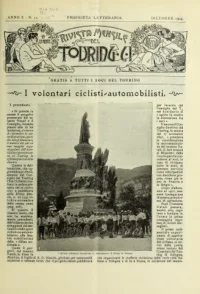
- Lead article of the December 1904 number tracing the volunteer cyclist corps idea from Lieutenant Natali's project, examined by the Touring Club Ciclistico Italiano council on 20 October 1895 and again on 17 November 1897 when it asked the War Ministry to let members serve on their own machines as in France and Belgium. Natali later founded the first regular bersaglieri cyclist company at Parma, while the Bologna consulate organised the cyclist despatch relays from Italian cities to Bologna and Rome for the 1901 convegno.
- Captain A. E. Angherà of the War Ministry general staff propagandised for an English-style volunteer cyclist corps and helped the Brescia committee — Colonel Chiaria, Captain Beruto, officers of the 12th Bersaglieri and the local Audax section — stage the first Italian experiment, backed by War Ministry letters of 2 and 17 June 1904. Participation was reserved that first time to Audax members, and Chiaria's official report concluded that the new institution needed the Touring's wide organisation to survive.
- The Touring's Brescia congress of 28 August voted on Colonel Chiaria's motion, and the parallel "first Italian experiment in automobilisation" was run by the Brescia Automobile Week committee under the nobile Camillo Martinoni, with Minetti as its organising brain. The Automobile Club Italiano of Milan under president cav. Massoni had earlier drafted a mobilisation table, and its members' turnout won the King's large gold medal.
- The Touring council had a draft organisation scheme prepared and secured adhesions from Brescia, from prof. Brombin of Padua whose printed project matched its own, and from Verona, Bergamo, Novara and Vercelli where battalions already existed. It lists the towns pledged in four zones — frontier (Torino to Udine), Adriatic coast, Mediterranean coast and interior.
- On 17 November 1904 the Milan headquarters convened the national committee that will organise the corps across Italy and federate those already formed, drawing in deputies (Albasini, Brunialti, Lucchini, Massimini, Mira), senators Taverna and Vigoni, the Unione Automobilistica Italiana under marchese Ginori, the presidents of every Automobile Club, and officers including Colonel Chiaria, Major Maggiorotti and Captain Angherà. Its first assembly was to meet in Rome in mid-December, and Giuseppe Cesare Abba, poet and one of the Mille, wrote accepting his place.
- The draft scheme: territorial companies raised first in frontier and coastal provinces, recruiting cyclists aged 15 to 20 and over 39 plus third-category, discharged or exempted men, tested collectively in endurance, speed, map-reading, reconnaissance and rifle shooting, with a personal brevet and badge for those approved. Each company would add a motorcycle platoon for fast work and, on Chiaria's thinking, cars for ammunition; no uniform and no fixed machine — the volunteer's own bicycle, with a practical rifle attachment to be devised.
- Department gathering the late-season 1904 rallies that had to be left out of the December anniversary number, which was given over entirely to the Touring's tenth birthday. The editors print the principal reports late rather than lose the record of them.
- On 16 October, at the instance of the Unione Sportiva Vercellese, seventy clubs and 2,314 cyclists paraded before Vittorio Emanuele III at the royal castle of Racconigi to congratulate him on the birth of the Prince of Piedmont. Vittorio Segre organised it and presented an illuminated parchment, M. Galbiati gave the King a gold and enamel badge, and the Velo Club di Magenta a gold medal bearing the Magenta ossuary; Queen Elena and the princesses Jolanda and Mafalda watched the hour-long march past.
- Ing. Gaetano De Angelis, Touring consul for Naples, describes a 1,400 km, 21-day ride from 14 August to 3 September with the Ottoman vice-consul Ali Riza Bey, cav. Cesare Rosati and avv. Giovanni Di Francesco: over the Macerone and Rionero Sannitico to Roccaraso and Pescara, up the Adriatic shore to Ancona and Loreto, then Fabriano, Nocera Umbra, Assisi, Perugia, Arezzo, Florence and Siena. He praises Siena province for its Touring signposts, which make a guide unnecessary, and condemns the Capua–Naples road as a formless heap of stones, ruts and dust.
- Consul cav. Bartolomeo Fragiacomo inaugurated the Smyrna section's banner with an outing to Mount Pagos — most members riding donkeys rather than bicycles given the state of the roads — with music by member Vittorio Calleya, refreshments at the Hotel de la Ville and ten new admissions. Lieutenant Uberto degli Uberti, consul aboard the R.N. Euridice, adds that Lieutenant Biamonte of the carabinieri has built a 25-member section in Crete and that the chargé d'affaires in Athens, baron Fasciotti, is a keen member.
- Nearly 500 cyclists answered the invitation to the celebrations of 16 October marking the opening of Montebelluna's aqueduct, built jointly with Volpago, and of its electric light. Giovanni Pozza describes the parade of 19 squads led by Touring consul Cesare Raffaelli, the speech from the theatre balcony by mayor count Lodovico Antonio Manin, the prize-giving, a charity tombola with a gift from the King, and a closing torchlight ride.
- Standing photographic department, its title hand-lettered inside an Art Nouveau engraving of a woman at a plate camera.
- Prof. Rodolfo Namias argues that leafless winter landscapes gain from aerial perspective and warns against small stops that flatten the planes, while snow scenes reproduce without detail and read flat. He then treats magnesium flash safety — the danger lay in chlorate, perchlorate, nitrate and permanganate oxidisers, whereas the powders now made by Bayer, Actien Gesellschaft and Krebs use stable metallic oxides — and covers bromide and Bayer "Pan" development papers for black, brown, red, green and olive tones, plus oxy-acetylene projection light generated with ossilite.
- Standing department on the campaign to bring foreign visitors to Italy.
- On. Attilio Brunialti, vice-president of the Associazione pel movimento dei forestieri and head consul of the Touring at Rome, completed a lantern-slide lecture tour of North America — San Francisco, two lectures at New Orleans, two at St Louis, Cincinnati, Washington, Baltimore, Philadelphia, Montreal, Boston, Buffalo and New York. The paper L'Italia of San Francisco reports the applause when Trento, Trieste and the Garibaldi monument appeared on the screen, and credits the local Touring consulate under rag. Armando Pedrini with the arrangements.
- Standing department covering exhibitions.
- The seventh Paris Salon opens on 9 December with two novelties — a show of the best garages and one of the best hotel bedrooms for tourists, prized respectively by the Automobile Club de France and by a Touring Club de France gold medal. The Touring Club Italiano takes part as the only non-French sporting body, with 96 square metres beside the A.C.F. and the Chambre Syndicale, showing its guides, maps, profiles, yearbooks, the Rivista and its road signposts; President Loubet will attend the opening.
- Turin's second international motor show opens on 21 January 1905 in the Palazzo delle Belle Arti in the Valentino park and closes on 6 February, with entries shutting on 31 December 1904. The committee is led by avv. Cesare Goria-Gatti with cav. Alfredo Rostain and ing. Arturo Ceriana as vice-presidents, rag. Nino G. Caimi as secretary general and cav. Giovanni Agnelli and Giovanni Ceirano on the technical commission.
- Standing railway department, its title hand-lettered inside an engraving of a locomotive.
- Since petrol and steam public motor services have mostly been abandoned in Italy, the Rivista describes Lombard-Gerin of Lyon's trolley-automotor working the Gallarate–Samarate line in Milan province: the trolley runs automatically ahead of the car so the flexible feed cable stays lightly tensioned and never fouls the overhead wire or other traffic. It succeeds on a bad road with turns as sharp as a right angle, where other electric road systems could not follow.
- Standing department on roads and road maintenance.
- Ing. Massimo Tedeschi explains the thinking behind the Touring's two road prizes: a monograph on the national and provincial roads of a single province, because diagnosing the cause — poor material, too little of it, too few workmen, absent supervision, bad administration or unfaced finance — must precede any remedy, and a manual for cantonieri, since roads are left almost entirely to roadmen recruited with no instruction at all. He hopes one monograph will come from every province in time for the road exhibit at the 1906 Milan exposition.
- The Rivista claims some credit for the Public Works Minister's circular of 28 September on the upkeep of provincial roads, which warns that neglected decay soon turns into ruin and abandonment or heavy rebuilding costs. The same circular went simultaneously to the provincial deputations, the prefects and the Genio Civile.
- A road-protection league has been formed in England against motorists' abuses, with five aims: preventing use of roads that harms or inconveniences the public, informing people of their road rights, investigating cases of danger and damage to life, roads and property, helping the injured bring claims, and pressing for enforcement and reform of the law. Ing. Massimo Tedeschi notes no such body is yet needed in Italy but warns where careless use could lead.
- Vittorio Schiesari Civolani reports the completion, after nearly three years and at about half a million lire, of the flyover at Borgo Magno outside Padua's Barriera Mazzini, where the roads to Cittadella–Bassano and to Castelfranco–Montebelluna met a level crossing of the Rete Adriatica. Designed by the engineer-architect Daniele Donghi, it has five ramps of 2.67 to 3.76 per cent, a 560 m main road 12 m wide and reinforced-concrete spans of 16.50 m.
- Standing signpost department, its title hand-lettered beneath an engraving of cyclists at a Splüga–Stelvio direction post.
- New subscriptions towards Touring road signposts from the municipalities of Monza, Besozzo, Moncalieri and San Remo, from marchese Gerino Gerini of Florence, the Ancona provincial deputation and other members, bringing the running total to 1,038 signposts and L. 14,040.
- The Royal Genio Civile of Sondrio writes that the slow-down signpost on a very dangerous bend of the national road was first damaged by rifle fire and then stolen outright. The Rivista comments that such losses are worst of all in the Valtellina.
- Standing cycling department, its title hand-lettered inside an Art Nouveau engraving of a woman cyclist against a rising sun.
- Arturo Colombo of Milan proposes a variable-lever pedal: an eccentric keyed to the crank axle carries a ball-borne ring and pedal arm, so the effective lever is longest on the down-stroke and shortest on the up-stroke. The Rivista judges it theoretically sound but of little practical gain, since a fixed pedal at the end of the same arm would do as well and the extra sliding surfaces cost free running, and suggests the eccentric be made adjustable and lockable to give a simple bicycle gear change instead.
- The Augsburger Tagblatt and the Radtourist report a Munich student who, cycling to Naples, ran into a carriage below Montecassino at night without a lamp, was found by carabinieri to be carrying a revolver without a permit and was given 20 days' gaol at Frascati, freed after twelve through the embassy. The Rivista draws the moral for foreign cyclists in Italy: ride with a lamp at night, do not hit carriages, and get a licence before carrying arms.
- Standing department on cycling and motorcycling in the mountains.
- Riccardo Ponzelli, of the Rome section of the C.A.I. and president of the Club Escursionisti di Jesi, rode his motorcycle from Longarone up the Zoldo valley past Forno di Zoldo to Fusine (1,178 m), then had it slung from a pole and carried by two mountaineers over the Forcella Staulanza (1,773 m) between the Pelmo and the Civetta. Remounting near Pescul he ran down the Val Fiorentina to Caprile, skirted the lake of Alleghe and reached Agordo by 7.40.
- Seven Alessandria members rode to Aosta and the Great St Bernard hospice, dropped to Martigny and up the Rhône to the glacier at its source, crossed the Furka (2,467 m) to Andermatt, then the Oberalp (2,150 m), followed the Rhine 100 km through Disentis, Ilanz, Versam and Bonaduz to Chur, went up the Via Mala and over the Splügen (2,117 m), returning by Chiavenna, Lecco and Milan. The trip was organised and led by consul Pasquale Innocenzo Torti.
- Standing motoring department, its title hand-lettered inside an Art Nouveau engraving of a chauffeur and lady in an open car.
- Delegates of the Unione Automobilistica Italiana met at the Touring's Milan headquarters: ing. Cesare Gamba and marchese De Mari for Genoa, marchese Di Soragna and avv. Agrati for Milan, marchese senator Carlo Ginori Lisci for Florence, cav. Giovanni Agnelli, avv. Goria Gatti and marchese Ferrero di Ventimiglia for Turin, comm. Federico Johnson, dott. Guastalla and comm. Silvestri for the Touring, and count De Lazara and comm. Rignano for Padua. Ginori Lisci, in the chair, commemorated the late count Emanuele Di Bricherasio, and a further meeting was set for 30 November.
- The Enigma hub is presented as a genuine motorcycle gear change built into the driving wheel, about 13 cm across with an aluminium pulley independent of the spokes and a total weight of some 5 kg. Two fibre-lined friction cone clutches give a direct high drive and, through a single pair of permanently meshed bevels, a low gear; a wire from the top tube or handlebar grip works the clutch, lubrication is by immersion in an oil-tight casing, and it suits belt or chain drive on any size of machine.
- A comparison of petrol and alcohol as motor fuels: three volumes of alcohol do the work of two of petrol, so alcohol must cost less than two-thirds as much to compete. Alcohol vaporises and explodes less readily but holds mean explosion pressure better, so an alcohol engine is slower on the level and faster uphill; it needs a higher compression and stroke-to-bore ratio, and a barbotage carburettor requires extra heating from the exhaust.
- Mechanically operated inlet valves against automatic ones: an automatic valve only opens when the piston's suction overcomes its spring, so full opening usually comes after mid-stroke and part of the charge is lost, while a worn valve closes late and lowers compression. The Motor's balance sheet sets reduced expansion, lower thermal efficiency and added complexity against greater power and the ability to run slowly without stalling.
- A round-up of Italian motor services: the Public Works Ministry approves Claudio Demartis's Palau–Tempio–Sassari postal line in Sardinia with a L. 13,000 subsidy; schemes for the Carnia by ing. Pandini and Marco Renier; the Tricase concession round Capo di Leuca with 16-seat steam cars twice daily at 8 and 5 centesimi a km; good trials in the Gargano; a petition from Girgenti province; the 118 km Orvieto–Pitigliano–Orbetello line opened on 16 October; an Elba project by the mayor of Marciana Marina; V. Memma e C. at Caserta; and the first international line, Locarno–Gravellona, opened at Domodossola on 15 September.
- Standing miscellany department of short technical and foreign notes.
- English trials of motor traction on farms: at Biggleswade the Ivel engine drove a pair of coupled Albion self-binders cutting over three metres of thick barley, and at Spilsby it worked ploughs — 14 quintals, 18 hp, paraffin-fuelled and costing L. 7,500 — against the lighter Scott tractor of about 13 quintals at L. 5,000. Highland Society tests gave the Ivel 2.8 acres in 1 hour 54 minutes on 4.95 litres of paraffin per acre, and both machines took gold medals as marking substantial progress rather than perfection.
- Boghos Pascià Nubar, director of the Egyptian railways, has had a new pulverising ploughing machine built at the Darblay works at Corbeil: a large four-wheeled frame with front driving wheels and rear steering, powered by a 30 to 40 hp steam engine. Its blades cut 30 cm deep over a 3.90 m strip at 20–30 cm a second, working about 2,000 square metres an hour, or two hectares in a ten-hour day.
- After lieutenant general Valles, commanding the 10th Army Corps, praised the cars used in his manoeuvres, minister Pedotti intends to appoint a commission on giving motoring a military role — linking coastal defence troops with the interior and carrying despatches now handled by cavalry and cyclists — leaving cavalry to the roadless country.
- S. M. Butler, secretary of the American Automobile Club, says New York motorists will henceforth carry rifles and return fire after farmers and even law officers shot at them, and that vagabonds posing as rural constables extort heavy on-the-spot fines. The New York Times calls the threat worse than stupid and defends shooting at chauffeurs who refuse to stop, while Chicago's Inter Ocean urges the club to expel reckless members and the police to give up their guns.
- Standing boating department, its title hand-lettered inside an engraving of a motor launch.
- The Pordenone fertiliser works and the Pasiano brickworks tested on the fast, winding Moncello and Meduna rivers a detachable propulsor supplied by G. B. Rion of Trieste and built by the Société du Propulseur Universel Amovible of Neuilly: five horsepower, only 70 kg, transferable between boats in minutes and with a steerable screw in place of a rudder. It drove a barge loaded with 200 quintals of bricks against the current, and a flat fishing boat carrying fifteen people made 16 to 20 km/h downstream.
- The Touring Club Suisse reports that at its instance the Swiss customs administration will let triptyque holders cross the Confederation's frontier as often as they wish while the document is valid. The holder must declare the intention on first leaving Swiss territory, and anyone unable to re-enter must notify the last customs office within the six months, failing which his club is liable for the duty.
- Standing department reporting legal rulings and opinions affecting tourists and cyclists; the heading is hand-lettered inside an engraving of scales and law books.
- Drawing on an article by member dott. Giorgio Rossi of Vicenza, the Rivista attacks a Council of State opinion on whether a prefect hearing a velocipede offence may rule on the merits: the Udine prefecture and the Justice Ministry would confine him to confirming the fine, the Finance Ministry treated him as an arbiter free to acquit, and the Council of State's compromise lets him condemn without appeal but, if he finds no offence, sends the case back to the courts — so that he is competent to convict but not to absolve.
- A Council of State opinion taken from the Municipio Italiano of Rome (Cosenza case, 11 March 1904) holds that a Royal Commissioner's ordinance banning cycles where other vehicles may pass is validly approved if the prefect merely stamps it with his visa. Avv. Garbati objects that art. 5 of the 1897 regulation requires a reasoned decision, since the same article allows appeal to the Interior Ministry within 30 days against a "decision" — and no appeal can be argued against a bare visa.
- Book department, its title hand-lettered inside an engraving of a lamp, inkstand and piled volumes, reviewing P. Jousset's lavishly illustrated L'Italie Illustrée (Larousse, 1904) with 784 vignettes and 14 coloured maps, Gaetano Battaglia's Guida descrittiva della Sicilia, Ezio Colombo's La Repubblica Argentina (Hoepli), Réne Champly's Manuel de Pratique Mécanique for chauffeurs, A. Berthier's Les piles sèches, Emilio Marenco on a proposed Turin school for chauffeurs, and the tenth Baedeker edition of L'Italie des Alpes à Naples.
- Notes on exchanges: the Rivista Mensile del Club Alpino Italiano on the Alpinisti Tridentini's meeting at Cavalese, L'Appennino Centrale of the Club Escursionisti di Jesi, the Mitteilungen des Oesterreichischen Touring Club on the Touring's Brescia congress, Liburnia of the Club Alpino Fiumano on physical education in schools, the St Petersburg Union on Italy's volunteer cyclists, the Bollettino dell'Alpinista on the Tridentini's dispute with the Deutscher und Oesterreichischer Alpenverein over a hut built 25 metres from theirs at the Tuckett pass, In Alto of the Società Alpina Friulana, and the Illustrazione Bresciana.
- Standing department of club announcements and news.
- At its sitting of 28 October the council postponed the Touring's tenth-anniversary festivities to the coming spring, while confirming that the commemorative medals would still be sent to members, and reluctantly accepted the resignation of cav. rag. Enea Pressi.
- The medals offered by director general comm. Federico Johnson are going out to every member regularly enrolled on 8 November 1904, the tenth anniversary of the club's foundation. Members now number over 42,000 and the medals 50,000, the surplus reserved for those who join until that figure is reached.
- On Friday 4 November, before comm. Federico Johnson, vice-secretary A. Zaffaroni, dott. Gildo Guastalla of the council, Rivista editor prof. Ottone Brentari and several donors, the club drew the propaganda prizes among 114 members holding 168 tickets, one for each ten new members introduced between 1 November 1903 and 31 October 1904. Alessandro Antilli of Modena won the trip to Paris, with Bowden and Cartoni brakes, Nixe, Pocket-Poco and Premo cameras and dozens of photographic plates among the rest.
- Work continues on the 1905 yearbook, which will carry notable additions on the 1904 edition, and circulars are going out asking for corrections and information. The editors press correspondents to answer promptly, since only people on the spot can know the small changeable local details — and to accent every place name.
- The club notes continuing orders for its motoring yearbook, priced L. 2.50 to members and L. 5 to others, and uniformly favourable press notices, the latest from Le Dion Bouton of Paris.
- Despatch to members begins within days of the Abruzzo guide compiled by roads section head L. V. Bertarelli, with as many copies posted daily as possible so that all members receive it within a few weeks; a review will follow next month.
- The Royal Istituto Geografico Militare is about to supply the maps, so the second and third groups of railway guides — Milano–Genova, Genova–Spezia, Genova–Ventimiglia; Verona–Venezia, Venezia–Bologna, Bologna–Firenze — will be ready within December. Copies of the first group (Milano–Torino, Milano–Bologna, Milano–Verona) remain, at 50 centesimi each or L. 1 a group to members.
- The Touring's road-improvement commission opens a competition for a monograph on the roads of a province of the entrant's choice, impartially setting out the merits and defects of its organisation so that better-placed provinces can furnish criteria for the worse. Entries close on 31 July 1905; prizes are one of L. 1,000 with a diploma of honour, two of L. 400, five of L. 200, five gold medals and an unlimited number of silver.
- A second competition, closing 31 May 1905, invites a Manuale pratico del cantoniere stradale setting out in plain language, free of uncommon technical terms, first the rules for restoring a badly built or worn macadam road and then those for keeping a good one in order. Prizes are L. 600, L. 400 and three of L. 200, plus silver medals.
- Answering many members' requests, the Rivista will restore the table of contents to every number from January, and promises to find a way of providing an index to each year's volume.
- A typographical error in the November number is corrected: the Guida della Toscana costs L. 5.50 to non-members and L. 2.75 to members, not the L. 4.25 and L. 2.35 printed on page 368.
- Twenty-fourth list of hotels affiliated to the Touring, with room and meal tariffs, servants' rates and garage space: the Alpi at Cannobio, Roma at Cittadella, Milano at Faido in Canton Ticino, Sole e Gambero at Lodi, Reale della Posta at Omegna, Lombardo at Potenza, Passera at Suzzara and Europa at Taranto, all allowing members 10 per cent off the total bill.
- Seventh list of affiliated petrol and lubricant depots, numbers 259 onward, running from Alassio, Bistagno, Bobbio, Bozzolo, Brescello, Chiavari, Crema, Diano Marina and Dogliani through Milan (Ernesto Reinach's own works) to Poirino and Polesella. Each entry gives the trade, address, the price per kilo of 670/680 and 695/700 grade benzine, Oleoblitz oil and Reinach grease by tin size, opening hours and where to call at night.
- List of candidates for membership between 15 September and 15 November 1904, life members first — from Brescia, Genoa, Girgenti, Mantua, Milan, Turin and Trieste, and abroad from Moscow (prince Serge Galitzine), New York, Paris (the Duc de Richelieu), S. Paulo and Shanghai — followed by the annual members arranged by province. The closing figures give 41,371 annual and 687 life members, a total of 42,058 at 15 November 1904.