Rivista Mensile del Touring Club Italiano, Vol 10, No 7
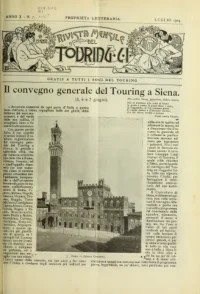
Articles in this issue
- Long illustrated report on the Touring's general meet at Siena, 5-7 June 1904, with cycling squads from Rome, Florence, Arezzo, Grosseto and Cagliari plus the bersaglieri and 9th infantry cyclist platoons received at the Palazzo Reale by prefect Gandin and director-general Federico Johnson. Covers the banquet at Palazzo Malavolti, the exhibition of early Sienese art in the Palazzo Comunale, the parade through the Campo, the prize-giving at the Santa Barbara barracks and the reception at the Accademia dei Rozzi, where countess Marina Pannocchieschi d'Elci added Siena's black-and-white arms to the women's cycling standard.
- Account of the touring meet at La Spezia on 18-19 June 1904, organised by consul prof. Francesco Corio with the Club Spezia and Ciclo Sport Club, with squads from Chiavari (under capo-console E. A. Musto), Genoa, Bologna, Florence, Savona and Pisa received at the Teatro Nuovo by mayor march. Luigi De Nobili. Includes the boat trip round the gulf to Portovenere, Palmaria and Lerici aboard the steamer Alleanza, a scathing traveller's letter about the overnight passage from Genoa on the Re Umberto, and the launch of the battleship Regina Elena before the King on 19 June.
- Standing department, headed by an Art Nouveau engraving of cyclists at a roadside, collecting reports of members' runs and of touring meets held and forthcoming across Italy and the Trentino.
- Rag. R. Trasatti's account of the Rome consulate's three-day ride to the Siena meet, 3-5 June, with consul Enrico Righetti, capo-console on. Attilio Brunialti, consuls Sbricoli, Lega and Guglielmetti and the signore Paula Folchi and Francesca Magrone. The party halted at Civitavecchia and Corneto (Etruscan tombs and the Palazzo Vitelleschi), suffered dust and heat on the Montalto-Orbetello stretch, and was received at Grosseto by capo-console Lorenzo Porciatti before climbing to Roccastrada and Monticiano.
- Announcement of a touring meet at Acqui (Alessandria) on 17 July, closing the San Giusto fair festivities, open to Italian and foreign cycling and motoring club members for L. 2,50 (L. 6 with banquet). The programme includes a visit to the thermal establishments beyond the Bormida and the sulphur springs; the executive committee is chaired by avv. Vittorio Alessandro Scuti with Touring consuls Enrico Aimar and Giuseppe Calligaris.
- Reminder of the touring meet at Agnone, in the Isernia district of Campobasso province, on 14-16 August, with entries already arriving in encouraging numbers. Praises consul Tirone Pier Giuseppe for propaganda work in a region so far cool towards cycling and tourism.
- Notice that the Touring's new Annuario dell'Automobilismo, a volume of about 400 pages divided into practical motoring, general information, addresses and local information, is in the press and due at the end of the month. Unlike the members' free publications it will be sold, at L. 4 to the public and L. 3 to Touring members, orders going to the head office in via Monte Napoleone 14, Milan.
- Report on the Bologna tourist exhibition through June, crowded for the rose and fan evenings and the children's festival, with portraits of consuls Giovanni Moreschi, Filippo Bulbrini and Carlo Sandoni and of Olindo Guerrini. Gives the referendum results for the stands - Edoardo Bianchi 90 votes, M. Türkheimer 88, L. Zucchini 70, Grazia e Fiorini 68, Marquart 58, and C. Serrantoni 122 in the galleries - the Touring's own stand having stayed out of competition, and reproduces cartoons by Nasica from the Bologna Turistica booklet.
- Boxed department gathering news about attracting and serving visitors, from the founding of a Lombard section of the national tourist-traffic association to organised excursion services in the prealpine valleys and the defence of Italian landscape.
- Founding meeting in the Milan town hall of the Lombard and Lakes section of the national association for visitor traffic, chaired by dott. Ettore Candiani with architect Broggi setting out its aims and members Bagaini, C. Mazzola and avv. Nigra speaking for the Varese, Orta and Garda groups. The council elected includes Edoardo Amman, L. V. Bertarelli, Luigi Broggi, Federico Johnson, Giovanni Silvestri and Innocenzo Vigliardi-Paravia, with delegates Broggi and ing. Alberto Riva sent to the general assembly in Rome on 20 June.
- A committee at Introbbio in the Valsassina above Lecco has arranged summer holiday services under which a single L. 15 ticket covers the Milan-Lecco railway, a landau over the mountain road to Introbbio, meals and every comfort for a one-day return trip. Similar outings are being organised for the Valtellina, initiatives the Touring backs as a step towards regular combined and economical tourist services.
- Reprints Ugo Ojetti's article, signed "dott. Ottavio" in the Illustrazione Italiana of 12 June, which follows Pierre Baudin's defence of French landscape and proposes that the Touring Club use its consuls and capo-consuls to compile a catalogue of Italy's essential landscapes and denounce the threats to them from felling, hydro works, military earthworks, railways, mines and advertising hoardings. The Touring accepts the proposal outright and asks its consuls for data; capo-console Camajori of Siena is quoted in support.
- Reports the praise given by the press to the Touring's free booklet on improving Italian hotels. L'Alpe of Bologna asks that a second edition, after the first 20,000 copies, use larger type, add illustrations of furnishings and utensils with approximate prices and suppliers, and end with a summary of the rules; L'Italia Termale of Florence calls the booklet fresh proof of the club's disinterested and patriotic work.
- Standing department noticing newly opened or notable hotels affiliated to the Touring, here with photographs of two of them.
- Angelo Regazzi, proprietor of the Hôtel Cadore e Venezia at Tai di Cadore, has opened a second house at Belluno, the Hôtel Belluno, fitted with electric light and the other comforts foreign visitors expect. Like the Tai hotel it is affiliated to the Touring.
- Description of Cagliari's principal hotel, the Scala di ferro, which stands fortress-like on the city bastion along the viale Regina Margherita. Converted from an existing building rather than purpose-built, it suffers from awkward room layout but has a small garden with fine palms and a freshwater bath establishment.
- Section devoted to the Ligue Internationale des Associations Touristes, the federation of fifteen national touring clubs to which the Touring Club Italiano belongs.
- Full report of the League's sixth congress, held at the Hotel Continental in Vienna from 10 to 13 June under the Austrian Touring Club, with the Touring Club Italiano represented by its head of office Luigi Cuneo Vidal. Debate ranged over customs (eight of nineteen motions), circulation, transport and international publications; the Italian proposal to unify triptychs into a traveller's identity booklet was found excellent but deferred, a Belgian phrasebook in six languages was offered at cost, a delegation went to the Austrian finance ministry over frontier formalities, and the 1905 congress went to Liège with Milan promised 1906.
- Boxed photographic column, in this issue given over entirely to a practical article on gum bichromate printing.
- Prof. Rodolfo Namias explains the fashionable but unreliable gum bichromate print process, warning that insolubilisation reaches full depth only in deep shadows so half-tones and detail are easily lost. He gives working recipes - well-sized rough paper, a preliminary gelatine and alum bath, a 3% potassium bichromate sensitiser, 25 g of grain gum arabic in 100 of cold water, 10-15 g of cheap red earth pigment per 100 cc, development by half an hour's immersion in cold water and clearing in equal parts 10% alum and 10% sodium sulphite - and recommends Hochheimer of Munich's ready-made paper for enlargements.
- Standing department, headed by an engraving of cyclists and motorists at a Spluga-Stelvio signpost, recording the Touring's road-sign campaign: signs placed, money and signs subscribed, and press comment on the scheme.
- Continued register of Touring road signs numbers 71 to 107, placed at Cortona, Albano S. Alessandro, Varese, Bellano, San Remo, Chiavenna, Novate, Morbegno, Aprica, Sondrio, Tresenda, Chivasso, Covolo di Piave, Pastrengo, Piovene and Rocchette, many given by Pneu Michelin, the Automobile Club of Milan, the garage Storero or comm. Giovanni Silvestri. New offerings from Pontassieve, the Veloce Club Pinerolo and the municipalities of Rubiera and Cuneo bring the total to 878 signs; the column also reprints the Cronaca Prealpina on Varese's municipal signs and reports signs on the Aprica road smashed by stones and shotgun fire.
- Boxed roads department, covering the Touring's road-improvement work, foreign technical practice and the state of Italian provincial highways.
- Announces that the Touring's Commission for the improvement of roads was definitively constituted on 8 June with some forty engineers, provincial councillors and administrators, among them Isnardo Carlo Azimonti, Giuseppe Chiodi, G. B. Pirelli, Augusto Massoni and Massimo Tedeschi of the review Le strade, together with Johnson, Alberto Riva, L. V. Bertarelli and Achille Binda for the club. Count Febo Borromeo was elected president, with Chiodi, Tedeschi and Bertarelli as vice-presidents and Azimonti as secretary, and the work has been split among three sub-commissions.
- Summarises W. Fawcett in the Scientific American on the rapid American advance in road work: rollers costing half as much again as ordinary ones that convert into traction engines able to haul 15 tons and drive gravel crushers, automatic spreaders laying stone from 25 to 200 mm thick, portable crushers producing 20 tons an hour, and dust and mud elevators handling 75 to 110 cubic metres an hour at barely L. 0,07 per cubic metre.
- Steam rolling is spreading in Italy: Bologna province has rolled part of the via Emilia with excellent results at the prompting of the Bologna consulate's road commission, Caserta has begun a contract covering 90 km of its most important roads, and Lecce, having rolled 90 km, has resolved to extend the method further, finding the extra cost slight and so scotching the belief that steam rolling is ruinously expensive.
- Notes the new column of the same name in the Turin review Le Strade, which so far records almost nothing but complaints - bad provincial roads reported in Catania, Como, Caltanissetta, Cremona, Cuneo, Girgenti, Messina, Pavia, Piacenza and Salerno. Signed by ing. M. Tedeschi, who hopes the reports and the Touring's own photographic inquiry will have some effect.
- Standing mountaineering department, headed by an Art Nouveau engraving of a climber, carrying congress programmes, club outings, new refuges and alpine notes.
- The Turin section of the Club Alpino Italiano circulates the programme of this year's alpine congress, 28 August to 2 September: delegates' assembly in via Monte di Pietà, then Lanzo, Balme and the Crot del Ciaussiné, ascents of the Albaron di Savoia (3662 m), the Uja di Ciamarella (3676 m) or the lago della Rossa, the inauguration of the section's new Rifugio-albergo Gastaldi, the colle d'Arnas, Bessans and the Moncenisio, closing with the Ciusalet (3312 m) and a banquet at Susa.
- The Turin excursionists' outing to Savoy: Aix-les-Bains, a special boat across the lake of Bourget to the abbey of Hautecombe, the funicular to Mont Revard (1500 m), Lovagny and the Gorges du Fier, and Annecy, where they were met by Dunat of the Savoy initiative syndicate and laid a wreath on the Carnot monument on the tenth anniversary of his death, before Chambéry and Modane.
- The new Venetian society's walking tour from Agordo over the passo di S. Pellegrino and the snow-covered Cirelle pass (2680 m) to Alba in Val di Fassa, where the Tridentine brothers feasted them and they in turn entertained the Alpinisti Tridentini and the Club Ciclistico di Alto Avisio. They went on over the Pordoi, where Giovanni Pedrotti of Trento is building a large hotel-refuge, to Arabba, Livinallongo, Andraz, Caprile, the lake of Alleghe, Agordo and home by Sedico Bribano.
- The Fiume alpine club's meet of 4-5 June at Benvac (815 m) drew eighty people, many of them women and the oldest veterans of Fiuman mountaineering, one group leaving Fiume on the Saturday evening to prepare and the rest going by Fuzine and Goriza. President ing. Conighi reviewed the past year's work, and after lunch the party climbed the Visevica (1428 m).
- The Chamonix section of the Club Alpin Français has voted to build a large new alpine refuge at the Couvercle on Mont Blanc, which will serve as an excellent starting point for ascents of the Aiguilles Vertes and the Triolet.
- Over-picking is driving the edelweiss from the French Alps, and the prefect of Savoy has issued an order forbidding both uprooting and gathering it. The writer wishes a similar measure were adopted in many parts of the Italian Alps.
- Standing motoring department, headed by an Art Nouveau engraving of a chauffeur and lady in a car, covering legislation, public motor services, exhibitions and miscellaneous motoring notes.
- The sub-commission on public services appointed by minister Tedesco - deputies Gallini and Sinibaldi, engineers Lattes, Miceli, Fucci and Soccorsi and a Post Office representative - has drafted a bill to encourage public motor transport between places not served by rail or tramway. The text is printed by courtesy of its principal author, the Touring's Rome consul comm. ing. Oreste Lattes.
- The nine articles of the draft law, authorising state subsidies for public motor transport on ordinary roads, with preference for services run by provinces, communes or their consortia. Subsidies are capped at L. 400 a year per kilometre for a full goods and passenger service, L. 300 for passengers only and L. 150 for goods only, granted for five renewable years, with obligations to carry the mails, add vehicles when traffic demands, keep audited accounts and obtain a quarterly prefectural certificate.
- Introduction to Pietro Pascoli's article in the Rivista d'artiglieria arguing for light petrol railcars on the army's portable narrow-gauge lines. Driven and maintained by one man, capable of at least 100 km without refuelling reserves, they would suit ground too soft for horse or man haulage and also serve colonial railway maintenance, inspection patrols, and running as staffette ahead of trains.
- Report from Siena on a fortnight of motor trials run with the Società Florentia between 5 and 31 May, using a twelve-seat omnibus car, over Siena-Montalcino by Buonconvento and Torrenieri, Siena-Massa Marittima by Monticiano and by Sovicille and Chiusdino, Siena-Greve by Gaiole and by Radda, and Siena-Grosseto by Monticiano and Roccastrada. Official representatives of the interested communes attended, and it now remains to be seen whether they will fund a permanent service.
- Ing. Vittorio Sambolino has submitted to the public works ministry a scheme to connect most of the inhabited centres of Pavia province with railway and tram stations and post offices by motor car, carrying passengers, luggage, goods and mails on timetables matched to the trains. The minister passed it to the general inspectorate, and with unanimous support from the province's communes Sambolino has applied formally for the concession, linking places from Pavia, Mortara and Varzi to Novara, Vercelli, Tortona, Voghera, Genoa, Piacenza and Bobbio.
- A Naples company running public motor-train services has asked the provincial deputation and the Gargano communes to subsidise a Lucera-Vieste route by San Severo, Apricena, Sannicandro, Cagnano, Ischitella, Rodi, Vico and Peschici, with twelve-seat cars making two runs a day at only 20 km an hour, and 15 on curves and descents. The item also notes Govone's move to form a consortium with Alba, San Damiano d'Asti and Villanova d'Asti for a direct goods and passenger motor service.
- Paris is studying a special international exhibition for 1905 of the sciences and arts applied to motoring and sport, proposed to the French Chamber by deputy Gervais on the argument that universal exhibitions are no longer feasible in the capital and only partial shows remain. The writer wonders how such a show, which most think superfluous, would relate to the annual Salon.
- Motoring miscellany: Ruggero Merlini of Genoa proposes the new Italian word "motorista" for a driver instead of chauffeur or the inexact "meccanico"; a New York millionaire has ordered a 306 hp car from a Cleveland firm while another American has commissioned a 200 lb, 1.40 m electric car doing 7 km an hour for his six-year-old son; dott. E. Blanchet finds motoring beneficial to consumptives, neurasthenics, gout and diabetes but contraindicated for cardiac cases; the Morning Post attacks the 20 km an hour limit; and import and registration statistics are given for the United States and Belgium.
- After repeated warnings about hostility to motorists at Campi Bisenzio (Florence), the car of dott. Gino Modigliani was stoned there, leaving the doctor, his chauffeur and a public security official injured and leading to many arrests. The Club Automobilisti d'Italia of Florence suggests asking the municipality of Prato to divert motorists by the Sesto Fiorentino road, though Campi's own council replies that the incident was isolated.
- Motorcycle section reviewing two current machines, the Peugeot and the Minerva, with their engines, transmissions and fittings, and giving the Italian agents for both.
- Review of the 2 HP Peugeot touring motorcycle, offered with mechanical or automatic inlet valve, belt, chain or bevel drive, accumulator or magneto ignition and a reinforced or elastic fork. The vertical engine is fed by a Longuemare carburettor and lubricated by a visible-level pump, the frame is only 55 cm high, and the article details the new elastic front fork, whose four nested spiral springs and friction pads damp the handlebar shocks that ruin both comfort and machine.
- The Minerva Motor has rounded its frame tubes for symmetry and offers both vertical and inclined engines of 2, 2¾ and 3½ HP, all with mechanical valves and the head cast in one piece with the cylinder. Ignition is by accumulator battery and coil with the plug set above the inlet valve to stay clear of oil, the carburettor is Minerva's own under Longuemare licence, the contact breaker a De Dion trembler, and the drive a three-ply chrome-leather trapezoidal belt.
- Standing cycling department, headed by an Art Nouveau engraving of a cyclist, here carrying a portrait of Gigino Casotti, son of the Cagliari capo-console and the smallest cyclist in Sardinia, a reminder that Milan's by-laws require all vehicles including bicycles to keep to the left, and Mendrisio's ruling that cyclists unwilling to ride at walking pace through the village must take the new via dei Prati or Castellaccio.
- Boxed miscellany of notes from around Italy on valleys, engineering works and institutions of interest to travellers.
- Announces that under the patronage of the Società degli Alpinisti Tridentini dott. Cesare Battisti is preparing a large-format illustrated monograph on the Avisio valley - Cembra, Fiemme and Fassa - a beautiful part of the Trentino little known to Italians and only too well known to Germans. Publication begins at the end of August and the cloth-and-gilt volume will cost 12 crowns paid in advance or 14 by instalments, orders going to the Società Tipografica Editrice Trentina.
- From the Pro-Familia of Bergamo, the inauguration of the railway bridge over the Adda at Deseo, four kilometres from Morbegno and close to the intakes for the Valtellina's electric traction. Of 70 m span and 9 m radius, built in Valmasino stone to ing. Murro's design by the firm Fratelli Bragani with timber centring by the Morbegno carpenter Leali Ismaele, it barely settled under a test load of five heavy Adriatica locomotives.
- A convalescent home - strictly a podocomio - was opened with a schoolchildren's cycle outing at Ponzate above Camnago-Volta near Como, 530 metres above the sea. Founded by the Patronato of the via Ariberto school in Milan, it will take convalescent and delicate children needing open air and walks, and is to be a frequent goal of school excursions.
- Standing legal department, headed by an Art Nouveau engraving, printing court judgments of interest to cyclists and motorists and answering members' legal queries.
- Section reprinting court decisions affecting cyclists and motorists, here a Lecco assault case and a Gallarate ruling on an unregistered bicycle.
- The Lecco magistrate avv. Zozzoli sentenced Bernardo Berizzi to ten days' imprisonment, a L. 50 fine and costs for pushing ing. Gattini, Touring consul at Castello sopra Lecco, off the road and insulting him merely for riding a bicycle on the verge; Gattini joined as civil party on behalf of all his fellow cyclists. The column adds a Gallarate judgment holding that wheeling by hand a bicycle without its plate and with flat tyres, on the way to the metric office to have it stamped, is no offence.
- Legal replies to members: avv. Barone Lercari of Finalmarina can clear himself of a car wrongly attributed to him but will get no damages from the prefect; a speeding ticket is valid even if served months later; communes may impose speeds below the legal limit; every bicycle must carry its own lamp; a hotelkeeper is liable for a car only if it was formally entrusted to him; and the fifteen-day denuncia certificate runs from its own date.
- Boxed department of official club announcements - election results, delegations, competitions and membership figures.
- Scrutiny on 16 June of the 2082 ballots closing the general assembly: the balance sheet was approved by 2050 votes and Federico Johnson (1956), Pietro Moro, Gildo Guastalla, Mario Badini, Pietro Gavazzi, Oreste Gorla, Alessandro Barutta, Giovanni Silvestri, Enea Pressi and Cesare Agrati were re-elected, prof. Giuseppe Fumagalli alone declining. The council co-opted dott. Ettore Candiani, avv. Bernardo Garbati and ing. Emilio Gola, confirmed Johnson as director-general, Alberto Riva as deputy and Vigliardi Paravia as secretary, and made Garbati head of the legal section.
- The club's head of office L. Cuneo Vidal was delegated to represent the Touring Club Italiano at the League's congress in Vienna from 10 to 13 June, and discharged the mandate to the council's full satisfaction.
- The council has appointed a commission to examine the musical settings so far submitted for the Inno del Touring, to verses by L. Stecchetti, so that unsuitable entries can be promptly returned to their authors and a setting of genial ideas and easy performance chosen and popularised.
- Eugenio A. Musto, capo-console for Chiavari, was proclaimed the 1903 recruiting record-holder with fifty new members in the year and received the special gold medal, earned also by his zealous propaganda for the club's development and standing. The record figure has fallen, but more members are now competing for the distinction, which will be awarded again for 1904.
- From the latest Atti della Società Dante Alighieri: the friendly relations between the Dante and the Touring were noted in the King's presence at the opening of the Bologna tourist exhibition by minister Rava, who said the Touring had given a friendly hand to other associations upholding the culture, name and language of Italy.
- As the membership list printed in this number shows, the Touring's roll had passed 40,000 members on 15 June 1904.
- Seven rules for members who complain of slow replies: write as telegraphically as possible, address letters impersonally to the Direzione rather than to a named official, put each subject on a separate slip so the sections can deal with them simultaneously, sign clearly with the membership number, enclose a stamp for private queries, consult the Rivista and the Annuario first, and be patient, since several hundred letters arrive daily.
- Twentieth list of hotels affiliated to the Touring, with category, room and meal prices and the 10 per cent discount to members: the Italia at Aquila, Cavour at Bari, Posta Reale at Chivasso, Nazionale at Cortona, Hôtel de la Poste at Foligno, La Patria at Lecce, Leon d'Oro at Pesaro, the Ristorante Garibaldi at Pontassieve, Byron and Cappello at Ravenna, Cagliaritano at Sassari, Lucini at Spoleto and the Ristorante Vesuvio at Taranto, several with garage space for cars.
- Fifteenth list of mechanics recognised by the club, in second category at Albenga, Ancona, Aquila, Assisi, Bari, Cividale, Fano, Foligno, Legnano, Orvieto, Pesaro, Senigallia, Teramo and Terni, and in third category at Barletta, Brindisi, Chieti, Fabriano, Potenza, S. Severo, Termoli, Terni and Vasto, with addresses and the cycle or cycle-and-motor qualification of each firm.
- List of garages recognised by the club: first category, Alessio Marcello in via Orto Botanico and Storero Luigi in corso Massimo d'Azeglio at Turin; second category, Brizzi Vittorio in via Belle Arti at Siena; third category, Carletti Ferruccio at Ancona and Cremonese Raffaele at Aquila.
- Third list of affiliated petrol suppliers, numbers 151 to 200, from Altare, Ancona and Aquila through Bellinzona, Chiasso, Domodossola, Florence, Foggia, Locarno and Melegnano to Stresa, Taranto, Urbino, Varenna and Ventimiglia. Each entry gives the dealer's trade, address, the density and price per kilo of benzine - mostly 695/700 at about L. 1,10, but only L. 0,45 at Chiasso and L. 0,55 at Locarno - opening hours and an out-of-hours contact.
- List of members completing five years' subscription, from Ugo Balboni of Rome and Paolo Barbaglio of Crema to Battista Zenoni of Chiari, with six abroad including Paride De Rin at Trieste, Giuseppe Falchi at São Paulo and two members at La Paz.
- Roll of members of merit, among them Giuseppe Caligaris of Acqui, count Lorenzo Cavasanti of Alessandria, prof. Carlo Trabalza of Prato, Stanislao Caselli of Siena and Ezio Giambarini of Shanghai, bringing the total at 15 June to 720.
- Register of candidates who applied for membership between 15 May and 15 June 1904, opening with life members from Arezzo, Genoa (the Vacuum Oil Company), Schio, Valdagno, Villaverla, Paris and São Paulo, then annual members arranged by province from Alessandria and Ancona through Bologna, Brescia, Cagliari, Como, Padua, Palermo, Parma, Pavia, Perugia, Ravenna, Rome and Rovigo, with a footnote setting out the statutory subscriptions.