Rivista Mensile del Touring Club Italiano, Vol 11, No 2
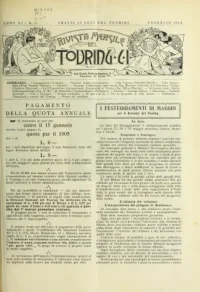
Articles in this issue
- Front-page reminder that the 1905 subscription of L. 6 (L. 8 for members living outside the kingdom, the extra 2 lire covering postage abroad) fell due on 15 January, with the late surcharge of L. 0,20 for Milan members and L. 0,55 for the rest deferred to 1 March. More than 30,000 members had already paid; the orange sticker that validates the 1905 card is returned with the receipt.
- Programme for the Touring Club's tenth-anniversary festivities in Milan on 27, 28 and 29 May 1905: a national congress, a general tourist rally, the muster of the Volontari Ciclisti e Automobilisti with practical and collective shooting contests at the new Boldinasco range, and a parade along viale del Sempione through the Parco and piazza d'Armi. A national outing to the Simplon tunnel will run in five caravans - cycling, motorcycling, cyclo-rail, rail and motoring - from Milan via Varese, Laveno, Lake Maggiore and Domodossola to Iselle, at entry fees from L. 8 to L. 15.
- Report of the meeting of 8 January at the Touring's Milan headquarters that constituted the national committee for volunteer cyclist and motorist corps, electing deputy Massimo Bonardi president, colonel Ernesto Chiaria and ing. Alberto Riva vice-presidents and Arturo Mercanti secretary. It records war minister Pedotti's letter of 25 January welcoming the scheme and the parallel founding of local committees at Ancona, Bologna, Brescia, Como, Ferrara, Turin, Udine and Verona.
- Giovanni Borella's illustrated description of the Val Vigezzo in the upper Ossola - its villages of Santa Maria Maggiore, Malesco, Craveggia, Toceno, Crana and Re, its carriage roads from Domodossola and the Val Cannobina, and the emigrant wealth of the Borgnis bankers of Frankfurt and the Mellerio jewellers of Paris that leaves the communes free of local taxes. He notes Crana as the birthplace of Giovanni Paolo Feminis, inventor of eau de Cologne, the marble, gold-bearing quartz and kaolin deposits, Dr Pollini's eccentric bequest to Malesco to be accumulated for 300 years, and his hope for the projected Domodossola-Locarno electric railway; the photographs are by TCI member Stefano Krentzlin of Milan.
- The magazine's standing photography department, whose hand-lettered Art-Nouveau masthead heads Prof. Rodolfo Namias's technical article on stripping and enlarging negative films and notices of forthcoming photographic exhibitions.
- Prof. Rodolfo Namias sets out his own method of stripping the gelatine film from glass negatives, hardening the thoroughly wetted plate in basic chrome alum and raising the film with a 5 per cent alkaline fluoride solution acidified with sulphuric or hydrochloric acid, in place of irritant formalin and hydrofluoric acid. He also reports Dr Spilimbergo's zinc simplification of the chrome-alum bath and Prof. Colombo's saturated sodium-carbonate technique, which swells a 9x12 image to 11x15.
- Three photographic exhibitions announced: one opening in the Kursaal at Rapallo in February and running through March, open to amateurs and professionals alike; an artistic competition for Ligurian amateurs at Genoa in May and June promoted by Ippolito Cattaneo; and an amateur exhibition being organised at Trieste in aid of the Lega Nazionale.
- The railway department, opened by an ornamental hand-lettered masthead, reviewing Maggiorino Ferraris's polemics on Italian railway policy and the inauguration of the Arona-Domodossola line.
- Summary of two articles by deputy Maggiorino Ferraris in his Nuova Antologia: "Come si viaggia in Italia ed all'estero" of 1 January, which argues that Italy holds the record for high fares and that beyond 25 kilometres only a small privileged class travels; and "L'anarchia ferroviaria in Italia" of 15 January, describing the vicious circle of missing wagons, locomotives, shunting tracks and unloading platforms. Ferraris judges the 1885 conventions a total failure and declares for a strong, permanent state-run system.
- The inaugural train reached Domodossola at 12.18 on 15 January over the new 54-kilometre line from Arona, which skirts the western shore of Lake Maggiore with stations at Meina, Lesa, Belgirate, Stresa and Baveno, crosses the Toce on a 150-metre iron bridge opposite the Borromean Islands and links Piedmont and Lombardy directly to the Simplon tunnel. A note on Domodossola records 4,629 inhabitants, 222 cyclists and only 31 Touring members.
- The roads department, carrying Ing. Massimo Tedeschi's argument for planting trees along Italian highways and Umberto Passerini's report on the rebuilt Bologna-Florence road.
- Ing. Massimo Tedeschi supports the public works minister's bill permitting tree planting along national, provincial and communal roads, reviewing the 1900 controversy launched by the Gazzetta dello Sport and the technical debate in the Turin review Le Strade. He answers the maintenance objection with ing. Sansoni's figures for the province of Padua, where 190 of 280 kilometres are planted with 28,000 plane trees costing L. 1 to 1,50 each to set out and returning about L. 15,000 net over 1895-99.
- Umberto Passerini reports the improvement of the old Futa road between Bologna and Florence, where six kilometres of new level road have replaced the steep Livergnano-Sabbiuno climb - a stretch on which the daily Bologna-Monghidoro coach had to hitch a pair of oxen - and the Sabbiuno-Loiano section is now being regraded. He argues that the route's ridge alignment between the Savena, the Zena and the Idice gives continuous wide panoramas and deserves to win back cyclists and motorists.
- A correspondent writing to the Berico of Vicenza from Lamon (Belluno) argues that pellagra there comes not only from spoiled maize but from half-cooked polenta: the district has abundant good timber yet no road, so firewood costs more than in the cities and the poor must walk a day along dangerous mule paths to fetch a bundle. He appeals for a road in the name of public health.
- The road-sign department reports that frost and snow have stopped installation for the winter while the office builds up a stock of signs for the spring, and lists signs numbered 225 to 242 newly erected at Villanova (Alessandria), Castelfidardo, Avellino and Atripalda, Pisogne, Savona, Sernio and Casaccie, Trana and Moncalieri. Donors include consuls and communes together with the firms Isotta Fraschini, Nazari e Gorla and the Automobile Club Italiano of Milan.
- Ing. Effren Magrini's technical review of the second Turin motor show, welcoming the new Italian makers Star (Fabbrica Torinese di Automobili "Rapid") and Itala and noting the general move to pressed-steel chassis largely supplied by Arbel and Forges de Douai, side-entrance coachwork, longer wheelbases, cylinders cast separately on Star, Bianchi and Isotta Fraschini, universal magneto ignition up to 30,000 volts and the spread of cardan drive. He also records the first economy cars (Peugeot Bebe, Minervette, Lux), the Rexette tricar, antiderapant tyres and Protettori by Samson, Gaulois, Sartiaux and De Bonmartini, and elastic front and rear forks on motorcycles.
- The motoring department, opened by an ornamental Art-Nouveau masthead, gathering Ing. E. M.'s technical notes, "Il Dottore"'s electricity primer, club and service news and motoring miscellany.
- Ing. E. M.'s roundup of new motoring devices for 1905, covering the valveless oil pump of the Delaunay-Belleville engine, the arrival of four-cylinder motorcycle engines, De Dion Bouton's reworked ignition and clutch, and the Simplex elastic motorcycle fork.
- Describes the new oil pump fitted to Delaunay-Belleville car engines, in which an eccentric gives the piston both a reciprocating and an oscillating motion so that the ports E and D open and close alternately, dispensing with valves entirely. The same design has been compulsory on French navy torpedo boats for eight years.
- Argues that the four-cylinder layout adopted in cars to even out the single power stroke in four is now reaching motorcycles, citing the four-cylinder 4 hp F.N. built by the Fabrique Nationale des Armes de Guerre of Herstal for the rider Osmond's tour of Europe - 75 kg, automatic valves lifted from the handlebar, magneto ahead of the engine and a Hydra plug - and the 8 hp four-cylinder Laurin-Klement.
- Explains De Dion Bouton's 1905 low-tension magneto ignition, whose novelty is to place the distributor between the coil secondary and the four plugs so that a single coil replaces four, firing cylinders IV, III, I and II in turn through a porcelain disc with four contact buttons. It also describes the new all-metal clutch of three discs on the crankshaft, held engaged by spiral springs and freed by a lever.
- Presents the Simplex elastic motorcycle fork described in France Automobile, successor to Truffault's fitment on the Peugeot machines seen at Paris and Turin. It can be adapted to any motorcycle, makes steering less tiring and spares the fork the sharp shocks that soon render a machine unserviceable.
- Season review concluding that the quarrel over mechanically operated inlet valves has died away, that the small magneto has been adopted almost universally along with the elastic front fork, and that the year's real transformation is the move from single-cylinder to two- and four-cylinder engines by Werner, Peugeot, F.N., Republic and Zedel. Power stays at 3 to 3 1/2 hp, with longer frames and stronger internal-expanding brakes, and few machines have clutches or gears.
- Describes the three Werner models for 1905 - singles of 2 3/4 and 3 hp and a new 3 1/4 hp twin with its cylinders set side by side across the frame, which helps cooling and lubrication on hills. It weighs only 45 kg, keeps accumulator ignition, opens the inlet rather than the exhaust valves for starting, and has an elastic fork convertible to a rigid one after a breakdown; agents are Werner Freres of Paris, represented in Milan by Mario Mazzoleni of via Palermo 19.
- First instalment of a beginner's series signed "Il Dottore" on electric ignition, using the analogy of a roof tank and a downpipe to explain amperes and volts, conductors and insulators, open and closed circuits, series connection and the use of the ammeter and voltmeter. It then treats accumulators as secondary cells of 2 volts each, warns against short-circuiting their terminals during a run and praises the maker who has sheathed the pole screws in ebonite.
- Report on colonel Renard's road train, a novelty of the sixth Paris Salon of 1903, recently tested for the army in Berlin before ministers von Hammerstein and von Podbielski, who rode in it themselves. Because power is carried by jointed shafts to the rear wheels of every trailer, technicians reckon 30 to 40 per cent of it is lost, and Louis Turgan and Der Rad-Markt conclude that no more than three vehicles including the tractor can usefully be coupled.
- Budapest has founded a society of volunteer doctors ready to answer calls to industrial accidents and other injuries, equipped with a special motor car carrying the driver, three physicians, a medicine chest, a case of surgical instruments and twelve portable stretchers that can be made ready in half a minute.
- Photograph and description of the ten-metre motor house in which Giulio Secrestat of Bordeaux recently reached Paris, containing a dining room whose table seats twenty, a bedroom with two beds, a kitchen and quarters for the mechanic. It runs on wooden wheels without pneumatic tyres and its 20 hp engine gives 30 kilometres an hour.
- Summary of Dr Naecke's study of the racing motorist's state of mind, based on numerous enquiries, which likens the sensation of extreme speed to absinthe or alcohol intoxication and attributes it to irregular blood flow to the brain and to disturbance of the lymph in the inner ear, aggravated by dust, heat, heavy leather clothing and tinted goggles. Naecke notes that nervous individuals can feel the same at quite moderate speeds.
- Describes a simple speed alarm already fitted to several cars in England: a metal tube fixed at the centre of a wheel holds a spring-loaded weight that moves outward under centrifugal force and, above the chosen speed, closes an insulated electric contact so that a loud bell rings until the driver slows. Current comes from a small dry-cell battery.
- Notes the influence motoring is exerting on fashion now that it has reached the royal courts, reproducing a Berlin house's design sent to the Allgemeine Automobil-Zeitung, the newest lady motorist's headgear from The Car of London and a full-face protective costume shown at the Paris Salon. The writer regrets being unable to show Italian designs, since Italian women motorists are still too few to influence national fashion and must order from abroad.
- Reports the third meeting at the Touring of delegates from the motor clubs of Milan, Turin, Genoa, Padua and Florence, at which president senator Ginori, back from the Paris international congress, announced imminent recognition by the international federation, and the Turin session of 25 January that constituted the Automobile Club Italiano with its seat in Turin, Ginori as president and Massoni of Milan and marchese Ferrero di Ventimiglia as vice-presidents. It also prints the Deutscher Automobil Club's letter warning it will not contest the Gordon-Bennett Cup if it is run over the same course and at the same time as the Grand Prix.
- Motor-transport news: Purrey steam railcars from Bordeaux now working the Roma-Viterbo line for the Societa Mediterranea, reaching 75 km/h on the Roma-Civitavecchia gradients with three intercommunicating coaches; a successful petrol railcar trial from Rome to Frascati on 26 January averaging 35 km/h; six motor-bus routes proposed by the Mantua provincial council; and a March trial of small electric vans by Turrinelli e Camona for clearing Milan's letter boxes and sorting mail in transit.
- The Societa d'Incoraggiamento d'Arte e Mestieri at via Santa Marta 18 announces a course of about thirty lessons on general mechanics, the motor and its parts, transmission, lubrication and brakes, with notes on motorcycles. Sixty pupils over seventeen may enrol for L. 10 after an examination in reading, writing and arithmetic on 12 February; lessons begin on 16 February, and the Touring Club Italiano and the Automobile Club di Milano share the cost.
- Calendar of the year's motor shows, from New York and Brussels in January through Turin, London's Crystal Palace, Chicago, Berlin, Detroit, Copenhagen, Vienna, Washington, Stockholm and Rouen to Paris at the Grand Palais in December, with Budapest's second international show on 7-21 May and a display of lamps and cycle and car accessories at Tombetta (Verona) in March.
- Miscellany noting that the English horse power of 550 foot-pounds equals 76,041 kilogrammetres rather than 75, so Italians should write C.V. instead of H.P.; Louis Beaume's argument in France Chevaline that nine of every ten Parisians buying cars never kept horses, so motoring is not taking trade from the horse; and the addresses of avv. Cavalli and the maker Francesco Passoni of Turin for the "mozzo enigma" hub.
- Reprints from Bemporad's Almanacco Italiano a Roman-dialect poem by Trilussa (Carlo Alberto Salustri) in which a horse throws its rider rather than carry him to war, protesting against the butcher who set brother against brother and telling the soldier that if he must go he should go by motor car, since he will kill more that way.
- A joke taken from the Schauferl of Munich: the motorist touring at 200 hp in search of impressions asks a policeman where he has arrived, is told "Paris, sir", and replies that he cannot be bothered with such negligible details - in what part of the world has he arrived?
- The boating and navigation department, opened by an ornamental masthead, reporting the tenth International Navigation Congress that Italy will host at Milan.
- The permanent international association, which has met since 1885 at Brussels, Vienna, Frankfurt, Manchester, Paris, The Hague and Duesseldorf, will hold its tenth congress at Milan in September with some 1,500 delegates, a parliamentary grant of 100,000 lire and organising sub-commissions housed at the Touring. Sections on inland navigation under senator Giuseppe Colombo and maritime navigation under rear-admiral count Candiani d'Olivola will debate mixed rail-and-water transport, deforestation and drainage, ways of overcoming great differences of level in canals, and whether a waterway could cross the Alps; excursions are planned on Lakes Maggiore and Como, the Po and by sea to Naples.
- New department on horse touring, reporting that the Touring Club de France has added it to its programme with a special section under M. Hornez funded with 10,000 francs, confined to the road and excluding the racetrack, and is surveying available stables and boxes with a view to a list of "affiliated stables" giving members 10 per cent off. The editors cite L. Barbier's article in the Revue Mensuelle on choosing, training and handling touring horses and invite Italian members to say whether the same could be done here.
- The mountaineering department reports the Club Alpino Italiano's delegates' assembly of 18 December at Turin (76 present, 1905 budget L. 42,382) with Randone's call for a large hut in the Trentino Alps, and the Societa Alpina Friulana's meeting at Udine on 27 December, which re-elected Prof. Olinto Marinelli. It adds that Europe now has 300 alpine huts, the highest La Cravate on the Matterhorn at 4,134 metres, and that the fourteen huts of the Alpinisti Tridentini drew 1,881 visitors in 1904 of whom only 835 were Italian.
- The winter-tourism department, covering the Stockholm snow festival, the rise of the bobsleigh in mountain resorts and winter sport in Switzerland.
- Stockholm's traditional snow festival runs from 4 to 12 February under the patronage of the crown prince of Sweden and Norway, with horse-drawn skijoring, sail-driven yachts pushed over the snow by the wind, swimming, ski races and jumping, motor races, the European skating championship and a mounted hunt, part of the programme being staged in the theatre with choirs and living tableaux.
- Explains the bobsleigh, a long low sled on two pairs of runners with the front pair pivoting as a rudder, crewed by a helmsman, ballast riders and a brakeman, and the four or five giddy minutes in which as many kilometres are covered. Davos, St Moritz and La Rosa are the oldest centres and races are now held at Leysin and Les Avants; Salvatore Curti, writing after watching the Davos-Klosters runs, urges Italian alpine clubs to organise similar meetings in the Cadore and upper Valtellina.
- Consular news from around the country: a farewell banquet at Alessandria for consul Pasquale Innocenzo Torti; the Bologna section of the Routier Italiano forming a band for the May festivities; a cycle and motor rally planned at Chieti; a new consulate at Cotrone founded by dott. Ferrari; the first outing of the Forte dei Marmi consulate under consul Angelo Magrini; a Naples dinner at which the tenth-anniversary medal and the Abruzzi e Molise guide were distributed; and a rally at San Remo on 8-9 April. Portraits of consuls Enrico D'Agostini of San Francisco and Angelo Magrini are printed, with the note that Lucca province has only 1,697 cyclists and 219 members because of its bad roads.
- Department on tourist and sporting societies, led by the Routier Italiano and followed by notices from Chioggia, Galatina, Montalcino and Suzzara.
- The new national cycling society based at Bologna, driven by its director general Edgardo Bonesi, already has 200 members in 32 sections including Trento, Trieste and Rovereto, means to take an active part in forming the volunteer cyclist battalions and will send a strong contingent to the Touring's May festivities. Its badge and the commemorative medal sent to its members are reproduced.
- Miscellany of Italian places: the Innsbruck building that housed the Italian law faculty for a single day before it was suppressed; Atri in the Abruzzi, which disputes with Adria the naming of the Adriatic, and its cathedral of 1285 frescoed by Luca di Penne and Andrea da Lecce; Herculaneum, from prince d'Elbeuf's shaft of 1719 to the Casa d'Argo, with Angelo Conti's plea in the Marzocco that Italy resume the excavations herself rather than leave them to an American committee; and Salvatore Pisani's new eleven-metre obelisk at Sondrio to the Valtellinese who died in the wars of independence.
- Two notes on Italian geography: L'Opinione Geografica's complaint that "Le Marche" is a plural francesism owed to the French text of the 1815 treaty of Vienna, the historic form being "La Marca"; and the reply in the Bollettino della Societa Geografica Italiana to the Naples congress's call for a 1:25,000 survey of the whole country, which reports about a third of the territory mapped, 2,060 sheets still wanting, a cost of L. 3,543,000 and some forty years' work.
- The book department, whose ornamental masthead is followed by reviews of new volumes sent to the Rivista and a long survey of periodicals received, with the standing note that only books sent in duplicate are noticed.
- Review of the tenth annual Almanacco Italiano (Florence, R. Bemporad e figlio, 660 pages) edited by the Braidense librarian Giuseppe Fumagalli, with 960 text figures, 38 plates and a chromolithograph. Besides T. E. Magnasco on motoring and cycling it carries articles on the customs of the Marche, Ladinia, the port of Genoa, Tuscan traditions, ancient sculpture, Albanians in Italy, the Siena old-art show and the Saint Louis exposition, and Camillo Pecorella's concise guide to Palermo.
- Review of De Amicis's new Treves volume (Milan 1905, 330 pages, L. 3,50), whose title sketch of 85 pages describes the Matterhorn observed from the hotel at Giomein. The reviewer praises its portraits of mountain dwellers, alpinists and rich idlers who go to the hills because it is the fashion, and says anyone still unmoved after reading it should stay on the plain and leave the mountains in peace.
- Review of Ferrari's Hoepli volume (Milan 1904, 272 pages, L. 35) on the less-known corners of Italy, a programme close to the Touring's own: three chapters on Sicily pass over Selinunte, Agrigento and Syracuse for Piazza Armerina, and Rome and the best-known Basilicata gives way to the Gargano promontory. Its 310 illustrations from the author's own paintings are called both the ornament and the flaw of the book, since Ferrari the painter keeps interrupting the text to cite his own drawings.
- Review of the album published at Milan by Giovanni Lampugnani and printed by the Istituto d'Arti Grafiche of Bergamo for the opening of the Simplon railway, in which the Piedimulera-based society presents the Ossola valleys in some fifty pages of views - panoramas, lakes, waterfalls, chapels, castles, huts, glaciers and costumes. It includes an itinerary map of the principal excursions drawn by capt. Giorgio Spezia, with photographs by Lossetti, Spezia, Baronio, Fumagalli, Lampugnani and others.
- Survey of periodicals received, from the first number of the Milan weekly L'Automobile and Der Motorwagen on German motoring terminology to The Motor Car on Canada, La Vie Automobile on the Chauvin and Arnoux speed recorder, De Kampioen's photograph of a Dutch cyclist among central Africans, Der Rad-Wanderer on a cycle tour from Ivrea over the Great St Bernard to Geneva made with the Touring's guide, and France Automobile's flattering article observing that the Touring Club Italiano's 42,000 members would be double if the centre and south took as much interest as the north.
- The club's own bulletin of publications, prices, membership schemes, consular appointments and obituaries.
- The new edition of L. V. Bertarelli's Lombardy guide runs to three cloth-bound volumes of over 1,000 pages with 1,000 profiles and itinerary descriptions of 2,300 road sections, sold to members at L. 8 at the Milan office rising to L. 9,75 post free for Belgium, Germany and Great Britain, and at L. 16 to non-members. Its 1:100,000 topographic map on six sheets of 90 x 65 cm, obtained from the Istituto Geografico Militare, can now be had separately for L. 6, the six sheets not being sold singly.
- Despatch of Bertarelli's Abruzzi e Molise guide is complete. It will be put on sale to non-members at L. 4 a copy, but only once the editors are sure every 1904 member entitled to a free copy has received one; members joining for 1905 will instead receive the forthcoming Puglie guide.
- Answers members puzzled by Bertarelli's preface calling Abruzzi e Molise "the second guide the Touring has published this year": the first was the new edition of the Guida della Lombardia, which was not given away but put on sale at the prices printed on the same page.
- Sets out what members received in 1904 - the monthly Rivista, the 696-page Annuario, the 228-page Abruzzi e Molise and the Swiss sheet of the frontier map, of which too few copies were printed and a second impression is promised to about 3,000 members - with the Stelvio and Moncenisio profiles and road monographs still owed and due in the spring. For 1905 the L. 6 subscription brings the Rivista, a rebuilt Annuario, the Puglie guide, the Franco-Italian frontier sheet and further monographs, valued together at L. 17,50.
- The Touring's railway guides have appeared in three groups: Milano-Torino, Milano-Bologna and Milano-Verona; Milano-Genova, Genova-Spezia and Genova-Ventimiglia; and Verona-Venezia, Venezia-Bologna and Bologna-Firenze. Each 40-page guide with map and three-colour cover costs 50 centesimi, or a whole group for L. 1 to members ordering direct; further guides will follow if groups II and III sell as well as the first.
- The motoring yearbook continues to be asked for and has been well received by the Italian and foreign press, copies even being sold at the Paris Salon. Few remain, priced L. 2,50 to members and L. 5 to others, to be ordered from the Touring's office at via Monte Napoleone 14, Milan.
- Complete half-cloth bound volumes of the Rivista for the years 1897 to 1904 are on sale post free and without discount, from L. 3 for 1899, 1900, 1901 and 1902 and L. 3,50 for 1903 and 1904 to L. 4 for 1898 and L. 5 for 1897.
- Work is well advanced on the 1905 Annuario, which will carry substantial additions on the 1904 edition. The editors press the correspondents who have received circulars to answer promptly and carefully - the Annuario being above all a collective work - and to accent every place name, observing that those who fail to reply are the same who later complain of the errors their answers would have prevented.
- The hotel improvement commission is drawing up, at the request of the 1906 Exposition committee, the programme for a competition for hygienic bedrooms modelled on the Automobile Club de France's contest at the Paris Salon. Its model "Camera Igienica" is being fitted out at the Touring's offices, with more rooms to be shown in hotels of the principal cities, and the commission continues propaganda aimed at individual hotels in proportion to their observed shortcomings.
- The information service, which has long functioned in fact if not in name, has grown enough to become a separate department with a clerk at a counter to answer members on customs formalities, itineraries and the like. Written replies will carry the postage, and enquiries requiring research a very light fee proportioned to their importance.
- Answers a question many members have asked: one who has already paid the L. 6 subscription for 1905 may still become a five-year member by sending a further L. 24, receiving the badge free and being enrolled through 1909, and should state his membership number clearly in the letter.
- For the Touring's tenth anniversary the council awarded a gold example of the commemorative medal to the Istituto Geografico Militare in gratitude for its support and co-operation, and the Institute replied with a letter praising the club's work of physical education and national fellowship as a lasting bond of sympathy between the two bodies.
- Piacenza's town council has voted unanimously to make the commune a perpetual member of both the Dante Alighieri society and the Touring Club Italiano, while the Florence consulate has sent L. 150 to enrol as a life member of the Dante, drawing a letter of thanks from Prof. Alberto Eccher Dall'Eco to capo-console Angelo Modigliani Rossi.
- List of members who have paid five years in advance, 1,732 names in all, arranged alphabetically with their towns from Verolengo and Loano to Livorno and Turin, followed by a short foreign section covering Capodistria, Toulon, Geneva, Bregenz, Borgo Valsugana, Trieste, Fiume, Vienna, Rosario Santa Fe and Lugano.
- Obituaries for Elisa Brentari nee Negrelli, who died at Rovereto aged 76 and was the mother of the Rivista's editor, buried with the attendance of the town council and the Alpinisti Tridentini; Enrico Morandi of Milan, co-owner of the Albergo Commercio and a member of the hotel improvement commission; and the singer Augusto Parboni, father of the club's former councillor Stanislao Parboni.
- Twenty-fifth list of affiliated hotels, giving category, room and meal prices, servants' rates and the standard 10 per cent discount on the whole bill, for Ancona, Arona, Benevento, Brindisi, Campobasso, Caserta, Lavis in the Trentino, the Grand Hotel Continental in Milan, Rivoli and Santa Maria Capua Vetere, several of them offering garage space for cars.
- List of candidates for membership who applied between 15 December 1904 and 15 January 1905, opening with life members from Alessandria, Bergamo, Catania, Florence, Forte dei Marmi, Mantua, Milan, Padua and Rome, and continuing over three pages with ordinary candidates arranged by province and commune from Ferrara and Florence to Palermo, Parma and Pavia.