Rivista Mensile del Touring Club Italiano, Vol 11, No 3
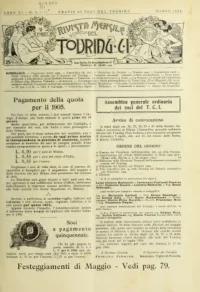
Articles in this issue
- Notice that the annual subscription due under art. 15 before 15 January, already extended through February, will now be collected from 1 March by postal draft delivered to members' homes: L. 6.20 for Milan, L. 6.55 for the rest of Italy and L. 8.55 abroad. Members are urged to send the money direct to the Milan head office in via Monte Napoleone 14, marking the counterfoil only "per quota 1905", after which an orange sticker validating the 1905 card is posted back.
- Members who have already paid the L. 6 or L. 8 subscription for 1905 may convert to five-year membership covering 1905 to 1909 by sending a further L. 24 within Italy or L. 32 from abroad.
- Convocation of the ordinary general meeting for Sunday 9 April 1905 at 15.00 in the Borsa hall on piazza Cordusio, Milan, with an agenda covering the auditors' report, a consultative vote on the 1904 accounts, and the election of twelve councillors (Luigi Vittorio Bertarelli, Innocenzo Vigliardi-Paravia, Federico Guasti, Lorenzo Bertolini, Arato Ardenghi and the interim appointees) plus three auditors. Ballot papers must return by 15 July 1905 and are counted on 17 July; signed by director-general Federico Johnson and council secretary Innocenzo Vigliardi-Paravia.
- Auditors Romeo Riva, Attilio Soffredi and Gino Turrini report on the 1904 accounts: assets of L. 404,395.32 against liabilities of L. 145,936.61, leaving net capital of L. 258,458.71, with 41,431 subscribing members bringing in L. 271,882. They single out the L. 13,017.90 spent adapting the new Monte Napoleone premises (the landlord, senator count Rinaldo Taverna, bore much of the rest), the L. 10,876.30 spent on road signs against L. 14,842 subscribed, customs guarantees passing L. 100,000, and propaganda costs swollen by exhibitions at Turin, Bologna, Brescia, Ravenna and Paris.
- The full 1904 balance sheet spread across two pages, listing assets from L. 258,500 of public securities and L. 47,944.94 of publications down to the library valued at L. 6,045.24 but carried at L. 1, and liabilities including L. 36,978 of five-year subscriptions paid in advance. The revenue account shows income of L. 343,721.19 against expenditure of L. 323,610.02, leaving L. 20,111.17 carried to capital; signed by the auditors, accounts chief rag. Piero Moro, director-general Federico Johnson, vice-director ing. Alberto Riva and secretaries Vigliardi-Paravia and Alfredo Zaffaroni.
- Plan of the cycle and motor-car hall to be built on the piazza d'Armi for the 1906 Milan exhibition: 11,000 sq m against Turin's 4,100 and Paris's 33,700, already judged too small, with 81 stands for cars, 35 for bicycles and motorcycles, 28 for tyres and three galleries for the "camere igieniche". The Touring has been given charge of that hygienic-bedroom show and will itself exhibit the three model rooms of the competition — for small-town, provincial-city and luxury resort hotels.
- Programme of the three-day national tourist festival marking the Touring's tenth anniversary. Saturday 27 May brings a National Tourist Congress with papers by cav. L. V. Bertarelli on tourism and roads, on. Maggiorino Ferraris on tourism and railways and on. Fausto Massimini on tourism and taxation (the petrol duty and the bicycle tax); Sunday 28 May the general rally, the muster of volunteer cyclists and motorists, the inauguration of the Boldinasco rifle range and a mass banquet under cover in the Castello Sforzesco courtyard. Enrolment L. 3, banquet L. 7.
- The Monday 29 May outing to the Simplon tunnel workings, open to Touring members only and run as separate caravans: motor-cars via Novara, Lake Orta and Domodossola to Iselle (L. 8); cyclists and motorcyclists via Varese and Laveno with a special steamer to the Borromean Islands, Baveno and Pallanza (L. 8); a cyclo-rail caravan with free machine carriage from Milan to Varese (L. 12); and a rail caravan (L. 15). All include a lunch basket at Preglia, dinner at Domodossola at 18.00, an enamel badge and a visit to the tunnel works, with a Simplon photographic competition and 500 beds arranged around Domodossola.
- A cycle and motor-car show will be held in Milan at the Giardini Pubblici beside the natural history museum from 13 to 31 May under the Touring's patronage, with free entry for members enrolled in the decennial festivities.
- Account of the fusion of the Milan committee, housed and supported by the Touring, with the Rome committee founded under the auspices of the Audax, voted at the plenary meeting of 19 February chaired by on. Massimo Bonardi: a single Comitato centrale nazionale seated in Rome, with four vice-presidents drawn from the T.C.I., the Audax, the Automobile Club d'Italia and the national rifle-shooting commission. On 20 February the War Minister received the delegates and named general Felice Sismondo president; twenty-four provincial and local committees already exist, from Ancona to Vicenza.
- Note introducing the month's engravings, which show the Milan monuments the May parade of cyclists will pass — the Arco del Sempione and the Castello Sforzesco, threatened with near-total demolition under the 1884 town plan and saved by Luca Beltrami's persistence.
- History of the arch: first raised in wood at the Porta Orientale in 1806 to Luigi Cagnola's design for the arrival of viceroy Eugène de Beauharnais and his bride Amalia of Bavaria, then decreed in marble at the head of the Simplon road. Begun on 14 October 1807, halted in 1814, resumed in 1826 and finished in 1837, it was inaugurated in 1838 by Ferdinand I as the Arco della Pace and cost four million lire; the servile inscriptions were erased in 1859. Reliefs by Pompeo Marchesi, Benedetto Cacciatori and others, with Abbondio Sangiorgio's bronze chariot of Peace.
- Describes the way the cyclists will enter the Castello Sforzesco — over the outer moat bridge and through the gate in the middle of the south-east front towards the Parco, between the Torre del Tesoro and the Torre della Corte Ducale, with the Torre di Bona di Savoia of 1477 (designed by Lodovico Gonzaga) rising behind; its restoration was where Beltrami's rescue of the castle began.
- The vast parade court, being cleared of Spanish and Austrian accretions, faced by the three city-side towers: the Torre Umberto I in the centre and the two round towers restored and turned into drinking-water reservoirs. It is here, under a purpose-built roof, that the Touring's great banquet will be held.
- How the central tower entrusted in 1452 by Francesco Sforza to Filarete, wrecked when lightning blew up the powder magazine on 21 June 1521, is being rebuilt with the roughly L. 100,000 collected in Milan in 1900 for a monument to King Umberto I — Luca Beltrami's idea of doing two good things at once. It will carry Luigi Secchi's marble high-relief of the king on horseback and house a room of royal memorabilia.
- The magazine's standing photographic department, its title hand-lettered inside an Art-Nouveau engraving of a woman with a camera; this month it carries prof. Rodolfo Namias on telephoto lenses for touring and alpine photography.
- Prof. Rodolfo Namias digests E. Wallon's 1904 Nancy lecture on telephoto lenses, valuable to the excursionist for photographing distant mountain chains. He compares the three systems — Vautier and Dufour of Lausanne's folded "telefoto", the converging-plus-converging doublet, and the converging-plus-diverging type devised in 1891 by Dallmeyer and dott. Miethe, now the commonest — with their distortion, flatness of field and heavy light loss, tabulates the lenses of Dallmeyer, Miethe, Zeiss and Goerz, explains Dallmeyer's variable "adon", and recommends Koristka of Milan's Negri-Koristka giving six to twelve diameters.
- The standing railway department, its title hand-lettered inside an ornamental engraving of a locomotive, opening this month with the study of Italian passenger fares.
- Argues under the heading "In Italia non si viaggia!" that Italy's 16,000 km of railway are barely used: 45,569,157 journeys on the Mediterranea, Adriatica and Sicula networks, an annual average of 1.43 per inhabitant against more than 27 in England, 20 in Switzerland, 17.39 in Prussia and 6.33 in Austria, with only Russia lower at 0.74. Drawing on on. Maggiorino Ferraris's study in the Nuova Antologia of 1 January 1905, it tabulates the price of 100 km and 500 km tickets across Europe to show the Italian tariff among the dearest, and blames fares and discomfort rather than poverty alone.
- The Touring's standing roads department, carrying this month ing. Massimo Tedeschi on the roads section of the 1906 Milan exhibition, the work of the roads-improvement commission and provincial news.
- Ing. Massimo Tedeschi of Turin previews the road division of the international land-transport section at the 1906 Milan exhibition. He recalls France's display at Paris 1900 — 400,000 km of roads built for eight and a half milliards and maintained on over 200 million a year, with departmental road maps, geological and quarry data and coloured graphs of maintenance cost and cart traffic — Russia's ministry of communications, the Paris city pavilion with its thirteen million square metres of paving and municipalised wood-paving works, and the Surveyor's road-machinery exhibitions at the Royal Agricultural Hall in London in 1899 and 1901. Milan, he argues, must find something more original.
- The roads-improvement commission reports on its two competitions — a monograph on the roads of one Italian province and a model handbook for roadmen — and on its approach to influential figures in each province to form local pro-strade committees. Meanwhile it is collecting the provincial administrations' own published road statistics and cantonniers' regulations, several of which have already arrived.
- Provincial notes: Turin's technical office is to plan general steam-rolled resurfacing across the roads within about 70 km of the city; Milan leaves maintenance budget surpluses at the technical office's disposal; Naples has approved a regulation tying wheel-rim width to load; Caserta doubles its rolling programme ahead of a Caserta-Caiazzo motor-bus service; and at Ancona the consuls Riccardo Jona and prof. Giuseppe Picciola have asked the mayor for a reserved strip for bicycles and motorcycles on the impassable road to the station, used every winter morning by hundreds of working cyclists.
- At Foza, one of the Sette Comuni above Vicenza, the local men Oro Valentino and Oro Giovan Maria have rigged a steel-cable ropeway running 1,200 metres from the summit of the Crànchental down the Valgadena, bringing timber almost to the Brenta in five minutes instead of dragging it for kilometres over stony tracks.
- Humorous column reproducing the Paris paper Sans-Gêne's mock apparatus for saving pedestrians — and motorists themselves — from breathing the dust thrown up by cars on the main roads, amid the serious flurry of societies, journals and projects against road dust.
- The standing road-signpost department, its title hand-lettered beneath an engraving of cyclists at a Spluga and Stelvio signpost, reporting the signs erected and the new subscriptions received.
- Signs numbered 243 to 261 put up in the province of Turin at the Deputazione Provinciale's expense, on the Torino-Genova, Torino-Savona, Torino-Cuneo, Torino-Milano, Torino-Cuorgnè per Rivarolo, Carmagnola-Chieri-Gassino and Brusasco-Crescentino provincial roads, at points such as Carmagnola, Chivasso, Valperga and Chieri — one at the Torino-Casale junction offered by cav. Alfredo Rostain. New offers from Silvio Armando Neri, the municipalities of Daniele Friuli and Mogliano Veneto, dott. Ugo Migliavacca, Felice Piazza and the Macerata provincial deputation bring the running total to 1,085 signs and L. 14,740.
- The standing mountaineering department, hand-lettered inside an Art-Nouveau engraving. This month: the 1905 Club Alpino Italiano congress to be held in September by the Venice section in the Cordevole, Avisio, Boite and Piave valleys with ascents of the Antelao and Marmolada; Luigi Brioschi elected president of the Milan section after ing. Alberto Riva declined; the Società Escursionisti Milanesi's tree festival at the Grignetta hut; the Alpinisti Tridentini's 1,555 members and Rovereto assembly; 1,366 visitors to the Castellaccio station above Monreale; and notes on William Coxe and Ramond in L'Écho des Alpes.
- Some thirty members of the women's Mediolanum club made their winter outing to San Martino di Sagno (744 m), between the Bisbino and the Generoso above the Val di Muggio, in spring-like weather. The Touring members of the Club Skiatori di Chiasso, also affiliated to the Federazione Prealpina, met them with a vermouth of honour and received them in their clubroom; a photograph shows the party with the Chiasso skiers.
- The standing motoring department, its title hand-lettered inside an Art-Nouveau engraving of a woman driving, carrying this month the report on the Turin motor show, the accumulator survey, the Turin trade congress and the new road-police regulation.
- Ing. Efren Magrini on the novelties of Turin's second motor show of January-February 1905, almost all of them in motorcycles: the four-cylinder F. N. with longitudinal engine, shaft drive, enclosed magneto ignition and elastic fork; the two-cylinder transverse Werner of 1905 weighing about 44 kg; and the water-cooled single-cylinder Picena with radiator, fan, pump and a gearbox between engine and rear wheel. He then reviews elastic suspensions and forks — Truffault, Garnier, Peugeot, Simplex, Benedetti and Balp-Bellomi — the Olivieri pedal stand, the Turkheimer "L'Indispensabile" automatic stand, the Bowden cartouche, the Badoni security bolt and the Codra exhaust whistle alarm.
- The detachable wheel of dott. Petracchi of Varese, which isolates the tyre completely from the wheel so that a damaged pneumatic can be replaced by an inflated spare with a few screws, and whose hinged rim eases mounting and allows an inextensible steel-wired beaded cover; its bolts stop the cover both tearing off and slipping round the rim.
- Humorous column: a peasant walking the road with his wife and his cherished piglet sees a passing motor-car crush the animal, and curses — of the two, it had to be the pig.
- Survey of the accumulators shown at Turin. Giovanni Hensemberger of Monza led with fourteen ignition types, improved ebonite separators and acid-proof screw terminals, traction batteries of 45 cells (96 amp-hours at the five-hour rate, 450 kg) for Fiat, and the carriage-lighting batteries of which 5,000 are in service on the Italian networks. Also Garassino of Turin's light celluloid cells and medical accumulators, Cerruti of Turin's perforated-celluloid plates, the Schmitt granular-paste type, the half-cell "Accu-mixte" L'Energique of Commelin, R. Viaux et Cie of Paris, and the Compound — closing with a protest at makers who quote physically impossible capacities.
- Record of the motor-trade congress held at the Automobile Club di Torino in the Parco del Valentino on 1 and 3 February with 400 adherents, chaired by avv. Cesare Goria-Gatti. Giovanni Gagliardi carried the motion founding a trade chamber; cav. Grosso-Campana and ing. Massimo Tedeschi won votes on wheel-rim widths, extending steam rolling to all national and provincial roads and watering tram-lined roads from track tank cars; ing. Vittorio Croizat obtained a call for a lower petrol and paraffin duty; and cav. Carlo Girard opened the question of reciprocal customs headings. The Camera sindacale was constituted with its provisional seat in Turin and a L. 24 annual subscription.
- The new road-police regulation published in the Gazzetta Ufficiale of 21 February requires motor-cars to carry two brakes of different systems and a loud horn (art. 55), a white plate with red letters and figures (art. 56), two front lamps one of them green and a rear lamp (art. 58), and limits speed to 12 km/h in built-up areas, 40 in open country by day and 15 at night (art. 67); owners must comply by 21 April. Motorcycles fall under the same rules with differences over plate height and Genio Civile fees, and the Touring will send the full text for 20 centesimi.
- Queen mother Margherita of Savoy drove from Rome to Turin in four days, covering 225 km a day with stages at Cecina, Spezia and Rapallo. La Stampa's reporter describes the phaeton lit by an accumulator battery, with a table for six, two armchairs and four folding seats, a small barometric station of barometer, thermometrograph and hygrometer, and a complete set of Touring publications — she is a life member and crosses frontiers on the Touring's triptyque. The article also describes the silver St Christopher medallion bearing an inscription she dictated, worn in gold by the Queen, her suite and her twelve chauffeurs under head mechanic Ettore Cariolato.
- The standing cycling department, its title hand-lettered inside an Art-Nouveau engraving of a cyclist at sunrise.
- Reply to the Corriere Meridionale of Lecce, which had demanded that the municipal guards enforce the 1898 cycling regulation more strictly, including the metal plate bearing the commune's name. The Rivista points out that that plate was dropped by the decree of 14 January 1900, the metric office tag now sufficing, and that Lecce with 32,029 inhabitants counts fewer than 72 cyclists against 683 at Treviso, 396 at Gallarate, 710 at Lodi, 895 at Monza and 1,446 at Novara — urging the town's 34 Touring members to set an example with brake, bell and lamp, and the local press to stop generalising from a few reckless riders.
- The Cyclists' Touring Club of England opens a competition, entries with drawings due at 47 Victoria Street, Westminster by 31 March 1905, for an anti-skid device fitted to ordinary bicycles and motorcycles. Entry costs one guinea, all property rights stay with the inventor, the club appoints the jury and the winner takes 200 guineas (5,300 francs).
- The Club Ciclistico is mounting a show of sport and tourism equipment at Tombetta near Verona from 12 to 26 March, during the fair, with competitions for bicycle lamps and brakes, numerous prizes, cycle, motorcycle and car meetings and races, and a cyclists' rally on 25 March; enquiries to avv. Mario Fabelli, palazzo Canossa, Verona.
- The standing new-hotels department, its heading set inside a rule box that the text layer misses. This month: the Grand Hôtel du Cap Ampeglio opened at Bordighera by F. Kunzler; the Imperial Palace Hôtel at Rapallo; the Hôtel Regina in via Veneto, Rome, facing Queen Margherita's palace; the enlarged Hôtel Glira at Rovereto; the renovated Grand Hôtel Royal at Siena with a Stigler lift; and the sale of the Hôtel Danieli and the Riva degli Schiavoni buildings in Venice to The Venice Hotels Limited, which plans a fireproof luxury hotel with American-style apartments.
- The standing miscellany department, its title hand-lettered inside an Art-Nouveau engraving, gathering notes on Italian monuments, landscape and civic questions.
- Vignola's palace at Caprarola, built between 1547 and 1559 for cardinal Alessandro Farnese, nephew of Paul III, now figures as the property of the count of Caserta, brother of Francis II of Bourbon. Recalling with regret the sale of the Roman Palazzo Farnese to France, Ernesto Ovidi argues in the Nuova Antologia of 1 February that the Bourbons hold only a right of use, so that the State could reclaim the building and put it to use as a scientific or artistic institute.
- After the vaporetti, so convenient to the public and so detested by the gondoliers, motor launches hired out by a company that has found its clientele chiefly among the English are now multiplying on the Venetian lagoon. They are to be made as quiet as possible and shaped as much like gondolas as possible, so as to pass for "gondomobili" — and one day, the writer fears, the rowed gondola may be a rarity in Venice.
- Rodolfo Puntini's recent illustrated account of the Tuscan hill town, of whose twenty-five towers still standing in the sixteenth century ten survive within a narrow circuit. They were raised between the thirteenth and fourteenth centuries and are headed by the 51-metre Rognosa above the old Palazzo del Podestà, which a council decree of 1602 forbade any other tower to exceed.
- The Società Dantesca Italiana telegraphs on. Rava, minister of agriculture, industry and commerce, against the threatened destruction of Ravenna's historic pine wood, the green crown of Dante's last refuge. Rava, himself a Ravennate, replies that he is preparing a bill to defend its last remnants against the abuse of an exaggerated right of use.
- Prof. Vittorio Cian's letter to the Giornale d'Italia protests that criminal, pathological and scandalous reporting is crowding everything else out of the Italian political press, and urges editors to send their travelling reporters to Italy's art, landscape, traditions and great workshops instead. The Rivista applauds but predicts nothing will change, since the public that buys news of the Musocco woman, the Murri trial and the Syveton scandal is what makes the paper — and is glad it can itself write only of beautiful things and how to go and see them.
- The standing department for outings, rallies and consulate news. At Lonigo (Vicenza) the Veloce Club Ciclistico, encouraged by last year's improvised success, is preparing a large cycling rally on a new plan of organisation and prizes; and at Naples on the evening of Saturday 28 January the Sezione Partenopea's consulate gave a banquet at the Ristorante Ferrari in the Galleria Umberto I in honour of director-general comm. Federico Johnson, at which the commemorative decennial medal was distributed and a second one signed for presentation to him.
- Two new clubs. At Galliate (Novara) the Sport Galliate and Sport Concordia merged in December as the Unione Sport, 150 members housed in the Castello Sforzesco with a large hall for festivities, under president Ercole Varzi and with Touring consul Agostino Crini on the committee. At Asti the local cycling elements have formed the Unione Sportiva Astigiana, with about eighty founding members, pretore dott. D. C. Eula (a Touring consul) as president and captain Dompè, commanding the bersaglieri regiment's cyclist section, as vice-president.
- The standing legal-advice department, its title hand-lettered inside an Art-Nouveau engraving, under which the club's legal section answers members' questions.
- Chief legal consultant avv. Bernardo Garbati rules on members' cases: a cyclist thrown against the railway fence after hitting an unlit level-crossing barrier in fog, who could himself claim damages; sledges and timber dragged on mountain roads in breach of the 1865 public works law; plates lost or stolen in transit, tampered plates and a motorcycle carrying a bicycle plate; a stationary car left with an unlicensed youth and a shying horse; the "contravvenzioni al volo" at Affori and the requirements of art. 58 of the 1881 road-police regulation; customs and circulation tax for members domiciled abroad or in Italy; refund of a fine paid after an amnesty; and the illegal "a passo d'uomo" notices of cyclophobe communes, with avv. Pizzagalli's proposal to boycott them.
- The standing library and book-review department, its title hand-lettered inside an engraving of piled books, noticing new Italian and foreign works and listing gifts to the Touring's library.
- Review of Carotti's 370-page volume with 188 illustrations, which identifies the rediscovered portrait of Cecilia Gallerani as genuinely Leonardo's, denies him the Louvre's Belle Ferronnière and the Brera pastel head of Christ (giving the latter to Cesare da Sesto), restores the Venice Accademia sketchbook to Raphael and reveals four hitherto unknown frescoed figures by Bramante; a further volume on Michelangelo, Giorgione, Titian and Correggio is promised.
- Frizzoni's contribution to the debate opened by the government commission on inland navigation chaired by on. Leone Romanin-Jacour, weighing the canal projects for the Po valley against the advantages they would bring the province of Bergamo; the volume carries several maps.
- The second annual report of the Ligue Internationale des Associations Touristes, produced for it by the Dutch Touring Club (Allgemeene Nederlandsche Wielrijders-Bond): the boards of the affiliated societies, the customs laws applied to bicycles, motorcycles and cars at frontiers, the internal and international circulation regulations, and a list of each society's maps and guides.
- The Pro Torino association's 146-page illustrated guide to Turin, its surroundings and province, the Italian edition being the first of four languages (with French, English and German to follow) and going out to the press of Italy and the Italian colonies; it carries numerous vignettes, a 1:16,000 town plan and a tramway map.
- Archdeacon's 40-page pamphlet against the French practice of booking a motorist on a policeman's unsupported judgment that he was going too fast, so that any collision is always the driver's fault however slowly he was travelling; with documented cases of judicial injustice, it campaigns for a change in the law.
- Notes on the touring press: the Union of Riga, organ of the Russian cyclists' union, printing itineraries for touring Russia; the last instalment of E. Kerber's cycle tour of Sardinia and Corsica in the Revue du Touring Club Suisse; Harro v. Stemann's Italian cycle tour in the Deutsche Radfahrer Zeitung; a Florence-to-Rome motor run in the New York Motor; issues of Der Rad-Markt, La France Automobile, the Allgemeine Automobil Zeitung and the Sportblatt zum Berliner Tageblatt given over to the Berlin, Turin and New York motor shows; and the first numbers of La Lettura Sportiva of Milan and of the Ideal Sport Club of São Paulo.
- The standing department of club communications and news, carrying the council's resolutions, membership figures and notices of the Touring's publications and services.
- Council resolutions of 7 January and 1, 5 and 24 February: on. Francesco Mira, dott. Carlo Moldenhauer, ing. Pietro Piola Daverio and ing. Francesco Pugno co-opted as councillors; the Milan consulate re-established under avv. Felice Pizzagalli, dott. Enrico Villa and others; the 1904 balance sheet approved; the general meeting called for 9 April; the anthem entrusted to a chosen composer; ing. Pietro Gavazzi's resignation as deputy chief consul general accepted; the 1905 motoring and general yearbooks commissioned; the international motoring congress deferred to 1906; a dedicated information office with its own counter created; and the gold medal awarded to the Touring at the Turin exhibition of 1905 recorded.
- Baron Ernesto von Hesse-Wartegg, born in Vienna in 1854 and among the most tireless globe-trotters of the day — the first German traveller to visit Korea and the first European to photograph the birthplaces and tombs of Confucius and Mencius — called at the Touring in Milan and wrote to the Vossische Zeitung of Berlin about it. He praised Bertarelli's guides, the Rivista, the railway guidebooks (no other nation, he says, offers anything like them), the yearbooks, the monographs and the road signs, and ended by wishing that a German Touring Club might be founded on the Italian model.
- The recruiting-prize scheme: a silver commemorative medal for every member who introduces ten new ones, a large silver medal for fifty, gold for a hundred, and a large gold medal for the year's recordman; Ernesto Reinach and the firm Torriani offer all 1905 benemeriti a pocket notebook not sold to the public. Everyone bringing in at least ten members between 1 January and 30 November 1905 enters a draw whose first prize is a 2 HP Laurin & Klement "Republic" motorcycle given by rag. E. Billiter of Venice, with a Gritzner luxury bicycle from E. Flaig, camera brackets from M. Ganzini and Pirelli tyres among the rest.
- The commission appointed to judge the settings of Stecchetti's words for a Touring anthem — cav. Innocenzo Vigliardi, dott. Piero Favari and rag. Gino Turrini, joined by professors cav. L. M. Tedeschi and Ettore Pozzoli of the Milan Conservatory — reported that no entrant stood out and advised either a fresh competition or a commission to a known musician. The council has abandoned the competition and charged the same commission with approaching a composer of its choice.
- Between 1 and 31 January 1905 the Touring enrolled 1,606 new members, far surpassing the 1,049 of January 1904 which had itself been described as a figure never before reached in a single month; new members are already a thousand ahead of last year.
- The 50,000 medals given by the director-general to mark the Touring's first decade mean that every new member who joins before the club's roll reaches 50,000 will also receive the commemorative medal — a point, the note adds, that will not be long in coming.
- The Touring's pocket railway guides, each describing a line of about 150 km, with a map specially drawn by the Istituto Geografico Militare, vignettes of the monuments and portraits of the personages along the route, in a polychrome cover. Three groups are out — Milano-Torino, Milano-Bologna, Milano-Verona; Milano-Genova, Genova-Spezia, Genova-Ventimiglia; Verona-Venezia, Venezia-Bologna, Bologna-Firenze — at 50 centesimi each, or L. 1 post free for a group of three to members.
- Obituaries. On. Massimo Bonardi, deputy for Brescia, born there in 1849, brother of one of the Thousand and himself with Garibaldi in the Trentino in 1866, under-secretary for education and for justice, president of the national committee of volunteer cyclists and motorists, died in Rome on 21 February after a few hours' illness, days after chairing its assembly of 19 February. Also recorded are ing. Giacomo Mangili of Milan, brother of the president of the 1906 exhibition; rag. Elia Levi Dereali of Turin, aged only 20; the small daughter of chief consul Guido Larcher at Trento; avv. Attilio Moldenhauer; and avv. Enrico Lenotti of Bardolino.
- Province-by-province list of the life and annual membership candidates who applied between 15 January and 15 February 1905, running from Alessandria to Turin and on to members abroad in Argentina, Uruguay, Brazil, the United States and Smyrna. It closes with the totals: 42,061 annual and 761 life members, 42,822 in all at 15 February 1905.