Rivista Mensile del Touring Club Italiano, Vol 11, No 5
Articles in this issue
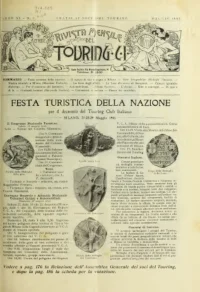
- Full programme of the Touring Club Italiano's tenth-anniversary national tourist festival at Milan on 27-29 May 1905, covering the congress, the national muster of Volunteer Cyclists and Motorists, the cycle-and-motor parade and the touring competitions. Gold commemorative medals go to clubs fielding at least ten cars in the parade, and an excellence prize to the society or section presenting the greatest aggregate mileage ridden to Milan.
- Saturday 27 May sitting of the national tourism congress in the Castello Sforzesco, opening with the presentation of the women's cycling standard and a civic reception at Palazzo Marino. The three papers announced are "Turismo e strade" by cav. L. V. Bertarelli, "Turismo e ferrovie" by on. Maggiorino Ferraris and "Turismo e fisco" by on. avv. Fausto Massimini.
- Sunday 28 May timetable: reception of the V.C.A. detachments, consulates and affiliated touring sections, entry at 8.30 to Milan's new Cagnola rifle range, the collective shooting match, the parade along the Corso Sempione under the Arco della Pace, and the evening "Banchettissimo". A fanfare competition is open to cycle-mounted bands of at least twelve players using any instrument playable from a bicycle or tandem, judged on musical value, numbers and ease of manoeuvre.
- Rules for the national muster of the Volunteer Cyclist and Motorist corps, whose honorary committee is chaired by Senator General Felice Sismondo, president of the central V.C.A. committee. Volunteers must appear with hat, armband and rank badges, and only those belonging to a Tiro a Segno society may take their rifles to Milan.
- Conditions of the detachments' collective shooting contest: six volunteers per unit, model 1901 rifle, 200 metres, six rounds each standing within one minute at a grey 1.65 x 1.30 m target containing three kneeling man-silhouettes. Entry costs L. 10, with three excellence prizes and gold, silver and bronze medals on a fixed points scale from 105 down to 70.
- Donna Remigia Ponti, wife of Milan's mayor, agrees to form and chair a committee of Milanese ladies including Princess Luisa Gallarati Scotti di Molfetta and the signore Johnson Aloardi, Riva Grandi and Candiani Costantini. They will present a gold-embroidered tricolour standard, on a telescopic metal staff clamping to a bicycle, motorcycle or car, to every provincial V.C.A. detachment turning out at least thirty men on 29 May.
- The mass banquet of 28 May under a special roof over the great courtyard of the Castello Sforzesco, seated in "centurie" of a hundred and served by the Unione Cooperativa of Milan, with a menu running from trout eggs in consommé to Piper Heidsieck champagne. Each diner receives a flower-holder keepsake given by comm. Federico Johnson, followed by cinematograph projections and a choral performance of the Touring hymn set to music by maestro Gellio Coronaro.
- Announcement of an unprecedented differential rail tariff of up to 60 per cent off return journeys to the Milan festival, granted to parties of at least ten with or without machines and, for cumulative tickets, to individuals as well. The reductions apply from any Italian station, valid 20-29 May outbound and 28 May to 10 June for the return.
- Final itineraries, fares and timetables for the five caravans converging on Iselle for the Simplon excursion: cars and motorcycles by Milan-Novara-Orta-Domodossola, cyclists by Varese with the Laveno lake crossing to Pallanza and Mergozzo, the cycle-rail party by Arona and Baveno, and the rail party by Laveno and the steamer Verbano round the Borromean Islands. Fees run from L. 8 for the cycling and motoring caravans to L. 15 for the rail caravan.
- The Valais cantonal authorities exceptionally lift the Swiss ban on motor cars over the Simplon for 29 May only, from noon to 8 pm, on the Iselle-Gondo-Gaby-Simplon-Berisal-Brigue road, under guarantees given by the Touring. For those who wish it the club may also organise a banquet at the summit, above 2,000 metres.
- Reception arrangements at Domodossola and the other communes passed through, with authorities, municipal bands and firemen in full dress, and a mountain bonfire competition on the evening of 29 May. At the Iselle workings the contractors Brandt, Brandau e C. put their engineers at the visitors' disposal and open works trains will run short excursions into the Simplon tunnel, entry only on production of the coupon attached to the ticket.
- Description, taken from cap. Carlo Gianni's pamphlet, of Milan's new 70,000 square metre rifle range at the Cagnola on the Simplon road near the Musocco cemetery crossroads, replacing the old district and military ranges. It has 36 firing lines expandable to 72, ranges up to 300 metres, a 34 by 10 metre stop-butt, a brick baffle with 36 windows and a 3.50 m perimeter wall, and will be inaugurated with the Italian volunteer cyclists' match during the Touring's May festival.
- The magazine's photographic department for May 1905, conducted by Prof. Rodolfo Namias, covering developing-out printing on citrate paper, H. Rawlins's oil-printing process, a new Milanese auto-copying printer and the Kodak company's 1905 competition.
- A method taken from the March number of Progresso Fotografico for obtaining developed prints on citrate paper after only seconds of exposure, using a bath of gallic acid, metol, sodium sulphite and acetate and acetic acid. Namias reports outstanding results on the citrate paper made by Fratelli Kahn of Milan, with tones ranging from dark brown or black to red according to exposure and dilution, and no toning needed.
- H. Rawlins's new printing process, announced to the Camera Club of London and called "oil printing": paper is coated with 15-20 per cent gelatine, sensitised in 2.5 per cent potassium bichromate, printed under a negative, washed free of bichromate and then inked with a gelatine roller, the pigment being held in proportion to the light-hardening on a principle identical to collotype.
- An inexpensive Milanese box for rapid bromide printing, in which a mirror set at 45 degrees throws the light of a lamp up under a horizontal printing frame, a crank-driven roller blind switching between red and white light. It yields at least 200 prints an hour, and a larger professional model prints up to 30 x 40 cm at 400 an hour.
- The Kodak company's 1905 competition is divided into an open class and one reserved for beginners who have never won a photographic prize; an ambitious amateur may enter both, but not with the same subjects. Programmes are to be requested from Società Kodak, via Vittore Pisani 10, Milan.
- The signpost fund's department, listing new donations from the municipalities of Castelfranco and Feltre, the Besozzo section, consuls Mongini and Morganti of Legnano and Attilio Piaggio of Callao. With previous offerings the fund now stands at L. 15,720 for 1,182 signs.
- Reminder that 31 May is the absolutely final closing date for entries in the Touring's competition for a practical handbook for roadmen. Prizes total L. 1,600 besides numerous silver medals; further details from the Direzione del Touring.
- The roads section for May 1905, given over to ing. Massimo Tedeschi's account of the road exhibit planned for the Milan Exposition of 1906.
- Ing. Massimo Tedeschi sets out the road exhibit planned for the 1906 Milan Exposition: an 8-metre "experimental street" north of the Piazza d'Armi paved in successive stretches with creosoted wood, asphalt, stone, steam-rolled macadam and macadam dosed with tar, vestumite and fix against dust. Life-size cutaway sections will expose foundations and buried sewer, water, gas and electric services, with a hall of steam rollers, stone breakers and sprinklers and a model level crossing.
- On. Guido Baccelli's tree festivals did little for Italian forestry, the writer argues, but greatly stimulated popular tourism: April brought one on Monte Barro run by the Società Alpina Operaia Antonio Stoppani of Lecco and another below the Grignetta by the Società Escursionisti Milanesi, whose hut at 1,230 m is a mecca for young climbers. At the latter the Escursionisti inaugurated their standard, already carrying medals from the Alpinisti Tridentini and the Touring.
- Survey of the Italian approach railways ready for the Simplon opening, following the final report of the committee chaired by count Giberto Borromeo with cav. Ettore Mola as secretary: the old Milan-Gallarate-Arona line past the mills of Rho, Legnano and Busto, the new Santhià-Romagnano line halted at Borgomanero by the Gattico tunnel, and the wholly new lakeside route opened in January from Arona to the Toce basin and the Diveria gorge. The Touring is issuing a 50-centesimi guide to each.
- The Touring will stage three grades of hotel bedroom - luxury, medium and modest - at the 1906 Milan Exposition, on the model of the Automobile Club de France's competition at the Paris Salon, whose 24 plates published by Charles Schmid supply the illustrations. Type A (4 m high, 6 by 7 m) has toilet cabinet, water closet, steam heat, telephone and hot and cold taps, while type C, for modest inns, is judged the most important of the three.
- The department on attracting foreign visitors, this month reporting on the proposed hygiene section at the 1906 Milan Exposition, the new Bologna committee, hotel news from Carpi, Messina and Monte Crea, the Pro Verona poster and the Como festivities.
- The Associazione Nazionale pel Movimento dei Forestieri asks the Milan Exposition's executive committee for a special section showing Italian progress in public services, transport industries and above all public hygiene, both of dwellings and of factories. The writer argues such a display would credit the country and refute the interested slanders often printed in foreign newspapers; the Direzione Generale della Sanità and the principal municipalities will support it.
- The Bologna committee, meeting at the Touring's consulate under cav. Carlo Sandoni, adopts a five-point programme covering natural and artistic beauties, roads and transport, climatic and thermal resorts, local agricultural produce, and events of industry, art, commerce and sport. It will send descriptions of Bolognese monuments to Rome, distribute illustrated guides free, and press travel agencies to include the city in their itineraries.
- Hotel notes: the new Hotel Carpi opens at Carpi (Modena) with electric light and modern comfort; Messina's council offers a first-class hotel of at least 200 rooms a L. 500 annual rent with ten years of free water, exemption from municipal duty on its first furnishings and roadworks around the site; and the restaurant with rooms on Monte Crea in Monferrato reopened on 16 April under Antonio Bernasconi.
- The Società Pro Verona has issued an advertising poster framed on the divisions of Mantegna's San Zeno triptych, in which the painter Viscardo Carton has set the Giusti garden, Lake Garda with Malcesine and the Trentino mountains, the Scaliger tombs, the basilica of San Zeno, the Arena and the tomb of Juliet, with the architects and painters represented in Verona named on the column bases. The successful touring exhibition at Tombetta di Verona is also noted.
- Como announces a programme of festivities for August and September promoted by a local committee: a band competition, a national exhibition of illustrated postcards, an international gymnastics and fencing competition, rowing races, a flower parade and rifle shooting.
- The motoring department for May 1905, reviewing the Züst 40 HP car, the Laurin & Klement motorcycles, new accessories, the Milan cycle and motor show, and the new road police regulation.
- The long-established works of ing. Roberto Züst at Intra are praised for a sober and elegant 40 HP car with magneto ignition on the break spark and wholly automatic carburation, solved by a hydraulic control patent that anticipated a similar Panhard arrangement. Lubricating oil is forced automatically at high pressure to the bearings, and the clutch is judged far better than the usual leather cone.
- Detailed review of the Bohemian firm of Laurin & Klement of Jungbunzlau, whose single, twin and four-cylinder machines run from 2 to 6 HP. It describes the air- and water-cooled single-cylinder engines carried forward in a specially built frame, the inverted magneto chain-driven from the crankshaft, the flat belt drive with a small tensioning pulley, the sprung front fork with coil springs, the band brake and the thermosiphon radiator of finned tubing wound round the fork's upper tube.
- A new bell-type sparking plug with a rod of pure nickel: the bell A is joined by rod B to terminal F, a copper-and-asbestos washer C compressed by the porcelain acts as a gland, and a small projection on the rod works as a valve so that gas cannot escape past it. Described by ing. Effren Magrini; address Bougie Luthi, 29 rue Brunel, Paris.
- A shock-absorbing suspension in which a rod fixed to the frame slides in a bronze bearing attached to the leaf spring, gripped by conical jaws pressed down by an adjustable coil spring set by a nut and locknut, so that sudden spring movements are damped and shocks to the wheels are absorbed. Made by W. Blanc et L. Parche, 6 Avenue de Fontenex, Geneva.
- A hot-tube ignition device patented by Giovanni Ducco and handled by Ribetti e Colombatto of Turin, shown at the Milan cycle and motor show. The tube is kept incandescent by the charge drawn in at each stroke, and throttling the carburetted mixture lowers the pressure in the tube and so automatically retards the ignition.
- The cycle and motor show at the Giardini Pubblici in Milan, 11 May to 1 June 1905: the buildings are finished and praised, the committee's offices moved in on 1 May, and an artistic commemorative stamp and postcard reproducing the poster are on sale. Success is assured with 140 exhibitors, some fifty of them foreign, and the participation of the Ministry of War; season tickets cost L. 8, or L. 5 for Touring members, with supplements for a bicycle, motorcycle or car.
- Programme of the Automobile Club di Milano's international touring competition of 15-17 May over three circuits of about 1,500, 900 and 600 km, each run in three stages, with all speed racing barred, a 40 km/h limit, commissioners riding in every car and closed parks during halts. Cars are graded by chassis price, prizes exceed L. 40,000 and include the King's cup and a silver and gold plaque given by the Touring, and a Gymkhana Automobilistico is held in the show grounds on 13 May.
- The new road police regulation of 21 February, the decree on subsidies for public motor services and the implementing norms of 30 March are gathered in a Touring pamphlet costing 30 centesimi; from 21 April no machine may circulate without a licence and a driver's certificate. The club is pressing for a movable trade plate for makers, and reprints the ministry's circular of 25 April allowing the front number to be painted on where a plate would block the radiator.
- Article 38 of the new regulation makes keeping to the right the general rule but allows municipalities of more than 25,000 inhabitants to require traffic to keep to the left within the town, marked by boards reading TENERE LA SINISTRA at the entrances. The Touring supplies such signs to communes at L. 10 for a wall plate or L. 20 mounted on a bracket.
- A cartoon from the Schnauferl of Munich: a man bristling with spikes and nails, with his dog similarly armoured, boasts that motorists and motorcyclists must now fear him and will swerve to avoid him just as he once had to avoid them.
- Motor services at home and abroad: a London company capitalised at £103,000 to replace horse omnibuses with 1,500 motor buses, a Hanover fire pump driven by compressed carbonic acid gas, and a proposed motor link across the Andes between the Buenos Aires and Valparaiso railheads. Italian schemes cover Cesenatico-Cesena, Lucera-Campobasso, Porto Maurizio-Ormea, Biella-Ivrea, Orbetello-Orvieto and the new Domodossola-Bognanco line, run in 20 minutes by a 24 hp ten-seater.
- A cartoon from the Schnauferl of Munich showing the "motosedicicicletta per famiglia", a sixteen-wheeled family motorcycle devised by a father who wants to take his wife and children out, to which another two-wheeled sidecar is simply added at every new birth.
- Review of the Album Sportivo compiled by avv. Carlo Biscaretti di Ruffia and dott. Carlo Curti, printed by Capriolo e Massimino of Milan with blocks by Alfieri e Lacroix. After caricaturing the sporting members of the royal house it surveys motoring, rowing, racing and aeronautics, with notes on the Jockey Club Italiano, the Regio Yacht Club Italiano and the Società Aeronautica Italiana, and colour plates of steamer and yacht flags; 400 pages, 10 lire.
- The cycling department for May 1905, carrying a member's Swiss firearms adventure, fresh evidence on baron Drais, and foreign notes on women's cycling, winter idleness, the German-Austrian cyclists' Kartell and cycling as a cure for influenza.
- A member signing P. G. recounts leaving his revolver in a public subway on a central Zurich square and recovering it from the police depot. The commissioner explained that carrying arms without a permit is illegal in Switzerland and that the canton of Zurich issues none, but freed him at once and handed back the weapon because he was an Italian tourist - which the writer offers as real, practical hospitality to foreigners.
- Following the note on the Karlsruhe monument to baron von Drais, rag. Roberto Morettini of Perugia sends a July 1817 entry from G. B. Marini's unpublished chronicle (codex 1233 of the Perugia municipal library) recording that the horseless carriage ran four post leagues at Frankfurt on a seat between two two-foot wheels pushed by the feet. Pietro Ugolini adds that a second bust is owed to whoever invented the steel ball bearing.
- Sir Lawranz Hild campaigns in the London papers for women's cycling and for employing women as telegraphists and messengers, holding that the open air is better for them than the workshop. He is studying an ideal saddle and a woman's machine, and concludes that cycling is the one physical exercise husband and wife can take together.
- Em. Sonchet, in the first number of the Union Vélocipédique de France, calls the four-fifths of cyclists who abandon their machines for three or four winter months "marmots", showing the harm and unreasonableness of the habit and urging a reaction against it; French and German papers are treating the same question.
- Notice of the sixth annual report for 1904 of the Kartell of German and Austrian cyclists' and motorists' federations, and of the tenth annual report of the Bavarian league for the defence of cyclists' and motorcyclists' interests, which is affiliated to it.
- The Sächsische Rad- und Motorfahrer-Zeitung prescribes cycling against influenza: at the first symptoms the cyclist should take a long ride, quickening the pace near home, then a hot bath at 24 degrees with soap, followed by an unbroken walk if he is strong or bed if he is weak, repeating the cure if once is not enough.
- Outings and rallies: the Circolo Velocipedistico Alessandrino's cycle and motorcycle meet of 16 April, fifty Ancona cyclists opening the 1905 season at Falconara, a Bologna party welcomed at Cento, and gatherings at Melegnano, Montichiari, Orzinuovi, Prato, Rho and Sanremo. Sanguinetto's consulate took first prize with a Touring triumphal car designed by ing. Bruno Bresciani, while members wrote from Biskra, from a walking race at Shanghai and from Willow Camp, California.
- New and revived clubs: the Società Ciclistica di Cornuda (Treviso), refounded with 47 members under Italo Tajer, with consul Guido Guillion-Mangilli as honorary president and donor of its flag; the Veloce Club Basso Avisio at Lavis in the Trentino under Augusto Stenico; a cycling circle at Melzo headed by Adolfo Frates; and a students' cycling section at Pisa, started by Plinio Carlo Bardelli, already 60 strong.
- The magazine's miscellany for May 1905, with the return of the Duke of the Abruzzi, the death of Jules Verne, the Legnano anniversary, the Venice art exhibition, the church of Riva San Vitale, the burnt St Gotthard hospice, the shanty town of Balmolonesca and Taormina.
- The Duke of the Abruzzi is festively welcomed back to La Spezia aboard the Liguria after a circumnavigation of some twenty months begun on 29 August 1903, by way of Madeira, Barbados, the Antilles, Buenos Aires, Punta Arenas, Peru, Mexico, Polynesia, New Zealand, Australia, the Philippines, China, India and Egypt. The ship covered 53,600 miles without engine trouble with 230 men aboard, her officers including Biscaretti di Ruffia as second in command.
- Obituary of Jules Verne, who died at Amiens on 24 March, born at Nantes on 8 February 1828. The magazine holds that no writer did more to spread the love of travel and popularise every means of transport - the balloon in Cinque settimane in pallone, ships in I figli del capitano Grant, submarines in Ventimila leghe sotto il mare - and notes that he travelled little himself but read exhaustively, so that many of his inventions became predictions.
- The 729th anniversary of the battle of 29 May 1176 falls on the very day the Touring's columns set out for the Simplon, and some members mean to turn aside to lay a wreath in the club's name on Enrico Botti's monument at Legnano. The monument shows a warrior raising his sword towards the Alps, with a bronze relief of the carroccio on one side of the base and, on the other, an inscription flanked by the names of the Lombard League cities.
- Postcards have appeared reproducing Ettore Tito's poster for the sixth Venice international art exhibition, printed in seventeen litho pulls. The jury of Alfred East, Ludwig Herterich, Giorgio Belloni, Giuseppe Romagnoli and Leonardo Bistolfi admitted 107 artists and 141 works out of 344 artists and 577 submissions, a quarter of the total, and the show opened on 26 April.
- The church founded at the end of the sixteenth century at Riva San Vitale on the southern shore of Lake Lugano by the priest Giovanni Andrea Della Croce, attributed to Pellegrino Tibaldi and holding paintings by Morazzone and the Procaccini, urgently needs restoration. The article reproduces the restoration scheme proposed by architect Augusto Guidini in his monograph Santa Croce in Riva San Vitale, published by Treves in 1905.
- The hospice near the St Gotthard pass (2,114 m) has been destroyed by fire. Its history is traced from the chapel said to have been raised by Azzone Visconti and the hostel built for prelates travelling to the Council of Basel, through rebuildings by cardinals Federico Borromeo and Federico Visconti, burial by an avalanche in 1775 and destruction by the French in 1799, to its custody by the Lombardi family of Airolo; the Hôtel Monte Rosa and the Albergo del San Gottardo stand beside it.
- Balmolonesca is the makeshift town of largely wooden shacks, taverns, shops, small hotels and dormitories thrown up on the Simplon road below Iselle to house the thousands of men working in the great tunnel, and it will vanish with them. Only the elegant church of Santa Barbara, built at the top of the village by Mons. Vicario, bishop of Novara, who also founded a nursery and schools there, will remain.
- Taormina, the ancient Tauromenium founded in 396 BC by the Siculi after the destruction of Naxos, stormed by the Saracens in 902 and taken by the Normans in 1078, is again in the world's newspapers after a visit by the German imperial family. Its rarest possession is the Greek theatre, Greek in origin but given its present form by Roman rebuilding, from whose ruins the view towards Etna and the sea is one of the grandest in Italy.
- Under the heading "Velocipedi a mano", the full text of the judgment of 7 April 1905 by the Milan magistrate avv. B. Severgnini acquitting Luigi Forghieri, aged 25, caught on 1 March wheeling a bicycle without the current year's plate, with both tyres flat and the saddle folded, on his way to the metric office. Since the law of 22 July 1897 punishes the use of a machine on public ground, and a bicycle pushed by hand is not in use, the court found no offence and ordered the bicycle returned.
- Avv. Bernardo Garbati's replies to members on cycle and motor law: wheeling an unplated bicycle by hand is no offence even when the machine is in perfect order, a bicycle unused in 1904 owed no tax, a stolen plate must be paid for again, and a plate that has lost its tongue is not tampering. He adds that the denunciation certificate lasts fifteen days and covers only its own machine, and that cyclists may still use any bell or horn.
- The library department reviews E. Coopmans's 2,000-page Guida generale di Milano e provincia with its 73-sheet coloured city atlas, Luigi Fossati's 1,400-page Pragmapoledittico gazetteer, the Guida Savallo in its twenty-fifth year at 1,934 pages, and Cesare Battisti's guide to Pergine and the Mocheni and Pine valleys. Also noticed are the Bayonne sheet of the Touring Club de France road map, Max R. Zechlin's Automobil-Kritik and the Danish and Swiss touring yearbooks.
- Periodicals received: the new L'Escursionista Meridionale of Avellino edited by dott. G. Stegagno, the weekly Fiorenza Revue des Étrangers, the Bulletin Pyrénéen with an account of an ascent of Vesuvius, In Alto of the Società Alpina Friulana on the Pro Montibus association, six touring route profiles from the Deutscher Radfahrer-Bund, La Lettura Sportiva's prize competitions for a sporting tale and lyric, and the first number of L'Italo-Australiano published at Sydney.
- Gifts to the Touring's library, chiefly from Oreste Bonfanti of Como: Club Alpino Italiano yearbooks for 1900-1904, an 1851 Vallardi guide for Italians travelling to London, an 1857 Artaria guide to Italy, Sicily, Malta, Sardinia and Corsica, and Lamartine's Nuovo viaggio in oriente of 1852. With them came a run of old maps including Keller's road map of Switzerland, a panorama of the Crimea and the theatre of war in Italy.
- The club's official section for May 1905, carrying the management's annual report for 1904, the minutes of the general meeting of 9 April, the council's resolutions, the Touring's part in the 1906 Exposition, the Dante Alighieri loan, the first sheet of the frontier map and the prizes offered to members who recruit.
- The management's report for 1904: membership reached 43,000 after a net gain of 8,085, 753 of them abroad, with 1,643 new five-year and 717 life members; the offices received 106,609 letters and despatched 804,000 packets, and assets stood at L. 258,458.71. Publications included the Abruzzo e Molise guide, the Swiss frontier map, the general and motoring yearbooks and six railway guides, alongside support for the Volunteer Cyclists corps.
- Minutes of the ordinary general meeting of 9 April 1905, opened by comm. Federico Johnson and chaired by ing. Carlo Vanzetti, at which Fortini's motion to postpone the accounts for want of detail on advertising revenue was ruled out after avv. Puricelli argued the club is governed by its own statute, not the commercial code. Dott. Ercole Bassi proposed a junior member class, avv. Luigi Gasparotto moved on the weekly rest day, and twelve councillors were elected.
- Resolutions of the directive council of 7 April: comm. Giovanni Silvestri was acclaimed Capo Console Generale and thereby joins the Direzione Generale under the new regulations, various section heads were appointed, and the management's report on 1904 was approved for reading at the members' meeting. The roads commission met several times to plan a practical trial of road maintenance in agreement with certain provinces.
- L. V. Bertarelli has been made a vice-president of the 1906 Exposition alongside Crivelli Serbelloni, ing. Luigi Mazzocchi and comm. Celoria of the Brera observatory, and also sits on its executive committee. Vice-director general ing. Alberto Riva joins the agricultural machinery section and the Dante Alighieri committee drawing up the programme for the "Italians abroad" display, to which all the Touring's foreign consuls will be invited to contribute.
- The central committee has circulated all Italian and foreign committees about the coming issue of the prize loan voted by Parliament in favour of the Cassa Nazionale di Previdenza for workers and the Società Dante Alighieri. Members are urged not only to publicise it but to place the bonds, since the success of this first issue will decide whether a second series doubling the benefit is floated.
- Despatch begins of the first sheet of the frontier map executed for the Touring by the Istituto Geografico Militare, covering the Italian slope of the Maritime, Cottian and Graian Alps from the Colle di Tenda to Mont Blanc together with Provence, the Dauphiné, Savoy, the lakes of Geneva and Neuchâtel, the southern Jura and Franche-Comté. Enclosed in a card cover bearing the Italian and French arms, it goes free to every member paid up for 1905.
- Rewards for recruiting: a silver medal for ten members presented, a large silver for fifty, gold for a hundred, and a large gold for the year's record recruiter, plus a pocket carnet from Ernesto Reinach and the Torri firm. Those presenting ten or more between 1 January and 30 November enter a draw headed by a 2 HP Laurin & Klement "Republic" motorcycle given by rag. E. Billiter, a Gritzner free-wheel bicycle from E. Flaig of Milan and Pirelli tyres.
- Deaths recorded: four-year-old Gino Maddalena, son of the head consul at Rovereto, following the loss of head consul Guido Larcher's small daughter at Trento; the father of cav. A. Rostain, head consul at Turin; and the 26-year-old consul avv. Silvio Perotta of Paola, of typhoid. Ing. Egidio Gerosa, for six months chief technician of the tunnel company, was murdered by one of his workmen at Cairo on 17 April aged 26.
- List of candidates for membership of the Touring Club Italiano who applied between 15 February and 15 March 1905, divided into life members - among them Antonio Grandi of Brescia, Vittorio Bernocchi and Luigi Mongini of Legnano, Don Augusto Torlonia of Rome and Rodolfo Crespi of São Paulo - and annual members listed province by province from Alessandria to the foreign consulates.