Rivista Mensile del Touring Club Italiano, Vol 11, No 6
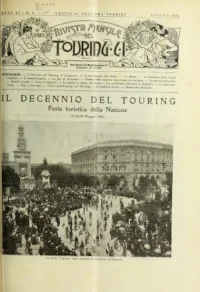
Articles in this issue
- Opening of the issue-long feature on the Touring Club Italiano's tenth-anniversary "Festa turistica della Nazione", held in Milan on 27-29 May 1905. Thanks are given to the Casa Reale (which sent the Conte di Torino), the government's representative on. Gerolamo Del Balzo, the Milan municipality, the Volontari Ciclisti e Automobilisti, the Tiro a Segno society and the Dante Alighieri.
- Banner opening the account of the festival's first day, 27 May 1905, given over to the Touring's national congress in the Castello Sforzesco.
- The Touring's congress opened at 9 a.m. on 27 May in the Sala delle Statue of the Castello Sforzesco, with mayor Senator Ettore Ponti, under-secretary on. Gerolamo Del Balzo, prefect Alfazio and generals Fecia di Cossato and Pallavicini present. Director-general comm. Federico Johnson replied for the club's 46,000 members, and vice-president ing. A. Riva presented the women's cycling standard given at Ferrara in 1902 by the marchesa Maria Plattis ("Jolanda").
- The Milan municipality's reception for the touring delegates at the Teatro alla Scala on the afternoon of 28 May, the theatre lit as by daylight and dressed with plants and flowers, with liveried footmen, helmeted firemen and civic guards. The writer contrasts its "signorile" note with the practical note of the congress and the patriotic note of the shooting match.
- Banner opening the account of the second day, 28 May 1905, which held the shooting competition, the parade, the Dante Alighieri flag ceremony and the great banquet.
- The shooting match at the Cagnola range on the morning of 28 May, opened with the inauguration of the new Boldinasco range. The bersaglieri cyclist companies of the 7th regiment (Milan garrison, captain Natali) and the 12th (Brescia garrison, captain Berruto) paraded in the courtyard, and the mayor praised the new alliance of civil and military cycling for national defence.
- The parade of cycling and motoring associations through Milan on the morning of 28 May: over 10,000 taking part before a crowd estimated at 300,000, marshalled by the Milan capoconsole cav. Pizzagalli and led by a squadron of mounted carabinieri, with the bersaglieri cyclist companies, V.C.A. detachments of bicycles, motorcycles and cars, and bands from Casalbuttano, Genoa and Novara. The Conte di Torino and prefect Alfazio watched from a pavilion facing the Castello.
- At 4 p.m. on 28 May, in the same Sala delle Statue, the Milan committee of the Dante Alighieri society inaugurated its embroidered and painted flag, the gift of a ladies' committee led by the duchessa Melzi d'Eril Barbò and carried through by a council of members chaired by professoressa Rosa Errera. Donna Remigia Ponti stood as its sponsor.
- The mass banquet held at 7 p.m. on 28 May in the great courtyard of the Castello Sforzesco, under a 4,100 sq m zinc-roofed pavilion lit by some forty electric arc lamps, seating 3,400 diners at thirty-six tables grouped into 34 "centurie". Director-general Federico Johnson gave every guest an aluminium flower clip with a carnation; the municipal band under maestro Nevi played, and the head table ranged from on. Cornaggia to on. Cabrini.
- Alphabetical roll, town by town, of the consulates, cycling and sporting societies, Audax groups and V.C.A. detachments that attended the Milan gathering, running from Alessandria to the last entries and numbering several hundred places. Genoa, for instance, sent its Audax and consulate, Veloce Sport, the Società Ginnastica Andrea Doria, the Unione Sportiva G. Mameli and its Volontari C. A.
- An account of the 189 letters of greeting from 47 Italian provinces handed to mayor Senator Ponti during the Scala reception, sent by mayors and royal commissioners and carried by capoconsoli and consuls. They ranged from illuminated parchments (Arezzo, Siena, Chiari, Morbegno, Sestri Ponente) to plain office sheets, and are listed here province by province.
- Gifts presented to the Touring's general direction during the festivities: a quattrocento-style illuminated parchment from the Asti cyclists bearing 85 signatures, a silk-bound parchment from Bergamo signed by architect Gallizioli, a yellow morocco album with an enamelled silver clasp by prof. Gaetano Jacoangeli from the Naples consulate to comm. Federico Johnson, a bronze plaque of eagles and a lion from Rome, and a miniated parchment from Taranto.
- Banner opening the account of the third day, 29 May 1905, devoted to the mass excursion to the Simplon tunnel.
- Member Eugenio Gagliardi of Genoa describes the 29 May excursion to the Simplon: a 4.45 a.m. departure from Milan, the steamer Verbano from Laveno past Pallanza, Stresa and Baveno, breakfast baskets at Domodossola, and a visit to the Brandt, Brandau & C. works at Iselle with their water-powered rock drills. A separate motor caravan of 82 cars and 120 motorcycles went by Novara, Orta and Omegna, greeted at Gozzano through the efforts of dott. Migliavacca.
- Standing miscellany department, here given over to press comment on the tenth-anniversary festival and to two notes on the Touring's growing patriotic character.
- Quotes the close of a Corriere della Sera article of 27 May naming the "triade" of Johnson, Riva and Bertarelli as busy industrialists rather than idle gentlemen, and argues that the Touring spreads Italian feeling abroad through consuls at Geneva, Lisbon, Berlin, Bucharest, Moscow, St Petersburg, Shanghai, Bombay, Massawa, Montevideo, New York, San Francisco, Smyrna and Valparaiso.
- Extracts from two papers of opposite politics: the moderate La Perseveranza, which calls the Touring a profoundly democratic association whose 46,000 members will multiply, and Il Tempo, which treats tourism as "a new religion" and the renewed youth of a world grown old on the fever for gold.
- The unveiling at Iselle at 3 p.m. on 29 May of the memorial tablet to the Italian workmen killed building the Simplon tunnel, designed by Bazzaro, cut by Trevisan of Monza and inscribed to text by dott. Robiola. It carries the 58 names of the dead — 22 at Brig, 20 at Iselle and 16 on the approach line — and avv. Giuseppe De Antonis gave the address before some ten thousand people.
- Prof. Alessandro Malladra of the Collegio Mellerio-Rosmini at Domodossola had lectured on the Simplon works since March 1904 in Milan, Cremona (with bishop Geremia Bonomelli), Lodi, Bergamo and Florence; the 29 May repeat at Domodossola was given for the Ossola section of the Club Alpino Italiano in aid of the Capanna di Santa Caterina on Monte Rosa. With lantern slides he covered the tunnel work up to the meeting of the two headings on 24 February 1905.
- Note on the body of magistrates of every rank who took part in the festival; ing. comm. Oreste Lattes managed to photograph eight of them aboard the steamer from Laveno to Baveno, among them a councillor of the court of appeal, a substitute public prosecutor and a magistrate.
- Letters of thanks to the committee of Milanese ladies headed by donna Remigia Ponti-Spitaleri, from A. Bini, president of the Cremona battalion, and from Iginio Cipullo writing in the Lombardia, for the banners presented to the visiting cyclist detachments.
- Notice that the V.C.I. badge commemorating the Milan Adunata was given free to the presidents of each detachment for distribution to the six marksmen who shot in the competition; further copies cost 2.50 lire and must be ordered through a detachment president, not individually.
- Dispatch of the Festa Turistica della Nazione badge and the Simplon excursion medal to the 11,243 paying congress members who could not attend on 27-29 May; societies and groups must return the coupons cut from their registration cards, name and address written on the back, to the general direction at via Monte Napoleone 14.
- The direction asks members who took photographs during the congress and the Simplon excursion to send prints, particularly those entered for the photographic competition (who must submit at least five different subjects), both to complete the club's record of the festival and for possible reproduction in the Rivista.
- A page of cartoons on the festival reprinted from the Gazzetta di Torino, Pasquino, the Illustrazione Italiana and L'uomo di pietra, including the bandmaster Gellio Coronato carried in triumph, "Il ciclismo orchestrale", and a congress delegate who rode from Rome to Milan in twelve hours — first class.
- Forthcoming meets for July and August 1905, the report of the Sardinian cycling gathering being held over: Legnano on 2 July (banner inauguration, parade, visit to the Tosi works and a balloon ascent by captain Frassinetti), Serravalle Scrivia on 30 July, Belluno on 13 August with the Veloce Club Alpino, Rieti on 13-14 August with an ascent of Monte Terminillo, and Romagnano Sesia and Fano on 15 August.
- The 1,000-page Annuario for 1905 is ready and going out to members in good standing, as is the first sheet of the Carta dei Confini d'Italia produced for the club by the Istituto Geografico Militare. The fourth group of railway guides covers the Simplon access lines Milano-Gallarate-Arona, Torino-Santhià-Arona and Arona-Domodossola-Iselle, at 50 centesimi each or one lira for all three.
- The club's standing legal department, whose Art-Nouveau engraved masthead heads the page; it carries the reported court decisions and the members' legal question-and-answer column.
- Reported decisions on motoring and cycling cases: two acquittals by the Pretura Urbana of Milan of Dubroy Luciano and Visconti di Modrone Carlo Giuseppe, both charged with speeding through Affori on the word of the local delegate; a ruling by the Intendente di Finanza of Ravenna that a bicycle wheeled by hand is not in circulation for tax purposes; and a Modena prefecture decision quashing a fine imposed at Reggio Emilia where the metric office itself had issued the wrong tax plate.
- Replies from the club's legal office to members' queries, covering the dismissal of chauffeur-mechanics, whether a motorcycle exhaust that disturbs sleep is an offence, crossing a pavement to avoid a carriage, the tax due when a bicycle or motorcycle is ridden into Italy from abroad, replacing a tax plate, children's bicycles, a plate stolen at an inn, hired bicycles in poor repair, and the licences and certificates of fitness required for self-propelled vehicles.
- Avv. Bernardo Garbati, the club's chief legal consultant, answers Cavazzocca-Mazzanti ("John Sportsman") on the new motoring regulation, arguing that articles 84 and following extend car provisions to motorcycles without repealing the law of 22 July 1897 or the regulation of 16 December 1897. He goes on to attack municipalities that make an income out of arbitrary restrictions, and proposes that fine revenue be paid to the state rather than shared with the officer who reports the offence.
- Notice that, under the convocation published in the March Rivista for the general assembly of 9 April, members' voting papers must be returned by 15 July.
- List of those who applied for membership between 15 April and 15 May 1905, life members first (including dott. Alberto Pirelli and Amerigo Ponti of Milan, comm. Alessandro Bonci of Florence and members as far off as Paris and Panama), then annual members arranged by province and commune.