Rivista Mensile del Touring Club Italiano, Vol 11, No 8
Articles in this issue
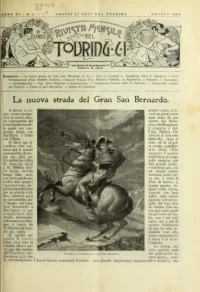
- Signed "o. b." (editor Ottone Brentari), a long illustrated report on the 14 July 1905 opening of the new carriage road from St-Rhémy to the Great St Bernard hospice, which finally links Aosta with Martigny; it covers the blessing of the new St Bernard statue on the Plan de Jupiter, the Italian and Swiss dignitaries present, and the Touring delegation of Federico Johnson, Giovanni Silvestri and Achille Negri. The author then drives on over the Little St Bernard to Mont Cenis for the Susa–Moncenisio motor race, where Cagno's Fiat starred, a Rochet-Schneider crashed at the last bend and Lancia retired just outside Susa.
- Explanatory notes on the issue's engravings of the Aosta valley: Napoleon's May 1800 crossing of the Great St Bernard on a mule (not David's rearing horse), the panorama of Aosta, the fort of Bard, the castles of Fénis and Verrès, the Roman bridge at Pont-Saint-Martin, the Torre Pailleron and Torre del Lebbroso, the hospice itself, its St Bernard dogs and maronniers, the tower of Gignod, and the 1844 print of the transport of Desaix's monument.
- The magazine's standing department of Touring Club Italiano outings, rallies and consular banner inaugurations, followed by a town-by-town round-up from Agnone and Albenga to Varallo.
- Report of the 28 May inauguration of the Monaco consulate's banner at the Hôtel de la Renaissance run by Roberto Andreotti, with capo console Gose, consul Ampugnani, Gendre for the Touring Club de France and Tairraz of the Sport Vélocipédique de Monaco, and a speech by Dr Onda. The party then rode to Grimaldi above Ventimiglia and lunched at the Ristorante Garibaldi.
- The Milan consulate of the Touring is organising a combined cycle, motorcycle and motor-car outing to Monte Generoso for 8 September 1905.
- Full programme of the 1,000 km August cycling tour of northern Italy announced by the Fortiores cycling club of Turin: Turin–Voghera–Cremona (222.6 km), Cremona–Mestre, two days in Venice, then Bassano–Trento, Rovereto–Riva, Lake Garda by boat to Salò, Brescia–Milan, the Lecco and Como lakes, Lake Maggiore and back through Borgomanero and Santhià to Turin.
- The Forza e Coraggio society of Mantua announces a 25–27 August ride to Trieste over two routes via Palmanova, with provincial squads of no more than five riders per Touring consul or club president, assembling at dawn on 27 August at Palmanova. Each squad carries a banner in Trieste's colours to be presented to the city's podestà; overtly political emblems are barred.
- Como's Associazione per gli Interessi has formed a committee to revive the Lake Como festivals through August and September, timed to the opening of the Scuola Superiore di Setificio, with musical, gymnastic, cycling and shooting competitions, regattas and a permanent multicoloured electric illumination. The big cycling and motoring rally is fixed for 24 September, promoted by the Società ciclistica comense, the T.C.I. consulate, the Audax and the Eureka Ideal club.
- A 200-guest banquet at the Valiani in Rome celebrated the enrolment of the Audax society's 4,000th member, attended by Touring capoconsole Brunialti and consul Lattes.
- Dr E. Magagni's illustrated description of Modigliana in the province of Florence, written to welcome the cyclists coming to its 13 August rally: its site where the Acereto, Tramazzo and Ibola meet twenty easy kilometres from Faenza, the long rule of the Guidi counts until their expulsion in 1377, and the town's part in the Risorgimento "trafila" through Don Giovanni Verità, who spirited Garibaldi to safety. He also describes its silk filatures and the Savelli cement works, the Palazzo Borghi legend of the 1773 changeling who became Louis Philippe, and the new Corso Garibaldi and water supply.
- Prof. Rodolfo Namias's standing photography column, set under a hand-lettered Art-Nouveau masthead.
- Namias restates the chemistry of toning baths, his conclusions having been confirmed by Dr C. Sturenburg in the Phot. Cronik: a separate gold bath needs about 5 g per litre of an alkaline chloride (common salt) alongside the gold chloride and acetate or borax, or gold is precipitated and the print stained. Platinum baths must avoid phosphoric acid, use oxalic acid, and likewise take a soluble chloride or hydrochloric acid.
- On the vogue for deliberately uncorrected "anachromatic" lenses championed in France by Pulligny and Puyo, whose 1904 Paris exhibition was made entirely with them: chromatic aberration is exploited by refocusing onto the violet rays before exposure, giving soft, blended portraits. Namias reviews the best forms — plano-convex, meniscus and two thin concave-facing lenses in symmetrical combination — with usable apertures from f/7 to f/15, and notes they suit heads and figures but have failed for landscape.
- The magazine's standing roads section, printed under a hand-lettered engraving of a workman barrowing road metal.
- Ing. Massimo Tedeschi relays ing. M. Perrin's report in the Annales des ponts et chaussées on watering the 93 km Ardennes circuit with westrumite for the May 1904 Gordon Bennett eliminating race: 73 m³ of westrumite and 789 m³ of water over 366,450 m², using 29 water-carts, 58 horses and 49 men, at L. 0.01 per m². Racing at 100 km/h raised no dust and the quartzite metalling was undamaged, but the benefit had wholly disappeared 40 days later.
- Further French trials reported by ing. Soubzmaigne: two coats of tar on 2 km of national road near Bergerac, at about L. 900 per km, penetrated 3 cm to form an elastic waterproof crust that resisted hard frost, while a westrumite section of 522 m lost its effect within five or six days. The conclusion, matching ing. Pietro Rimondini's experiments in the province of Ravenna, is that tar remains the best dust treatment.
- Federico Caumont Caimi argues from Salsomaggiore that the new road code's left-hand-traffic exception for towns over 25,000 must be extended as far as the urban electric tramways run, with conspicuous "keep right / keep left" boards where it ends, and praises the "Rallentare: tenere la destra ai giri" signs on the Menton–Nice and La Turbie roads. Shorter notes follow on Rimondini's book comparing tar with petroleum for killing dust and germs, California's oiled roads and Naples' paving trials, new provincial roads in the Rovigo area, and the restaurant-omnibus now running in American cities.
- A. Regeunein replies to ing. Tedeschi's April article, citing the failure of the Chieri (1902) and Spoleto (1903-04) motor-bus services to argue that motor vehicles cannot yet serve cheap rural routes. He advocates the "Filovia" overhead-wire system studied since 1902 — power split among individual driven axles, mixed animal and mechanical haulage — which would run 15–20 km/h cars, haul freight on wide-tyred wagons at 5–6 km/h and roll the road metal with otherwise wasted energy.
- New donations to the Touring's signpost fund, headed by L. 2,000 from the Provincial Administration of Genoa for 100 posts, with smaller gifts from Vedano Olona, Fiesole, Fino-Mornasco, Darfo, Alessandria and Rovato, bringing the running total to L. 17,910 and 1,286 signs.
- Photographs of the road from the royal palace at Caserta to Capua, being resurfaced near S. Maria Capua Vetere for the new motor-omnibus service, and of the tree-lined Trentola road from Aversa, steam-rolled in January 1904. The article praises Caserta, Lecce and Trapani for adopting steam cylindering and for handing contractors the metalling at a valuation, so that funds always exist to restore what traffic wears away — a discipline the northern provinces lack.
- The magazine's standing railway section, under a hand-lettered Art-Nouveau masthead showing a locomotive and viaduct.
- Profile of the new director of the Italian State Railways operation, born at Casale Monferrato on 20 August 1854 and first of 69 candidates in the Alta Italia competition of 1880; his Bianchi-Servettaz hydrodynamic apparatus won a gold medal at Paris in 1899. As head of the Sicilian railways he introduced night trains between Palermo, Messina and Catania, tourist trains to Cefalù and Girgenti, restaurant cars and the ferry-boats carrying the Paris–Naples and Berlin–Naples luxury trains through to Palermo.
- The second Simplon bore, 17 metres from the first axis to axis, was holed through on 7 July; the hydraulic power conduits already installed make it likely it will be completed to full section before traffic reaches the 40,000 lire per kilometre set by the international treaty.
- The Touring's four published groups of railway-line guides — Milan–Turin and Milan–Bologna, Genoa–Chiavari–Spezia, Verona–Venice–Bologna–Florence, and Milan–Arona and Domodossola–Iselle — each with a polychrome cover, over thirty vignettes and a map by the Istituto Geografico Militare, at 50 centesimi apiece or L. 1 a group to members.
- The magazine's standing mountaineering section, under a hand-lettered masthead of a climber above a lake.
- Day-by-day programme of the XXXVI Italian Alpine Club congress, 4–10 September 1905: the unveiling in Venice of the monument to Francesco Querini, then Agordo, Cencenighe and Falcade, the Passo San Pellegrino meeting with the Tridentine climbers and the Taramelli refuge, Pordoi, Fedaia, Cortina d'Ampezzo, Misurina and Borca. Ottone Brentari's guides to Belluno, the Trentino and the Cadore are recommended, and further notes cover the Federazione Prealpina's pocket route guides, the Milan C.A.I. programme, a projected refuge on the Paganella and the newly opened Quintino Sella and Rabuons refuges.
- The magazine's standing motoring section, edited by ing. Efren Magrini and set inside an ornamental ruled box.
- Ing. E. Magrini explains exhaust silencers, now required by many Italian municipalities: a chain of expansion chambers lets the burnt gases lose pressure gradually, illustrated by a water analogy, at a cost of 10–15 per cent of engine power (25 per cent in early types). He describes the Ossant Frères design that won the Paris A.C.F. competition, the Sharpe, Sturtevant and Motor and Manufacturing Work patterns, and the Marcel et Larrieu type in which opposed gas jets collide; water-cooled silencers were found actually to raise output by about 10 per cent.
- Ing. Magrini describes the free-wheel coaster-brake hub made by the New Departure Co. of Bristol, Connecticut, praising its very small number of parts, its easy cleaning and a brake that can be applied gradually on a descent or all at once by simply back-pedalling in an emergency.
- "Il Dottore" explains accumulator capacity in ampere-hours and why it falls as the discharge current rises, warning that some makers overstate it. He gives a home test — 15 m of 0.5 mm florist's iron wire wound on a wooden batten to draw half an amp, timed against the claimed rating down to 1.8 volts a cell — and describes the pocket "Voltmetro verificatore" that reads the state of charge between 3.6 and 4.2 volts.
- The War Ministry's enrolment terms for motorists at the grand manoeuvres in Campania from 20 to 31 August: L. 10 a day to the driver and L. 5 to the mechanic, L. 0.15 or L. 0.10 per kilometre for tyres, mileage reckoned from the Touring guides at 200–400 km a day by horsepower, plus petrol and lubricants. Cars carry a coloured pennant and a large number, drivers wear matching armbands and a service book, the owner ranking as an officer and the mechanic as a non-commissioned man.
- Round-up of new motor services: the Turin–Casale and Alessandria–Valenza lines promoted by Giovanni Marini, a 20-seat car on the Biella–Oropa road, projected lines at S. Giuseppe Jato and on the Gargano, and the Varallo–Alagna service opened on 16 July. Lighter items follow on a 16 HP Rapid municipal watering car tried in Turin, French pastors preaching the gospel from a motor car, Wagner's heirs winning a suit against a maker who named a model "Parsifal", and Fiji islanders christening Charles Glidden's car "the father of all devils".
- The magazine's standing aeronautics section, under a hand-lettered masthead showing a dirigible above clouds (the spelling is the magazine's own).
- Description of Count Almerico da Schio's 60,000-lire airship: a 17 m aluminium-tube car for four crew carrying a 12 HP Bucher engine and a 4.50 m Tatin tractor propeller, under a 39 m varnished-silk envelope of 1,208 m³, climbing and descending by tilting silk planes instead of dropping ballast, at 30 km/h and up to 1,500 m. On the morning of 3 July it circled the new cemetery at Schio, ran free to the Timonchio below the railway bridge and returned to its exact starting point in fifty minutes.
- A letter from Carlo Cadelli of Pordenone arguing that the terms adopted by the 1889 Paris aeronautical congress should be Italianised with the "ae-" root — aerostato, aeronave, aeroplano, elicoptero, aviazione — and that ing. Magrini's January article and most Italian papers transcribe them wrongly.
- Avv. Bernardo Garbati's standing legal-advice department, under a hand-lettered Art-Nouveau masthead.
- The department's regular selection of court decisions bearing on cyclists and motorists, with the consulting lawyer's notes on each.
- Tribunal of Teramo, 7 September 1904: Costanzo Trifoni of Giulianova, whose motorcycle startled a mule at Corropoli so that carter Massimantonio Spinelli was thrown under his own cart and died, was held only an indirect cause and not criminally liable, the direct cause being Spinelli's own attempt to hold the animal by the reins.
- Monza magistrate, 21 June 1905: Dante Lombardi committed no offence in having a boy wheel his unplated bicycle by hand to the municipal office to have the 1905 tax label fitted, since the law penalises only the actual use of a machine on public ways as a means of locomotion.
- Carmagnola case sent in by consul Luigi Zuccoli of Racconigi: magistrate Count Radicati di Primeglio held that the side paths, or banchine, of a road are not closed to cyclists even where municipal notices reserve them for pedestrians, and dismissed the charges against Dr Antonio Dominici.
- Udine magistrate, 30 December 1904, upheld by the criminal section of the Rome Court of Cassation on 17 February 1905: Guido Piccinini was rightly acquitted, since neither the 1897 law nor its regulation says when the declaration certificate must be produced, so a cyclist need not carry it on his person.
- Garbati reports the Finance Ministry's dispatch of 30 March 1905, which, faced with growing numbers of tampered and stolen bicycle tax plates, orders all such cases to go to the courts rather than the prefects, and notes the Milan magistrate's practice of returning cases without fraud to the administration to spare the offender extra costs.
- Instructions to members sending their membership card to the Milan office to be stamped for crossing frontiers by bicycle or motorcycle without a deposit: the card must carry name, profession, domicile, photograph and signature plus the machine's type, make, original number and weight, with L. 0.12 (L. 0.30 abroad) enclosed for registered return postage.
- The bill passed by Chamber and Senate adds customs heading 182-bis, setting import duty on ordinary road carriages and motor cars at L. 200 each up to 500 kg, L. 400 from 500 to 1,000 kg and L. 600 above 1,000 kg.
- The club's standing bulletin of official communications, council business and administrative notices.
- The full prize list for the Touring's tenth-anniversary festivities: Brescia's 108 points won the Volunteer Cyclist-Motorist team shooting match ahead of Ancona and Pisa, while the tourism competition's premio d'eccellenza went jointly to the Unione Ciclistica Veronese and the Volunteer Cyclist-Motorist battalion. Hundreds of further medals are listed for societies, consulates, fanfare bands and the individual consuls who organised the visiting squads.
- By a council resolution of 28 July the Touring's offices were divided from 1 August into administrative and technical divisions of four sections each, under a single general head of office, the post falling vacant on the resignation of Luigi Cuneo Vidal after six years.
- At the scrutiny of 17 July the auditors Soffredi and Turrini, under ing. C. Vanzetti, counted 1,720 postal ballots: the balance sheet was approved with 1,697 votes and the retiring councillors were re-elected, L. V. Bertarelli and Federico Guasti heading the poll with 1,703 each.
- Obituaries of Efisio Bocca of Cagliari, who died young trying to save two workmen asphyxiated in a wine cistern, and of the sculptor and photographer Vittorio Valenti, Touring consul, thrown from his motorcycle against a cart on the Avenza–Carrara road on the evening of 22 July, leaving a young widow and four children.
- The recruitment prizes for 1905: a silver commemorative medal for every member introducing ten new ones, a large silver medal for fifty and a gold medal for a hundred, with the year's top recruiter proclaimed "recordman" of propaganda. Those introducing at least ten also enter a draw whose prizes include a 2½ HP Laurin & Klement "Republic" motorcycle, a free-wheel Gritzner bicycle, Pirelli tyres and a Star Wizard camera from Gundlach-Manhattan.
- Twelfth list of affiliated petrol depots, numbers 332 to 341, giving each dealer's trade and address, prices for 695/700 benzine, Oleoblitz, Reinach grease and calcium carbide, and opening hours: Acireale, Courmayeur, Cupramarittima, Issime, Malnate, Orta, Palmanova, Pont S. Martin, Ronco Scrivia and Salò.
- List of life and annual members proposed between 15 and 30 June 1905, arranged by province and including foreign groups in Austria-Hungary, France, Romania, Serbia, Switzerland, Algeria, Egypt, Brazil and Smyrna, bringing the club to 47,069 annual and 864 life members, 47,933 in all.