Rivista Mensile del Touring Club Italiano, Vol 12, No 3
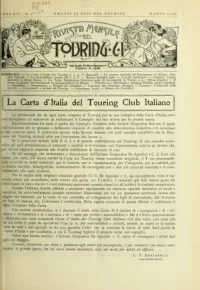
Articles in this issue
- L. V. Bertarelli, head of the roads section, reports that the Società Geografica Italiana resolved on 27 January to give the T.C.I.'s new 1:250,000 map its patronage and scientific support, and that the Istituto Geografico De Agostini has begun engraving, with the first two sheets promised for May.
- Massimo Tedeschi previews the first Italian road exhibition at the 1906 Milan Exposition: a 30-metre wooden pavilion designed by ing. Aceti north of the piazza d'Armi, with an experimental roadway of paving samples and rolled-macadam trials by the province of Milan.
- Cars photographed at set speeds over a flour-covered track, and the English engineer M. Cooper's adjustable tricycle apparatus, show that dust is reduced by smooth undersides rising toward the rear and by underbody shields kept well clear of the road.
- Minutes of the Roads Commission meeting of 30 January 1906 (Tedeschi, Oliva, Gola, Pugno, Chiodi, Guastalla, secretary Mercanti): road-wear and traction experiments at the Exposition, a proposed tourist road toward Como or Abbiategrasso, unified road naming, an Italian anti-dust league, and an inquiry into Calabrian roads through T.C.I. consuls.
- The Società Nazionale delle Officine di Savigliano has been given the contract for a 605-metre iron bridge of eight 75.6-metre spans over the Po at Piacenza, replacing the dangerous pontoon crossing, with a new embankment on the Milan bank and a masonry viaduct on the Piacenza side.
- Reprinted from Turin's Gazzetta del Popolo: of Italy's 6,728 km of national roads only about 110 km are tree-lined, against 25,000 of France's 38,000 km, and the bill before the Chamber merely permits rather than obliges planting. Signed Sebastiano Lissone.
- The Vedetta Senese of Siena recalls ing. Rambaud, who had hundreds of thousands of vines and fruit trees planted along Tuscany's railway embankments to supplement the crossing-keepers' pay, until the Convenzioni ended the scheme.
- A letter to Rome's La Tribuna supporting the roadside-planting bill points out that Serbia already lines both its national roads and its railways with fruit trees — walnuts and chestnuts in the hills, apples, pears, cherries and plums lower down — tended by the casellanti.
- Dott. Ravà Sforni, T.C.I. consul at Mantua, reports from a motor tour on the worst stretches: Rolo Novo to the via Emilia with no cycle verge, the deplorable paving around Rome, Capua to Naples and on to Pompeii, and the unbridged river crossing at Vagone on route 193 between Passo Corese and Terni.
- The provincial deputation of Venice records signs 346–376 placed at junctions from Mira Taglio and Quattro Cantoni di Mestre to Salzano and Dolo, several donated by comm. Federico Johnson, cav. L. V. Bertarelli, dott. Gildo Guastalla and Pneu Michelin; new offers on page 8 bring the running total to L. 18,624 for 1,419 signs.
- Socio Alberto Valdambrini of the Genio civile at Grosseto reports that the Pisa–Rome provincial road is cut by the Ombrone 9 km beyond Grosseto with only a provincial ferry, reached down steep ramps after long straights; the T.C.I. has placed two warning signs at the approaches.
- The Club Escursionisti di Jesi persuaded Ancona's provincial deputation to erect kilometre posts and direction indicators on its roads and at forks, bringing the province into line with Pesaro, Perugia and Macerata.
- Under the Ciclismo heading: councillor di Carpegna urged Rome's mayor during the budget debate to abolish the surviving time restrictions on cycling in via Nazionale, the new via del Tritone and the corso Umberto, and the paper La Vita presses the Giunta to act.
- Written from the Touring stand and signed "o. b.": the third Turin motor show (3–18 February 1906) grew to 3,200 square metres and 94 exhibitors, 15 of them foreign, and the T.C.I. stand drew many new life members with a full-size sample sheet of the forthcoming Carta d'Italia.
- Prof. ing. Effren Magrini's technical review of the Turin show finds no important novelty: pressed-steel frames now general, magneto ignition standard, cardan drive gaining on chain, and a run of light cars — the Knap and Gregoire at Alberti of Florence, the Passe-Partout at Brambilla, the Invicta, the Reo and the Lacoste et Battmann range shown by Taurus of Turin — closing with a chassis price table.
- Programme of the congress of 24–29 May 1906, organised by the T.C.I. and the Automobile Club di Milano under senator Giuseppe Colombo, with papers by Turrinelli on electric cars, Giovanni Enrico of F.I.A.T. on petrol engines, Serpollet on steam, Kellner on coachwork, Pirelli on tyres, Tedeschi on roads and Colard on customs, entry L. 25 (L. 20 for members).
- Motor-service news: the Adria–Ariano and Adria–Piove di Sacco line is to open on 1 May once Venice and Padua approve the technical scheme, the new Caserta–Santa Maria service is keeping its timetable punctually, and the Great St Bernard hospice monks have been trying a motor vehicle.
- Citing Lavalard of the Paris omnibus company and Henri de Parville, the piece argues the motor car has not killed the horse: London's omnibus stud rose from about 12,000 to over 17,000 and Paris's from 10,000 to 14,000, so the striking cabmen of Turin and Milan are fighting the wrong battle.
- Negotiations are well advanced to merge Fiat, Fiat-Ansaldi and the Muggiano yards into a 40-million-lire company of 200,000 shares, while G. Storero of Turin and G. Alberti of Florence have combined to run garages in the main Italian cities.
- Concessions obtained for members during the Exposition: Banfi Stevani's 200-room "Sezione Sport" pavilion opposite the Stazione Centrale, with 450 sq m of bicycle and car storage and a repair shop, at L. 5 a night less 10 per cent, and ing. Enrico Beretta's "Il Riposo" at L. 3.80 net; travel reductions and free museum entry are still being negotiated.
- The Italians-Abroad pavilion in the piazza d'Armi, designed by engineers Bianchi, Magnani and Rondoni, has had little help from Italy's official representatives abroad, but the duke of Avarna at Vienna, the Brussels legation, the Italian chambers of commerce at Paris and Marseilles, and the colonies of Eritrea, Egypt, Tunis and South America all promise exhibits.
- Dott. Luigi Castellani, T.C.I. consul at Florence, summarises the Colombo commission's report on the direct Bologna–Florence railway: the Protche scheme worked out by Minarelli and Dallolio, running from Sasso up the Setta valley and under Montepiano in a 16,380-metre tunnel to Prato, 89 km long and costed at 125.5 million lire.
- After comm. Giovanni Silvestri's memorandum for the Touring, the State Railways committee approved over 600,000 lire of urgent works at Milan Centrale — three new covered platforms on the site of the old Adriatica engine shed — while the city has optioned 115,000 sq m at the Trotter for the future station at about L. 17 the square metre.
- The first international students' alpine congress, promoted by the university section of the Club Alpino Italiano for Milan, 21–28 April 1906, with a committee of Gaetano Scotti, Camillo Ferrari, Oreste Meroni, Franco Wiget and Piero Crosti offering trips to the Simplon tunnel and Monte Cistella (2,881 m); the Rivista urges delegates to challenge the German-Austrian Alpenverein over its hut at the Passo di Tuckett.
- Carlo Cadelli, still unpersuaded by ing. Effren Magrini, proposes settling the spelling of aeronautical terms by consulting Enrico Forlanini, colonel Alessandro Pecori, Cosimo Canovetti, Carlo Baseggio and conte Almerico Da Schio; the editors invite their replies.
- Consular news: the Florence consulate plans a four-day June run to Milan via Altopascio, Spezia, Genoa, Tortona and Pavia at L. 60; geom. Italo Cappio Valle founds a 180-member rifle society at Mosso S. Maria; dott. Arturo Casarini of Ravenna wins the Riberi prize; and Rivarolo Ligure banquets its consul Ettore Molinari.
- New affiliated clubs: the Compagnia Ciclistica Farese at Fara d'Adda, a 45-strong cyclists' association at Grottammare under G. Rivosecchi with consul cav. Alceo Speranza as honorary president, and Mede's Circolo Ginnastico Sportivo, now 140 members, founded with consul Giuseppe Resta.
- After on. Rava's circular, the mayors of Rome and Genoa have ordered hotel and shop signs in Italian with any foreign version in smaller type; Federico Fioroni of the hoteliers' society replies that Genoa needs its "Hotels", and the Rivista rebuts the Rivista degli Alberghi's attack on the very name Touring Club.
- O. F. Magni writes to the Corriere della Sera mocking the Revue des Sciences for advertising its April Corsica–Elba–Sardinia–Balearics cruise as visiting Sardinia "under armed escort"; the Associazione pel movimento dei forestieri and the Corriere Mercantile of Genoa protest at the slur.
- Council and Direzione resolutions of January–February 1906: monthly ordinary sessions, two commissions for the Carta d'Italia with Bertarelli covering the touring side, participation in the Turin motor show despite onerous terms, a new petrol plate, the 1906 motoring yearbook at L. 2 to members, L. 250 to the Milan chauffeurs' school, and news of vice-director ing. Alberto Riva's skating accident at St Moritz.
- The draw for the 1905 recruiting prizes was held on 2 February at the T.C.I. offices in via Monte Napoleone before notary cav. Guasti; over three hundred members competed for ten prizes, the motorcycle going to Arnaldo Navoni of Milan, the bicycle to Bertaia of Sanguinetto and the camera to Borghi of Pisa.
- The club's new elongated triangular burgee, in fast-dyed linen on a pitch-pine staff, carries the initials T. C. I. on the green and either a ship's wheel or a gearwheel on the white: L. 6 for cars (0.41 × 0.27 m), L. 7 for boats (0.60 × 0.38 m).
- Deaths of cav. Augusto Massoni, 51, president of the Automobile Club di Milano and of the Touring's signposts commission, buried at the Cimitero Monumentale with mayor Ettore Ponti among the pallbearers; of Savina Savini of Foiano della Chiana, killed at 28 in a collision between cyclists; and of prof. Vittorio Fruttaz, long consul at Carmagnola.
- The Oesterreichische Automobil Klub announces a touring-voiturette trial on 12–13 May 1906 over the 410 km Vienna–Graz–Vienna road, open to commercial cars with one-cylinder engines up to 1.5 litres or two cylinders up to 2.5 litres, first prize 1,000 crowns.
- Under Consulenza legale: the Varese magistrate avv. Giulio Bianchi acquits Ugo Introini of Gallarate of speeding because the mayor missed the notification deadlines of art. 100 of the regulation of 8 January 1905; a Cassation ruling on unregistered cycles; and Bologna's tribunal jails Gaetano Quattrini of Lagaro for nine months for stoning cav. dott. Adriano Bastiani's car.
- Readers' legal queries answered: the one-year warranty on a faulty bicycle and how to force replacement or arbitration, whether a cyclist may kill a dog that attacks him, use of a horn as a cycle warning, and when the new cycle and motor tax regulations will appear.
- Customs warnings: members must have re-exportation certified by the exit office itself, obtain the discharge slip when taking cycles out of Austria, and re-export cars within six months on the triptyque, or pay L. 42.60 duty on a machine whose old contrassegno no longer covers it.
- Thirty-third consular list for the 1905–06 biennium, naming new consuls at Arezzo, Baden, Bangkok, Bellagio, Bergamo, Borgosesia, Buenos Ayres, Glarus, Lucerna, Macerata and elsewhere, followed by the thirty-fourth list for the medical section.
- Members who applied to join between 1 and 31 January 1906, listed as life members (Angera, Caselle Torinese, Florence, Genoa, Milan, Rome, Turin, Vercelli, Agram) and then as annual members province by province through the Kingdom.