Rivista Mensile del Touring Club Italiano, Vol 12, No 4
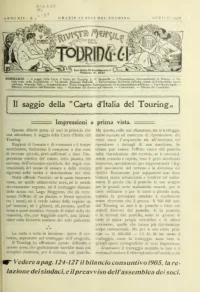
Articles in this issue
- L. V. Bertarelli presents the specimen sheet of the Touring's own Carta d'Italia, printed in two sample zones — prealpine and high mountain — to show the cartographer's line work on the Borgomanero moraines and the slopes falling from the Mottarone. Gradients follow the T.C.S. scheme: black double lines under 4%, orange-red 4-7%, brown above 7%, the point at which the cyclist must dismount.
- The 1906 Milan Exposition is billed as essentially a tourism show, and the Touring claims paternity through its 1901 Mostra Retrospettiva delle Comunicazioni. Bertarelli guides the writer over the 1,130-metre monophase electric elevated railway joining the Parco to the Piazza d'Armi (400,000 lire, worked by the Gadda firm at 10 centesimi a ride), the full-size Simplon tunnel replicas built by ing. Lanino and ing. Scheidl behind Butti's sculpture group, and the retrospective transport gallery.
- The direction answers members' letters about the Exposition: no special railway reductions could be obtained beyond those already fixed by the State Railways, but a 5-lire weekly season ticket was created on the Touring's initiative, Milan's mayor granted congress delegates free entry to the civic museums at the Castello Sforzesco and the Giardini Pubblici, and members may buy the Gualdoni guide L'Indispensabile for 35 centesimi and the Guida Album di Milano for 0.60 lire.
- The war ministry has authorised concentrating at Milan in June 1906 the cyclist bersaglieri companies of the 1st regiment (Turin), 4th (San Remo), 5th (Bologna), 7th (Milan) and 12th (Brescia), alongside a national muster of volunteer cyclists and motorists (V.C.A.) held with the international shooting contest, with combat firing on the Brughiera.
- Two further lodging offers reach the club: the Società Gite e Viaggi's newly built 200-room Excursion International Hotel on piazza M. Buonarroti facing the Piazza d'Armi entrance, and the Società Anonima Milanese Alloggi's thousand beds at 3 to 5 lire — both granting Touring members, and their direct relatives, a 10 per cent discount.
- Minutes of the Bertarelli-chaired commission for the national hotel-bedroom competition: the Touring is represented on the jury by cav. Bertolino, ing. Binda and dott. Favari, with architects Brioschi and Mainoni and ing. Giannino Ferrini as technical members. Twenty-three rooms from fifteen firms will be shown, with 9,000 lire of prizes plus Touring gold and silver medals for closet and toilet fittings.
- The Exposition's executive committee assigns 10,000 lire from the King's prize fund to an international competition testing the practicality of motor omnibuses in public service, open to vehicles carrying at least twelve passengers besides the driver and conductor.
- A royal prize of 5,000 lire is set for an international motor-boat race on Lake Maggiore on 20 September 1906, over a course of at least 100 km, open to craft up to 12 metres between perpendiculars (40 English feet counted as 12 metres) with any type of motor.
- Funded by the commune of Milan, a competition with prizes of 4,000 and 2,000 lire for a self-propelled machine to sweep street mud into a one-cubic-metre box, working on stone, cobble and asphalt paving with no more than two men and climbing 3% gradients at 8-10 km/h.
- The magazine's standing roads department, edited by ing. Massimo Tedeschi, covering tarred macadam construction, the effects of the Touring's road campaign, wheel-rim regulations, Ravenna's road budget and road upkeep in Sicily.
- French engineers Viasonneau, Hédelme and Doffoux combine a variable-load roller of eight to fifteen tonnes with a compressed-air tar sprayer, its thermosiphon holding the tar below 70°C, to build what they call elastic macadam. Trials on the roads of Quincy near Meaux gave good results, two men and one horse tarring 350 square metres an hour.
- Conte Nicolò de' Claricini, provincial councillor of Padua, built his published reply to the provincial deputation on the rolling of Padua's roads almost entirely from articles in this Rivista, which he cites by name — evidence, the editor argues, that the Touring's road campaign is telling.
- Since the magazine began pressing the case in February 1904, Novara, Bergamo, Ferrara and Verona have joined Milan in regulating cart wheel-rim width in proportion to load; the Touring helped distribute the Milan regulation to every commune in the province, since provincial rules are useless unless the communes apply them too.
- On a study by its technical office, Ravenna's council voted 750,000 lire to complete its road network and 50,000 lire a year for maintenance — an example ing. Massimo Tedeschi commends to every Italian commune.
- A Palermo correspondent reports that Sicilian communes without railways are left to slow, uncomfortable diligences because the roads are too poor for pneumatic-tyred motor services, and urges the communes to combine in a legal agitation rather than wait for the provincial administrations to act.
- Giuseppe Osti's account of a student party's winter traverse of 14-16 December 1905, a year after he, Carlo Livi, Giovanni Gruppioni and Mario Prezzolini took Corno alle Scale. They pass the Dardagna falls, Lago Scaffaiolo, the Polentino and Spigolino, take an hour and a half over 200 metres of iced rock led by Gruppioni's ice-axe, reach the Cimone, bivouac frozen in a hut and descend by moonlight over Pian Cavallaro and the Passo della Morte toward Fanano.
- The magazine's standing motoring department, carrying a model Turin garage and the full programme of the third international motoring congress at Milan.
- L. Storero of Turin, the Fiat agent, had a purpose-built garage designed on corso Massimo d'Azeglio when his old premises could no longer serve his clientele. Plan and interior views show a central hall, four inspection pits, a forge with polisher, fan and small lathe driven by a 2 HP electric motor, a washing bay fed under pressure from the town main, petrol store, and toilet, bath and W.C. rooms for the mechanics and chauffeurs.
- Programme of the third international motoring congress, Milan 24-29 May 1906, organised by the Touring and the Automobile Club di Milano with the Automobile Club de France under Vittorio Emanuele III. Lists the committees, the three sections (technical and road, economic, legislative and customs) with papers by Jeantaud, Serpollet, Kellner, Pirelli, Majorana and Massimo Tedeschi, and the 27 May lakes excursion with lunch at Luino and tea at Villa d'Este.
- The magazine's standing legal advice department, whose Giudicati turistici rubric prints two touring judgments in full — a fatal motor accident at Castellucchio and a bicycle carrying a tampered tax plate.
- Judgment of 27 February 1906 of the civil and criminal tribunal of Mantua acquitting dott. Antonio Riva of Milan and Emilio Mantero, charged over the death of Lucia Gibellini at Castellucchio on 4 September 1904: Riva was inspecting the course of a motor race past a white flag signalling a clear road, so the speed limit of art. 17 of the 1901 regulation could not be invoked and no culpable negligence was proved.
- Judgment of 21 December 1905 of the pretore of Brescia in the case against Francesco Cappelletti, a 21-year-old Brescia shopkeeper: a rider who unknowingly uses a bicycle with a tampered tax plate cannot be convicted where he proves the tax was paid and that he never had another machine.
- The club's balance sheet at 31 December 1905, set across a two-page spread. Assets include 12,500 lire of Italian 5% rentes and 60 Southern Railway bonds at market price, cash, furniture, publications, badges and plaques, repair boxes and signposts in store, and the library; liabilities cover advance subscriptions for 1906 from 5,394 renewals and 1,026 new members, affiliates' plaque deposits and the share subscribed in the 1906 Milan Exposition.
- The auditors report to the club's 50,000 members: assets of 429,343.25 lire against liabilities of 139,760.43 leave net capital of 289,573.82, up from 186,358.71 at the end of 1904 once 72,100 lire of life subscriptions and 22,500 taken in 1905 are added and 2,850.61 of losses deducted. Revenue for the year was 396,612.94 lire, and the reserve for public-securities fluctuation rose with the price of Italian rentes.
- The club's standing bulletin of council decisions, official notices, member privileges, consular lists and petrol affiliations.
- The council telegraphed its good wishes to vice-director general ing. Riva, ill with influenza at St Moritz; approved the De Agostini specimens for the 1:250,000 Carta Itineraria d'Italia, the hotel-bedroom competition jury, the 1905 balance sheet, covers for the new Pordoi and Fugazze profiles, and postcard sets at 1 lira per twenty. Silvestri urged more signposts fixed to houses, trees and rocks rather than poutrelles, and a deposit system against customs triptychs for cars and bicycles.
- Distribution of the 1906 yearbook to members' homes has begun, keeping the promise made the previous October. One volume now holds most of what filled three in 1903; localities return to a single alphabetical sequence with their province or state appended, and the symbols of the Ligue Internationale des Associations Touristes, explained on pages 6 and 7, replace the old notation. New matter includes consular agents in Italy and abroad and altimetry.
- Answering members who ask whether prizes will again be offered for recruiting, the direction promises more of them than usual — recruiting being easier this year because every member will receive the Carta d'Italia free — and will publish the full list of gifts in the next number.
- The Lake Maggiore and Lake Garda steamer companies have raised their fare reduction for Touring members from 30 to 50 per cent, and the Como-Brunate funicular now carries members return for 1 lira on production of the membership card.
- Thirty-fourth consular list for the 1905-06 biennium: conte Guglielmo De La Feld as capo console in London and consuls at Castel d'Ario, Civitavecchia and Lisbon; with the medical section's thirty-fifth list of doctors from Anzate to Suzzara, a pharmacist at Recoaro, legal advisers at Mantua and Sora, and newly approved T.C.I. mechanics and garages at Menton, Milan, Sesto Fiorentino, Sondrio, Viterbo, Rome and San Remo.
- Deaths reported of Emilia Bignami Formenti at Lodi, wife of Luigi Formenti, an active Touring consul, and of Luigi Pirovano at Brescia, a member and energetic propagandist.
- The Touring approves the Vacuum Oil Company of Genoa's Auto Velocité Mobiloil, Vacuum Mobiloil, Vacuum Motor Grease and Vacuum Graphite Grease, then prints the eighteenth list of affiliated petrol suppliers — from the Giovanelli pharmacy at Ambri in Ticino to De-Gregori at Recco — with densities, prices per kilo for benzina, Oleoblitz and Grasso Reinach, calcium carbide, opening hours and after-hours contacts, plus price reductions at Breno, Cittadella, Como, Fivizzano, Ottone and Tirano.
- Candidates for membership who applied during February 1906. The life members are led by Turin motoring names — Felice Nazzaro, Alessandro Cagno, Matteo Ceirano, Michele Lanza, Luigi Storero, ing. Enrico Marchesi and the Automobil Club di Torino — followed by the annual candidates arranged by province from Alessandria onward.