Rivista Mensile del Touring Club Italiano, Vol 12, No 6
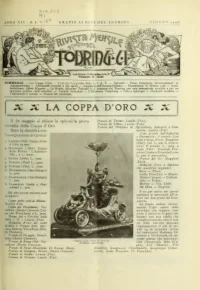
Articles in this issue
- Results of the Coppa d'Oro touring trial, which closed on 24 May 1906: Lancia (Fiat) took the gold cup and L. 25,000 ahead of Maggioni (Züst) and Cagno (Itala), while Vercellone (Diatto Clement) swept the President's Cup and the Perugia, Roma Club and Darracq Italiana prizes. The jury gave a solemn commendation to the Züst, Itala, Fiat, San Giorgio and Isotta Fraschini cars that covered the 4,000 km course without straying more than fifteen minutes from the regulation maximum average.
- Full-page photographic plate of the Coppa d'Oro: Lancia, Nazzaro and Boschis (Fiat), Fraschini (Isotta-Fraschini), Cagno (Itala), Glentworth and Macdonald (San Giorgio Napier) and Maggioni (Züst), with the finishing line at the Milan Exposition on 24 May 1906.
- The eighth congress of the Ligue Internationale des Associations Touristes, held 24–29 May 1906 at the Touring Club Italiano's Milan headquarters, with delegates from twelve countries and cav. ing. Alberto Riva announcing that federated membership had passed 450,000. Finland's touring association was admitted and eighteen resolutions adopted, on frauds at the Franco-Swiss frontier, motoring in Switzerland, Spanish customs, British circulation taxes and the cycle tax.
- Photographic plate of the congress excursion to the Certosa di Pavia — the fountain cloister, the great cloister and monks' cells, the entrance portal, delegates at the church door, the gate of Binasco castle, the Touring's lunch under the great cloister portico, and the tomb covers of Isabella d'Este and Lodovico il Moro. Photographs by cav. Vigliardi-Paravia.
- The petition signed by every voting L. I. A. T. delegate and sent by director-general F. Johnson to the Italian finance minister asking that the bicycle tax be cut from L. 10 to L. 5, arguing the bicycle is now the transport of workmen, artisans and clerks and citing Coutant's 501-to-34 victory in the French Chamber on 19 March 1906. It reckons Italy's 242,000 bicycles against 4,000 cars and 5,000 motorcycles; comm. Oreste Lattes presented it to the new minister Massimini.
- The congress's closing excursion on the morning of 29 May, by special interprovincial tramway from Porta Ticinese to Pavia along the Naviglio di Pavia, whose Napoleonic history and L. 7,786,500 cost were recounted en route. The conservator marchese Astorre Antaldi showed the delegates the Certosa and the Touring gave a lunch in the great cloister; the party halted on the way back at Binasco castle, where Filippo Maria Visconti had Beatrice di Tenda beheaded in 1418.
- The cycling department for June 1906, carrying Ing. prof. Effren Magrini's notes on two new components: the "La Flexible" sprung front fork and the Vigor back-pedal brake.
- Description of the "La Flexible" sprung front fork made by the house of I. Pupille of Paris: a coil spring inserted into a front fork cut in two, with projections front and rear limiting the travel for safety and a large-diameter leather friction disc that makes the movement slow rather than abrupt, the fork keeping the look of an ordinary one when at rest.
- How the Vigor back-pedal brake works: an angled lever clamped to a frame tube carries an adjustable pawl set 1 mm from the chainwheel teeth and 6 mm below the chain when taut, so that when the rider stops pedalling the slackening chain tips the pawl into the teeth and back-pedalling swings the lever to apply the calliper or stirrup brake. Signed by Ing. prof. Effren Magrini.
- Full report of the third International Motoring Congress, Milan 24–29 May 1906, opened at the Villa Reale before princess Laetitia by mayor Ettore Ponti, prince Piero Strozzi of the Automobile Club d'Italia and senator Colombo, with more entries than the 1903 Paris congress. Papers were read by Kellner on chassis and coachwork, Ferrus on elastic wheels, Jeantaud on electric cars, Barrère on tourist cartography, Baillie on public motor services and Reiss of Berlin on lorries.
- Photographic plate of the motoring congress: the foreign delegates, princess Laetitia arriving for the inauguration, members at the Villa Reale and on their visit to Isotta-Fraschini, the press, and the garden party.
- The congress's 27 May motor run to the Lombard lakes: cars gathered at the Villa Reale at 7 a.m., halted at Saronno and lunched at the Grand Hotel in Luino, went on to Lugano and a five o'clock tea at Villa d'Este, then to a civic reception at Como before reaching Milan at 8 p.m. Silvio Crespi, Giovanni Silvestri, Gildo Guastalla, Baillie, Lumet, Gatti Goria and Mercanti took part, each given an illustrated route booklet compiled by Ottone Brentari.
- Congress members toured the main Milanese motor and coachbuilding works: Edoardo Bianchi, where Bianchi himself and Gian Fernando Tomaselli received them and gave out a commemorative medal; the Carrozzeria Sala, shown round by ing. Agrati with Kellner of the Paris coachbuilders' chamber present; and Isotta e Fraschini, where ing. Fraschini, avv. Isotta and signor Cuneo Vidal showed them the assembly and testing shops.
- The Spezia–Porto Venere overhead-wire electric bus line opened its Spezia–Fezzano section on 10 February: the Società per la Trazione Elettrica pairs a simple Cantono-type trolley with a light 14-seat car weighing under 1,500 kg on two 4 HP direct-current motors, covering the 7 km open section in under 25 minutes on a coast road with 10-metre radius curves and gradients to 6.8 per cent. The company is building lines at Siena, Pavia and the Milan Exposition.
- Announcement of the Touring's 1906 motoring yearbook, 838 pages carrying more than 15,000 addresses of makers, builders, dealers and owners of cars and motorcycles in Italy and abroad, together with circulation rules, customs formalities, transport charges for cars in each Italian region, lists of garages, mechanics and hotels, and the 1906 racing calendar. Price L. 2 to members and L. 4 to non-members.
- Guide to the Milan Exposition, split between the smaller Parco site and the larger Piazza d'Armi and staged to crown the completion of the Simplon tunnel, with keyed plans of both grounds. It picks out the motoring and cycling galleries, the Touring's own hotel-bedroom exhibition and road show with its experimental paving strip, the aeronautics ground with dirigible hangars, the maritime, railway and Simplon sections and the foreign pavilions.
- Ing. prof. Effren Magrini's motoring technical department for June 1906, reviewing new ignition, starting, engine, suspension and tyre equipment shown at the Paris Salon, the Turin international exhibition and the Cordingley Show.
- Description of the Louis Gianoli high-tension magneto, whose armature carries both primary and secondary windings and gives two sparks per revolution turning either way, with an automatic breaker worked by the magnetism of the armature core, unpierced permanent magnets held by special flanges, and ignition advance obtained by shifting the pole shoes through 40 degrees. A double-ignition version combines the magneto with a vibrator coil through a mixed distributor and a switch marked M or B.
- The Cinogène starter seen at the Paris Salon and the Turin international exhibition, which uses carbon dioxide liquefied at 60 atmospheres in a cast-iron bottle to drive a piston and rack that spin a pinion engaging the engine. A bottle tested to 250 atmospheres holds 2 kg of gas, enough for about 100 starts of a four-cylinder 35 HP engine, and the same supply will inflate tyres through a rubber tube.
- Two rotary engines shown in 1906: the Rotor of Ducco, Ribetti and Colombatto, studied at the Turin exhibition, in which the cylinders revolve while pistons and shaft stand still, giving effective air cooling with no pump or radiator, no flywheel and perfect balance; and the six-cylinder air-cooled Lamplough of about 18 HP (76 mm bore, 102 mm stroke) built by the Albany Manufacturing Company and fitted to the Albany chassis.
- Engineer Green's combined engine and radiator, devised for the new Rex tricars shown at the Cordingley Show: water-cooled, with a nid d'abeilles radiator forming a single body with the cylinder and split into two parts applied to the sides of the engine so that the whole unit takes up the least possible room.
- The outboard built by the American Waterman Ont-Board Motor Co. of Detroit, which clamps to any boat: a four-stroke single of 70 mm bore and 75 mm stroke running at 700 rpm for about 2 HP, driving a 25 cm propeller at 500 rpm through four bevel wheels for some 7 miles an hour, pump water-cooled, with the petrol tank above the tiller and a total weight of about 53 lb.
- Four new elastic suspensions: the Kelsey, an inner disc bolted to the chassis with four inclined faces carrying rollers under a steel band and a vulcanised-fibre friction ring; the pneumatic Simplex, a pump-type cylinder with a piston linked to the leaf spring; and the two American spring systems of the Diezemann Shock Absorber Company of Hoboken and of ing. P. M. Hotchkin of Chicago.
- A one-eighth-scale working replica of a standard 16 HP car, shown at the New York and Chicago motor exhibitions: two horizontal water-cooled cylinders of about 2 HP, two-speed gearbox with reverse, steel chassis, two brakes and a weight of 110 kg — the only thing not reduced being the price, 5,000 dollars or some 25,000 lire.
- The detachable Cromwell non-skid tyre protector, notable at the Turin exhibition after winning praise at the Paris Salon: small chrome-leather plates studded with proud-headed nails and hooked to the wheel rim, so light and foldable that it stows in a locker, fitted by deflating the tyre, laying the leather band over the cover and levering the metal hooks under the rim edge at equal spacing. Signed Ing. prof. Effren Magrini.
- Ing. Massimo Tedeschi's roads department for June 1906, opening with the first Italian road exhibition at the Milan Exposition and going on to a projected motor road in Siam and a new coast road to Santa Margherita Ligure.
- Tedeschi's first look at the road show on the north side of the Piazza d'Armi, which he likens to Piedmont's admission to the 1856 Congress of Paris as a turning point for Italian road building. On the eve of the opening it was still unfinished — Turin's provincial stand nearly ready, Milan's machinery almost installed, the Gola e Conelli pavilion going up and the experimental road's urban paving samples incomplete — with forty-seven exhibitors in all.
- Engineers Boch and Allegri have drawn up a motor road to open Bangkok to the sea, since the mail steamers touch only Penang, 67 hours away, or Singapore, and a courier's round trip takes sixty days; a railway would cost far too much, whereas the road would cut the journey between the two cities to one or two days and carry goods and passengers as well as mail. Tedeschi notes with pride that Allegri is an Italian, long resident in Siam and probably a Touring member.
- The contract has at last been let for the road from the hamlet of S. Lorenzo della Costa down to Santa Margherita Ligure, ending the detour that forces travellers from Genoa to run on to Rapallo and double back, and reopening one of the loveliest stretches of the Riviera di Levante. Signed Ing. Massimo Tedeschi.
- Results of the Touring's two road competitions: the road-monograph first prize was divided between "Italico" (ing. Enrico Pozzoli of the Milan provincial technical office) and "Italia" (ing. Francesco Sansoni and ing. Eugenio Bocchi of Padua), with L. 400 seconds to ing. Antonio Albertini of Modena and "Parva favilla". The L. 600 first prize for the roadman's handbook went to "Mente e braccio" by the late ing. Alfredo Biadene of Pisa.
- The signpost department lists boards 400–454 offered and erected by the provincial deputations of Parma and Vicenza, on the Emilia and the roads to Traversetolo, Langhirano and Colorno and on the Trevisana, Marosticana, Padovana and Veronese provincial roads. New offers from consulates, municipalities and the deputations of Bergamo, Arezzo, Ancona, Parma, Siena and Ferrara bring the running total to 1,635 signs worth L. 22,719.
- Plate of photographs of the April 1906 Vesuvius eruption, sent in by ing. De Angelis, Touring consul at Naples, and taken by members Piscinelli of Collesana and Ali Riza Bey: prof. Matteucci and the carabinieri who stayed at the Observatory on 14 April, tourists sunk in ash and lapilli on the climb, the buried track of Cook's electric railway, the lava taking the avv. De Siena's house and piazza Sant'Anna at Boscotrecase, and the ashfall at Ottaiano.
- The excursions and meetings department for June 1906, carrying the first social outing of the Touring's Bombay consulate and a full account of the first International Student Alpine Congress.
- The Touring consulate at Bombay held its first social gathering under cav. Giovanni Gorio, consul of the King of Italy and of the Touring: an excursion to Borivli, a village 30 km out on the main line inland, where the Mongini brothers, confectioners in Bombay, laid on risotto alla milanese and Piedmontese wine in an old Brahmin temple. Gorio noted that membership had risen from half a dozen to 38 out of barely eighty Italians resident in Bombay, and the full roll of members is printed.
- Emilio Terni's account of the first international student mountaineering congress, called by the C. A. I.'s university section alongside the first International Student Convention and held at the Villa Reale in Milan. It drew delegates from the universities of Milan, Pavia, Bologna, Pisa, Florence, Parma and Turin and from Trieste, Bienne, Amsterdam, Munich, Lausanne, Rio de Janeiro, Jassy, Helsingfors, Berne, São Paulo and Montevideo.
- The student congress's 26–28 April crossing of the Simplon: the party left Milan on the Domodossola train and drove to Isella in sleet, and thirty-one of them pushed on up the Napoleonic road through deep snow past the Simplon village, reaching the hospice door at 12.30 to hot soup from the monks and thirty-one beds. They came back next afternoon over fresh avalanche debris, regaining Isella at 9 p.m.
- The legal-advice department for June 1906, given over to a reported judgment on whether railway hall-guards count as public officials.
- Judgment of the Civil and Criminal Tribunal of Brescia of 5 February 1906 in the case of Gioachino Bina of Desenzano, who shoved hall-guard Alessandro Gherardi aside when the guard barred his porter from the station for having no ticket. The court held that hall-guards and crossing-keepers are merely persons charged with a public service, not public officials under art. 207 of the penal code, so the conviction was set aside.
- The Touring's own notices for June 1906, opening with the two new road profile-monographs of the Pordoi and the Pian della Fugazza and going on to the affiliated-hotel list, the rolls of five-year and benemerito members and an obituary.
- Distribution to members has begun of two new profile-monographs compiled, like those of the Stelvio and Mont Cenis, by Ottone Brentari: the Pordoi road from Moena in Val di Fassa over the Dolomites to Aróba in Livinallongo, opened only the year before, and the Pian della Fugazza road from Schio in the Vicentino to Rovereto, the first alpine road in the Veneto, now getting a motor service.
- Nineteenth list of hotels affiliated to the Touring, with room and meal prices, servants' rates and garage space: the Corona at Aosta, Lago Grande at Avigliana, Victoria at Bordighera, National Engadinerhof at Chiavenna, Carpi at Carpi, Corona at Levico, Caldelàri at Lugano, Regina Elena at Santa Margherita Ligure and the Sondrio at Sondrio, all allowing members 10 per cent off the total bill. The Albergo Lozeron is struck off following the proprietor's death.
- Obituary of signora Beatrice Ricci-Miorin, who died suddenly of a heart attack at Udine; she was the wife of Giacomo Miorin, the Touring's consul at Cagliari and one of its most active propagandists in Sardinia.
- List of candidates for membership of the Touring Club Italiano who applied between 1 and 30 April 1906, arranged by province from Alessandria onwards, with life members from Alba, Arquà, Bergamo, Florence, Lovere, Loano, Moltrasio, Naples, Perugia, Rome, Santiago and Santos. Footnotes give the statute's terms: L. 100 once for life membership (L. 125 abroad) and a L. 2 entrance fee plus L. 6 a year for annual members.