Rivista Mensile del Touring Club Italiano, Vol 12, No 7
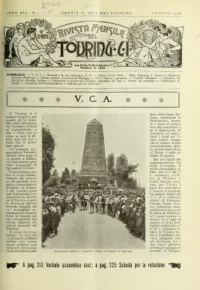
Articles in this issue
- Report on the memorable 14 June muster of Volontari Ciclisti and Bersaglieri Ciclisti at Milan, whose mock battle under colonel Chiaria ran from Turbigo and the Naviglio Grande bridge to Boffalora and the Ticino island of Visarino, watched by generals Avogadro and Valcamonica with Touring director comm. Johnson in the accompanying motor car. It ends with combat shooting at the Cameri range, a visit to the Magenta ossuary and an appeal for cyclist-volunteer platoons in every province.
- F. R. defends the Como–Brunate funicular against De Amicis-style horror at Alpine "comfort", describing a line that lifts passengers 493.18 m over 1074 m of track on gradients of up to 55.10 per cent in eighteen minutes, without a single mishap in twelve years. He presents it as a democratisation of Alpine beauty, opening the panorama and Brunate's hotels to every purse and every pair of legs.
- Avv. Carlo Valle takes the Verona–Vicenza provincial tramway through Caldiero, Colognola and Illasi to Tregnago and up the Valle d'Illasi to Giazza, the last village before the political frontier, whose people call it Ghetzen and speak a German dialect long ascribed to the Cimbri but shown by Cipolla, Marinelli and Malfatti to derive from thirteenth-century Bavarian charcoal-burners. He recommends it as an easy ride from Verona and a base for Rivolto and Cima di Posta.
- Luciano Morpurgo of Venice rides out of Spalato past the Roman ruins of Salona and up to the Venetian fortress of Clissa, crosses the stony Mojanka plateau through Dugopolje and Dizmo to Sign on the Cetina, then climbs the Vagan pass at 1230 m into Bosnia. A ruinous stony descent forces him to walk down to Prolag and on to Livno with its minarets, Hotel Kaiser Franz Josef and Narodna Kafava, after which he loads the bicycle onto the diligence for the return.
- Announcement of the projected electric narrow-gauge Vigezzina railway from Domodossola up to S. Maria Maggiore, designed by engineers Urbano Marzoli and Leopoldo Candiani and exhibited in the Simplon gallery at the Milan Exhibition. Extended to Locarno it would ring the Simplon, Gotthard and the lakes, and would put the 900 m Vigezzo plateau three hours from Milan.
- The case made by Francesco Gonella, Emilio Silvano and Edoardo Coggiola, on prof. ing. V. Baggi's project, for a carriage road over the Colle Ferret joining Courmayeur to Martigny by way of Entrèves, La Vachey and Sagioan. It contrasts Chamonix's forty-five hotels and 130,000 visitors with Courmayeur's five hotels and two thousand, notes the Valais Grand Conseil's 1904 classification of the Orsières–Chalets de Ferret section, and puts the cost at L. 325,000.
- First instalment of the magazine's referendum on roadside kerb-stones, printing seventeen replies in favour from members including Francesco Benvenuti of Rome, console Carlo Corticelli of Cetona, ing. Attilio Rossi and avv. Fulvio Cazzaniga of Cremona. They argue the paracarri preserve the banchina that carts and motor cars would otherwise churn up, and have saved riders on the Ceva–Millesimo road and the Bocchetta pass; a Palestro member sends a poem, and the piece is marked "Continua".
- Numbered register (nos. 455–524) of Touring road signs newly erected, beginning with fifteen put up at Gozzano by console dott. Ugo Migliavacca with gifts from conte Tornielli, senatore Parona and others. Further entries cover the provinces of Aquila, Milano, Firenze, Alessandria, Reggio Emilia, Perugia and Siena, and sixteen signs placed by the Genoa provincial technical office along the Genova–Ventimiglia road between km 63.3 and 81.9.
- Standing department on attracting foreign visitors, hotels and tourism, carrying reports on American luxury hotels, southern Italian sanitation, the defence of Italy's natural beauties, the use of topographic maps and autumn festivities on Lake Maggiore. It also lists newly opened or rebuilt houses at Menaggio, Naples, Rapallo, Santa Margherita Ligure, Pinerolo and Alpe Veglia.
- Summarised from Mary Spencer Warren in Chambers's Journal by way of Minerva of Rome, an account of the Waldorf-Astoria on Fifth Avenue: 1385 bedrooms, 800 bathrooms, 34 electric lifts, 25,000 lamps, 10,000 meals a day and a "royal apartment" at 2500 francs a night, run under director T. M. Hilliard with its own waiters' school. The St. Regis and the pneumatic-tube-equipped Hotel Astor are described more briefly.
- Quoting "Viandante" in the Pungolo of Naples, the Rivista deplores the disappearance of proper sanitary arrangements in inns south of Rome, citing Goethe's 1786 experience at Torbole on Lake Garda and a similar mishap suffered by on. Fortis in Calabria. Members are asked to send reports on the water closets of the hotels they visit so the Touring can advise, or blacklist, backward hoteliers.
- Extracted from Carlo Sandoni's report on the Associazione Bolognese per il movimento dei forestieri, a proposal that the Touring, the Associazione Nazionale pel Movimento dei Forestieri and a new national body — an Italian counterpart of the French Comité des sites et monuments pittoresques — defend woods, waters and panoramas as well as monuments. It cites the campaigns over the Marmore falls, Beltramelli's defence of the Ravenna pine forest and Luigi Rava's speech introducing the Pineta law.
- Reprinted from L'Opinione Geografica, an argument that questori, carabinieri commanders and public-security officials newly posted to a town should carry topographic maps rather than depend on local guides. The example given is the carabinieri captain at Rome who, hurrying to the marchese Corsini motor accident at the Ponte Catena, took the via Prenestina instead of the via Casilina; the writer urges that every secondary-school pupil buy and learn a topographic sheet.
- Programme of the August–October festivities in the Borromean basin and at Pallanza celebrating the opening of the Simplon, run by a committee under the honorary presidency of the Duke of the Abruzzi and the effective presidency of barone Antonio de Marchi. It includes rowing championships under the R. Rowing Club Italiano, motor-boat races under the R. V. J. C., a marathon, an automobile gimkana, a Touring convegno and alpine contests with the Club Alpino Italiano.
- Civitanova Marche prepares the fourth centenary of Annibal Caro's birth, with a monument modelled by prof. Romeo Pazzini of Florence and shown at the Macerata regional exhibition, and a L. 1000 prize from the R. Deputazione Marchigiana di Storia Patria for the best monograph on his life and works. At Porto Civitanova the Club sportivo Motus, under dott. Natalucci, has formed a sub-committee to mount a large touring demonstration in 1907.
- Club and outing news from Ascoli Piceno, Avellino, Bagnolo Mella, Carpi, Jesi, Noventa Vicentina, Oneglia, Piove, Saluzzo, Savona, Schio, Teramo and Vobarno, including new cycling societies and signpost inaugurations. Rome reports that Francesco Radi, under the Sezione Romana's auspices, has begun his fourth foreign cycle tour, this time through Sweden and Norway by way of Copenhagen, Malmö, Stockholm and Christiania.
- The club's official section for the July 1906 number, carrying the minutes of the annual members' assembly, the prize scheme for recruiting members, competitions and circulars on the detachable plate, repair boxes, customs signs and affiliated hotels, and the monthly list of membership candidates.
- Minutes of the general assembly in the Salone della Borsa, Milan, chaired by ing. Carlo Vanzetti, with the Direzione's report on the Decennio festivities that drew some 10,000 tourists, the VIII L. I. A. T. congress, the III international automobile congress, a consular corps past 2000 and the new 1:250,000 map of Italy made with the Istituto Geografico De Agostini. Avv. Luigi Gasparotto pressed the Touring on Sunday rest and cav. Pizzagalli on fixing the detachable bicycle plate.
- Members who introduce ten or more new members during 1906 enter a draw for prizes offered by Italian and Swiss firms: Giovanni Hensemberger of Monza accumulators for motorcycles and cars, six precision watches from Stüdy & Fils of La Chaux-de-Fonds, a folding "Cosmos" 9x12 plate camera from Bellani e C. of Milan, and pocket first-aid cases from U. Marucelli e C., supplier of the Touring's medical boxes.
- Having won the detachable bicycle licence plate from the government, the Touring finds it is too easily stolen, and the sample safety springs offered by mechanics were unsatisfactory. It therefore opens a competition, closing in August 1906 and carrying no prize, for a clasp combining solidity and practicality, the winning pattern to be recommended to members in the Rivista.
- The Direzione asks capoconsoli, consoli and all members to report whether the repair boxes distributed across Italy are properly looked after, fully stocked and in good order, and offers to send the special regulation governing them free on request.
- To reduce the trouble caused by motorists who ignore the rules on triptychs, the Touring will place paired notice boards at customs offices facing both those entering and those leaving Italy, with four-language wall notices inside on the temporary importation of cars, motorcycles and cycles. Permission and the cost of installation were obtained through Rome console ing. comm. Oreste Lattes and comm. Brusca of the Direzione Generale delle Gabelle.
- The provincial deputation of Florence joins the Touring's life members and sends L. 300 towards signposts, the news coming through capo-console Angelo Modigliani-Rossi. The editors hope every provincial deputation in Italy will follow through the work of the capo-consoli.
- A notice promoting Lake Garda, reached from Milan in under two hours and from Venice in under three via Desenzano and Peschiera, with steamer connections at Riva to the Mori–Arco–Riva line and the Südbahn. Touring members show their card for a 50 per cent reduction on the Impresa di Navigazione steamers, whose Milan office in via Pontaccio 13 supplies timetables.
- Touring members who show their membership card can obtain a return ticket on the Como–Brunate funicular for one lira.
- A circular from Giuseppe Alessandro Vecellio, president of the Cadore section of the C. A. I., and Augusto Baroni, president of the Club Ciclistico Cadorino, proposing that the two societies jointly sign the Cadore's mountain paths, forks, steep descents and road bends using the Touring's internationally agreed pattern of cartelli indicatori. They appeal to comuni, local associations and residents who profit from tourism to subscribe to the cost.
- The candidates who applied for membership between 1 and 31 May 1906, listed as life members and then as annual members province by province from Alessandria to Vicenza, with separate sections for Austria, Belgium, France, Germany, England, Monaco, San Marino, Switzerland, Turkey, Africa, and North and South America. The running totals give 51,093 annual and 1,098 life members, 52,191 in all.
- Thirty-sixth list of consular appointments, naming cav. ing. Ernesto Todros capo-console for Brussels and ing. arch. F. Enrico Daverio for Madrid, with new consuls at Breganze, Cheren, Oristano, Perugia and Venafro.
- Thirty-seventh list of the medical section and allied services, registering pharmacies at Cuorgnè, Messina, Poviglio and Villa d'Adda, second-category Touring mechanics at Aosta, Baveno and Breganze, and a second-category garage in Milan.
- Twentieth list of hotels affiliated to the Touring, with category, room and meal tariffs, the members' ten per cent discount and the presence of a garage or dark room noted for each. Houses listed include the Scudo di Francia at Barberino di Mugello, the Croce Rossa at Chiasso, the Splendid at Desenzano sul Lago and the Albergo della Posta at Fivizzano.