Rivista Mensile del Touring Club Italiano, Vol 12, No 9
Articles in this issue
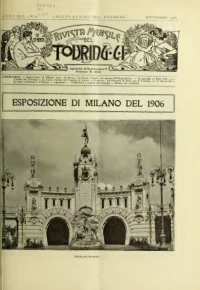
- Opens the issue's monographic guide to the 1906 Milan International Exposition with its smaller half at the Parco, crowned by Enrico Butti's colossal allegorical group of an engineer and three miners set between the twin Sempione tunnel mouths.
- Full-size reconstructions of the two Simplon tunnel mouths, each 65 m long and 15 m apart, showing Brandt drills working real rock under compressed air, the calotte versus base-heading methods, the ironwork of the notorious 42 m fault, and Sempione pumps, compressors and a compressed-air locomotive.
- The fishing and aquaculture pavilion, largely German: the Helgoland Biological Institute and the Prussian commission at Kiel, models of fishermen's houses at Blankenese and Gothmund, herring loggers, North Sea herring weirs and the Eckernförde 'Quase' fishing boat with auxiliary propeller.
- Achille Bertarelli's print collection tracing early ballooning, the first locomotives, steamers and railway tickets, the wooden Bassano bridge by Bartolomeo Ferracina, and an 1842 Vienna print jokingly predicting cars and cycles; it also names Luigi Negrelli of Primiero, not Lesseps, as first to conceive the Suez cut.
- Ing. Giannino Ferrini's pavilion, modelled on the courtyard of Palazzo Marino, showing how Milan is administered — accounts, schools, hygiene (a model of the Dergano contagious-diseases institute), road upkeep, dazio, markets, cemeteries and the successive stages of the city's regulatory plan.
- Bernese-style pavilion facing the Salone dei Festeggiamenti, with cav. Ernesto Rusca's allegorical painting, reliefs dated 1882 and 1906 for the Gotthard and Simplon openings, medallions of Haller, Euler, Gessner, Dufour, Pestalozzi, Vela and Böcklin, and a 40 m tower overlooking the Castello and Arena.
- Alberto Grubicy's pavilion, thrown up in a few weeks and finished only for the opening, devoted to paintings by Giovanni Segantini and Gaetano Previati and dominated by Leonardo Bistolfi's statue for the Segantini monument at the Maloja.
- Ing. Gino Coppedè's lead-coloured, bolted 250 sq m pavilion for Sampierdarena's mechanical and naval industries, showing copperwork, liqueurs, steamer models and, in a central case, the palette of painter Nicolò Barabino (1832-1891).
- Rules and layout of the national painting, sculpture and architecture show ranged around the 30 m-wide domed Salone dei Festeggiamenti: three works per artist, collective group displays permitted, 76 rooms in all — cut to 61 after the fire of 3 August destroyed the 15 architecture rooms.
- W. Hutchison's demountable sheet-metal pavilion laid out like a temple, exhibiting Canadian gold, silver, nickel, cobalt, mica and asbestos, a pine trunk of extraordinary girth, wood pulp, wheat and apples, and a cosmorama of buffalo, reindeer, bears, wolves and beavers.
- The Russian section, authorised by the Tsar only on 9 March 1906 and organised by commissioner Bilbassoff, showing the Kolyvan and Ekaterinburg imperial works' Siberian jasper and porphyry vases (one cup valued at 20,000 roubles) and the kustar rural cottage industries said to employ some 25 million peasants.
- The Società Umanitaria's pavilion by architects Conconi and E. Monti, reproducing a two-room flat from its via Solari workers' housing occupied by about 1,000 workers on 29 March, with painted graphs from the municipal inquiry linking mortality to overcrowding.
- Peace pavilion designed by architect G. B. Bossi, with groups by Tulio Brianzi, decorative figures by Orazio Grossoni and Gaetano Previati's large canvas of the horrors of war, mounted by the Unione Lombarda of the Società Internazionale per la Pace.
- The 2,200 sq m thrift and insurance pavilion, with a vestibule painted by Carlo Paolo Agazzi, a conference hall, five galleries (one upstairs on workers' housing) and rooms for the Popolare-Vita, Assicuratrice Italiana and Zurigo companies; some 800 exhibitors in all.
- With the Italian and Hungarian decorative-art halls destroyed by the 3 August fire and being rebuilt, attention falls on Japan's porcelains, lacquers and ivories (dismissed as old stock), Persian carpets, Dutch ceramics, English furniture and the Indian, Moroccan and Turkish displays.
- The goldsmiths' 860 sq m pavilion in iron and reinforced concrete facing the Viale delle Nazioni, built to outlast the Exposition, with 38 exhibitors from Milan plus Rome, Naples, Florence, Vicenza and Venice showing chased silver, enamels, necklaces and precious stones.
- The Parco's attractions: the Tobogga boat-slide plunging into its lake, the Areoplano swing ride, the Viaggio al Polo Nord through grottoes to a penguin-filled pole, the animal theatre, the Sempione cinematograph and a children's railway pulled by a compressed-air engine used on the tunnel works.
- Opens the guide to the larger Piazza d'Armi half of the Exposition, which holds the transport shows by land, sea and air together with the industrial, agricultural and colonial pavilions.
- The flashing lighthouse before the Marina pavilion, built by La Filotecnica of Milan: three 60 cm parabolic mirrors on a clockwork-driven mount, each with a 50-ampere arc lamp, giving beams of about 20 million candlepower at a quarter the cost of a Fresnel-lens oil light.
- The Royal Italian Navy's display, organised under minister on. Carlo Mirabello from material already held in the Regi Arsenali, divided into cartography, ship design and hull construction, engines, arms, electrical plant, signalling, hygiene and a retrospective, alongside German, French and British sections.
- A full-size section of a liner's central deckhouse — Louis XVI music and conversation saloons, children's dining room, luxury cabins and a working Marconi wireless room signalling the Parco — to be dismantled and installed on the ship Re Vittorio then building at the Odero yard.
- The Belgian show covering 16,150 sq m, with Bracke's St Michael slaying the dragon, Flanders linens, tapestries, lace and silverware, models of the ports of Ghent and Antwerp, Congo flora, and rolling stock including a 45-seat dining car and narrow-gauge locomotives.
- The Milan committee of the Dante Alighieri's show of Italians abroad, its catalogue running to about 2,000 numbers, with three rooms on the Eritrean colony listing barley, wheat, taf, 38 kinds of bean, the oil seeds niugh and salit, and Italian vegetables grown under irrigation.
- Austria's two pavilions: tourist rooms for Dalmatia, winter sports, Carinthia and Carniola, Tyrol and Salzburg and Bohemia with free cinematograph shows, a large railway display of locomotives and a tank wagon, and the city of Vienna's exhibit costing 300,000 crowns on municipalised electricity.
- Seven great galleries and nine kilometres of track on which Italy, France and Germany show locomotives, carriages and freight wagons, with the State Railways' octagonal hall of photographs, a large model of the Brunate funicular, and a statue of Paulin Talabot (1799-1885).
- The teaching exhibit along the Viale Bersaglio, open through September, headed by Turin's municipal elementary and vocational schools, with contributions from Brescia, Gallarate, Vercelli, Uboldo, Bologna, Domodossola and Milan's institutes for the deaf-mute, and a British arms section at the end.
- The little-visited Swiss land-transport gallery behind the railway pavilions, with a 1:10,000 relief of the Bernese Alps, Prof. F. Becker's 1:5,000 relief of the mountains round Montreux, Gotthard rolling stock, a 1:1,000 model of the Biaschina spiral tunnels and a Matterhorn panorama.
- War Ministry display: the 5th Alpini's pack trains and ski-troop figures, the Military Geographic Institute's maps and instruments, mountain medical mules and wheeled field hospitals, the Novaretti road train, and pontoon and trestle bridges of the 4th Engineers with the railway brigade's track.
- The Red Cross exhibits a section of each of its hospital units to convey the scale of material distributed among its sub-committees throughout the kingdom, and to reassure the country that the wounded would be properly cared for.
- The hygiene pavilion in piazza d'Armi, its vestibule hung with Latin mottoes, arranging exhibits in six classes: general public hygiene, rural hygiene, hygiene in land transport, naval hygiene and rescue, transport of sick and wounded soldiers, and industrial hygiene and accident prevention.
- Latin American pavilion opening with Laforet's statue of Columbus crying 'Tierra, tierra', a semicircular room of presidential portraits from Gonzalez Viguez of Costa Rica to Amador Guerrero of Panama, and cases of coffee, shoes, beer, wines, liqueurs and pharmaceuticals.
- The international agriculture show in three 10 m-high larch galleries of 10,000 sq m plus a 600 m livestock shed, divided into rural history from the Etruscans to the Middle Ages, agrarian meteorology and geography, machinery, agricultural teaching and associations, and animal and vegetable products.
- The French decorative-art pavilion, 200 by 50 m and 10,000 sq m by architect D. Bongi with Oreste Labò's Painting and Sculpture reliefs, nicknamed the 'Paradiso delle signore': leather, silk, carpets, lace, crystal, fans and fine bookbinding, plus a room devoted to the city of Paris.
- Bulgarian pavilion built as a Bulgarian house, its loggia painted with national costumes, backed by statistics on cereal exports averaging 62 million, livestock sold to Turkey, silk cocoons, hides and the attar of roses of the Kazanlik, Karlovo and Kaloffer valley of roses.
- The Touring's own hotel-bedroom show, aimed not at grand city hotels but at village inns brought back into use by the bicycle and the motor car, arguing for plain furniture, smooth uncluttered rooms and sanitary closets rather than novelty gadgets.
- The TCI's pavilion charts its growth to 51,979 members, a stack of one year's Rivista reaching 1,244 m, maps of consuls, affiliated garages, petrol sellers, doctors and hotels, road signs and repair boxes, with stands of the Ligue Vélocipédique Belge, Touring Club de Belgique and Touristen-Bond voor Nederland.
- The coachbuilding galleries, from mastodontic goods wagons and every kind of spring cart to a motor omnibus, plus boots, hats, gloves, trunks, whips and horseshoes, stables, prams and carriages, with France the most elegant exhibitor after Italy.
- The most visited show of the Exposition: three parallel galleries of 127 by 25 m, 37,000 sq m in all, admitting only machinery that yields finished products, in six classes from graphic arts and artistic metal and woodwork to ceramics, textiles and leather.
- Two pavilions in the courtyards of the Galleria del Lavoro: the silk industry followed step by step from egg and cocoon through spinning, weaving and dyeing, and the Regia Sale e Tabacchi's display where Macedonia cigarettes are rolled.
- The temporary-exhibits pavilion reached from the elevated railway, now holding photography, a pneumatic liturgical organ, antique and modern arms, German perfumery, wines and beers, chocolate, preserves, pasta, toys and, outside, the bells.
- The aeronautics show under a balloon-shaped dome beside a 300 by 110 m balloon park, with the War Ministry's three-wagon field section, Germany's Sigsfeld and Parseval 'pallone drago', the Lindenberg Prussian aeronautical observatory's instruments, and Italy's Filiasi aeroplane model.
- The metrology exhibit in the galleries right of the via Buonarroti entrance, its retrospective recalling the some 2,000 different units once in simultaneous use in the Italian provinces before the metric system, against a modern section built on the centimetre-gramme-second standards fixed by the 1881 electricians' congress.
- Piazza d'Armi amusements: the electric horses and the captive balloon, both still not running, the Montagne Russe, the Villaggio Eritreo of conical thatched huts with its inhabitants, camels and giraffes, the Palombari divers, the Grotta Azzurra and the 5,000 sq m Cairo quarter with minarets and dancers.
- The 1,130 m elevated railway over a timber, iron and reinforced-concrete viaduct — Italy's first single-phase line — worked at 2,000 V and 15 cycles with four-car trains of six 30 HP motors; built for about 450,000 lire, with Gadda supplying stock and staff for a share of takings.
- Keyed notes to the plans of both halves of the Exposition, numbering everything from the elevated-railway station, Carrozzeria and Touring hotel-bedroom galleries to the Murano glassworks, the Bulgarian pavilion, the Ansaldo-Armstrong and Vacuum Oil stands, restaurants, kiosks and the aeronautics hangars.
- Bertarelli reports Prof. De Agostini's month-long tour of the leading Austrian and German geographical institutes, contracts signed with their cartographers and engravers, and the final sheet-cut of 56 sheets matching the Austrian 1:200,000 — each covering about 83 by 101 km — warning members that the first sheets will be late.
- Bertarelli praises the State Railways' 282-page guide 'Sempione ed Ossola' in three parts on the access lines, Domodossola and the Simplon, and the Ossola valleys, with engravings by Arti Grafiche di Bergamo and printing by Roux e Viarengo, faulting only its dated 1:300,000 map.
- The Verbano festivities at Pallanza, running to early October under president baron Antonio De Marchi with vice-president avv. Cesare Peletti, treasurer and Touring consul avv. Carlo Eugenio Erba and secretary Luigi Podio; the Rivista urges a tramway to link Fondo Toce station with the town.
- Council and Direzione decisions: a consultative commission for the 1:250,000 map (Celoria for geodesy, Ascoli for place-names, Bertarelli for touring), a meeting of Milanese motor manufacturers on a radial motor road out of Milan, official representation at Pallanza, medals for Rovigo and Piombino, and Alberto Pirelli onto the Roads Commission.
- The referendum results on the movable number-plate are held over for lack of space; the Touring is pressing minister Massimini to cut the plate tax to 5 lire before the 1907-1908 budget is approved.
- Members are reminded to produce their TCI card when insuring, since those who take out accident policies without declaring membership lose the favourable terms of the 1903 convention with the Società Anonima Italiana di Assicurazione contro gli infortuni.
- German rules unified from October: 6 Mk plate for cars and 3 Mk for motorcycles (10 and 5 outside office hours), 15 km/h in built-up areas, brakes stopping the car within 5 m, single-tone horns only, and exemption from the customs deposit for TCI members holding a Passierschein.
- Complaints from affiliated dealers that members' chauffeurs buy petrol elsewhere at higher prices, with a province-by-province tally of refuelling points (Genoa and Milan 26 each, Turin 25, Novara 21) and the new blue enamelled plate available on an 8 or 11 lire deposit.
- Applicants for membership between 1 and 31 July 1906, listed by city and class — life members including Arturo Zùst of Intra, Conte Gian Carlo Borromeo of Milan and the Società Anonima Italiana S. Giorgio of Genoa, followed by the annual members.