Rivista Mensile del Touring Club Italiano, Vol 13, No 11
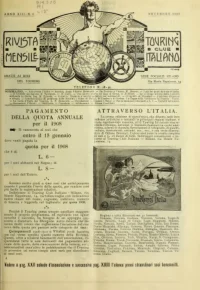
Articles in this issue
- Notice that the 1908 subscription — L. 6 for members in the Kingdom, L. 8 for those abroad — must reach the Touring at via Monte Napoleone 14, Milan, by 15 January, with an appeal to move up to the quinquennale 1908-1912 or vitalizio classes and be rid of the yearly renewal of dues and card.
- Luigi Vittorio Bertarelli's Attraverso l'Italia instalment urges cyclists to ride the Castellammare-Sorrento-Varco dei due Golfi-Amalfi-Salerno circuit and climb to Ravello. He describes the Duomo's 1272 mosaic pulpit by Nicola di Bartolomeo da Foggia, S. Giovanni Battista del Toro with its pulpit attributed to Alfano da Termoli and its wheel-bearing St Catherine, and the cloister and hanging gardens of Palazzo Rufolo, owned by the Scotswoman Mrs Reid.
- Having finished the inventory and cataloguing of its library, the Touring asks members to present guides, travel books, works on fine art, monuments, motoring and cycling, promising to name each donor in the Rivista, and to send photographs or picture postcards of monuments, costumes and local festivals for the photographic archive it is reorganising after the wishes expressed at the Venice geographical congress.
- Marco Matucci's twenty-two-day, 2000 km ride, leaving Tortona on 15 August and reaching Vienna by Cremona, Mantua, Verona, Rovereto, Trento, the Valsugana, Feltre, Belluno, Pieve di Cadore, the Mauria pass, Carnia, Villach, Klagenfurt, Leoben and the Semmering. He returns through Graz, Marburg, Cilli, Laibach, the Adelsberg grotto and Trieste, crosses to Venice by steamer and takes the Via Emilia home through Ferrara, Bologna and Piacenza.
- Penultimate instalment of the readers' inquiry into Italy's finest viewpoints, printing contributions numbered 29 onwards; the editors explain they discarded answers that repeated earlier ones or swelled into monographs, and promise to close the inquiry in the next number.
- Agostino D'Ermena picks the Belvedere at Mondovì Piazza, 559 m above the sea and reached by funicular from Breo, for a sunset over the Po plain, the vineyards of Garzegna, the towers of Castellino and Lesegno and a skyline running from Monviso and Rocciamelone to the Gran Paradiso, the Cervino and Monte Rosa.
- Antonio de Toni protests that Italians hunt for beauty at Nice or in Switzerland while neglecting Sirmione, reached by carriage road from Rivoltella on the Brescia-Verona or by steamer from Desenzano or Peschiera, with its Scaliger castle and the Grotte di Catullo among the olives; he quotes Catullus and Carducci and notes that German tourists have all but pitched their tents there.
- Nazzareno Basiliotti of Foligno recommends the viale Icilio Vanni at Città della Pieve, 508 m up in Umbria and the birthplace of Perugino, for its prospect of Monte Cetona, the Monterale, Lake Trasimeno and the silver thread of the Astrone torrent, adding that the town holds masterpieces by Perugino.
- Fazio Fazioli of Ancona describes Monte Conero, about 570 m high and reached from Ancona by a good cycling road to Poggio and then a short walk, giving a view over Camerano, Offagna, Castelfidardo, Loreto, Osimo and Recanati, the beaches of Porto Recanati and Numana, and the Napoleonic fort and medieval church of Portonovo.
- Aldo Spallicci of Forlì leads the reader to Monte Maggio above Bertinoro, a little over 300 m up under the cypresses, for an autumn view across the Romagna plain, the Ravenna pine forest and the Adriatic to the far Dalmatian coast, taking in San Marino, Rimini, Cesena and Forlì and the cypress of Francesca replanted by Carducci.
- Massimiliano Massella recommends the Lessini mountains in the province of Verona: without climbing the Tomba (1766 m), the summits of Monte Bosimo (1357 m) and the Corno d'Aquilio (1546 m), one and three hours from Erbezzo, look south-west to Lake Garda by Desenzano and Peschiera, south past Mantua to the Apennines and Monte Cimone, and south-east beyond Rovigo.
- Angela Rosati di Carlo nominates the octagonal tower of the Farnese castle at Valentano, 549 m up in the Viterbo district and once the summer seat of the dukes of Castro, from which one looks on one side to Lake Bolsena — whose eels Annibal Caro praised — and on the other to the Tyrrhenian and the island of Giglio.
- A. Rispoli, Touring consul at Sant'Angelo dei Lombardi, chooses Monte Cervialto at about 2000 m, whence one sees the villages of the Avellino province, the Salernitano and the Cilento, Vesuvius, the Lucanian and Calabrian ranges with the isolated Vulture, the Sabato, the Calore and the springs of the Sele, and on clear mornings the coasts of Dalmatia and Montenegro.
- U. Ferraroni describes the crossing to Sicily by ferry-boat: the island rising from the sea at the knot of Antennamare, falling to the Faro tower on the Tyrrhenian side and to the Ionian on the other, Etna's cone showing between the ridges, and orange gardens greening both the Sicilian and the Calabrian shore.
- C. U. Gabbi on the castle built in the Parma valley from 1448 by Pier Maria Rossi, with its four towers, halls painted by Cesare Baglioni and the Camera d'oro celebrating Rossi's love for Bianca Pellegrini, wife of the Milanese Melchiorre d'Arluna. He traces its passage to Lodovico il Moro in 1483 and then to the Pallavicini, the Sforza di S. Fiora, the Sforza Cesarini and the Torlonia, and to its present owner cav. Cacciaguerra.
- The roads department for November 1907, carrying Giuseppe Robbiati on the new lakeside road from Dongo to Menaggio, ing. Massimo Tedeschi on the state of Italy's ordinary road network, the memorial tablet for the Traversette tunnel above Saluzzo, a bill for provinces whose roads were wrecked by landslides, and a note on oiling roads against dust in Washington State.
- Giuseppe Robbiati travels the newly opened carriage road along the upper western shore of Lake Como, from the Pian di Spagna past Gera, Domaso and Gravedona with its Villa del Pero and sixth-century S. Maria del Tiglio, through the blasted rock of Musso and on by Pianello, Rezzonico, Acquaseria and Nobiallo to Menaggio. He notes the Touring's road commission has been asked to rule on carrying it beyond Tremezzo so as to join Como with Colico.
- Ing. Massimo Tedeschi digests the Direzione generale di ponti e strade report to 30 June 1907: 101 national roads totalling 7798 km, kept by 2203 cantonieri at an average L. 890 a kilometre; the still unfinished provincial programmes of the 1869, 1875 and 1881 laws; and the 1903 law subsidising communal roads to stations and landings. He concludes that the laws promise much while the money to carry them out is always withheld.
- Correspondents at Saluzzo report the wording of the tablet to be set at the Italian mouth of the Traversette tunnel, recording that Ludovico II, marquis of Saluzzo, opened it to trade between the Marquisate and Provence from 1475 to 1480, that Luigi Vaccarone documented it in 1881, and that it was reopened on 25 August 1907 with help from the government, the province of Cuneo and the Monviso section of the C.A.I.
- Note that a bill is shortly to reach the Chamber to help the provinces whose roads were damaged by last winter's landslides, printed with a letter from Ferdinando Zanardelli, chief engineer at Brescia, defending the state of the provincial roads of the 1907 Brescia circuit against the September article 'Come si prepara un Circuito'.
- Railway and tramway notes: a fast luxury through train between Cannes and Rome from 1 December; a meeting at Cavaglià on a standard-gauge tramway from Chivasso by Rondissone, Alice and Salussola to Biella; Guarcino building its own tramway; the Appulo-Sannitico consortium's electric line in the Fortore valley; and the Arco meeting on the Trento-Sarche-Riva and Sarche-Tione electric railways.
- Register of new motor-omnibus services: Ferrara's town service, Verolanuova to Orzinuovi in the Brescia plain, Imola to Florence by Firenzuola, Oneglia to Ormea, Sassuolo to Montefiorino, the Novellara-Rolo line opened on 1 September to feed the Reggio Emilia railway, the experimental Vignola-Guiglia-Zocca run by the province of Modena, and schemes at Recanati and Osimo.
- Aeronautical notes: Count Zeppelin's 126-metre airship, which on 30 September stayed seven hours over Lake Constance with eleven men aboard at fifty kilometres an hour, after swallowing more than 3,700,000 francs of his own fortune; the British Nulli Secundus, wrecked by a squall at the Crystal Palace on 10 October; and Santos Dumont's hydroplane trials on the Seine at the quai de Neuilly.
- Mountaineering department reporting the Società Escursionisti Milanesi's new Capanna Pialeral, the Venice C.A.I. section's Rifugio del Mulaz, six huts to be opened together before the 1908 Trento rally, the new consortium and code for waymarking, and the shooting match that launched the volunteer alpinists.
- About 250 climbers went up in the rain of 6 October to open the Capanna Pialeral at 1460 m in the Foppa del Ger under the Grigna, the Società Escursionisti Milanesi's second refuge, built for L. 10,000 subscribed by the young members themselves. Dott. Ezio Baroni spoke for the Escursionisti and the president of the Milan section of the C.A.I. stood godfather, while the women of the Mediolanum group came up with their president Amelia Cavaleri-Mazzucchetti.
- The Venice section of the Club Alpino Italiano, under Giovanni Arduini, has built the Rifugio del Mulaz at 2560 m on the Passo del Mulaz in the Pale di San Martino, half an hour below Monte Mulaz and under the Focobon chain, easing as well the crossing from Falcade in the upper Agordino to the Trentino valleys at Rolle. It was inaugurated on 8 October with speeches by dott. Giovanni Chiggiato and rag. Guido Larcher.
- The Società degli Alpinisti Tridentini and the Touring consulate for Trento will hold a cicloautoalpinistico rally at Trento in August 1908 and, on the same day and hour, open six huts: the Albergo Rifugio alla Fedaia below the Marmolada, Cima d'Asta, the Dodici Apostoli in Val d'Agola, the rebuilt Rifugio Stoppani at the Passo del Grostè, Rifugio Mantova below the Crozzi di Taviela, and the enlarged Rifugio Venezia in the Cevedale group.
- The Touring, the Federazione Prealpina, the Società Escursionisti Milanesi and the Milan section of the C.A.I. have formed a waymarking consortium chaired by ing. Francesco Pugno, and print its fourteen-article code: marks only on routes safe for inexpert walkers, a distinct symbol for each path, visibility above winter snow, a red circle round a white cross at the summit, and a monograph with timings and dialect place-names for every marked route.
- After the volunteer cyclists and motorists come the volunteer alpinists: the Federazione Prealpina, with the Milan Tiro a Segno society and the Società Escursionisti Milanesi, held a team shooting match at the Boldinasco range on 27 October, for which the King, the ministers of War and Education and the mayor of Milan gave gold and silver medals.
- The motoring department for November 1907, carrying the Touring's continuing study of petrol, the dates for the fifth Turin motor show, the tenth Paris Salon and the London Olympia show, the Coppa delle vetturette at Rambouillet, and the industrial merit prizes offered by the ministry of agriculture, industry and commerce.
- The Touring reviews its year-long petrol campaign: the duty cut won on ministro Massimini's bill but swallowed by the foreign distillers' trust, and the fuel it supplied for the 1907 army manoeuvres, specified by complete distillation below 100 °C instead of by density. It prints prof. Gianoli's analyses of Italian crude and type 'I' benzine, the consumption and finishing order of the Brescia Coppa della Velocità cars (Cagno's Itala at 105.1 km/h), and dott. Warschauer of Berlin on benzol.
- Key dates from the rules of the fifth Turin international motor show, which in 1908 also marks the tenth anniversary of the Automobile Club di Torino: entries close 30 November 1907, stands are allotted 8 December, the show opens 18 January and closes 2 February 1908.
- The tenth Paris Salon de l'Automobile opens at the Grand Palais on 12 November, the Touring's stand again serving as the Italians' meeting place. The Italian exhibitors listed include F.I.A.T., Itala, Isotta Fraschini, Edoardo Bianchi, Brixia-Züst, Florentia, Aquila Italiana, S.P.A., San Giorgio and Officine Turkheimer.
- Note that the annual motor exhibition will be held at Olympia from 11 to 23 November, with several of the leading Italian firms taking part.
- The voiturette cup, run for the third year by the Paris sporting daily L'Auto, was held from 21 to 27 October over 1725 km of the Rambouillet circuit in six stages; full results are promised for the next number, and the Rivista calls it the triumph of the cheap small car.
- The ministry of agriculture, industry and commerce opens its industrial merit competition for firms that created or advanced industries in 1902-06: the motor-car and cycle class carries a first-class gold medal with diploma of honour, two second-class golds and two silvers, entries due by 31 December 1907, with a parallel competition for works managers, foremen and workmen.
- The map department, carrying Bertarelli's question to Sardinian members on Sulcis place-names, the proposed diplomas of merit for collaborators on the Carta and medals for members who recruit new subscribers, and the roll of those who did the preliminary work on sheet 19 (Ravenna).
- L. V. Bertarelli asks Sardinian members to settle how the Istituto Geografico Militare should name the farmsteads of the Sulcis on sheet 233 of the 1:100,000: dott. Alessandro Tornu of Santadi holds that 'Furiadroxiu Pinnas' must become 'su de is Pinnas', while ing. Edmondo Sanjust di Teulada and the marquises Manca di Villahermosa and Sanjust di Neoneli would merely prefer it. The answer will govern the Touring's own 1:250,000.
- The map commission and the Direzione propose two grades of diploma of merit — a large one for ministries, public offices and a few private collaborators, a small one for lesser contributors and for general propaganda — together with a medal for members who bring in new subscribers taking the back numbers of the Carta d'Italia.
- Roll of the engineers, surveyors, doctors and priests who helped with the preliminary work on sheet 19 (Ravenna) of the Carta d'Italia, from Faenza, Forlì, Ravenna, Imola, Cesena, Budrio, Medicina and the Romagna villages, together with the chief engineers of the Genio Civile and the provincial technical offices of Arezzo, Bologna, Florence, Forlì, Pesaro-Urbino and Ravenna.
- Department on traffic, customs and taxes, carrying the reminder that the vehicle plates go on sale on 1 December, the Forlì provincial ordinance putting carts and carriages under the same road discipline as motor cars, the campaign for a L. 5 cycle tax, and the Touring's inquiry into how the February motoring circular is being applied.
- Reminder that from 1 January cycles, motorcycles and motor cars must carry the plate that goes on sale from 1 December under the regulation of 22 April 1906. The Court of Cassation, most recently in the Gasperini case, holds a rider liable even when the plate is in his pocket, so the Rivista reluctantly advises compliance, preferring though it does the contrary ruling of the Vigevano magistrate.
- The provincial deputation of Forlì, alarmed at collisions caused by careless drivers, orders its road cantonieri to watch carts and horse-drawn vehicles as strictly as motor cars: keep to the right, do not block the centre of the road, never drop the reins, carry a lamp after dusk, keep loads within measure, never drive abreast, and carry the plates required by article 34.
- The Touring presses minister Lacava to cut the cycle tax to L. 5, arguing from France — where reducing it from L. 12 to L. 6 and then to L. 3 raised the yield — that Italy's 300,000 taxed machines against France's two million show the L. 10 tax is what keeps the bicycle from becoming a workman's vehicle. Director general Johnson's telegram of thanks to the finance minister is printed.
- After the ministry of public works circularised the prefects in February demanding strict enforcement of the motoring rules, the Touring obtained a clarification that this was a reminder and not a restriction, then surveyed the communes of Italy through its consuls; the replies showed that while all meant to enforce the traffic regulations, none intended to treat passing motorists vexatiously.
- The road-sign department: new gifts bring the running total to 2786 signs worth L. 38,358, with news of boards used as targets by sportsmen near Frascati, about a thousand signs of the new pattern erected during 1907, the new L. 20 commune sign, and a proposed frontier board reading 'Italia'.
- Register of new gifts of Touring road signs from the communes of Acquasparta, Casarsa della Delizia, Castellanza, Chiari, Dovadola, Fossano, Gualdo Tadino, Massa, Medole, Montalcino, Palazzolo sull'Oglio, Russi, Scandiano, Termini Imerese and Zelarino, and from the Automobile Club of Milan, console Di Scalea of Palermo, on. Gavotti of Genoa and cav. dott. Geisser of Turin, bringing the total to 2786 signs and L. 38,358.
- Quoting the Corriere d'Italia of Rome, the Rivista deplores the sportsmen who use the Touring's signs on the Frascati road for target practice until they are illegible, as Valtellina shooters did the year before, and contrasts the respect such boards receive abroad.
- About a thousand signs of the new pattern were erected during 1907, and the Touring appeals to consuls and members to work on their own town councils, since its budget alone cannot meet the demand. It also presses the new commune board, 50 by 115 cm, giving the town's railway, telegraph and telephone particulars for a contribution of L. 20 and no upkeep cost.
- The Touring has designed a frontier board — enamelled iron, 65 by 100 cm, the word 'Italia' on a tricolour ground with the pass, its altitude and the distance to the first Italian town — to be set just beyond the customs posts on the main alpine roads, and hopes through its Rome consul cav. avv. Italo Bonardi to obtain government approval.
- Decisions of the Direzione and the council: membership at 30 September 1907 already past the year-end forecast; L. 2000 voted for a publication on Italian toponymy; support for widening the via Emilia at Castel S. Pietro, now in the Bologna provincial programme; Vigliardi's proposal to remodel the Rivista with signed monthly articles; new enamelled plates for affiliated hotels; and the Automobile Club di Milano admitted to the Touring's Paris Salon stand for L. 2500.
- From 15 November the Touring opens offices at Rome, Turin, Genoa, Florence, Venice, Naples, Palermo, Catania and Milan under an agreement with the Società Nazionale dei Trasporti Fratelli Gondrand, where members may pay renewals, join, buy publications and obtain motoring log-books and triptyques; only Milan members must still pay their dues at the via Monte Napoleone head office.
- Programme for the festivities at the opening of the new Po bridge at Piacenza, promoted by capo-console on. Giovanni Raineri and colonel Cappello with the Automobile Club d'Italia: a cycle and motor show with industrial engines, a general Touring rally and national muster of the Volontari Ciclisti Automobilisti manoeuvring in defence of the Po line under general Chiaria, an international competition for lorries and public-service cars, and a run of motor boats up the Po.
- The usual inquiry for the 1908 Annuario Generale begins with a questionnaire to members — the book, the Touring boasts, is the only one in Italy with 60,000 collaborators — while the 1907 Annuario dell'Automobilismo is nearly sold out and owners, makers, dealers, garages and motor-service operators are asked to send additions for the 1908 edition.
- The manual promised by the Touring's 1904 prize competition has appeared: about a hundred pages on heavy paper, cloth bound, compiled by ing. Massimo Tedeschi from the best of the entries, on making and maintaining macadam roads. Copies have gone to every provincial technical office, whose observations are invited for a future reprint.
- A touring rally at Almese during the annual Valsusino congress drew crowds of cyclists and motorcyclists, with women riders from Revello, Rivoli, Moncalieri, Grugliasco and Bussoleno, and two hundred to dinner; capo-console cav. uff. A. Rostain and on. P. Boselli arrived by motor car, and Boselli spoke on touring as a chief agent of physical education.
- Reviews of books sent to the Touring: Michelangelo Raimondi on the Badia di Valvisciolo, Giuseppe Nolli's In Valmalenco, Marcel Plessix on marine paraffin engines, Antoine Salvatori on pneumatic propulsion for air navigation, Honoré and Lévy on tarring and oiling roads, Nicolò Cobol's Alpi Giulie, the Munich tourist society's Bayerisches Verkehrsbuch and Bartolomeo Freve's La via alla forza.
- Eighth list of new Touring consuls, from Abbadia S. Salvatore, Abbiategrasso, Alassio, Alife, Altare, Amelia, Aversa, Bagnorea, Chioggia, Gallarate, Livorno, Pesaro, Pescasseroli, Pienza, Rovereto, Thiene and Treviso, followed by the eighth list of the medical section, the seventh of legal advisers, new garage, mechanic and chemist affiliations, and the rolls of soci quinquennali (4987 in all) and soci benemeriti.
- New consular plates in iron and enamel, white lettering on a blue ground, replace the painted sheet-metal ones that wore out too fast; the small model measures 5 by 13 cm, and although dearer to make they are still sent post free at L. 0.70 for the small and L. 2.60 for the large, for consuls and capo-consuls alike.
- List of candidates who applied for membership between 1 and 30 September 1907, arranged by town, opening with the life members — arch. Claudio Rossi of Alassio, the Milan section of the Associazione Elettrotecnica Italiana, Antonio Bernocchi, the duke of Palazzo at Catania and Francesco Lopez y Royo duke of Taurisano at Lecce — and continuing with the candidates of Milan and its province.