Rivista Mensile del Touring Club Italiano, Vol 13, No 12
Articles in this issue
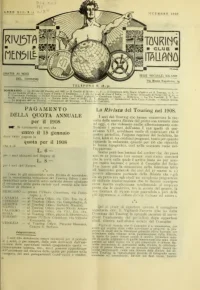
- Reminder that the 1908 subscription (L.6 in the Kingdom, L.8 abroad) falls due by 15 January, and that members living in Bergamo, Catania, Florence, Genoa, Naples, Palermo, Rome, Turin and Venice must now pay at the new local Touring Offices or consulates instead of the Milan head office.
- The Direzione announces the magazine's redesign for 1908: illustrations on white American paper, official notices and consular lists on tinted stock, a coloured cover with a new vignette each month, a smaller format posted unfolded, more clichés and a regular Rivista delle Riviste; councillor-secretary cav. I. Vigliardi-Paravia reports on the study, noting a print run of 75,000.
- Signed C. V. Inauguration of the new forestry hut built at 1,200 m in the Rivolto (Revolto) valley of the upper Val d'Illasi, on land bought by the Italian government from the Trentino commune of Ala for reafforestation, attended by the Verona prefecture, the provincial forestry committee and the Club Alpino Italiano.
- Signed o. b. On the Dante Alighieri society's congress at Cagliari and Sassari, where most delegates behaved as tourists: excursions to Alghero, Porto Torres, Osilo and Ardara, the students' Amsicora at Sassari, and complaints about the Navigazione Generale's single Civitavecchia steamer and the Ferrovie Reali Sarde's 25 km/h trains. Touring members in Sardinia rose from 735 to 889.
- A group of castle notes drawn partly from A. Sorbelli's series in the revived Bologna paper L'Alpe, covering Monteveglio in the Bolognese Apennine, Duino and Miramare near Trieste, and the threatened castle of Bari.
- The turreted castle commanding the Samoggia valley on the Modena-Bologna border: held by the Byzantines and then the Lombards, besieged in vain by Emperor Henry IV in 1092, subjected to Bologna in 1198, and holding out in 1527 against the Duke of Bourbon's soldiers.
- The castle south of Gorizia on the road to Trieste, once held by the lords of Tolmino, where tradition says the exiled Dante was a guest.
- Built from 1855 for Archduke Maximilian of Austria on a rock near Trieste and lived in until he sailed for Mexico; its rooms keep his art and books, and one cabinet exactly reproduces his cabin aboard the Novara. Carducci sang its « bianche torri ».
- Protest at prefect Buganza's announcement to the provincial monuments commission that the great Norman-Swabian castle of Bari — associated with Roger the Norman, Frederick II, Charles of Anjou and Bona Sforza, and studied by Huillard-Bréholles, Schultz, Venturi and Bertaux — is to be turned into a judicial prison.
- The magazine's standing department on the Italian lakes, given over this month entirely to Lake Trasimeno.
- Report of the general meeting of the Società Anonima Navigazione Trasimeno at Passignano on 6 October, where marchese Giorgio Guglielmi reviewed the company's finances since 1906 and recalled Queen Margherita's tour of the lake; with a survey of the fifteen castles round it — Panicale's Perugino St Sebastian, Vernazzano's leaning tower, Montalera, Castiglion del Lago — and the lake's pike and regina fishing.
- Concluding instalment (Continuazione e fine) of the readers' survey of Italy's finest viewpoints, numbers 38 to 53; the editors close the inquiry, saying the hundreds of further replies cannot be printed because Italian viewpoints are effectively infinite.
- Cap. medico dott. Martino Cusani of Turin on the ruined Benedictine abbey on Monte Pirchiriano (961 m), an hour by cobbled mule track above S. Ambrogio station 28 km from Turin, looking over the Susa valley and the Chiuse dei Longobardi where the Lombards held Charlemagne's Franks.
- Prof. Enrico Melchiori of Stimigliano on the isolated Lazio mountain, ancient Faliscan sanctuary of Apollo sung by Horace and Virgil and refuge of St Silvester, whose summit commands Rome's domes, the Sabine and Alban hills, the winding Tiber and Lake Bracciano.
- Felice Melotti of Turin on the medieval castle of marchese Scarampi di Villanova at 310 m above the right bank of the Po, 7 km from Trino Vercellese, with a panorama running from Monviso to the Simplon.
- Virginio Rosa of Turin on the medieval castle above Caravino on the Strambino-Settimo-Rottaro road, said to hold Arduin's bones, looking over the Dora, the tower of Candia above its lake and the Ivrea moraine amphitheatre.
- Giovanni Capra of Omegna on the 2,162 m summit reached from Omegna by Strona, Lusogno and the Alpe Campellaro, with views over Lakes Orta, Maggiore, Mergozzo, Como and Varese on one side and the Val d'Ossola and Sambughetto, home of the Monte Rosa guides, on the other.
- Umberto Oliva of Rome on the 2,487 m Abruzzo peak, a four- or five-hour climb giving views of the Sirente, Maiella and three-peaked Gran Sasso, the Fucino plain with the great collector tunnel draining it to the Liri, and as far as St Peter's dome and the Tyrrhenian.
- Giuseppe Robbiati on the 2,907 m Ossola peak, called the Righi of the Ossola, climbed in about five hours from Varzo on the Simplon line or from the Alpe Devero or Alpe Veglia, with an open refuge just below the top for those who stay to watch sunrise over the Alps.
- Pio Giuseppe Fassio of Genoa on the little-known 1,701 m beech-clad peak of the western Ligurian Apennine between Bobbio and Serravalle Scrivia, climbed from Cantalupo Ligure in Val Borbera, from Val Grue or Valle del Curone, or by the Monte Antola ridge from Torriglia; the nearest village is hospitable Aje di Cosola (926 m).
- Signed Q. T. The old castle 20 km from Verona, whose spiral stair leads to walls, ramparts and a tower commanding the plain, the Colognola hills, the castle of Illasi, the Trentine Prealps and Monte Baldo.
- Signed B. M. The Monferrato village at 507 m, on the highest hill of the Monferrato, Astigiano and Torinese, whose castle tower gives an almost circular panorama from the Maritime Alps to Monte Rosa; reached from Asti or Chivasso, or by the Torino-Brusasco steam tram, and hard going for cyclists.
- Emilia Sanchioli of Abbiategrasso on the Certosa di San Martino above Naples, now a museum, reached by the Piazza Dante-Vomero electric tram or the Chiaia and Montesanto funiculars, and on the view over the bay from its glazed Belvedere hall.
- Giuseppe Robbiati on the Ossola alp reached in under six hours of easy mule track from Varzo on the new Simplon line, a basin of pasture under Monte Leone with larch woods, rhododendrons, the small Monte Leone hotel open June to September, and a gaseous mineral spring at 1,832 m, the second highest in Europe.
- Innocente Sacchetti of Venice on the 1,765 m outer spur of the Belluno Prealps carrying the Club Alpino's Rifugio Budden, six hours from Belluno and about five from Vittorio, with views from the Tauern to the Rosengarten and out to Venice and the Adriatic.
- Umberto Guidi of Gallarate on the 1,308 m pilgrimage mountain west of Avellino, reached from Mercogliano and Ospedaletto, whose summit weather hut commands Irpinia, the Molise, Puglia, Naples, Vesuvius and Capri — yet the place has no decent hotel.
- Giuseppe Onofrio on the 2,372 m summit between Biella, Ivrea and Aosta, crowned by the monument to the Redeemer, whose panorama runs from the Apennines near Genoa to the Prealps near Bergamo.
- Rag. Riccardo Beduzzi on the 1,861 m peak of the Parma Apennine, whose ridge overlooks the mountains of Massa-Carrara, the Apuan Alps, the streams feeding the Magra and the Gulf of La Spezia.
- The magazine's standing motoring department, running from the tenth Paris Salon through the postal-van competition, the Milan car-lighting contest, Swiss army volunteer motorists and the Turin motor show.
- Signed a. m. Review of the tenth Paris Salon at the Grand Palais and Les Invalides: six cylinders now general on large cars and adopted even by Louis Renault, cardan drive spreading to small Fiat and Itala cars, limousines giving way to coupés, automatic starting quietly dropped after the 1907 season, the jante amovible still the basis of tyre practice, and the Salon to be held only every three or five years. The T.C.I. and the A.C. Milano shared a stand.
- The Ministry of Posts and Telegraphs offers 30,000 lire for the best motor omnibus to carry passengers, mail and parcels in regions without railways; the jury under senator conte Biscaretti di Ruffia, with prince Scipione Borghese and comm. Federico Johnson, closes entries on 10 December and meets again at Turin.
- The council of the Automobile Club di Milano will hold an international competition early in 1908 for the best generator, the best headlamp and the best complete car-lighting installation; the executive committee is on. comm. Silvio Crespi, nob. Fazio Dal Pozzo, dott. Alberto Pirelli, Luigi Brigatti and conte Carlo Sorniani.
- The Swiss federal council creates a corps of volunteer motorists who serve four years with their own cars, may bring a mechanic, rank as ungraded subaltern officers with uniform and revolver, and are exempted from other military duty and from the tax.
- Ugo Casalis's report on mechanical traction on ordinary roads, approved at the 11 November Milan congress of Italian motor-vehicle builders and operators and now to be circulated to every chamber of commerce, urging government to cut back the tangle of existing laws and set up a clear system of concessions.
- The Automobile Club di Milano reopens its chauffeurs' school after last year's good results; lessons begin on Tuesday 7 January 1908 with an inaugural address by on. Silvio Crespi, enrolment at the club in piazzale Stazione Nord.
- Restoration has begun on the Palazzo delle Belle Arti for the fifth international motor show of 18 January to 2 February 1908; entries closed on 30 November, the Touring will take its usual stand, comm. Federico Johnson sits on the honorary committee, and races and contests are planned for the fortnight.
- Notice on customs triptyques left undischarged: French and Swiss are valid 16 months, Italian three, German a year, and the Austrian pass to the year's end with no single stay over a month; holders must return the counterfoils stamped by the exit customs to avoid paying duty.
- The magazine's standing motor-boating department, this month the trials of the Forlanini hydrofoil on Lake Maggiore.
- Trials at Laveno of the Società Leonardo da Vinci's Forlanini N. 1: a fusiform hull with submerged fore and aft foils and two five-bladed air propellers driven by a 75 hp Fiat, 1,700 kg all told, timed at over 72 km/h. On 14 November, before ing. Lavasseur of Paris, ing. Braty of Ganz, prof. Menozzi and Bertarelli, it rose about a metre clear of the water.
- The magazine's standing cycling department: St Catherine adopted as patron of cyclists, a Greek club tour of Italy, and petitions from cyclists at Parma and Pavia for the right to use certain roadside paths.
- After L. V. Bertarelli's article in the previous issue on Ravello and its St Catherine holding a bicycle, a committee at Borgomanero proclaimed her patron saint of cyclists and marked her feast on 25 November with a banquet.
- The Elliniki Podhilatiki Etairia will send a party of Greek cyclists to Italy in spring 1908 to repay a Touring visit to Greece: landing at Naples from Piraeus, they will ride to Rome, Viterbo, Orvieto, Siena, Florence, Bologna, Milan, Padua and Venice in 25 days, with about ten Athenians so far enrolled.
- The magazine's standing mountaineering department, this month the prize-giving of the Federazione Prealpina's Tiratori Alpinisti.
- Medals from the Federazione Prealpina's first Tiratori Alpinisti shooting contest of 21 October were distributed at the Boldinasco range on 24 November: the King's gold to the Società Escursionisti, the war ministry's to the Alpinisti Monzesi, silver to Sempre Uniti and the Alpina Operaia of Lecco, with championship golds to Attilio Conti, Carlo Preattoni and Oreste Silvestri.
- Signed a. b. b. Legal notes: the Cossato magistrate acquitted Pietro Pariani because a commune's messo cannot book offences under the general road-police regulation of 8 January 1905; the Cremona tribunal acquitted avv. Beniamino Ranza and his chauffeur, holding pedestrians owe drivers the same care; Turin quashed a fine on the club's own consultant avv. Ceresole for cycling on a footway; and a warning about vexatious agents at Mestre and Lesa.
- Book notices: Paride Razzini's Considerazioni sul ciclismo militare, which urges merging the twelve bersaglieri cyclist companies into three battalions; Luigi Pochini's Pro Dirigibile Fiorenza; Colombi's Annuario ufficiale del Cantone Ticino; Werth's L'industria galvanica (Hoepli); the L'Express European railway timetable; and Lorraine-Dietrich's Les Grands Itinéraires Français.
- The Touring reprints its illustrated work in 31 fascicles on American paper, with two thousand photographs and text by Ottone Brentari; 29 parts are already printed and the complete set is offered to members at L.26 post free within the Kingdom as a Christmas present.
- Standing department on the club's 1:250,000 map of Italy, this month a vanished road missing from the Pisa sheet, a Sardinian place-name inquiry, and news of the Livorno and Brescia sheets.
- L. V. Bertarelli's history of the road Francesco III d'Este ordered in 1738 and had the mathematician Domenico Vandelli build over the Alpe di S. Pellegrino to link Modena with Massa and Carrara: 250,141 lire to reach S. Pellegrino, forced snow-clearing gangs, land and tax exemptions for settlers, and doubled duties on the old Montefiorino route — yet it was abandoned and so is absent from the Touring map.
- Signed o. b. An on-the-spot Sardinian inquiry into whether the Carta d'Italia should keep the Sulcis word furriadroxiu: prof. Angelo Cossu of Sassari would substitute casa or capanna, avv. Ugo Ranieri of Cagliari accepts either form, and on. Enrico Carboni-Boy with eight other Sardinian notables signed a declaration that the Istituto Geografico Militare wording must stand unaltered.
- L. V. Bertarelli reports the Livorno and Brescia sheets going out and Pisa and Bologna-Firenze to follow at the end of December; the map envelopes now carry a kilometric scale on their stiff edge at ing. Rabbeno's suggestion, a tiny stud on each station symbol shows which side of the line the building stands, and he reads the Elba and Po-valley landscapes off the sheets.
- Lists by name and town the local collaborators thanked for sheets 18 (Bologna-Firenze), 17 (Pisa), 11 (Brescia) and 21 (Livorno) of the Carta d'Italia — engineers, doctors, surveyors, parish priests, mayors, town clerks and the Genio Civile and provincial technical offices.
- Two new local promotion societies: the Società Pro Devero, based at the Alpe Devero in July, August and September, to keep its scenery intact and improve its communications; and the Società Pro-Introbio under ing. Giulio Martelli with Angelo Tomè as secretary.
- The club's standing roads section: the Commissione Strade's decisions, plus a Genoa hamlet left roadless by a quarry, the proposed Val Pellice-Val Queyras carriage road, the Austrian Zara-Montenegro coast road for motorists, and the Cerro-Laveno lakeside road.
- Decisions of the executive committee: a badge of recognition for the cantonieri who entered the Manuale pratico del cantoniere stradale competition; chasing the provincial technical offices that have not yet returned the roads inquiry; contributing to the machine competition Turin province means to hold for road maintenance; and printing the pamphlet on draught effort in relation to wheel-rim width.
- Readers' letters on Fazzari's proposed motor highway: ing. Vittorio Zangelmi and dott. Pietro Bruni of Turin both want the ordinary road network mended first, since a third of Italy is served only by mule tracks; Fosco Tricca of Marradi would add a lane for ordinary traffic and build it through road consortia; and prince Giuseppe di Scalea, capoconsole at Palermo, asks that a Turin-Reggio road be continued into Sicily.
- The Touring Club Italiano advertises for a competent civil engineer with modern training for continuous work in the technical section of its Milan offices; applications with credentials to the secretariat, via Monte Napoleone 14.
- Direzione resolutions: enrolling the club in the second Paris denatured-alcohol congress with George Bertaux as delegate; life membership of the Società Geografica Italiana; Johnson's appointment to the postal motor-van jury; a telegram to minister Lacava on cutting the bicycle tax; the 1908 Annuari commissions; condolences on the death of A.C.I. president prince Strozzi; and the election of marchese Ferrero di Ventimiglia to succeed him.
- Questionnaires for the Annuario Generale 1908 have gone out to consuls, town clerks and members, who are asked to return them promptly, other members being invited to help using the form inserted in the November issue.
- The order of issue of the map sheets: Torino, Milano, Venezia and Genova free to 1906 members in February 1907; Civitavecchia and Frosinone in July, Roma and Napoli in October, Brescia and Livorno during December, Pisa and Bologna-Firenze from the year's end. The 12-sheet 1906-07 block is offered complete to new 1908 members for L.6.
- The hotel-improvement commission met at the Touring on 14 November under Luigi Gavirati, with Bertarelli, Brentari, Binda, Caspani, Consonni, Mazzola and Zaffaroni: it resolved on regional meetings of consuls and hoteliers, a competition for hotel designs to feed a technical manual (Binda and arch. Giachi), pressure on public-health offices over latrines and baths, and a Rivista inquiry into places that lack hotels.
- A Touring Club Argentino has been founded at Buenos Aires by local sportsmen; the ministry of public works has promised support for road improvement in Argentina, the founder members have subscribed 33,000 lire, and the first assembly falls this month.
- S.A.R. Elena d'Orléans, duchess of Aosta, joins the members of the royal house enrolled as life members of the Touring.
- The communes of Arenzano, Garlasco Lomellina and Novara are added to the municipalities enrolled as life members, appearing in this issue's candidates list.
- Bergamo members may again pay their 1908 subscription at the local consulate in via Paleocapa 3A, which issues the receipt and 1908 tab, enrols new members, stamps their cards and keeps a full stock of Touring publications and small goods.
- Ninth list of newly appointed consuls, from Acquate, Acqui and Altamura to Sanluri and Trinità, including Emilio Lattes at Buenos Aires, Camillo Andrei at New York and Roberto Uziel at Genoa.
- Ninth list of the club's affiliated doctors, including dott. Salvatore Mannuzzu, dott. Teresio Martinengo, dott. Piero Pistono, dott. Nino Dosi at Corte Cerro, dott. Carlo Borsini and dott. Giovanni Audrich.
- Eighth list of the club's legal consultants: avv. Augusto Bruni and avv. Arturo Marchi.
- New affiliates in four classes: garages (Società Automobili « Roma » and the Hôtel Savoy), the mechanic Vittorio Inquet, pharmacists cav. prof. Luigi D'Emilio, Luigi de Dal Lago and Giovanni Raviola, and the petrol dealers listed under section IV.
- List of members who have taken the five-year subscription, from geom. Guido Pinerolo to Alberto Traldi of Milan, bringing the total to 5,013.
- List of members honoured for recruiting, including avv. Roberto Genova, cap. Riccardo Calcagno and rag. Claudio Prada of Milan, bringing the total to 1,332.
- Obituary of Oreste Gorla, who died suddenly at Gorla on 12 November 1907: a founder of the Touring in 1894, councillor from the start and deputy capoconsole generale from March 1896 until his resignation in September 1904, when the council voted him its gold medal of merit; the Direzione recalls his celebrated after-dinner oratory.
- New signpost donations from the province of Padua, the councils of Dovadola, Fossato, Pisogne, Russi, Scorzè and Seriate, Mario Angelini of Scandiano, console Conestabile della Staffa and Philipp Schoeller of Vienna, taking the running total to 2,810 signs and L.38,848.
- The November article has stirred the petrol trade: dealers complain that buyers now demand petrol guaranteed to distil completely below 100°C rather than sold by the empirical gravity reading. Pending a simple field test, members are advised to buy nothing denser than 0.700; the Comando del Corpo di Stato Maggiore's letter of 8 October thanking the club's benzina section for the grand manoeuvres is printed.
- The new Italo-Russian commercial treaty cuts the Italian import duty on light mineral oils from L.24 to L.16 from 1 January 1911 — a gain for motoring unless carburation has meanwhile changed.
- List of candidates for membership who applied between 1 and 31 October 1907: life members first, among them the duchess of Aosta at Naples, Hussein Chérif Bey at Bologna and the communes of Arenzano, Garlasco Lomellina and Novara, then annual members arranged by province and by country abroad.
- Bound-in note on the club's map: engraved rather than drawn on stone, with hachured relief, in 58 sheets with 58 partial indexes, a general index and a report; given free to members over five years, it should reach some 100,000 complete copies or 5,800,000 sheets, a diffusion no commercial publisher could match.
- List of the extraordinary prizes to be drawn in January among members who enrolled ten or more subscribers during 1907, one ticket per ten enrolments; the first prize, given by Ugo Bellani of Milan, is a leather-covered aluminium folding camera with rectilinear lens and three-speed shutter.