Rivista Mensile del Touring Club Italiano, Vol 13, No 2
Articles in this issue
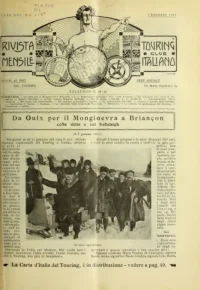
- Account of the Turin consulate's 6-7 January 1907 sledge and bobsleigh run from Oulx over the Monginevra to Briançon, led by capo console cav. Alfredo Rostain and filmed by Ambrosio, with lunch at the Croce Bianca in Cesana and an extra ranfòrz horse harnessed for the climb. Beyond the France signboard, between the sources of the Dora and the Durance, the party explored Briançon's steep grande Rue, its military dovecote and the cathedral built to Vauban's design.
- Dott. Carlo Ferranti's tour of the Marsica, reached by the three mountain railways that climb out of Sulmona towards Aquila, Avezzano and Isernia. He describes Celano and its Piccolomini castle, the skull-lined crypt of S. Giovanni and the church of Santa Maria in Valleverde, the eight-kilometre Fucino collector canal running to the Incile, the Liri cascade and timber ropeway at Capistrello, the gorges of the Foce torrent and the climb to S. Potito.
- The Circolo Numismatico Milanese, whose president is prof. Serafino Ricci, devoted a special number of its Bollettino di Numismatica e di Arte della Medaglia to the medals and coins shown at the Milan International Exhibition. The Rivista reproduces several, among them the Simplon tunnel medal with its two portals and perforating machine, Queen Victoria's jubilee medal, William Wyon's portrait of James Watt and the 1843 foundation medal of the Milan-Venice railway.
- Ing. Massimo Tedeschi's survey, in the Sezione Strade, of the road machinery other nations showed at the Milan Mostra Stradale: the French Ministry of Public Works' paving models, including the S. Raffaele porphyry carriageway of the Marseille Cannebière, and a Dion Bouton five-cubic-metre steam watering cart for the Bois de Boulogne. Germany, Austria, Switzerland, Argentina, Peru and Hungary follow, with Vienna's 400 km of mostly double-track tramways and a Schmid-Michtener trailer snowplough.
- L. V. Bertarelli announces that the Touring's Council has voted two extra sheets of the 1:250,000 Carta d'Italia — 7 bis (Trieste) and 13 bis (Fiume) — carrying the map past the political frontier to take in the whole of Istria. He presents it as an affirmation of the association's italianità, made possible by offers of local documentary help.
- Despatch terms for the Carta d'Italia: the first four sheets (Torino, Milano, Genova, Venezia) began going out on 30 January and are free to members of 1906, while those joining in 1907 may buy them for L. 2, or L. 2.20 registered. No advance despatch is possible, a second copy can be sent unfolded for binding, and the Touring declines to mount sheets on cloth as the mounting would cost about as much as the map.
- A member urges that the projected Rome-to-sea road be built at once, at least 60 metres wide and divided by tree rows into six lanes for the electric tram, ordinary vehicles, saddle horses, bicycles and pedestrians. Meanwhile the new avenue from Ostia to the sea has opened, though the Tribuna warns that its seaward circular piazzale is nothing but gravel spread on beach sand, in which heavy motor cars will sink; a following note reports the Lega contro la polvere's winter goudronnage trial.
- The motoring department for February 1907, signed by ing. prof. Effren Magrini, covering the season's detachable wheels and the newest American shock absorbers.
- Detachable wheels since Michelin's use of one in the 1906 French Grand Prix: dott. Pietro Petracchi of Varese's 1905 design, now backed by a new company, and the French Sadjal wheel on the Lonstaunan system, which toured Italian garages and changed a tyre in four minutes at Turin, two or three with practice. The 1907 Hartford Rubber Works wheel of Hartford, Conn. dispenses with bolts, locking its movable steel rim by a right- and left-hand double screw turned through a pinion and worm wheel.
- Four new American elastic suspensions: the hydraulic Graygood (J. E. Smith's patent, Grahann & Goodman of New York), whose piston works in a cylinder of water or glycerine; the Vestal of the Vestal Shock Absorber Company of Pittsburgh, combining a friction collar with two coil springs; the Shippey, a curved steel plate passing between two rollers; and the friction ring-and-collar Toquet of South Norwalk, Conn.
- Argues the tricar never took hold in Italy because it had neither the motorcycle's nor the car's advantages while suffering the drawbacks of both. The recent Paris Salon produced its successor, the trivetturetta — a three-wheeled cut-down car that can carry pedal clutch and declutch, a hooded body and even a train baladeur gearchange — which the writer expects to succeed where the vetturetta failed as the cheap car for everyone.
- From the Locomotion Automobile, a review of motorcycle design since Werner's first roadworthy machine: the De Dion Bouton type engine has settled vertically at the bottom bracket, with magneto ignition and automatic carburettor, and the frames of Werner, Seidel & Naumann, Brennabor, Puch and Laurin & Klément are compared. It closes on lord Tollemache's machine — six V cylinders, clutch, gearchange, springs front and rear, chain drive — and the chain-and-belt and cardan-shaft runners-up.
- London already runs two thousand motor omnibuses with some 1,200 more due within a year, and their noise and smell have driven tenants out and depressed house values along the streets they use. No authority, not even the police, can impose a route on them; the underground lines from the City to the West End have lost so much traffic that the District Railway, losing nearly 100,000 lire a month, is raising fares.
- Faroux's table of annual motor-car output reprinted from the sporting press: Italy rises from 300 cars in 1901 to 18,000-19,000 in 1906, France from 1,631 in 1898 to about 55,000, England to 27,000-28,000, Germany to about 22,000, Belgium to about 12,000 and the United States to 58,000-60,000.
- The Touring backs the Turin motor manufacturers' committee against the petrol duty, arguing Italy depends wholly on imports since the Fiorenzuola d'Arda refineries produce too little. Foreign refiners now ask fr. 47-48 a quintal against L. 25-26 last year, and with 48 francs of duty and carriage the 1907 price will reach L. 130; Austria's threatened 11-franc export duty would worsen it, and the piece appeals to the ministries of Posts, Public Works, War and Agriculture against the Treasury.
- Plan of the halls and full numbered exhibitor list for the fourth international motor show at Turin, 16 February to 3 March 1907. Exhibitors range from Minimax extinguishers and La Stampa Sportiva to Soc. Italiana Autom. Darracq, Garage Marquart with Delaunay-Belleville, Garage Squaglia with Napier and La Buire, Hermes of Naples, Continental tyres, the Peugeot agents Fratelli Picena and Oleum lubricants.
- The cycling department for February 1907, carrying the campaign for a reduced bicycle tax, a French motor-bicycle contest and news of the Casalbuttano club's spring tour.
- The Touring presses the campaign of its 56,000 members for a cut in the bicycle tax before the Finance estimates reach the Chamber, publishing a further roll of supporting deputies including Abozzi of Sassari, Barzilai of Rome, Fradeletto of Venice, Galimberti of Cuneo, Facta of Pinerolo and Molmenti of Salò. It also names the consulates — Acqui, Bari, Belluno, Biella, Rimini, Varese and many more — that had still not answered the referendum by 15 January.
- L'Auto, the French sporting daily, will hold a contest for motor bicycles in 1907 to demonstrate the practicality of a machine that forms the link between the bicycle and the motorcycle, taking the advantages of both and, for touring purposes, avoiding their faults.
- The Touring members of the Casalbuttano consulate, who also belong to the 150-strong local Società Sport, will make an eight-day cycling tour next May from Casalbuttano to Genoa, San Remo, Monte Carlo and Nice and back, accompanied by the club's fanfara. Fifty have already entered, and Gino Usuelli is organising the run.
- Book notices, prefaced by a reminder that the Rivista prints 75,000 copies and that one of any two review copies stays in the Touring's library. Titles include A. Venturi's Storia dell'arte italiana vol. V (Hoepli, 1907), Giglio-Tos's butterfly album Tra le farfalle (Clausen, Turin), the Biasutti-Bortolotti guide to Tricesimo, Angelo Sullam's Die wirtschaftliche Entwicklung Italiens im Jahre 1905 and Tedeschi's Adattamento delle strade alla locomozione automobile.
- Notes from other periodicals: Arturo Frova on the Gothic churches of Cadore in Rassegna d'arte, the first number of the Illustrazione Veneta e Adriatica, Bistolfi's Segantini monument at the Maloja in Alpinismus und Wintersport, E. Clausetti on the aeronautical section of the Milan Exhibition and Celestino Usuelli's balloon crossing of the Alps, Fahrrad und Automobil Export's Italian cycle and motor trade figures for 1906, and travel articles in the Touring Club de Belgique's monthly.
- The Touring's new first-aid outfits for motorists, made because so many Italian communes have no chemist. A leather-covered 19x17x26 cm case built to the Touring's specification by Marucelli of Milan holds compressed cotton, bandages, antiseptic solutions, ten tubes of tabloids, thermometer, forceps and scissors at L. 100; a two-compartment japanned tin case from Burroughs Wellcome of London costs L. 120, with smaller pouches for motorcyclists and cyclists at L. 65 and L. 15.
- The Touring's official communications for February 1907, covering the Council's deliberations, the year's publication programme, the new regimental consulates, affiliations and the roll of candidate members.
- Council minutes: comm. Bertarelli hands out the first four sheets of the Carta d'Italia (Torino, Milano, Venezia, Genova), credits councillors Guastalla and Moldenhauer and the Istituto Geografico De Agostini, and wins a commemorative medal for its workforce. The Council approves the extra sheets 7 bis (Trieste) and 13 bis (Istria), a new roads commission, a new edition of Attraverso l'Italia, patronage of the 1908 Piacenza Po-bridge festivities and the petition against the petrol duty.
- The year's publication programme and the state of each despatch: the Trentino sheet of the frontier map, the 240,000 copies of the first four Carta d'Italia sheets due with entitled members within February, and the 1907 entitlement of Rivista Mensile, a renewed Annuario Generale, the second and third groups of map sheets and illustrated route profiles — about L. 21 of value, where the T. C. F., C. T. C. and T. C. B. sell rather than give their publications.
- The Direzione used the publication of the 1:250,000 Carta d'Italia to spread the Touring's aims among young army officers, obtaining the higher authorities' opinion on setting up consulates within the regiments. The canvass of regimental commanders was well answered and gave very encouraging results, and the appointments approved run for the 1907-1908 biennium.
- Register of newly affiliated tradesmen and hotels, opening with chemists at Momo, Ponne and Varese Ligure, and asking consuls to have the old affiliation plaque changed. It records affiliations lapsed at Prato, Sestri Levante and Sturla, places where petrol has fallen in price (Caselle Torinese, Formia, Sasso, Seregno) or risen (Aprica, Bergamo, Monselice), and notes that the Hotel Trombetta at Turin no longer exists.
- Roll of candidates for membership of the T. C. I. who applied between 1 and 30 December 1906, given first as soci vitalizi — from Cantalupo of Alba and Borla of Biella to the Magyar Automobil Club of Budapest, Gavotti of Genoa and prince Pierre d'Arenberg of Paris — and then as annual members arranged by province.