Rivista Mensile del Touring Club Italiano, Vol 13, No 3
Articles in this issue
- Notice convening the Touring's general assembly for Sunday 17 March 1907 at the Palazzo dell'Esposizione Permanente in via Principe Umberto 31, Milan, with an agenda covering the 1906 accounts and the election of six councillors (Gavazzi, Johnson, Moro, Belotti and others) and three auditors; signed Federico Johnson and Innocenzo Vigliardi-Paravia.
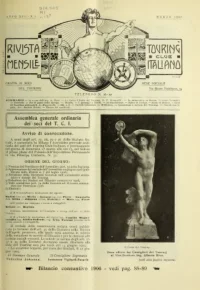
- Account of the intimate gathering at the Touring's Milan headquarters on the evening of 30 January honouring ing. cav. Alberto Riva, for twelve years vice-director-general before handing the post to Luigi Vittorio Bertarelli; director-general Federico Johnson presented him with a bronze "Genio del Touring" modelled by the sculptor A. Dal Castagnè in the Johnson works.
- L. V. Bertarelli reports that the Civitavecchia (27), Roma (28), Frosinone (34) and Napoli (35) sheets are well advanced, names Verona (12), Messina (51), Reggio Calabria (52) and Catania (56) as the fourth instalment, and explains that flat unfolded copies of the first four sheets, sold at L. 2, are given free to new five-year and life members.
- L. V. B. publicly thanks the bodies and individuals who assisted with the first four sheets of the Carta d'Italia, from minister Cocco Ortu and the Forestry Administration to war minister Viganò, the Ferrovie dello Stato under comm. Riccardo Bianchi and the Istituto Geografico De Agostini.
- Corinna Corinaldi of Padua drives from Turin through Ivrea and the Val d'Aosta past the castle of Fénis and the Arch of Augustus at Aosta, on to Chamonix and the Mer de Glace, Lake Geneva and Chillon, Ripaille where Amedeo VIII abdicated in 1434, the Grande Chartreuse, Briançon and the Monginevro pass, returning by Cesana, Pragelato and Fenestrelle.
- The railway department for March 1907, carrying the Grisons concession request for the Splügen line, the Milan rail-layout commission's report and an advertisement for prof. Ottone Drentari's twelve illustrated Touring line-guides at 50 cent. each.
- The government of the canton of Grisons has asked Berne to concede the Chur–Chiavenna Splügen railway: 84 km, of which 50.925 in Swiss territory, a 26.135 km summit tunnel with three crossing stations, 300 m minimum radius and 26 per mille maximum gradient, steam-worked to Rothenbrunnen and electric thence to Chiavenna.
- Milan's commission on the city's railway layout proposes a new marshalling yard at Lambrate for up to 10,000 wagons a day, a new goods yard north of the Cimitero Monumentale replacing Porta Garibaldi, demolition of the Stazione Centrale for a two-level terminus to its north, and new yards at Porta Vittoria and for livestock.
- The new Société Française d'Initiative pour les Transports par Automobiles, using Darracq-Serpollet material under president Jules Niclausse and managing director C. L. Charley, would run motor services on ordinary roads instead of building branch railways — France has 46,762 km of rail against 700,000 km of road, Italy only 16,226 km and 138,096 km.
- The Touring's own experiments on level-crossing barriers, authorised by the Ferrovie dello Stato in November 1906 and carried out at Rogoredo, Musocco and Acquabella, with replies gathered from the Swiss Touring Club, the Algemeene Nederlandsche Wielrijdersbond, the Deutscher Radfahrerbund and the Cyclists' Touring Club of London on colouring and night lighting.
- Public works minister Gianturco asks the presidents of the provincial deputations to send in, by 30 June, their road-building programmes for the 1907-1908 to 1912-1913 six-year period together with commitments already entered into, so the State's contribution can be budgeted.
- After the Rivista's February article "Contro il rincaro della benzina", minister Massimini has laid a bill cutting the petroleum duty from L. 48 to L. 24 the quintal and abolishing the L. 10 internal manufacturing tax; the T. C. I. announces bench tests of 720-730 gravity petrol of Russian, German, Roumanian, American and Italian origin on fixed engines.
- Prague's third motor show runs 24 March to 1 April in the Palazzo dell'Industria; Madrid holds its first, under the patronage of the King of Spain and the Royal Automobile Club, from 4 to 19 May; Zurich's third opens in the Tonhalle from 14 to 26 May.
- Trials by New York's chief municipal engineer show refuse hauled 3.5 km costs L. 1.40 a tonne by motor lorry against L. 2.20 by horse, one motor lorry and trailer taking eight tonnes in the loading time of a 1,750 kg cart; a motor water-cart covers in ten minutes a round taking a horse cart half an hour, of interest to Turin and Milan.
- Why makers quote two figures for one engine — 16-20, 20-24, 40-50 HP: some rated simultaneously in poncelets (1 poncelet = 1.35 HP) and horsepower, while Hotchkiss's 17-30 meant 30 HP at the motor and only 17 available at the driving wheels; catalogue figures are deliberately understated as a safety margin.
- The IV Esposizione Internazionale di Automobili at the Valentino was opened on Saturday 16 February by the Duke of Genoa with the Marchese Ferrero di Ventimiglia, president of the A. C. T., Senator Frola and minister Schanzer; 164 exhibitors against 66 last year, and the Duke visited the Touring stand, received by capo console Rostain, admiring the new road signs and the Carta d'Italia.
- Regulations for the III Milan Salon, to be held from 18 May to 9 June at the Parco in the old Decorative Art pavilion of the 1906 International Exhibition, with sections for cars, chassis, motorcycles, bicycles, motor boats, tyres and accessories plus an aeronautics section, entries closing 1 April and a minimum stand of three and a half square metres.
- After two accidents in Rome and questions in Parliament, the Public Works Minister has circularised every prefect urging strict enforcement against motorists and empowering mayors to close urban streets or impose walking pace; the Touring protests that carters, cabmen and pedestrians cause more accidents and has petitioned both the Lavori Pubblici and the Interno.
- First instalment by ing. Andrea Maggiorotti on chassis types for lorries and omnibuses, arguing that Italy's gradients and poor road surfaces rule out the heavy English pattern: wheelbases are lengthening from 3 to 4 m and chassis to 6 m, steering lock has grown from about 30° to 45°, and track from the traditional 1.50 m to 1.80 or 2 m.
- A survey of skiing in Italy, introduced ten years earlier by engineers Kind and Hess of Turin, with interviews of Antonio Rossini of the 135-member Ski-Club di Milano (outings to Picco di Bobbio, the Fortino di Porta Vittoria and Andermatt, and the new Baita Coltignone), avv. Guffanti of the Escursionisti Milanesi ski section founded in 1905 under Gustavo Engelmann, and captain Adolfo Viola of the 5° Alpini on army ski courses at Campodolcino and Monte Spluga since 1902.
- New subscriptions from the provinces of Florence, Verona, Pisa and Genoa, the F. I. A. T. of Milan and others bring the Touring's road-sign fund to 2,020 signs and L. 28,048, followed by lists of signs erected in the Spezia and Chiavari districts of Genoa province and in Modena, Rome and Pisa.
- The club's official section for March 1907, carrying the January-February council resolutions, news of the Carta d'Italia despatch, subscription and address-change rules, club news and obituaries.
- Resolutions of the sittings of 28 and 30 January and 4, 9 and 11 February: cav. ing. Francesco Pugno named the Touring's representative on Gianturco's new roads commission at the Ministry of Public Works, a hotel-improvement commission created, patronage granted to the Reggio Emilia, Agnone and Perugia rallies, a silver medal to ing. Piero Pagliani for a Sicilian railway guide, and some 300 favourable replies from deputies on cutting the bicycle tax.
- The committee of the VI Italian Geographical Congress, meeting at Venice from 26 to 31 May 1907, invites comm. L. V. Bertarelli to present a memoir or lecture on the Carta d'Italia, calling its publication the greatest Italian cartographic event of the year.
- The despatch begun on 31 January involves 240,000 sheets, 240,000 indexes, 240,000 waterproof envelopes and 60,000 wrappers — 780,000 pieces — with thirty workers making no more than 2,500 complete blocks a day; delivery is complete for Milan, Turin, Genoa, Venice and Rome and for other provinces alphabetically to C, and portfolios and index boxes are promised in economy and luxury models.
- The Council grants the first four flat sheets free to members joining in 1907 as five-year or life members, and to 1906 members who renew for five years at L. 30 or become life members for L. 100 (L. 90 after two years' membership); those who already paid L. 2 for the sheets are refunded.
- Members are asked to write briefly, use a separate sheet for each subject, sign legibly with their address and membership number because of the many namesakes among members, and enclose a stamp; queries already answered in the Rivista will simply be referred back to the relevant number.
- From 1 March a late-payment surcharge of 20 cent. for Milan members and 55 cent. for those outside applies, and from the 15th arrears will be collected by assegno of L. 6.20 for Milan and L. 6.55 for the rest of the kingdom.
- The administration explains that address changes cannot take effect for about a month because addressing work begins twenty days before despatch, and warns it may have to charge for members who notify several changes in a single year, as newspapers and foreign Touring clubs already do.
- The Genoese photographic society "La Luminosa" announces a 1907 competition on its own plates, closing 30 June, with 38 prizes worth L. 5,000 in all plus five five-year Touring subscriptions.
- Prince Prospero Colonna and comm. ing. Oreste Lattes, capo console and console for Rome, head the new Roman committee of the national physical-education institute; ing. C. Curti, aged 23, takes the automobile-construction chair at Strelitz; ing. Carlo Leidi opens a course for chauffeurs in Milan; and Mariano Savari of Ancona, past fifty, rode 5,050 km between 24 April and 6 November.
- Reggio Emilia's general touring rally is fixed for 18, 19 and 20 May; Padua's Pro Touring held its annual assembly under president dott. Domenico Meneghini; and the Milan consulate, under capo console cav. Pizzagalli, plans a May cycle, motor and tramway outing to Trezzo d'Adda to see the Crespi hydro-electric works.
- Obituaries of avv. Paolo Prudenzini, newly appointed console at Breno and climber and describer of every peak of the Val Camonica from the Baitone to the Concarena, dead at barely fifty, and of Ernesto Rossi of Padua, road endurance champion and member since the club's foundation, killed in a motorcycle accident.
- The balance sheet at 31 December 1906, showing assets and liabilities of L. 537,272 and a general administration account of L. 411,166 on 43,451 renewals and 8,903 new subscriptions — 52,354 members in the year — signed by auditors Magnacavallo, Soffredi and Turrini, accountant Pietro Moro and director-general Federico Johnson.
- The auditors Camillo Magnacavallo, Attilio Soffredi and Gino Turrini report the club's patrimony up by L. 15,058.78 in the year to L. 337,457.60 at 1 January 1907, praise the administration's handling of the Exhibition, the membership growth to 55,000 and the Carta d'Italia, and invite members to approve the accounts.
- Reconfirmations and a first list of new consuls for the 1907-1908 biennium, from Alfedena and Aquila to Venaria Reale, including regimental consuls in the alpini, bersaglieri and artillery and, for Rome, provincial delegate Prince Pietro Lanza di Scalea with capo console Prince Prospero Colonna.
- First list of the Touring's medical section for 1907-1908, naming club doctors from Agnone and Balzola Monferrato through Belluno, Ciriè, Desenzano and Forlì to Rosignano Marittimo.
- First list of the club's legal advisers for the 1907-1908 biennium: avv. Flaminio Ricci at Arezzo, avv. Ugo Allegrini at Catanzaro, avv. Pietro Orioli at Faenza, prof. avv. Vincenzo Manzini at Siena and others.
- New affiliated mechanics, garages and hotels — Fratelli Pedraglio of Como, the Garages Riuniti "Fiat-Alberti-Storero" of Milan and Rome, Pattison of Naples — with room and meal tariffs for hotels at Aquila, Falconara, Gallarate, Genoa, Mantua, Mendrisio, Milan and Porto Maurizio, and notes on petrol affiliates, price rises at Chiavenna and Mantua, and the new blue enamelled plaques.
- Twenty-fourth list of new petrol affiliates, numbered from 442, opening with rag. Ercole Sancinni of Fossombrone selling benzina 695/700 at L. 1.15 the kilo and the grocer Angelo Bianchi of Gallarate at L. 1.05, with Stern Sonneborn and Oleoblitz oils, grease, calcium carbide prices and opening hours.
- Books received and noticed: Pinardi and Schiavi's L'Italia economica (Milan, 1907), E. Pozzoli's prize-winning Monografia stradale della Provincia di Milano, the Sonzogno volume L'Esposizione di Milano illustrata, the Bayerischer Automobil Club Handbuch and Carabelli's La pratica del Codice civile, with review notes from the Lega Navale, the Allgemeine Automobil Zeitung, Pro Torino and the Touring Club de France.
- Avv. Bortolo Belotti, the new councillor delegate to the legal section, opens his term by asking the club's legal advisers throughout Italy to keep the department alive with information and to help members with particular questions.
- Belotti argues that communes municipalising public bill-posting cannot lawfully forbid private firms from displaying the Touring's affiliation plaques, since the plaques state a title held by the firm rather than advertising, and are issued by the club on deposit and not disposable as commercial publicity.
- Recent rulings: the Cassation of 23 October 1906 (Cortese) holds a bicycle tax plate must be physically fixed to the machine and not merely carried; a car owner absent from his speeding chauffeur is civilly but not penally liable (S. C., 24 July 1906, Cibelli); and hiring a car with chauffeur is a contract of carriage, not of hire (Milan Appeal, 31 October 1906).
- Members who applied for admission between 1 and 31 January 1907, listed by town as life, five-year and ordinary members, from Bologna, Brescia and Coggiola through Milan, Florence and Genoa to Porto Maurizio, Potenza and Ravenna.