Rivista Mensile del Touring Club Italiano, Vol 13, No 9
Articles in this issue
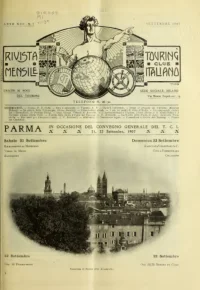
- C. N. Gatti's guide to Parma for the T.C.I. general convegno of 21–22 September 1907, tracing the city from M. Emilio Lepido's Via Emilia through Cadalo's Duomo, Antelami's Battistero begun in 1296, Correggio's cupolas in the Duomo and S. Giovanni Evangelista, the Teatro Farnese of 1618–19 and the Pinacoteca. It closes on the Castello di Torchiara, 15 km out, built in 1448 by Pier Maria Rossi, which the convegno excursion will visit.
- Hour-by-hour timetable for the Parma convegno: squads received 7–10 on Saturday 21 September, the municipal reception at the R. Teatro with the flag offered by the Parma ladies to the Touring consulate, museum visits and the new Ippodromo; Sunday brings the Volontari Ciclisti e Automobilisti muster at 6, the 17 km ride to the Castello di Torrechiara, the shooters' departure from the Ponte Taro range and a gala evening.
- The outings-and-meetings department for September 1907, running from the Perugia convegno through the Venetian consuls' first regional convegno (put back to 22 September at the Restaurant Bauer) and the Bagni di Casciana meeting with its congress on Tuscan road conditions, to news of Trieste's new Società Ciclistica Liberi e Forti, the Fivizzano convegno, the postponed Giro di Sicilia, Pescara's red-shirted squad at Solmona, Grottamare and Zogno.
- Report on the Touring convegno at Perugia, 24–26 August 1907, where the city's arms were added to the club standard at the Teatro Pavone, director-general comm. Johnson spoke for the sodalizio's sixty thousand members and a 500-cover banquet was held at the Teatro Turreno. Cycling and motoring parties came from Aquila, Vicenza, Parma, Milan, Siena, Gubbio, Bologna, Macerata, Turin and Rome, with a closing run to Assisi.
- A. F. marks the fourth centenary of Jacopo Barozzi da Vignola, born at Vignola near Modena on 1 October 1507, recalling his portico di Banchi at Bologna, S. Maria degli Angeli at Assisi, the Villa Giulia, the Farnese villa at Caprarola and his treatise on the five orders. The town's rocca on its tufo mass, the Palazzo Buoncompagni with its barozzian spiral stair and the Ponte Muratori are commended to visitors.
- Over twenty riders of the Società Ciclisti Veneziani, one of them a woman, under sporting director Giuseppe Zanetti rode from Mestre by Montebelluna, Cornuda and Feltre to Fiera di Primiero, walked up to S. Martino di Castrozza and crossed the snow-covered Passo di Rolle (1994 m) before descending to Paneveggio and Predazzo. They returned by Cavalese, Trento, the Val Sugana and Bassano, covering about 300 km in four days.
- Register of new subscriptions for Touring road signs, taking the running total from 2,619 signs and L. 35,548 to 2,652 and L. 36,033. Donors include the province of Cosenza and the communes of Brandizzo, Gattico, Marmirolo, Ospedaletto Euganeo, Quarona, Sesto S. Giovanni, Soncino and Spezia, with private members such as conte Eugenio Brunetta d'Usseaux and the Milan firm Ricordi Sessa e C.
- The roads department for September 1907, carrying Massimo Tedeschi on the surfacing of the Brescia motor circuit, Ottone Brentari on the Valtrompia and the new Pro Collio, and the resolutions of the Touring's own Commissione Strade.
- Massimo Tedeschi drives the 60 km Brescia circuit with ing. cav. Gola, director of works, describing how the A. C. di Milano committee of conte Marinoni, dott. Aldo Weill-Schott and cav. Mercanti took possession in April and had ing. Italo Vandone survey the macadam. Two thirds of the course was dust-proofed with Reinach's Fix and a third tarred, after three mechanical sweepers cleared 10–12 km a day and a new railway underpass freed Brescia of its level crossing.
- Ottone Brentari welcomes the new Pro Collio, modelled on the Pro Valcamonica of the late avv. Paolo Prudenzini of Breno, as a local improvement society for the head of the Valtrompia. He describes Collio, 40 km from Brescia with Federico Bagozzi's Albergo Mella and its hydropathic establishment, the climbs to Monte Pezzeda, Corna Biacca, Dosso Alto and the Colombine, and don Giovanni Bonomini's observatory at Memmo, which still lacks a telescope.
- Resolutions of the Touring's roads commission under ing. cav. Francesco Pugno, with Chiodi, Tedeschi and Gola as vice-presidents: Pugno's appointment to the Ministry of Public Works' national-roads commission, an inquiry into Novara's contractor-cantoniere maintenance trial, an anti-dust league on French and Swiss lines, Tedeschi's manuscript for the Manuale dello Stradino, a vote for the lakeside Azzano–Cadenabbia route and a 7 m minimum width for provincial roads.
- Continuation of the members' referendum on Italy's finest viewpoints, with Ferruccio Inselvini on Monte Generoso, sac. Gioachino Rebora on Santa Maria della Guardia above Genoa, Vincenzo Gaudio on Monte Aglio near Maddaloni and Francesco Fatuzzo on Monreale, followed by Rocca Priora, the Grigna Settentrionale, Campo dei Fiori, Monte Ceppo, Brunate, Monte Baldo, Gaino, Lagune di Bisano, the Altipiano dei Sette Comuni and avv. Ignazio Pandolfini on Taormina.
- The cyclist company of the 7th Bersaglieri rode from Milan by Arona along Lake Maggiore to Cannobio, up the Val Cannobina to the Piano di Sale (980 m) and down into the Val Vigezzo, then based itself on Domodossola for the Val Formazza and the 160 m Toce falls. Further runs took in the Simplon galleries and military works and Piedimulera–Macugnaga to the Monte Rosa glaciers, returning by Omegna, Gozzano, the Val Sesia, Varallo and Novara.
- The Touring's campaign to cut the annual bicycle tax from ten lire to five, backed by a referendum in which over 300 deputies declared themselves in favour. On. Massimini had agreed to lay a bill before Parliament, and his successor at the finance ministry, on. Lacava, has now taken the question up again.
- The Rivista salutes the 16,000 km Peking–Paris motor run made by prince Scipione Borghese, a life member who flew the Touring's guidon on his Italian car, with Luigi Barzini reporting and mechanic Ettore Guizzardi keeping it running. Capo-console Berteaux greeted him at Paris for the club, director-general Federico Johnson met the party at Courmayeur, and commemorative medals were presented at Milan.
- Vittorio E. Bravetta's ode on the Peking–Paris run, in which the Italian flag given to Borghese by the sailors guarding the legation at Peking — flown beside the Touring guidon — crosses Asia's burning plains and mountain gorges; a broken wheel is recut from forest timber by fair-haired craftsmen who still speak Latin, and the poet asks that it be hung up at Rome's ancient columns.
- Dott. Pietro Alvino of Capua summarises dottor Le Gendre's study in No. 21 of the Revue de Thérapeutique on motoring's effects on skin, airways, circulation, digestion, nutrition and nerves. He reports benefit for the anaemic, asthmatic, gouty and neurasthenic, warns off the tubercular with a tendency to haemoptysis and the gastric-ulcered, and would bar epileptics and habitual drinkers from driving altogether.
- Roche tells the medical committee of the Bouches-du-Rhône that defective eyesight is among the causes of motor accidents, citing a colleague's chauffeur blind in one eye and astigmatic and myopic in the other, and a young astigmatic advocate who on a motorcycle rode into a flock of sheep he had taken for a watered road. Alezais's motion to name a commission on a minimum visual acuity for drivers was carried unanimously.
- Notes on new public motor services: a consortium of Acquasparta, Massa Martana and Todi; an Italian company formed at Milan to run public cars at Naples; services opened on 2 August along the Via Emilia from Angelo to Reggio and Reggio to San Maurizio, with Novellara–Rolo and Reggiolo–Guastalla to follow; the maximum state subsidy for Sassari–Tempio–Palau; and steam cars between Borgo San Dalmazzo and Demonte.
- Carlo Valle reports the Sezione Veronese of the Club Alpino Italiano's enlargement of the Rifugio del Telegrafo on Monte Baldo, with a ground-floor refectory and two upper rooms, one reserved for ladies. He traces the approach by rail through the Valpolicella to Affi and Caprino, the carriage road to the Spiazzi and the Santuario della Madonna della Corona of 1625, and argues that the view from the Punta del Telegrafo (2200 m) rivals the Rigi and Pilatus.
- L. V. Bertarelli announces despatch of the Roma and Napoli sheets, which with Frosinone and Civitavecchia show the Alban and Phlegraean volcanic masses standing clear of the Apennine chain and the Matese block, and contrast the empty Campagna with the unbroken town from Naples to Caserta. Four more sheets — Livorno, Pisa, Bologna-Firenze and Brescia — are in hand, covering the Cento Croci, Bracco, Cisa, Cerreto, Abetone, Futa and Scarperia passes.
- Prof. Domenico Franchella rides up the Aventino valley to the Grotta del Cavallone at Lama dei Peligni, where the Società della Grotta's president Alessandro De Lucia has replaced a dangerous scramble with a blasted zig-zag ramp up seventy-seven metres of cliff. Quoting De Titta's verse and D'Annunzio's La figlia di Iorio, the party walks four kilometres in nearly four hours through the Caverna di Cosma, the Camera di Aligi and the Antinferno.
- L. V. Bertarelli contrasts the lighting of the Adelsberg and San Canziano caves, 55 and 25 km from Trieste. State-run Adelsberg is flooded by incandescent lamps and arc lights strung along the gallery roof, killing every shadow, with cable bundles, switch boxes and inn-sign labels in mangled Italian on show; San Canziano's 3,000 candles, under the D. u. Ö. Alpenclub, leave a Dantean gloom and a thirty-metre vertical line of flames hanging in the void.
- The library department for September 1907, reviewing console Ottorino Mondini's road guide to Castelleone and the Florentine societies' Istruzioni per lo studio della Colonia Eritrea, and listing the books presented to the Touring's library.
- Review of the hundred-page Guida stradale delle comunicazioni più comuni fra Castelleone ed i paesi limitrofi by geom. Ottorino Mondini, the Touring's console for Castelleone. Its 42 itineraries give distances both ways, notes on road upkeep and local altitudes, with an appendix carrying the velocipede and motor-car tax law and the cycling traffic regulations; price L. 0.80.
- Notice of Istruzioni per lo studio della Colonia Eritrea, published by Florence's Società di Studi Geografici e Coloniali and Società di Antropologia, Etnologia e Psicologia comparata under Paolo Mantegazza. Its 192 pages tell the non-specialist traveller how to record cartography, geology, hydrography, meteorology, botany, zoology, ethnography and prehistory, and how to photograph; L. 2.
- List of books presented to the Touring library, among them Photophilus's La Fotografia in pratica, Gai's guides to the Valle dello Spluga and the Engadine, ing. Pietro Rimondini's monograph L'Incatramatura delle strade, Luigi Orsini's Imola e la Valle del Santerno, G. Sergi's La Sardegna, the Automobile Club de Belgique's Annuaire 1907 and Izart's four-language motoring dictionary.
- The legal-advice department, printing two judgments of interest to riders and motorists: the Carpi magistrate on wheeling an unregistered bicycle by hand, and the Monza magistrate on a motorist's civil liability when a passing car set a draught animal bolting.
- The Carpi consulate forwards a judgment of 22 May 1907 by pretore avv. Giuseppe Fiore holding that article 4 of the law of 10 December 1905 does not catch a man wheeling an unregistered bicycle by hand. A bicycle-maker's boy delivering a new machine while riding a registered one was found to have committed no offence, the vehicle not being used for the purpose for which it is taxed.
- Judgment of 9 April by pretore avv. Vittorio Ceccon of Monza in Parodi v. Meda: Caterina Parodi was thrown from a cart near San Remo when Paolo Meda's car passed and the mule bolted, and was bedridden over forty days. Though the criminal court found insufficient evidence, Ceccon held civil fault distinct from criminal, cited article 67 of the road police regulation of 8 January 1905, and awarded L. 1,500 with 4 per cent interest.
- Resolutions of the Touring's general direction: a gold medal for the Parma convegno committee's V. C. A. shooting prizes, a silver one for Fivizzano on 29 September, and a reply to on. Raineri's Piacenza motor competition proposing a flotilla of motor boats from Venice up the Po for the new bridge. For the Peking–Paris raid, gold medals go to prince Borghese and his Italian companions, presented at Paris by capo console Berteaux.
- Obituary of Giulio Chazalettes, Piedmontese industrialist, councillor of the commune of Collegno, president of the sporting society Pro Grugliasco and Touring console, struck down by an assassin's hand on 9 August — a man he had long befriended.
- Monthly list of members proposed between 1 and 31 July 1907, opening with life members from Acireale, Latisana, Lonigo, Milan (including the Corriere della Sera and the Società Petroli d'Italia), Paris, Rome, São Paulo and Turin, then annual candidates province by province from Alessandria and Ancona through to Turin.