Rivista Mensile del Touring Club Italiano, Vol 15, No 11
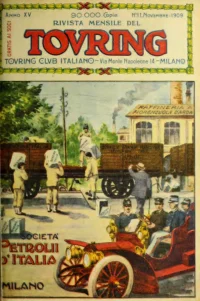
Articles in this issue
- Second instalment of L. V. Bertarelli's journey on the Ferrovia dell'Appennino Centrale from S. Sepolcro to Gubbio, past S. Giustino's Villa Bufalini to Città di Castello with its Vitelli palaces, Angelo da Orvieto's Palazzo dei Priori, Signorelli's San Sebastiano and a gothic silver reliquary of 1420. At Gubbio he finds the ruined Palazzo Ducale of Francesco di Giorgio da Siena, Gattapone's Palazzo dei Consoli, the Tavole Eugubine and the running of the three ceri on St Ubaldo's day.
- Dott. Mario Beretta explains why Italy's shifting river beds — silted by torrents such as the Trebbia in flood — need marked navigable channels, and the Touring's Commissione Nautica announces an international competition for a signalling system, funded from the residue of the 1905 Milan navigation congress. Entries close 31 May 1910, trials are to be run on the Po under the Genio Civile, and prizes are L. 1000 and L. 500.
- Nine articles of the Commissione Nautica's competition rules: the marker may be floating or rigid but must resist a shifting bed and ordinary floods, be easily moved along the river and cheap to install and maintain; entries in Italian or French reach via Monte Napoleone 14 by 31 May 1910; shortlisted competitors each get L. 100 and must submit to full-size trials on the Po under the Genio Civile, with prizes of L. 1000 and L. 500.
- Silio Carpani's All Souls' Day essay on "the last tourism", running from the Memphis necropolis across its lake of judgement and Greek and Roman obsequies — including the crow of the Via Appia given a full funeral and buried at the Campo Rediculus — to the modern first- and third-class hearses, the sealed cart used for contagious dead, the electric mortuary trams he expects to supplant third-class funerals, and burial at sea.
- With the 1909 season closed after Reims and Brescia, the writer reviews the Paris aeronautical Salon and the Esposizione Internazionale di Aviazione opening at Milan's Corso Hotel on 9 November, then compares the Blériot XI and XII, the Wright and Farman biplanes, Santos Dumont's Demoiselle and the 16-cylinder Antoinette, with prices from L. 7500 to L. 30 000. Latham at Blackpool, Curtiss round the Statue of Liberty and De Lambert round the Eiffel Tower are judged daring, not progress.
- The bill cutting the bicycle tax to L. 6 — claimed as the Touring's greatest victory in fifteen years — was left unvoted when the Chamber rose in July, so the club has petitioned the finance minister and on. Giolitti to have it passed first at the reopening, or the tax suspended by royal decree as was done in 1905, in time for 1 January 1910.
- Arnaldo Cipolla traces a crossing from the Congo mouth to the Giuba: the Cateratte railway that replaced a twenty-day caravan, steamers from Leopoldville to Stanleyville, pirogues up the Ubangi to Yakoma and the Uelle to Bomokandi, then months of porterage — which he condemns as central Africa's worst affliction — to Lake Albert and the railway to Mombasa. Italy's coastal railway in the Benadir has been dropped for a thirty-kilometre line from Mogadiscio to Afgoi.
- Report of the diplomatic conference opened at the Quai d'Orsay on 5 October, prepared by the 1907 Homburg meeting of recognised automobile clubs: twenty powers took part, Italy's delegation including comm. Bodrero, cav. Aloisi, cav. Ruini and dott. Guastalla for the Touring and the Automobile Club d'Italia, and the protocol was approved on 8 October under the presidency of Gavarry, with Millerand closing the session.
- Text of the Paris protocol: every car must pass an official roadworthiness examination and carry solid steering, two independent brakes and an anti-rollback device; drivers must be over eighteen and hold an authorisation; a one-year international carnet de route then frees them in every adhering state; and each car shows an oval 30×18 cm nationality plate (I for Italy, D for Germany, GB for Britain, US for the United States), a deep-toned horn, two front lamps and one rear.
- Section IV of the engineers' and architects' congress voted unanimous praise for the Touring's paper on Italian road signage and carried its four proposals on unified units of measure, progressive kilometre numbering, distances shown both ways and budgeted upkeep — the club has planted 5000 signs against more than 23 000 posts in France. Also reported: Tempestini and Frosali on road-metal aggregates and tarring, and ing. Vandone on maintenance and steam rolling.
- The Fédération Aéronautique Internationale, meeting at Zurich, voted an international calendar of 1910 aviation meetings — to be confirmed at Paris on 10 January — so that no two international contests clash. The writer also urges uniform air-circulation rules modelled on maritime regulations, ground signals, maps marking safe landing grounds, hangars and Italian hydrogen production; the Commissione di turismo aereo under sen. Celoria meets on the 29th.
- Celestino Usuelli explains the valve and rip panel and the physics that makes a balloon's descent accelerate, then describes dropping from 3300 m and halting five metres above ground by throwing 20 kg of ballast, landings on wooded slopes, and why ripping over water is fatal — the mistake that killed a companion in the Adriatic on 2 June 1906. His February crossing from Padua over Trieste and Istria ended near Lio Maggiore in the Venetian lagoon.
- Ten duties pressed on every member: bring in at least one adherent, renew by 15 January, take the renewal as the moment to become socio vitalizio or quinquennale, consult no touring publication but the Touring's own, subscribe a cartello indicatore, prefer T.C.I. services and put forward hotels, garages, mechanics and petrol suppliers for affiliation — and remember that on the same subscription the French T.C. has 115 000 members and the German Lega Navale over a million.
- The Touring's Commissione di Turismo nautico sets out its programme: to gather the yachting, motonautica, canottaggio and camping bodies round the club with the Lega Navale, design a light boat usable under oar, sail and paddle and portable by rail, found canoe clubs on the rivers, and win landing and lock concessions, refuelling points, charts and Touring landing markers and buoys.
- News photographs of the month: the Paris industrial-vehicle competition seen from the pesage, the start of the Gaillon hill-climb, and the Italian military dirigible passing over Rome near the Orto Botanico and flying above Naples.
- Members are asked to send the 1910 subscription of L. 6 (L. 8 abroad) early by cartolina-vaglia to the Touring in via Monte Napoleone, quoting name, address and membership number, and are warned that the Rivista and the other publications stop for anyone unpaid after 15 January.
- The Direzione asks members to use the renewal season to push the Sodalizio in families, schools, sporting societies, public bodies and among soldiers and clergy so the Touring can soon celebrate 100 000 members, and to convert their annual subscription into socio vitalizio (L. 90, L. 115 abroad) or quinquennale (L. 30, L. 40 abroad), which carry a free enamelled badge and the Agenda-Touring 1910.
- Book notices including Accatino on modern agriculture, Tocchetti's La città delle buone arie on Argentina, W. Vittorio Carpi's Al di qua e al di là dell'Atlantico, Piscicelli's Nel Paese dei Bungo-Bungo, Candiani on the veterans' home at Turate, Bettoni Cazzago's Storia di Brescia, Sandron's cheap edition of Stendhal's Certosa di Parma, two Italia Artistica monographs edited by Corrado Ricci (Brescia and Randazzo), and "The Car" Road Book edited by Lord Montagu.
- The Comitato Nazionale per le Esposizioni all'estero has asked the Touring to organise Italy's central hall and the Mostra dei trasporti italiani at the 1910 Buenos Aires world exhibition — fitting work, the writer argues, since propaganda among Italians in Argentina already brings the club ten to twenty new members a week.
- Progress report on the year's free publications: a reprint of the 1908-1909 Annuario for new members and an "aggiunte e varianti" fascicle for old ones; of the eight promised Carta d'Italia sheets, Pesaro and Sciacca went out in August, Ravenna and Caltanissetta are being posted and Cuneo-Portomaurizio, Macerata, Chieti and Palermo follow before the year end; the Abruzzo guide appears this month and Sicilia at the start of 1910.
- Tally of the 1:250 000 Carta d'Italia: 4 sheets in 1906 (Milano, Torino, Venezia, Genova, now L. 2), 8 in 1907 (Roma, Napoli, Civitavecchia, Frosinone, Brescia, Livorno, Pisa, Bologna-Firenze), 8 in 1908 (Verona, Siena, Etna, Messina, Como, Perugia, Cefalù, Catania) and 8 in 1909 ending with Cuneo-Portomaurizio, Macerata, Chieti and Palermo — the whole block of 28 sheets to be sold to members at L. 14.
- Resolutions of the Direzione: a diploma of merit to the Vicenza provincial technical office for its road signage; the Commissione di Turismo Aereo's inaugural Brescia session under sen. Giovanni Celoria with ing. Cesare Saldini and nob. Luigi Origoni; medals for the Italian delegates to the Paris motoring conference; adherence to the Federazione Nazionale Pro Montibus at Bologna; and the 8000-lire prize returned by lieutenants Calderara and Savoja for an all-Italian aeroplane.
- Eleven new five-year members: Corti of Milan, Dose of Venice, Fracchia of Belluno, Grossi of Forlì, Magelli of Modena, Riva Berni of Mantova, Sanguinetti of Bologna and Prosdocimo of Motta di Livenza, together with march. ing. Da Passano at St Petersburg, De Scalzi at Guayaquil and Von Miguel at Saarbrücken.
- Thirteen new soci benemeriti, from Luigi Angeli of Bardi and Oreste Botter of Milan to ing. Enrico De Natale at Benevento, Mario R. Goio at Valparaiso, Riccardo Raffo at Tacna, prof. Rodolfo Panichi of Florence and ing. Marcello Zorzoli of Novara, bringing the running total to 1600.
- The Touring's legal-advice department carries the Busto Arsizio bicycle-tax case argued by its consulente legale avv. Renato Piceni, and an editorial note urging every magistrate to adopt the Pretore's principle that the agent who enforces a regulation may not himself break its procedural rules.
- Headnote and full text of the judgment of 9 October 1909 by avv. Carlo Boneschi, Pretore of Busto Arsizio: a prosecution cannot proceed on a verbale drawn up without the offender's countersignature or, failing that, two witnesses, as art. 29 of the 22 April 1906 regulation requires. Rag. Elia Ferrario and Ottavio Mei of Gallarate, stopped at Gorla Maggiore with their tax plates pocketed, escaped the charge and were acquitted of insulting vigile Francesco Fava.
- News of new services: the 86 km Vievola-Nizza motor line opened, work about to begin on the Canareggio bridge in Rovigo province, approval of the Villa di Teolo tramway in Padova province, a committee formed for the Alba-Barolo filovia, the Firenze-Badia a Ripoli-Grassina tramline inaugurated, and motor services opened from Langhirano to Tizzano, Corniglio and Monchio.
- Road notes: complaints of bad roads in several Brescian communes, in the province of Ravenna and throughout the city of Parma; the Castel San Nicolò-Montemignaio road opened and the Faenza-Modigliana provincial straightened near Cà di Livuano; work on the Maccagno-Pino-Confine road to start next year; the Biella-Occhieppo road impassable, the Traiana provincial up to Segni in poor state, and the bridges over the Dora and the rio di Salomia in Val di Susa unsafe.
- Two railway schemes: a funicular studied from Maccagno by Musignano up to the Lago d'Elio, and a Castelbolognese-Riolo line under examination at the Ministry of Public Works.
- Seven rules for writing to the Sede: register any letter containing money, send no foreign stamps but international ones, use a separate sheet for each subject, always quote the membership number, enclose the printed address label when moving house, and pay L. 1 a year (L. 2 abroad) to have the periodicals registered, since the Amministrazione will not replace copies lost through changes of residence; duplicate numbers of the Rivista cost L. 0,40.
- What the 1910 subscription brings: the Rivista, a monthly fascicle of about 80 pages; the 1910 Annuario Generale; eight Carta d'Italia sheets, probably Ancona, the Quadro d'unione, Bergamo, S. Severo, Susa, Gargano, Domodossola and Orbetello; the illustrated regional guides, with Abruzzo and Sicilia in the press after Umbria and Puglie; and for new members the three-volume Guida delle strade di grande comunicazione.
- Roll of applicants for the month, opening with the life members — among them the Camera Italiana di Commercio at Constantinople, the Legione Allievi R. Guardie di Finanza at Maddaloni and subscribers at Montevideo, Rosario and Hodeidah — then province by province from Avezzano and Arezzo to Treviso and Turin, and abroad from Germany, England and Odessa to Boston, Burlington, Chicago and New York.
- Membership table: 73 730 annual members at 15 September, less 119 resignations, unreachable and defaulters, plus 622 enrolled to 15 October, giving 74 233; life members rise from 2329 at the end of 1908 by 576 since 1 January to 2905, for a total of 77 138 soci.