Rivista Mensile del Touring Club Italiano, Vol 15, No 2
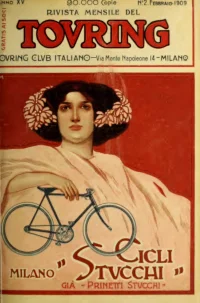
Articles in this issue
- Unheaded leader signed La Direzione mourning the 28 December 1908 Calabro-Sicilian earthquake, its two hundred thousand dead and the Touring members lost in it, and saluting those members who worked in the ruins.
- Assunto Mori's illustrated survey of Calabrian and Sicilian earthquakes from 1638 to 28 December 1908, drawing on Baratta's catalogue of 140 shocks, the 70,000 dead of 1693, the 1783 disaster at Scilla, Bagnara and Palmi, and the Suess fracture line running from Cosenza to Palermo; photographs show Messina's Palazzata, Reggio and Palmi before and after.
- The Touring opens an office at Como jointly with the Società Nazionale di Trasporti Fratelli Gondrand and the Pro Como association, giving free timetable, rail, steamer and road-itinerary advice, taking subscriptions and selling the Guide, Profili, Annuari, Attraverso l'Italia and the Carta d'Italia al 250000.
- Notice that from February the administration suspends despatch of all publications, the Rivista included, to members who have not paid the 1909 subscription, and will deliver a receipt at their door for the fee plus collection costs.
- The Como consular corps fêted L. V. Bertarelli at Brunate on Sunday 17 January for the publication of the Como sheet of the Touring's Carta d'Italia; ing. Ponci presented a gold medal bearing the southern arm of the lake and Catullus's Lario imminens Comum, with speeches by cav. Dolara, avv. Cattaneo and director-general comm. Johnson.
- L. V. Bertarelli traces Etruscan burial forms in the Faliscan territory from the cremation pozzetto through the fossa with its side loculus to the great family chamber tomb with sculpted door and portcullis slab, using Cozza's material lent by the Accademia dei Lincei, and follows the line down to the Roman columbarium.
- Members who introduce ten new members are declared benemeriti and receive the silver medal, fifty the large silver and a hundred the gold; every benemerito also gets the gilt-ornamented Agenda Touring pocket carnet, otherwise sold at L. 1.
- Members procuring two new subscriptions in 1909 with purchase of the L. 10 block of twenty published Carta d'Italia sheets (Torino, Milano, Venezia, Genova, Roma, Napoli, Brescia, Etna, Messina, Como and the rest) get the bronze Carta medal, four the silver, and 1908 silver-medal holders who bring four more a larger first-grade silver.
- G. C. Abba on the Garda morainic amphitheatre from Salò to San Vigilio — Lonato, Castiglione, Solferino, San Martino, Custoza and Pastrengo, the now-useless fortress of Peschiera, Monte Baldo as the peasants' weather-glass, the Adige squeezed to sixty metres at the Chiusa di Ceraino, and Bonaparte's victory on the Rivoli plateau.
- The magazine's standing mountaineering department, under its art-nouveau banner cut, given this month wholly to the international ski meeting arranged at Bardonecchia for the 24th and 25th.
- The international ski meeting fixed for the 24th and 25th at Bardonecchia (1,300 m) has been postponed, but the jump built by the Alpini under capitano Ferretti will send a man flying some forty metres, and entries are expected from the Italian army, French clubs and Norway; signed N. N.
- Arturo Mercanti, writing from Siracusa on 14 January, reports the first Paris aeronautical Salon: the Ville de Bordeaux, Republique and Clément-Bayard airships, Wright's 99 km flight at Auvours before moving to Pau, the Voisin biplanes of Farman and Delagrange against the Blériot and Esnault-Pelterie monoplanes, and the Antoinette, R.E.P., Wright, F.I.A.T. and Farcot engines — with a claim of priority for Forlanini's 1878 helicopter.
- Ornamental banner — a racing cyclist over a map of the peninsula — opening the Rivista's campaign for the 2,500 km Giro Ciclistico d'Italia announced for the coming spring.
- Eugenio Camillo Costamagna traces touring from Byron riding the Ravenna pines and Massimo d'Azeglio on horseback to the bicycle as a multiplier of human energy, the velodromes and champions, the price fall that democratised cycling, and the 2,500 km Giro Ciclistico d'Italia announced for the coming spring at 27–28 km an hour.
- Mario Beretta's illustrated descent of the Rhine: Cologne, Heidelberg set against the nine-million-tonne port of Mannheim, Worms reborn with a new harbour after the German inland-navigation congress, Frankfurt's Römer and Kaisersaal, Mainz, and the legend-haunted reach from Bingen to Königswinter with the Mäuseturm, the Lorelei, St. Goar and Rheinfels.
- Digest of other magazines: the Revue on Ido as the modern bicycle to Esperanto's old ordinary, Je sais tout on storks needing a run-up like aeroplanes, a Neumann anecdote in Nuova Antologia about the horse Grane and Teresa Vogl's leap into the fire, the Outlook on Japanese sport, the Turkestan excavations, Die Umschau on airships in war, and the Kaiser's reported purchase of the Villa Falconieri at Frascati.
- Full-page montage of nine winter landscapes by an amateur photographer — snowbound woods, a farmstead, a tobogganing pair — printed to answer those who complain that winter offers nothing to the tourist beyond skating, sledging and ski.
- The Touring issues forty-five mountain waymarking monographs — Monte Laurasca, Resegone, Grigna, Monte Ebro, Passo d'Emet, Monte Zoncolan and the rest — produced by the 1907 Consorzio per le segnalazioni in montagna with the CAI, Federazione Prealpina, Società Escursionisti Milanesi and the Alpini regiments, and by the 1,000-lire Concorso Ravà Sforni; 10 cent. each, L. 1 the group of twelve.
- Reviews of Baragiola's La casa villereccia delle Colonie Tedesche Veneto-Tridentine, Taris's L'automobile et les armées modernes, Peary's Plus près du Pôle, Hachette's Michelangelo album, Goffin on Pinturicchio, Foville on Pisanello and the medallists, Hourticq's history of painting, Luzzietti's Risorgimento postcards, and a Berger-Levrault study of the Wright aeroplane.
- Picture page of the Stockholm olympic games (skate-sailing and ski-joring behind horses), the panorama of Pau where the Wright brothers train, Orville Wright travelling to Europe with his sister Katharine, dogs harnessed as draught animals in the Alps, and a spectacular slide at Chamonix photographed by Brocherel.
- The Rivista opens a new department entrusted to cav. Italo Bonardi, its consul at Rome, to report the bills and official statistics bearing on motoring, cycling, inland navigation, physical education, export trade and prize competitions before Parliament has already passed them.
- The Senate sitting as Alta Corte di Giustizia acquitted senator Colleoni, whose car was under repair at Milan on 24 September 1908, and senator Mangiagalli, booked for speeding through Laveno on 11 July, its permanent commission of accusation holding no offence existed.
- A German imperial bill would make car owners liable without proof of fault, cap compensation (50 marks for a death) save in cases of fault or intent, require driving licences with three months' gaol for the unlicensed, and multiply driving schools with a stiffer examination.
- On. Cottafavi's bill of February 1905, never proceeded with, would oblige owners of the borrow-pits dug alongside the railways to fill and cultivate the stagnant, malarial ditches that disfigure the view from the train, on pain of fine and then public auction of the land.
- American federal returns show Italy shipped 48 cars worth 90,000 dollars to the United States in October alone against one worth 3,000 the year before, and 213 (435,000 dollars) in the first ten months against 71 (21,000).
- Turkey's disorder and want of made roads have kept motor cars out of the empire; since the constitution was restored the ban stands unrevoked but the police tolerate cars in the streets of Constantinople.
- The magazine's standing legal-advice department, under its ornamental banner, this month reporting a single motoring judgment on the powers of communal technical officers.
- Judgment of the R. Pretura di Orbassano of 19 November 1908 in the case of conte cav. Vittorio Rignon of Turin: geom. F., the technical employee of Piossasco, was out walking, unsworn and in no uniform, so he had no power to stop car 63-794 or report it for exceeding 12 km an hour, and the report was void.
- Eleven new benemeriti named — Bonardelli of Saluzzo, Bruno of Buenos Aires, Chirola of Genoa, Eccher of Rovereto, Perolari of Ponte Nossa, Tria of Matera and others — bringing the total to 1,478.
- Alphabetical list of members taking the five-year subscription, running from Aymonne-Cat of Turin and Ajo of Perugia through to Zignone, and continuing across the following advertising pages.
- Town-by-town list of those who applied for membership between 1 and 31 December 1908, opening with life members such as Kluzer of Abbiategrasso, Isolani of Bologna and the Piaggios of Genoa, then the annual members by province from Alessandria onward and subscribers in Buenos Aires, Tacna and Guayaquil.