Rivista Mensile del Touring Club Italiano, Vol 15, No 3
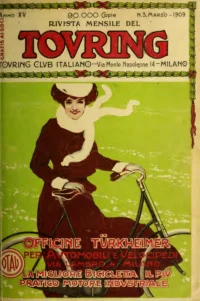
Articles in this issue
- L. V. Bertarelli marks the Touring's new free volume "Puglie", written by cav. Michele Oro with a Duilio Cambellotti cover, by describing Apulia's isolation despite 600 km of coast, the treeless Tavoliere, the wine slump around Trani, Barletta and Cerignola, and the chronic thirst awaiting the Sele aqueduct.
- Members who have not yet paid the 1909 subscription are warned that despatch of the Rivista and the other publications stops with this issue, the Administration reserving the right to collect the dues at their address by cash-on-delivery.
- Writing from London in February 1909, Giuseppe Bevione reports the English fashion for horse-drawn caravan touring, quoting Capt. W. G. Smyth on rear-entry vans, high wheels, paraffin Bunsen cookers and a good watchdog, with outfits from a thousand-lire home-built van to the 48-HP motor caravan seen at the Ockham meeting.
- The Council announces the sudden death on 27 January at Golfo degli Aranci of dott. Luigi Casotti, capo console of Cagliari and one of the Touring's oldest consuls (appointed 1898), who won the club its following in Sardinia.
- Luigi Brasca's sketch of losing a new mountain track at dusk on a scree slope above a vallone, and his conclusion that a path is simply the geometric locus of human footprints, born when one walker trusts the traces of another.
- Silio Campani surveys Italian carnival customs: Venice's Giovedì Grasso fireworks and year-round masks, Rome's moccoli and the corsa dei barberi, Verona's "Carnevale dei gnocchi", and the Ivrea pageant of the miller's daughter Violetta and Toniotto with its burning scarli — plus masked motor floats at Honolulu.
- Luigi Maurizio Tedeschi, illustrated by the painter Amero Cagnoni, argues music is the most touring of the arts: La Scala's conductors, chorus and orchestra migrate to Argentina, singers do autumn at Milan's Dal Verme and carnival at Palermo, while street organs grind out Tosca, Bohème and the Vedova Allegra waltz.
- Acqui prepares honours for the navigator Giacomo Bove nearly 22 years after his death, recalling the Vega's return to Naples from the discovery of the North-East Passage and his two South American and Congo expeditions.
- A. Mercanti's winter round-up of new machines: Maurice Farman's Renault 50-60 HP biplane, Bleriot's refined monoplane, the Obre and Lejeune derivatives, Voisin biplanes for De Caters and Sims, De Chrawez's helicopter, Bertelli's at Brescia and Faccioli's first hops at Turin before the Brescia and Bologna meetings.
- Photo page from the Chamonix winter sports meeting showing the ski-jump finish, a children's race, French chasseurs and the Italian "grey" Alpini, a ladies' race, a bobsleigh run and an Italian lieutenant with a Norwegian officer.
- On runner-shod motor vehicles for snowbound roads: Dr. Charcot's Lautaret trials with a toothed driving wheel before sailing for the Antarctic, Canadian winter practice, and the models — including an air-propeller sleigh — shown at the Automobile Club de France's Grenoble winter competition.
- Dott. G. Scotti reports the S.U.C.A.I. students' winter: Milan's ascent of the Cengalo (3391 m) and the 1909 camp planned for the Alpe Zocca below Pizzo Badile, Rome's first winter ascent of Monte Portella from the Duca degli Abruzzi hut, Turin's Monte Vandalino outing and the second Moncenisio winter rally.
- A. Mercanti reviews Turin's show section for small industrial engines: single-cylinder 2-4 HP units by F.T.A.L. of Legnano, Motor Frigor's petrol-driven refrigerator and generating sets, Cigala's "The National" petrol, paraffin and alcohol motors and the Società Meccanica Bresciana's 5-6 HP engine, with Strafforini's thresher-carrying motor wagon.
- Report on the Ministry of Agriculture's Piacenza trials of farm motors, opening with senator Méline on steam replacing oxen: first prizes to G. Soller of Basel (camion) and to Langen e Wolf of Milan, whose 12 HP paraffin locomobile also took the King's grand gold medal, with awards to Süddeutsche Automobilfabrik of Gaggenau, The Ivel Agricultural Motors and Saunderson of Bedford.
- Following the 1907 Homburg congress the French government will convene the European states in May to unify motoring rules — vehicle and driver certificates, road and obstacle signs, warning apparatus, number plates and customs formalities — a cause the Touring first pressed with its international triptyque booklet.
- Ing. C. Zanetti describes the grey-green uniform adopted by Milan's Volontari Ciclisti Automobilisti: single-breasted tunic with concealed buttons and embroidered V.C.A. shoulder ciphers, cyclist breeches with gaiters, flat tinned-iron water bottle and a three-pocket haversack that clips into the bicycle frame, all for under 40 lire.
- Two curiosities: Ferdinand Louis's craft of two parallel floats carrying an ordinary bicycle frame that drives a stern propeller, and M. Rémon's pair of 2.50 m gondola-shoes for strolling on the Seine.
- The 1908 customs returns show car imports down from 725 to 348 while exports rose to 1,629 worth L. 28,236,745 and bicycle imports climbed to 7,541; also the merit-competition awards (gold to Achille Reina, then Isotta Fraschini, Fiat, Frera and Fram) and Spain's extension of triptyque validity to a year.
- Digest of other magazines: Nuova Antologia on the forgotten Palio di Asti and its odd prizes, World's Work on American open-air schools and camps, prof. Martin in the Nineteenth Century predicting airships will end British naval supremacy, the Globe Trotter on Menelik's motor car and Abyssinian thief-finding, and Emporium on the Florida railway viaducts to Key West.
- Books noticed: Lapointe's Essai sur la navigation aérienne, Borrino's Hoepli manual for motorcyclists and tricar drivers, Vitry's Jean Goujon, Girard and de Bouville on dirigibles, Scarfoglio's lecture on the New York-Paris raid, Maggiorotti on the Touring's Carta d'Italia, and the Italia artistica volumes on Pesaro and Arezzo.
- News in pictures: Menelik out driving near Addis Abeba with the French dott. Vitalien, the British army's Cody aeroplane after its crash, the new Guillebaud monoplane, the Stockholm Olympic games, and a race between a sailing sledge and a motor car.
- Silver and gold medals and the Agenda Touring for members who recruit ten, fifty or a hundred new members, plus a draw offering Atala, Senior and Frera bicycles, Pirelli covers, Aquilas lamps, an Auto-Alba camera and cases of Fernet Branca and Strega.
- The ordinary general meeting is called for Sunday 28 March 1909 at 15.00 in the Palazzo dell'Esposizione Permanente, via Principe Umberto 32, Milan, to hear the Council and auditors, vote the 1908 accounts and the amendments to statute articles 17, 21 and 44, and elect four councillors and three auditors.
- Auditors Camillo Magnocavallo, Attilio Soffredi and Gino Turrini report net capital of L. 545,307.42 at 31 December 1908 and a surplus of L. 54,161.69, over L. 500,000 held in Italian rendita and state-guaranteed railway bonds, and invite the 70,000 members to approve the balance sheet by acclamation.
- The balance sheet at 31 December 1908 and the year's administration account: L. 973,629 of assets and liabilities, L. 548,781 of income against L. 494,620 of expenditure, with 67,235 annual members and 2,329 life members.
- The Council puts two changes to the members: a Touring Delegation in Rome (new article 46) whose president and vice-president would sit on the Council even if not resident in Milan, and an amendment to article 44 letting part of the club's capital be invested in a building for its own headquarters.
- Council and Direzione resolutions: publicity for Rome's 1911 exhibition in the Touring stand at the Turin motor Salon, ing. Cattaneo invited onto the Roads Commission, the Paris agreement on disc signposts, remission of 1909 dues for members in the earthquake zone, and a signpost-maintenance convention with the province of Bergamo.
- Minutes of the 27 January sitting under senator Bettoni: the Touring takes on the sub-committee's running costs, the Rivista Mensile becomes its official organ, new provincial committees at Brescia, Venice and Bologna are recognised, and Milan's proposed uniform is approved for propagation.
- Sixteen newly declared benemeriti, from Albino Buizza of Vertova to Antonio Vaghi of Milan, bringing the roll to 1,493.
- Alphabetical list of members on the five-year subscription, running from Andrea Albaroni of Novi Ligure to Edoardo Croce of Genoa and continued in the next number.
- Applicants for admission between 1 and 31 January 1909, listed town by town as life or annual members, with entries from Bari, Bologna and Brescia to Buenos Aires, Calcutta and Columbus.