Rivista Mensile del Touring Club Italiano, Vol 15, No 6
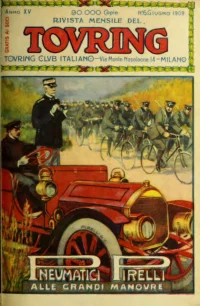
Articles in this issue
- Cover leader launching the Touring's campaign on Italy's forestry problem ahead of the June Forestry Congress in Bologna, arguing that Italian law protects the wood but ignores the pasture; it appeals to the club's 80,000 members and lists first subscribers including Edison, the Società Lombarda, the Forze dell'Adamello and the Touring itself.
- A medical-climatology guide to choosing an Italian bathing station, contrasting the windier Ligurian and Tyrrhenian coasts (Livorno, Ardenza, Voltri, Arenzano) with the calmer Adriatic (Venice Lido, Rimini, Porto Corsini) and advising which suits anaemic, run-down or neurasthenic patients.
- The Touring joins the Dante Alighieri society for a tourist-patriotic gathering at Magenta on 4 June, the fiftieth anniversary of the battle, and a general Convegno at Desenzano on 24 June with excursions to Solferino and S. Martino; bronze plaques are the Director-General's gift and Giuseppe Cesare Abba will speak at the ossuary.
- Avv. Bortolo Belotti claims the government's bill cutting the bicycle tax as the Touring's own victory, and describes the memorial sent with the Automobile Club d'Italia asking for quarterly instalments, retention of the 1905 rates for cars under 16 HP and a flat L.20 tax on motorcycles.
- Announcements on the club's two yearbooks, with an appeal to consoli, members and readers to send corrections and additions on the printed form bound into the 1909 edition.
- The 1910 Annuario Generale is to be completely revised, adding every Italian comune with its monuments and sights, renewed street plans of the provincial capitals and a map showing the Touring's consoli, doctors, lawyers, hotels, garages, petrol suppliers and mechanics.
- The specialist yearbook the Touring has published since 1903 appears under a new title for 1909: an 850-page leather-bound pocket volume at L.3 to members, listing cycle and motor makers, dealers and sporting societies worldwide plus aeronautics, aviation, railways and a map of the roads closed to cars in Savoy, Switzerland and the Tyrol.
- Three plate pages of photographs from the first Giro d'Italia — Beni of Rome carried to the infirmary in his home city, Rossignoli at the finish, Gerbi exhausted after a fall, Ganna before the Colosseum and gaining confidence at Naples — by Luca Comerio and the Touring's consulates.
- Revisits the royal-prize competition for an automatic railway coupling launched at the 1906 Milan International Exhibition, where some 160 models were entered but only two — one Italian, one German — were judged worthy of honourable mention.
- The Touring's practical-motor rubric, this month devoted to internal-combustion engines shown at the agricultural competitions.
- Surveys petrol machinery at the recent Paris agricultural show: single-cylinder units on two-wheeled trolleys, motor pumps throwing water 18 metres, the A. Amiot flat-bottomed aquatic mower for clearing weed from rivers, an Albiges motor saw and a motor plough on a raisable chassis.
- The aviation rubric, opening with photographs of Wilbur Wright in Rome with the journalist Profili and Countess Cellere, and with his pupils Lt. Calderara and Lt. Savoia.
- Reports the lull following Wright's and Blériot's flights, Farman's rebuild of his Voisin with rear ailerons and landing skids, Forlanini's hydroplane, the Roe triplane and the Antoinette monoplane, and prints the rules for the Brescia air circuit in September with L.100,000 in prizes and a Gordon Bennett eliminator in August.
- Argues that air navigation will force new legislation on frontier crossing and customs, damage to crops, municipal landing grounds, overflying paying enclosures, and fortifications; since no police could make an arrest in the air, it proposes registering machines with national signal flags painted on the planes rather than numbers.
- Explains why Bakewell's and Caselli's mid-century writing-transmission machines fell into oblivion and how Korn's synchronous system reproduces handwriting at a distance, the message written on a metal foil scanned by a stylus and recovered photographically over an ordinary telephone line.
- Describes the Pavia, newest of the Po tugs, built for the Società di Navigazione Interna's regular Venice–Milan towing service and designed around the limited dimensions of the locks that hamper navigation between the two cities.
- Laments the Naples council's decree replacing the traditional carrozzella with the taximetered cittadina from 1 July, the drivers put into grey summer and dark blue winter uniforms with the city arms, and the earlier resistance of the cabmen of the Vicaria and Mercato quarters.
- On Italy's military carrier-pigeon service: the division into resident 'addetti' and captive 'prigionieri' birds, the tube of despatches tied to a wing feather, a facsimile message sent from the battleship Liguria to the Spezia divisional command, and the Ligurian mountaineer whom carabinieri caught shooting the birds to eat them.
- Reports the Automobile Club de France technical commission's trial in which a 8,900 kg, 40 HP car ran 2h40 on 29.2 kg of naphthalene costing 4.22 francs against 14.20 francs of petrol, implying a saving of 66 to 70 per cent.
- Drawn from the first International Road Congress in Paris, it compares Trésaguet flagstone sub-bases with foundations of small graded stone, recalls Macadam's insistence on uniform 170-gram pieces, and sets out the English, Viennese and rigid concrete-and-tar methods.
- The Touring's legislation-and-statistics rubric, collecting official reports and trade figures bearing on motoring and tourism.
- Summarises the War Administration inquiry's report urging mechanical traction for army supply columns and cyclist battalions: some 1,000 lorries, half of them state-owned, would replace about 12,500 carts and 55,000 horses for 8 to 9 million lire, all spent at home.
- Italian car exports to the United States rose from 16 vehicles worth $130,000 to 192 in the first seven months of the fiscal year, while South American sales lag for want of roads — about 500 cars running in Rio de Janeiro and a hundred in São Paulo, mostly French.
- Councillor Vercelloni's interpellation to the mayor of Rome over chauffeurs opening their exhaust valves in the street, and the health assessor's promise to have the technical office study measures like the French penalty for fumée.
- After the 1908 Apulian drought the Agriculture Ministry's commission of scientists bored to 200 metres with a rapid Express rig searching for aquifers in Puglia, Calabria and Sicily, and formally recorded the failure of the dowsers whose chosen sites yielded nothing.
- A tour of famous labyrinths: the pavement maze of Chartres cathedral used for Calvary processions, the 50-centimetre one carved on a pillar at Lucca, examples at Châlons-sur-Marne, S. Michele in Pavia, Poitiers, Reims and Ravenna, the 17-metre maze at St Anne's Sneinton, a 1537 Italian design and the English 'Rosamund's Bower'.
- News photographs of Federico Tesio's horse Fidia, winner of the Premio del Commercio at Milan; lancers at the Rome horse show; the Touring Club de France's river caravan on the Seine; Wellman's airship gondola for the North Pole attempt; and the monument to Blériot's first air journey.
- Book notices including Ferber's L'aviation, Paul Renard's L'aéronautique, Fougères' Joanne guide to Greece, Coubertin's Une campagne de vingt-et-un ans, Casarini's La fatica nella vita militare, the Blondel aeronautical chart of the approaches to Paris, and the 'Italia Artistica' monographs on Verona, Cortona and Siracusa.
- The sub-committee under Sen. Bettoni recognised the Parma provincial committee and the Bormio and Gallarate local ones, bringing the total to 15 provincial and 6 local bodies, and reported the War Ministry's concessions: preference for enlistment in the Bersaglieri cyclist companies and 50–75 per cent reductions on rail transport.
- Despite a winter of exceptional snow on the Alpine and Apennine passes, by 22 May only the Great and Little St Bernard and the Stelvio remained closed, and all three should open by the end of June.
- Resolutions of the Direzione and Consiglio on the reforestation commission and its manuals, the bicycle-tax reduction, the Roads Commission's monographs by Rimondini, Tedeschi and Pozzoli, the Magenta–Solferino–San Martino jubilee, the new Commissione Italiana Aeronautica and the international governments' conference on the triptyque booklet.
- List of members taking five-year subscriptions, from Avv. Ernesto Arbib of Rome to Ercole Zorzoli of Vigevano, including subscribers at Buenos Aires, Detroit, Canton, Vienna, Smyrna and Leipzig.
- Ten benemeriti members, among them Lt. Guido Barutta of Parma, Mario Combi of Genoa, Ferruccio Ferrucci of Vicopisano and Avv. Orazio Solinas of Ozieri, bringing the total to 1,535.
- Candidates for membership listed as soci vitalizi and soci annuali by province and town, from Bologna, Como and Genoa to Palermo, Trieste, Tivoli and St Petersburg, with the statute's subscription rates of 100 lire for life members in Italy and an annual 6 lire.