Rivista Mensile del Touring Club Italiano, Vol 15, No 9
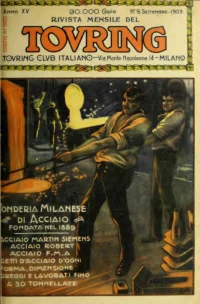
Articles in this issue
- Second instalment of L. V. Bertarelli's Aeolian cruise, sailing from Lipari past Salina, Vulcano and Basiluzzo to climb Stromboli's crater above the villages of S. Vincenzo and S. Bartolomeo, rowing out to the basalt stack of Strombolicchio, and closing with a scathing attack on the filthy inns of Lipari and Milazzo and on Italy's failure to exploit the islands.
- Ing. Piero Piola describes Montenegro's transformation from mule tracks to carriage roads and the new Antivari–Lake Scutari railway, the 250-metre mole and free port being built at Antivari by the Italian-financed Compagnia di Antivari, the ruined old town overgrown with ivy, and a boat crossing of shallow Lake Scutari towards Albania.
- After serving the 1907 manoeuvres in the Ivrea–Novara–Domodossola triangle, the Touring supplied the 1909 army manoeuvres in the Cremona–Brescia–Verona–Mantova quadrilateral, using 18 affiliated firms at Manerbio, Montichiari, Lonato, Desenzano, Peschiera, Bozzolo and Piadena to deliver 500 quintals of petrol and 60 of lubricants, with the Milan V.C.A. lending a car for inspection.
- A page of Dutch photographs by I. Vigliardi-Paravia — Zaandam, Volendam with its old fishermen, children at Monnickendam, and windmills along the North Canal — offered to persuade Italian tourists to rest their nerves in Holland.
- A long technical preview of the first Italian aviation week (5–20 September 1909), tracing the aeroplane from Leonardo to Wright, Voisin, Bleriot, Esnault-Pelterie, Antoinette, Farman and Curtiss, and listing the entrants — Cobianchi, Faccioli, lieutenant Calderara, Cagno, Anzani, Curtiss, Moncher's helicoplane, Bleriot, Leblanc, Rougier — with the 45,000-lire Gran Premio di Brescia over 10 laps of 100 km.
- Photographs by Abeniacar of Naples' September Piedigrotta festival, noting that the classic 'carrozzella' has vanished this year but that Neapolitans will ride to the feast on any vehicle, as noisy and inventive as ever.
- Avv. Bortolo Belotti attacks the new decree on mechanically propelled vehicles: fines raised to a 100–500 lire range, and above all the owner's joint liability for a driver's offence, which he calls juridically revolutionary; he allows that article 15's type-approval and article 22's exemption for trade test-running answer old Touring demands, but objects to the 15 km/h town limit and the vague 'passo d'uomo' rule.
- The Ministry of Marine has authorised Touring members to fly the club's burgee: an elongated triangular tricolour with red and green bands across a white field, a ship's wheel at the crossing and the T.C.I. badge at centre, in three sizes (25x55, 30x50, 45x85 cm) at 5, 7 and 10 lire.
- Ambrogio Mori's illustrated essay on how a child learns to walk — bone and muscle growth, rickets and arrested limb development, Broca's and Wernicke's cerebral localisations, the deformed foot of a Chinese woman set against a normal footprint, and the mechanics of walking, running and jumping — concluding that moderate alpinism is the best exercise and that a locomotive's worth lies in its brakes.
- Notice of the international competition for machines to work vineyards mechanically at the Alba agricultural exhibition in September, with a 6000-lire prize from the Ministry of Agriculture and a second of 2000 lire and a gold medal; Italian imports of agricultural machinery rose from 2.5 to 16 million lire between 1893 and 1908, while France has just held its first congress of agricultural motor vehicles.
- The Touring's Direzione defends the bilingual place-names on its new Carta Automobilistica after the Trieste consulate and the Pola consul resigned in protest, distinguishing invented pan-German and pan-Slav names (banned) from names genuinely used locally, and citing the Isonzo basin figures — 78,327 Italian speakers against 10,822 Slovenes around Gorizia, but 129,760 Slovenes to 2,809 Italians in the districts of Tolmino, Plezzo, Caporetto and Sesana.
- Distribution record of the Touring's 1:250,000 Carta d'Italia — 4 sheets in 1906, 8 in 1907, 8 in 1908, with the 20-sheet back block on sale at 10 lire — and the 1909 issue of Pesaro, Sciacca, Ravenna, Caltanissetta, Cuneo, Macerata, Chieti and Palermo (replacing Orbetello), delayed by the De Agostini institute's move from Rome to Novara.
- Filippo Tajani argues the railway will meet competition from the motor car and the aeroplane by abandoning the double track: he reviews the Beyer and Lartigue monorails, Behr's Brussels installation aiming at 150–200 km/h at a third the cost per kilometre, and Brennan's gyroscopic single-rail car shown to the Royal Society on 9 May 1907, foreseeing pointed 250 km/h coaches on dedicated monorail lines.
- Fifty-four prizes drawn among members who recruit ten or more new adherents during 1909, on top of the silver, large-silver and gold medals for ten, fifty and a hundred recruits: a Frera touring bicycle with B.S.A. three-speed hub, an Atala de luxe from G. Gatti e C., a Senior from Bonzi e Marchi on Polack tyres, Pirelli semelles, an Oleoblitz drum, a Troubetzkoy headlamp, six Aquilas lamps, an Auto-Alba camera, six Gillette razors, Fernet Branca and a case of Strega.
- News in pictures: the first trial of the Italian military dirigible Italia 1 bis, the Monte Rosa and Punta Nordend group where the Milanese climbers Castelnuovo, Bompadre and Sommaruga were killed, a swimming race starting in the gulf of Naples, and Wellman's North Pole expedition failing once again.
- Book notices headed by the official guide to the Circuito Aereo di Brescia edited by A. G. Bianchi, with Luca Beltrami's reconstruction of Leonardo's aeroplane from unpublished drawings, a Stroppa panorama of the flying field and Ugo Valeri's aviator caricatures (2 lire, 1.50 to members); also La Toscana alla fine del Granducato, Preziosi's Gli italiani negli Stati Uniti del Nord, the Guide Michelin and the Touring Club de Belgique manual.
- Book notices continued on the yellow pages: Morosini on Ferentino, the catalogue of the exhibition annexed to the I Congrès international de la route, the Uruguayan and American touring club route books, Ugoletti's Brescia in Corrado Ricci's illustrated series (timely for the aviation circuit), Oleias's Tedeschi e trentini, Lucini's Carme di angoscia e di speranza and the Milan committee's report on a Milan–Lodi–Po waterway.
- The Council re-elects the general management by acclamation — Federico Johnson director-general, L. V. Bertarelli deputy, Vigliardi Paravia secretary, Zaffaroni vice-secretary, Ettore Candiani chief consul — accepts the resignations of councillors Gavazzi and Mira and of the Trieste consulate and the Pola consul Sottocorona over the Slav place-names, sets up a forestry commission, and votes gold medals to Luigi Bleriot and Alessandro Anzani for the Channel flight.
- Case note on 'Motociclo sprovvisto di contrassegno': the Pretore of Gallarate, avv. Umberto Guidi, on 24 February 1909 acquitted Angelo Piotti of riding an unplated motorcycle, holding that a machine lacking its ignition gear could not run under power and, at some 50 kg, was not a velocipede either.
- Headnote and text of the Gallarate judgment: a motorcycle missing the part that fires the petrol cannot circulate as such, and since it weighs about 50 kg it cannot be pushed along by muscle power either, so Angelo Piotti could be required to carry neither a motorcycle nor a velocipede tax plate.
- Italy's contributions to the second International Road Congress at Brussels in 1910, with engineers Tedeschi, Corazza, Vandone, Cattaneo, Gola, Benetti, Cinque, Pinciroli, Pugno, Accenti and Albertini reporting through the Touring's road commission; plus new motor services Chiavari–Cicagna, Terni–Todi and Courmayeur–Little St Bernard, and tramways Collestatte–Ferentillo, Salerno–Valle di Pompei and Viareggio–Marina di Carrara.
- After Italy's thin showing at the Paris road congress, the Permanent Association asked the Touring's Commissione Miglioramento Strade to recruit reporters for Brussels 1910: Tedeschi and Corazza on question I, Vandone on II, the Touring's technical office on III, Cattaneo on V, Gola, Benetti and Cinque on communications, Pinciroli on VII, Pugno and Accenti on VIII, Albertini on IX, with a plea for official government representation and for Italian to be admitted as a congress language.
- New motor-coach lines: Chiavari–Cicagna and Terni–Todi opened, trial runs on Umbertide–Perugia–Chiusi, a new Genoese company formed for Chiavari–Cicagna and Chiavari–Borgonasca, special runs from Schio and Recoaro to the Hotel Dolomiti on Sundays, Tuesdays and Thursdays, and a service from Courmayeur to the Little St Bernard hospice opened on 25 July.
- A newly built section of the Collestatte–Ferentillo tramway inaugurated, negotiations under way for a Forlì–Cesenatico line, the Salerno–Valle di Pompei tramway opened, and the first stretch of the electric tramway that will run from Viareggio to Marina di Carrara.
- Ing. G. Toller answers a reader who asked why the roads of Milan province improved while those of Como stayed dusty, retorting that Diano Marina–Riva Ligure, Bergamo–Fontanella and Chioggia–Cavarzere are just as bad, and pointing to the Touring's Manuale pratico del cantoniere and its diplomas for road-menders in place of the reader's proposed cantonieri school.
- Consuls collaborating in the permanent road-conditions survey are asked to quote the numbered profile of each main-communication road on the postcards they send in monthly.
- New subscriptions for road signs — from the municipalities of Milan, Asola, Empoli, Brescia, Naples, Malcesine and Rivoltella, the provincial deputations of Turin, Mantua and Brescia and the Società Dante Alighieri — bring the running total to 3,719 signs worth L. 59,202.50; Vicenza's technical office has sent a map plotting every sign, direction discs in blue and danger discs in red.
- Subscription table for road signs: 3,604 signs worth L. 54,537.50 previously offered, plus Milan (13), Asola (6), Empoli (4), the provincial deputations of Turin (12), Mantua (8) and Brescia (2), Affori (6), Rosignano Marittimo (10), Ponte Valtellina (4), S.N.F.T. Iseo (6), the Società Dante Alighieri at Pieve di Cadore (5) and baronessa Padoa of Florence, bringing the total to 3,719 signs and L. 59,202.50.
- The Naples consulate is reconstituted under barone ing. Gaetano De Angelis as capo console, with cav. ing. Antonio Balsamo, conte Diego Filangeri De Candida Gonzaga, Ernesto Galli, cav. Alfredo Pattison and the counts Piscicelli; new consuls are also listed for Parma, Almese, Arienzo, Brivio, Ceva, Melbourne, Milan and Modena.
- Conte ing. Giovanni Sanvitale appointed chief consul for Parma.
- New consuls appointed at Almese (dott. G. Cesare Ronchail), Arienzo, Brivio, Cambiano, Ceva (prof. Placido Zunino), Fara d'Adda, Gambara, Magliano in Toscana, Matelica, Melbourne (A. Bindo Serani), Milan (dott. Mario Beretta), Modena, Omegna and Verolanuova.
- Touring medical officers appointed at Borgo a Mozzano, Caprino Veronese, Castiglione delle Stiviere, Cessalto, Graglia Biellese, Spello and Thiene — dottori Bernardi, Perinelli, Rossi, De Lucchi, Colvara, Ruozi and Oriani.
- Avv. cav. Raffaele Pasculli appointed the club's legal correspondent at Trani.
- Roll of members honoured for recruiting new adherents, from Andrea Albaroni of Milan and ten. Angelo Anau of Sarzana to Eugenio Rivara of Montevideo and the Società Pro Stresa.
- List of members taking the five-year subscription, including contessa Leopolda Brandolini d'Adda, contessa Elisabetta di S. Giorgio, the Camera di Commercio ed Arti of Girgenti and members writing from São Paulo, Mar del Plata, Santos, London and Mannheim.
- Candidates for membership who applied between 1 and 30 June 1909, listed as life members (100 lire in Italy, 125 abroad) and then as annual members province by province from Alessandria to Vicenza, with foreign sections for Europe, Africa and the Americas.