Rivista Mensile del Touring Club Italiano, Vol 16, No 10
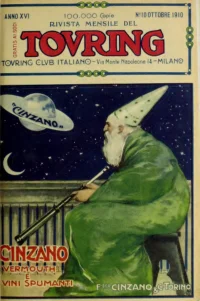
Articles in this issue
- Umberto Geloni's illustrated essay on Italian shooting, opening with Accursio Corsini, Jacques Du Fouilloux, Xenophon, Plutarch and Alfonso X on the virtues of the chase, then lamenting the collapse of game: deforestation, the nets strung at the Alpine passes that kill millions of thrushes and larks each autumn, and poachers; it covers hare, woodcock, chamois and capercaillie and the Sunday "proletari del fucile".
- Results of the photographic competition the Touring announced in its April 1910 Rivista with the Biella section of the Club Alpino Italiano, to gather illustrative material for the "Per il bosco e per il prato" propaganda; the jury included Maurizio Sella, Emilio Gallo, Ferrari Agostino and Guido Rey.
- Prize list for the T.C.I. class of the Biella international photography competition, headed by a 200-lire award to Ugo Sella of Cossato; entrants marked with an asterisk received a bronze plaque for supplying the minimum number of prints.
- Silvio Zambaldi's tale of a moonlit motor run out of Villa Salviati at Porta San Gallo along the old grand-ducal road towards Bologna with cavalier Jacopo Bandelli, donna Amalia and Lady Sheriman: a crash on the Apennine near Monghidoro is followed by the appearance of the buckled-shoed marchese di Camaldoli, alive "da oltre centocinquanta" years.
- La Traversata aerea delle Alpi (L'attesa degli aviatori e del pubblico a Briga) (opens in a new tab)Photo plate of the waiting at Brig: the launching field and hangars, the crowd outside Chavez's shed, Cattaneo among the Swiss gendarmes posted to stop any escape by air, Farman and Weymann watching Chavez's first attempt, and commissioner cav. Arturo Mercanti explaining the route to journalists.
- Photo plate of Weymann's failed attempts: Farman making the last adjustments to his biplane, the take-off, the climb towards the Simplon pass and the return to Brig at 13.30.
- Photo plate of Chavez's flight: the moment before departure, the monoplane clearing the first Simplon peak and crossing the Vaira valley, the triumphal descent at Iselle and the disastrous landing at Domodossola.
- Silio Campani on the Italian grape harvest: the dithyrambic vintage songs, the vines married to trees in Tuscany and central Italy, the piffero-and-cornamusa processions and treading at the palmento in Campania, Calabria and Sicily, the prickly pears fed to pickers near Girgenti and the nailed boots worn by the treaders at Acireale.
- Antonio Baldacci's ethnographic notes on the Waldensian colony of Guardia Piemontese in Calabria: the ruined Spinelli castle and church of the Annunziata, the women's red sleeveless vestaglia and blue gala dress with gold braid, the surviving val d'Angrogna dialect and songs collected by Bruzzano, and the Inquisition massacre of June 1561 in which nearly two hundred people were hanged or burned.
- Sofia Bisi Albini takes the runaway twelve-year-old found sleeping on a Milan bench as her text for praising Baden-Powell's Boy Scouts: Sir Francis Vane's English camps, the 300,000 Swedish members, the Italian boys among the most popular scouts, and the first Italian battalion formed at Bagni di Lucca.
- Alberto De Angelis reviews Italy's air fleet after Parliament voted ten million lire: the military airship yard at Vigna di Valle, the brigata specialisti's workshops in viale Giulio Cesare, and the flights of the dirigible 2 bis and the Farman biplane.
- How, under general Bossi, the specialists' brigade let its six groups of spherical balloons decay and moved from ballooning to the airship, keeping only the two Fides balloons of the Società Aeronautica Italiana for annual exercises.
- Description of the yellowish 2 bis conceived by captains Crocco and Ricaldoni after the 1 bis: 80 metres long, 12 in diameter, 408 cubic metres, with a 120 HP Clement Bayard in the rear of a 10-metre autoscafo-shaped car, which had just flown from Rome to Venice.
- Lieutenant Savoia's 25-minute Farman flight from Centocelle over Rome on 14 September, the two masonry and six knock-down hangars at the Centocelle military field where Wright taught lieutenant Calderara, and the ministry's plan for a flying corps, a second school in the Po valley and a design laboratory.
- Weighs airship against aeroplane in war, citing maggiore Douhet's argument that in an aerial battle the dirigible would be at an absolute disadvantage, and noting that the Government gives the brigade's flyers neither accident cover nor extra pay.
- Practical guide to descending the 620 km of the Po from Turin to Venice in eight to ten days, with a stage table (Torino-Chivasso-Casale, Casale-Valenza-Pieve del Cairo, and on through Cremona, Ostiglia and the Canal Busiola to Chioggia), notes on the river's five-metre level change, the mills and pontoon bridges, and advice to use a flat-bottomed Venetian chiatta like the Olona club's Achille.
- Snapshots from the Milan air meeting: Cattaneo surrounded by admirers, the aviators discussing Chavez's death, Audemars' Demoiselle about to start, Paulhan, and the Count of Turin in conversation with lieutenant Savoia.
- Machines in the air at Milan: Legagneux, winner of the altitude prize, Cattaneo landing his Blériot in a vol plané, the jury's box and the semaphore pylons, Fischer on his Farman, Ruggerone on Eros and Caillé flying the Paulhan biplane.
- Popular-science article signed U. T. on the narrow band of distances the mind can grasp: the ear's 35 to 35,000 vibrations, microns and millimicrons and the thickness of an oil film, then Scheiner's reduced solar system with a 40-metre Sun in Piazza Venezia, Mercury circling at Castel Sant'Angelo and Neptune out beyond Chiusi, and finally the light-year.
- The regulation on the tax on cycles and self-propelled vehicles, approved by royal decree at Venice on 31 August and published in the Gazzetta Ufficiale of 26 September, finally sets rules for trade plates; minister Facta's circular, the communes' half share of the proceeds and the exemption of trolleybus vehicles.
- News in pictures: the semi-rigid Morning Post built in England by national subscription, the new Italian military airship 2 bis at Bracciano, Pagliani's Italian half-hour record at Naples, the death of Giosuè Giuppone at Boulogne-sur-Mer on 16 September, Cattaneo flying over Milan cathedral, and Zuccarelli's Hispano-Suiza winning the Coupe des Voiturettes at Boulogne.
- The Rivista's monthly round-up of short news items, arranged by subject from archaeology and motoring through railways and shipping to fisheries and roads.
- Parliament votes 200,000 lire to underpin Pienza cathedral and 220,000 against fire risk in the Turin palace housing the Egyptian and Roman museums; Corrado Ricci stays at the antiquities directorate; Buonamico Buffalmacco frescoes are uncovered in the Badia at Florence; and the Mostra Etnografica rises for Rome's 1911 jubilee.
- The new prism periscope that lets a driver see the road behind a closed car, followed by a long list of newly opened motor-bus services (Futa and Giogo passes, Viterbo-Civitavecchia, Catanzaro-Sala, Susa-Moncenisio-Modane, S. Piero a Sieve-Bologna) and minister Sacchi's approval of subsidies totalling 1,532,000 lire for 66 lines over 2,754 km.
- Kites in practical use: carrying a life-line to a stranded ship, flying signal flags four or five hundred metres up where broken ground blocks the view, and lifting men, from Samson's American trials and captain Baden-Powell's linked kites to the Hargrave type used by the Russian navy and the Cody used by the British.
- Captain J. E. Bernier sails again in the Canadian government ship Arctic, the former Gauss, for the islands west of Jones Sound where Sverdrup worked in 1898-1902, and will then attempt the North-West Passage, ending at Victoria on Vancouver Island.
- Heilmann's turbo-electric locomotive revived by an English engineer; the Italian automatic-coupling competition won by ing. Pavia and capotecnico Casalis with tests at Saronno and Bern; the Loetschberg tunnel three-quarters bored for a 1913 opening; a 300-tonne Delaware and Hudson locomotive with sixteen driving wheels; and the State Railways' exhibit at Buenos Aires.
- The Coppa dei Laghi raced off Bellano and won for the Regio Verbano Yacht Club by marchese Dal Pozzo's Vestale over the Lario monotypes; the Saint-Valéry motor-boat meeting and the stepped hydroplane Duc II; the schooner Seafarer's world cruise reaching Singapore; the unlucky 23-metre class; and the Harmsworth Cup kept at Larchmont by Dixie II after Pioneer fouled weed.
- Captain Carlo Citerni's mission sails from Naples on 2 September for Addis Ababa to mark the Somalia-Ethiopia boundary from Dolo on the middle Giuba, with dr. Brigante-Colonna and topographers Grupelli and Venturi; the Istituto Geografico Militare begins its 1:200,000 map of Italian Somaliland, 12 of 40 sheets due in August.
- Two Americans, Frank Clarke and George Becker, argue that the Earth can be neither more than about 70 nor less than 55 million years old, a claim given weight by their having reached it along wholly different routes.
- Whales ramming ships, from the loss of the whaler Essex in 1820 through the Cunarder Scythia in 1875 to the Kaiser Wilhelm der Grosse; new ships and services for the Orient, Aberdeen, Holt and Pacific Mail lines; world shipbuilding tonnage to 30 June 1910; and the Olympic and Titanic soon to be beaten by a thousand-foot Cunarder.
- Four and a half miles of the Panama Canal now open from deep water in Panama Bay to the Balboa railway sheds; 413,531,305 passengers carried on United States waterways in 1909 with 278 deaths; and the Tablada cut that will let the largest ships reach Seville by 1914, in time for the Hispano-American Exposition.
- J. T. Jenkins warns that the fur seals of Pribilof and the northern Pacific islands are close to commercial extinction: Canadian sealers took 4,452 skins in 1908 and the Japanese, who never signed the Paris convention, 13,197, hunting just outside the three-mile limit and killing mostly females.
- The Dane Hans Kundsen is testing apparatus that would replace Morse signalling on submarine cables with ordinary typewriters at each end, allowing several telegrams at once and quadrupling a cable's capacity.
- New roads: Carpaneto to the Genoa-Piacenza highway, the Camogli station road to the Boschetto, Brunate to Montepiatto and the military Navarons-Frisanco road. Bad roads: dust on the Gassino and Moncalieri provincial roads, the unmetalled Orbetello-Sgrilla stretch, the Rasa bridge curve at Brinzio, the Valle di Pompei-Boscoreale road and Rome's broken paving.
- Book reviews opening with Orioni's Hoepli manual Il Ciclista (496 pages, 285 cuts, with a specimen sheet of the T.C.I. map) and Dorcel's Les hélices de canots automobiles, and taking in Linati's Porto Venere, Govi's Appennino Modenese, Sylva's memoir of the Thousand and several Dunod motoring handbooks.
- List of books presented to the Touring library, including the State Railways monograph Italia for the Buenos Aires exhibition, dr. Pericle Gamba on sounding balloons, the Annuario 1910 of the Automobile Club d'Italia, Errera's Epoca delle grandi scoperte geografiche and the Aosta guide.
- October recommended as the finest month for hill and mountain touring by cycle or car, with a table of some seventy passes and their heights from Abetone (1,388 m) and Aprica to the Stelvio (2,756 m), Umbrail and Vars, none of them blocked by snow before about the 20th.
- After the Brussels exhibition fire, T. Sambucetti of the Italian Chamber of Commerce in London reports that Rome 1911 will use separate pavilions and Mannesmann steel mains at 15 atmospheres, giving jets of some 500 feet.
- Encouraged by the Pordenone and Cameri schools, enthusiasts have founded a flying school at Corso Buenos Ayres 66 in Milan, with theory lessons this winter and practical flying next spring on ground to be bought near the city.
- Senator Celoria, president of the national air-tourism commission, introduces the Touring's first aeronautical yearbook and its four parts (technique and sport; associations, schools and pilots; customs and transport; industry and makers), and claims for the commission the idea of the Traversata delle Alpi at the 1910 Milan air meeting.
- New and resigning T.C.I. consuls, military consuls and doctors, including appointments at Oggiono, Pieve di Teco, Senis, Valparaiso and Vittoria and resignations at Padenghe, Pozzomaggiore and Sassari.
- The Direzione Generale offers communes the comune sign at twenty lire and the new altimetric sign at three, cuts the "Rallentare" sign to ten lire, and will replace illegible signs at 2.50 lire a plate with carriage paid; subscriptions reach 75,120.75 lire for 5,418 signs at 31 August 1910.
- Members taking five-year subscriptions, from bar. Nicolò Agnello Spoto of Siculiana and Silvio Bertucci of Buenos Aires to Robert H. Oppenheim of Berlin and cap. Marco Alberto Violini of Bologna.
- Members named benemeriti this month, among them Giacomo Brioschi of Cogno, Aurelio Machado of São Paulo, col. Ottavio Reghini of Genoa and Lucillo Zamboni of Verona.
- Candidates who applied for membership between 1 and 30 August 1910, listed as life and annual members by province and country, from Acireale and Aquila through Milan and Turin to Buenos Aires, São Paulo, Constantinople and Shanghai.
- Membership figures: 79,402 annual members after 556 joined between 15 August and 15 September and 44 were struck off, plus 3,803 life members, giving a total of 83,205.