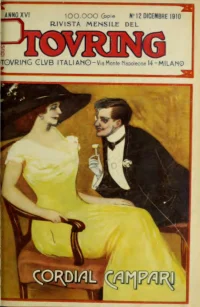
Rivista Mensile del Touring Club Italiano, Vol 16, No 12
Articles in this issue
- Members are pressed to send the 1911 subscription of L. 6 (L. 8 abroad) before 15 January or lose delivery of the Rivista; the year's free gifts are the Sicilia, Piemonte and Lazio regional guides, the propaganda monographs on woodland and pasture, the Torino e l'Esposizione 1911 monograph, eight Carta d'Italia sheets and twelve Rivista issues, with life membership cut to L. 90.
- The first volume of the Commissione Nazionale di propaganda per il bosco e per il pascolo — about 150 pages on coated paper with eight three-colour plates and over 100 illustrations — begins distribution in December; the first run is 15,000 of the planned 100,000 copies, going to life members, then five-year and annual members.
- Two new winter costumes that have met with great success in Paris and London are reproduced from clichés for the Rivista's readers.
- Giuseppe Imbastaro traces the Nativity through Christian art — the fifth-century fresco in the catacombs of S. Sebastiano, the Mantua sarcophagus, Giotto at Padua, Orcagna, Ghiberti's baptistery doors, Beato Angelico, Ghirlandaio, Correggio's Santa Notte and Gherardo delle Notti — then describes Christmas customs in Norway, England, Provence and Germany.
- Prof. Giacinto Martorelli hails Hagenbeck's new zoological garden at Villa Borghese in Rome as Italy's first, recalls Vittorio Emanuele II's short-lived Turin menagerie, and argues for one in Milan, sketching rock enclosures, a reptile-house on the Regent's Park model, a tropical aviary, an aquarium and an insect-house.
- Banner heading the Rivista's campaign for the roads and railways that would open the neglected shores of Lake Garda to Italian travellers.
- Ing. Vittorio Cinque, chief of the Brescia provincial technical office, describes the L. 800,000 rebuilding of the Toscolano–Gargnano road, the projected Gargnano–Campione provincial road, and the 10.3 km Tremosine road with its 12 tunnels and 18 bridges through the Forra di Brasa, plus the Mantova–Peschiera railway and Valtenesi tramway schemes.
- Photographs of the Seine in flood once more, its waters covering the gardens, quays and streets of Paris.
- Picture spread on the aviation Gordon Bennett cup, first flown over 20 km at Reims in 1909 and contested a second time over 100 km at Belmont Park, U.S.A., on 29 October, where the Englishman Graham White won on a Blériot; Latham's new 100 hp Antoinette, the disappointing small Wright biplane, Curtiss's exclusion and Moisant over the Statue of Liberty are shown.
- Nino Salvaneschi argues that skating, like dancing, is above all a woman's art, citing De Amicis's «Olanda» and the Frisian milkmaid, Tegnér's saga of Frithjof and Ingebord, Klopstock's verses, Kaulbach's portrait of Goethe on skates, and a German championship where the man could not match his partner's grace.
- Photographs by dott. S. A. Neri of the Turin 1911 site: the Po bank with the Belgian and French national palaces, the finished French palace, the Chinese and Siamese pavilions, the still-shapeless United States palace beside the white German one, the Russian palace, the Touring's own exhibit near the Castello del Valentino and the palace of the Città Moderna.
- With the Grand Palais reopening for the XII Paris Salon and Olympia gathering 700 cars worth some 25 million lire, the article notes valveless engines, worm-drive differentials, the revival of six cylinders, long-stroke motors, pressure lubrication, metal wheels, front-wheel brakes and detachable rims, quoting the 6 HP Jackson and Rover at 3,750 lire against 25,000-lire Rolls-Royce, Mercédès and F.I.A.T. chassis.
- Reprinting Travel & Exploration, the Rivista recounts the Dover–Brussels motor-boat raid run by the Royal Ostend Yacht Club: Xebec beating South Foreland across a foggy North Sea, 37 boats racing the 36 miles from Terneuzen to Antwerp, and 76 craft reviewed by King Albert at the Humbeck locks — a precedent for the T.C.I.'s Venice–Rome cruise of 1911.
- Photographs of the sixth Giro di Lombardia won by Micheletto, with the leading group heading for Gallarate and below Varese, the chase after Lapize, the field at Erba and Lecco, Lapize taking the lead after Erba and the crowd at the Sesto S. Giovanni finish.
- Dott. Gaetano Scotti explains the Norwegian ski method: choosing skis by height (160 cm under ten years, up to 230 cm for very heavy adults), centring and the Huitfeldt binding, turning, climbing by zig-zag or «in scala», the Telemark and Christiania stops, jumping, and greasing the soles for wet snow.
- P. Bongrani makes the case for Italian water tourism — the canoe as the ideal touring craft — praising the Touring Club de France's Lagny meeting of over a hundred rowing boats, and sets out the T.C.I. Commissione di Turismo Nautico's competitions for river signalling and for an unsinkable boat under 40 kg costing no more than L. 300, to be judged on the 1911 Turin–Pavia river cruise.
- Answering October's article on shooting in Italy, Umberto Grioni urges the Touring to become the «Messia dei cacciatori d'Italia», tying game protection to reforestation and to the olive-fly damage caused by killing insectivorous birds, deploring netters and poachers and Italy's poor showing at the Vienna hunting exhibition, and proposing a Commissione della Caccia allied to the Federazione Nazionale delle Società cinegetiche.
- Snapshots from Italy: the «Idripede» of signori Ferrari and Marino making 12 km an hour in the Gulf of Naples, the statue of Vittorio Emanuele II, the demolition of the Palazzetto Venezia in Rome and one of the monumental doors of the Museo del Risorgimento.
- Obituary group for Giuseppe Cesare Abba, Leo Tolstoy and Angelo Mosso.
- Born at Cairo Montenotte on 6 October 1838, the author of the Noterelle d'uno dei Mille died of heart failure in a Brescia street on 6 November; a valued Rivista contributor, he had joined the Touring's caravan commemorating the Thousand and wept while speaking from the Calatafimi monument.
- At 82 Tolstoy left his house at Jàsnaia Poliana for a monastery and died after a slow agony at Astapovo, a lonely steppe station; Anna Karenina, War and Peace and Resurrection are recalled as the fullest portrait of Russian society and landscape.
- The Turin physiologist, dead at 64, is credited with Italy's revival of physical training: his «ergografo» demonstrated the link between mental and muscular fatigue, and La Paura, La Fatica, La Temperatura del cervello and L'Uomo a grandi altezze spread his teaching to schools and sportsmen.
- Pictures of the month: Chanute, the aviation pioneer who died in Paris; the aeronautical museum of sig. Deutsch de la Meurthe presented to the French government; the Vedo Velli aeroplane; and Mexico in revolt, with a Mexican landscape and an infantry regiment in a street of Mexico City.
- Christmas and New Year list of the Touring's own gifts: a membership, «Attraverso l'Italia» at L. 25 to 32, the motoring and first aeronautical yearbooks at L. 3, the 1:650,000 motoring map, the cabinet and portfolio for the Carta d'Italia, the solid-silver enamelled plaque at L. 20, pennants, medical pouches and a binding case for the Rivista.
- The monthly news rubric, running by subject from aerology, aeronautics and alpinism through archaeology, astronomy, motoring, aviation, railways, motor-boating, shipping and telegraphy to the state of the roads.
- Prof. Gamba reports that sounding balloons released by the Royal Observatory of Pavia on 6 October crossed the Alps and fell at Le Bar sur Loup in France, reaching about 18,000 metres, where the barometric pressure was only 60 mm, and recording 65 degrees below zero.
- Recalls Giuseppe Collina's memoir read to the Accademia dei Filodidaci in Florence on 31 August 1856 for a horizontally steerable ellipsoidal airship 21 m long carrying eight to ten people, and his prophecy that the conqueror of the air would be «l'uomo dell'anno 2000».
- Notes from the mountaineering world: the Società Alpinisti Tridentini's new president, the fee due to a porter used as a guide, the S.U.C.A.I. almanac for 1911 and the Rifugio Albergo Carlo Porta.
- Count Lamberto Cesarini Sforza is elected president of the Società Alpinisti Tridentini for the three years 1910-1912.
- The Rivista objects that porters hired for an ascent and used as guides have taken to demanding the guide's tariff, though they carry none of the guide's responsibility.
- The S.U.C.A.I. issues its almanac in aid of the Rifugio Roma: 128 luxury-paper pages with a three-colour frontispiece of the Torri di Vajolet and illustrations printed in eight colours, describing approaches to alpine refuges and climbing technique.
- Building work is well advanced, and there is talk of linking the hotel to the summit of the southern Grigna by an aerial funicular.
- American millionaires are reported to be after the Casa Martelli collection in Florence with its Donatello San Giovannino, Davide and Arma; the Vittorio Emanuele monument in Rome is to be inaugurated on 4 June 1911; the young Florentine Rossellini wins the Ugo Foscolo monument competition in S. Croce; and Giacomo Boni, back from the Roman fort of Abusina on the Danube, pleads for what is left of the Castro Pretorio.
- The comune of Ocre in the province of Aquila means to fell the wood that surrounds and shelters the state-owned convent of S. Angelo; the Rivista asks the province and the government to forbid it and to reafforest the hills of Fossa and Ocre instead.
- On the extent of the visible universe: the Milky Way is now reckoned at some 120 million suns, and since light from Arcturus takes 102 years to reach us the faintest stars lie about 374,000 light years — roughly 4,000 centuries — away.
- News of the motor car, from a new one-piece rubber wheel to the spread of public motor services across Italy.
- Trials at Singapore of a car wheel made entirely of rubber in one piece, vulcanised so hard at the hub that it rings under a hammer and softening to ordinary rubber seven or eight centimetres from the rim; the makers will not say what it weighs or what it costs.
- A round-up of new motor-bus services and subsidies: the Milletti scheme for Perugia–Città della Pieve–Chiusi, new lines from Rome to the Parrocchietta, Sestri to Acqui and Scordia to Palagonia, projects for Crema–Codogno, Cavallermaggiore–Saluzzo and Terni–Visso–Tolentino, and Tolfa's L. 3,000 a year for the Allumiere–Civitavecchia run.
- The rubric's aviation column, given over this month to an eighteenth-century prophecy of flight.
- Louis-Sébastien Mercier's «L'an deux mille quatre cent quarante» (1770, enlarged 1786) is recalled for its chapter LIV, in which the dreamer watches an air-ship from Peking descend on a Paris square after seven and a half days' flight and eight mandarins step out.
- Railway news: the Pan-American line, an Italo-Austro-Swiss alpine network, the exact length of the Simplon, the new Innsbruck–Munich route and the co-operatively built Reggio–Ciano d'Enza line.
- The Pan-American Conference's special commission reports that the New York–Buenos Ayres line planned in 1890, 10,116 miles long, is two-thirds built, and that it will be carried on a further 1,600 to 1,700 miles to the Straits of Magellan.
- A scheme to make Trento the hub of a metre-gauge, electrically worked network of 1,307 km — 770 in Austria, 139 in Switzerland and 398 in Italy — linking Merano, Bolzano, Toblach, Pieve di Cadore, Belluno, Schio, Peschiera, Salò and Brescia, at a cost of 231 million.
- A joint commission fixes the Simplon tunnel at 19,803 m, of which 10,719 lie in Italy and 9,084 in Switzerland, so that Italy's buy-back from 1 June 1921 would cost L. 35,379,305; work on the second bore is to begin next summer and take seven years.
- Begun in 1909 and due in 1912, the 105 km electric alpine line from Innsbruck to Reutte avoids the long detour by Kufstein, pierces the Martinswand by a 1,787 m tunnel and climbs the Seefeld pass at gradients of 35 per thousand.
- Opened in October, the 31 km standard-gauge line from Reggio Emilia through Barco, Bibbiano and S. Polo d'Enza to Ciano, with a branch to Montecchio, cost three and a half million and is the first Italian railway built and worked by a co-operative consortium.
- Local schemes and openings: a trolleybus between Asti and Govone, agitation for the Roma-Ostia-Mare line, the raised subsidy for the Agordina electric railway, the new Vicenza–Marostica–Bassano tramway, the Alba–Barolo trolleybus and a L. 1,000 annual grant towards the Lecco–Valsassina tramway.
- Motor-boating news: entries for the Monaco meeting, the Regio Yacht Club Italiano's returns, the raising of Brynild, transatlantic challenges, the first hull for the Venice–Rome cruise and the Paris motor-boat show.
- Entries are coming in for the annual Monaco regattas; the Daimler Gesellschaft will send Daimler I, a 9 m cedar-hulled copy of Despujols's Duc with a four-cylinder 130 x 220 mm engine timed at 60.5 km/h on the Havel.
- The American Frank Dennis challenged the English to an Atlantic motor-boat race last August and found no taker; the Rivista recalls that the ocean had already been crossed by the tiny Abiel Abbot Low in 1902 and by the Gregory.
- Romano and Nazar of Baia have launched at Naples a 22 m paraffin-engined cabin launch for comm. Rocco, thought to be the first of the boats being built for the Touring's 1911 cruise: 9 tons gross, 11 knots, four berths, electric light and 700 litres of drinking water.
- At the Grand Palais motor-boat show held with the aeronautical Salon, Fiat alone flew the Italian flag with a 20-30 HP monobloc and a 100 hp industrial unit; Oerlikon showed a single-valve engine, Renault a 60 hp four-cylinder and Peugeot-Huber a range from 3 to 60 HP.
- The Regio Verbano Yacht Club challenges the Club Nautique de Nice for the six-metre cup twice won by Cesarina di Barral; the Italian challenger will be Vampa, owned by the marchese Ferrero di Ventimiglia and sig. Conelli De Prosperi of Turin.
- The nine-ton yawl Pandora, 11.20 m by 4.20 m, has reached Sydney; her Australian and English owners mean to sail round the world in her, which would make her a smaller craft than Captain Slocum's Spray.
- The Duke of the Abruzzi is said to intend challenging for the Coppa d'Italia with an eight-metre boat to be built at Voltri.
- At the Paris congress of the International Motor Yachting Association, where Italy was represented by count Brunetta d'Usseaux, the existing Monaco rating was confirmed for racers, while for true cruisers organisers may use either the German or the Swedish formula in 1911.
- Shipping notes: Italy's first motor cargo ship, the loss of the Preussen, the Cunard giants, the raising of the Maine and the Board of Trade's casualty figures.
- A motor ship for a regular cargo and passenger service between the two Adriatic coasts has been launched at Ancona, the first Italian vessel of the kind.
- After a collision with the mail steamer Brigadier the five-masted Preussen, the largest sailing ship in the world at 124 m and 5,081 tons register, parted her tow ropes off Dover and was driven onto a shoal east of the military port.
- A pretty motor launch has for some time been at the disposal of tourists on the Dead Sea, a comfortable little yacht that is said never to be idle.
- With the White Star giants Olympic and Titanic entering service, a new landing stage at Montauk Point on Long Island, served by fast Pennsylvania Rail Road expresses, is expected to cut at least six hours from the crossing to New York.
- The Board of Trade records 733 total losses, 2,219 serious casualties and 4,738 lives lost between July 1908 and June 1909, of which only 1,606 were true victims of the sea; the worst wreck was the Hong Kong steamer Ying-King with 412 passengers.
- Lloyd Brasileiro, having bought a fleet of good twin-screw ships, opens a service from Lisbon and Leixões to Pará and Maranhão; the Amazon bars limit the steamers to 3,500 tons.
- Cunard has completed plans for liners of exactly a thousand feet (304.80 m) and 50,000 tons, with 90,000 HP machinery burning some two thousand tons of coal a day for a speed approaching 30 knots.
- Cuba and the United States, which has voted 300,000 dollars, have begun raising the battleship Maine, blown up at Havana in February 1898 with some 250 of her crew; the O'Rourke Construction Co. of New York will lift her in a cradle of steel cables, leaving the wreck undisturbed so the cause can be settled.
- Shipping Illustrated makes the largest motor yacht the Allegro, 197 tons gross and 38.10 m long, driven by three 120 HP White and Middleton petrol engines to 15 knots on 370 litres an hour, owned by Colonel James Elverson of the Philadelphia Inquirer.
- Two items from the Ministry of Posts and Telegraphs: an economy in Morse working and the new internal telegraph tariff.
- Pasquale Fasilla, assistant director of telegraph and telephone construction at Milan, proposes joining the like poles of the batteries at the central and terminal offices of a continuous-current circuit so that no current flows while the offices are silent; the trial has given excellent results.
- The tariff in force from 1 December: 60 centesimi for ten words and 5 for each extra word, L. 1.80 for urgent messages, a press rate of 60 centesimi for twenty words at night, the abolition of the city rate and of the reduced parliamentary rate, and reply-paid minimums cut from fifteen words to ten.
- The roads rubric, listing bad, interrupted and newly subsidised roads and the state of their bridges.
- Complaints and remedies: on. De Michele Ferrantelli's question about abandoned intercommunal roads in Sicily, coarse new gravel around Pieve di Cadore, mud on the Cadeo–Carpaneto road, the sunken provincial road through the Vasto district, and the ministerial commission on road rolling that includes the Touring's ing. Francesco Pugno.
- Diversions and hazards: heavy carts and cars sent round by Carrara while the Ponte del Frigido–Avenza road is widened, a 30-quintal weight limit at Lavenone on the Brescia–Odolo–Anfo road, falling stones beyond the Ponte del Diavolo near Borgo a Mozzano, and the ferries over the Ombrone and Albegna cut by rain.
- Two bridges on the Fusco–Canicattini road near Syracuse are called a standing danger: the Ponte di Ferro by the Dorin property has lost its parapets, and the one opposite the Cannarella holding is part-planked with boards that no longer hold.
- Reviews of Girardault's Les automobiles industrielles, Gautier's Capitan Fracassa illustrated by Doré, Frescura's emigrant guide to Argentina, Vinai's L'Italia idrologica e climatologica, Guironnet's aeroplane formulary, Giuriati on aviation and crime, Maupassant's La vita errante, Favaro's Galileo and Pecoraro-Pessina's sabre treatise.
- List of books presented to the Touring's library, from the Automobile Club of Philadelphia's 1910 yearbook and German works on monoplanes and wing form to Palmieri's Appunti di geologia agraria, Pesenti's Bergamo and the official Italian catalogues for the Buenos Ayres and Brussels exhibitions.
- Decisions of the Direzione: a gold medal for the «Villino Moderno» competition, avv. Ferruccio Sorcinelli named capo console for Sassari, an approach to the province of Como over its bad roads, objections to the new regulation on wheel-rim widths, the gift of ing. Stragliati's Simplon model, new yearbooks for 1911, a silver medal for the national photographic competition, a reply on Esperanto and a «stazioni fiorite» competition for 1911.
- Legal column reporting the Firenzuola magistrate's ruling of 25 October 1910 in the Degli Innocenti case and a Cassation judgment of 17 March 1910 on the Rossotto appeal, both holding that a motoring charge cannot proceed unless the prefecture has first invited the driver to settle it administratively.
- The special cards that let members take a bicycle across the Austrian frontier without lodging the 60-crown deposit expire on 31 December 1910; renewal requires a form from the Touring's dogane section, the machine's make, number and weight, a photograph, a member's countersignature and L. 1.
- After pressure from the Touring the Minister of Public Works has granted a final extension to 31 December for renewing licences and number plates that were due by 16 November; latecomers face a L. 30 fine.
- From 1 January every bicycle, motorcycle and car on public roads must carry the metal tax token under the regulation of 31 August 1910; the 1911 token is only valid from 1 January, so vehicles used up to 31 December must still show the 1910 one, and cyclists must fix it to the steering tube and never remove it.
- The Touring will publish the eighth Annuario dell'Automobilismo, del Ciclismo e dei Trasporti moderni and a second Annuario dell'Aeronautica; owners, clubs and traders are asked to send corrections by 31 December, while 1910 members will receive only a supplement to the general yearbook.
- House rules for dealing with the Touring: one sheet per subject and always the membership number, registered post for valuables, how to claim for lost publications, how to notify a change of address, the L. 0.40 charge for duplicate Rivista issues, and what a membership card must carry to be stamped for customs.
- December subscription list for the Touring's signpost fund, with contributions from the municipalities of Livorno, Milano, Ostiglia, Lanzo Torinese, Pontebba and dozens more and from the provincial deputations of Ravenna and Padova, bringing the total to L. 79,006.50 and 5,556 signs subscribed to 31 October 1910.
- Nine new benemeriti — among them Piero Amati of Oggiono, Giannino Grignola and Alessandro Molteni of Milan, ing. Jacopo Polese of Castelfranco Veneto and Amedeo Valle of Alexandria in Egypt — bringing the total to 1,711.
- Thirty new five-year members, from count Giovanni Biscaretti di Ruffia of Turin and Carlo Geibel of Leipzig to Domenico Giuria of Valparaiso, Arturo Faleni of Buenos Ayres and the municipality of Caltagirone.
- Members who applied between 1 and 30 September 1910: life members from Bologna, Broni, Caltanissetta, Capodistria, El Trebol and Santiago, followed by annual members listed province by province from Alessandria and Aquila through Genova, Milano and Napoli to Torino, Treviso and Udine.