Rivista Mensile del Touring Club Italiano, Vol 16, No 2
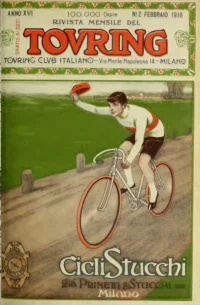
Articles in this issue
- L. V. Bertarelli offers a free second-class circular railway ticket to any member who signs up 15, 20 or 25 new soci who also take the back sheets of the Touring's 1:250,000 Carta d'Italia, on routes from Milano-Firenze-Roma-Genova-Torino up to a 25-member Milano-Venezia-Ancona-Taranto-Messina-Palermo-Napoli circuit, valid until 1 December 1911 for the Turin and Rome Cinquantenario exhibitions. He notes only 2,500,000 sheets of the Carta have gone out in four years to 80,000 members.
- Programme of the first Abruzzese winter meeting at Roccaraso on 26-28 February 1910: practice under the Smith brothers and alpini officers, toboggan races, speed and jumping contests for club skiers, alpine soldiers and ladies, and a closing ski excursion to the Coppe del Tesoro, with medals given by the Touring.
- How man-lifting box kites serve military reconnaissance where no high ground exists: paired cellular kites on a cable hauled by a winch raise a balloon basket carrying one or two observers, shown by the official trials at Boulogne in which M. and Mme Saconney were lifted to 100 metres.
- Under the display head « La Patria adottiva », Innocenzo Cappa recalls his 1905 and later visits to Buenos Aires, the row La Prensa made over Luigi Barzini's Corriere della Sera letters, the carriages of the Avenida de Mayo, the word-of-honour produce market and the satire Locos de Verano, closing on the two poles of the Argentine soul, the gaucho and the atorrante; illustrated from prof. Scardin's photographs.
- Announcement that the Touring Club Italiano, with the Federazione Nazionale delle Associazioni Giornalistiche, will run a national caravan over Garibaldi's route — Quarto-Genova-Marsala-Calatafimi-Palermo-Messina-Napoli-Caprera — with the programme to be published in the March number.
- Silio Carpani, prompted by a Milanese child-stealing story, traces the gypsies to the Sindh region of the Indus and a Sanskrit-based dialect, counts some 800,000 of them (220,000 in Romania, 4,000 in England), and describes their camps and tree-notch route signs, their disguising of stolen horses with false manes and silver nitrate, their violin playing, and the failure of Hungarian settlement grants and of Liszt's attempt to train a young gypsy musician in Paris.
- The Touring's Commissione Strade attacks the new motoring regulation: art. 11's 10 cm minimum rim width, art. 12's 25-quintal axle limit (Switzerland allows 60 for lorries) and art. 13's ban on towing, arguing that the 1908 International Road Congress found no appreciable macadam damage below 25 km/h and 40 quintals per axle, and asking why provincial councils may not regulate as communal ones do.
- Review of E. Bonomi's new Touring-patronised series L'Italia Monumentale, whose first two albums treat the Duomo of Milan and the Certosa di Pavia with historical prefaces by « Polifilo » (Luca Beltrami); it follows the Duomo from 1386-87 through Filippino degli Organi, Amadeo's tiburio, Seregni's and Carlo Buzzi's façade projects to the Napoleonic completion, and the Certosa from Caterina Visconti's bequest of 1390 to the last seven Carthusians leaving in 1866.
- Alessandro Schiavi contrasts the Italian worker's Sunday osteria with the provision made by Cadbury at Bournville, Lever at Port Sunlight, Burroughs, J. Crossfield and the National Cash Register Co. — gymnasia, swimming baths, tennis and football grounds, free bicycle garages, paid holidays and music during work — and notes that in Italy only the Società Italiana per l'Industria dei Tessuti Stampati has laid out a football ground for its 14- to 18-year-old workers.
- Giorgio Molli's history « Dopo il Centenario di Fulton », from Blasco de Garay's paddle trial with the Trinidad at Barcelona in 1543 and Papin's 1707 boat to Fulton's Clermont of 1807 and the warship Demologos, then the Savannah's 1819 crossing, the Enterprize's voyage to Calcutta, the 1838 race of the Sirius and Brunel's Great Western to New York and the iron screw Great Britain, with the Italian Ferdinando I (1818) and Rubattino's Dante (1838). Concluded next month.
- Preview of the international exhibition spread over 2,800 metres of both banks of the Po and 250,000 square metres, entered by the Ponte Umberto I: a Palazzo della Moda, an electricity palace showing wireless telegraphy and the singing arc, a press pavilion in an 80-metre hall, talk of dirigible services from Superga and even Milan, and the Concorso Ginnastico, firemen's contest, Olympic Games and a Touring road competition; a keyed plan lists the foreign pavilions.
- For its independence centenary Argentina opens four international exhibitions on 25 May — Fine Arts, Land Transport, Agriculture, Hygiene and Medicine — over 200,000 square metres in the Palermo park by the Rio de la Plata, with a 22-million subsidy voted by the Congreso; Italy's transport section takes about 7,000 square metres with the Touring in a place of honour, and the government has voted L. 500,000.
- The Brussels exhibition opens in April 1910 for at least six months in the Avenue Louise quarter beside the Bois de la Cambre, on about 100 hectares; the Comitato nazionale has secured Italy 12,950 square metres — 6,200 of industrial galleries, 1,350 in the machinery hall, 700 for rolling stock, 1,200 of gardens and 500 in the Palais du Cinquantenaire.
- Minutes of the four sub-commissions that met at the Touring on 27 December 1909 and of the presidency of 5 January 1910: Bertarelli's cartographic group weighs dott. Moedebeck's aeronautical maps against the Touring's 1:250,000, Guastalla's proposes a Touring booklet visaed by consuls to spare aeronauts customs trouble abroad, Saldini's calls for new observing stations, and Celoria approves an Annuario dell'Aeronautica on the model of the Annuario dell'Automobilismo.
- News photographs of the month: the Emilian village of Scopolo about to be swallowed by a landslide, ministers Rubini and Millerand meeting at Ventimiglia over the Cuneo-Nizza railway, Delagrange's smashed monoplane after the disaster of 4 January, and a diagram of Latham's flight of 7 January.
- The Senate debate of 29 December on cutting the bicycle tax (Bettoni and Biscaretti pressed for L. 5 rather than 6 for Italy's 470,000 cyclists) and raising the motor tax, with Cencelli's motion to hand the car tax to the provinces, which maintain 43,000 km of road against the State's 6,000, and Pirelli's plea for a single cylinder-based horsepower formula; also a case for a spa visitors' tax capped at ten lire, and American figures of 170 million dollars a year spent travelling in Europe.
- An English paper reports the Zeppelin company building a 300-metre airship for three hundred passengers on a Hamburg-Baden-Baden line, while Munich has voted 60,000 marks for a dirigible hangar so that the Parseval 3 can begin public passenger flights on 1 May at 200 marks for three hours.
- The C.A.I. delegates' assembly at Turin on 19 January elects conte Vittorio di Cessole an honorary member and re-elects comm. Palestrino vice-president; the Duke of the Abruzzi will lecture on his Himalayan expedition at the Teatro Vittorio Emanuele for the guides' fund; and avv. Antonio Grober, C.A.I. president since 1891 and promoter of the Regina Margherita observatory on the Punta Gnifetti, has died suddenly at Novara.
- The « bella fanciulla d'Anzio » in Michelangelo's cloister divides opinion, an English archaeologist arguing the statue is a young Gallic priest; also the twenty-year deadlock over Piazza Colonna and a proposal to move the Fontana di Trevi to the Palazzo Buoncompagni site, objections to linking the Campidoglio palaces by cavalcavia, and Italian alarm at France's plan to buy Palazzo Farnese for its embassy.
- Uneven weight distribution is named the chief cause of rear-tyre wear — of an 1,850 kg load some 1,250 kg falls on the back axle — so heavy spares should go in the front bonnet; followed by new Italian motor services including San Piero a Sieve-Monghidoro-Bologna, Pontassieve-Forlì, Rovigo-Crespino-Adria, Recanati-Macerata and a Trento-Giudicarie-Brescia link subsidised at 20,000 lire a year.
- The official record table just issued by the international commission: H. Farman 4h 17' 53" and 234 km at Mourmelon on 3 November 1909, Latham 453 m at Châlons and then 1,100 m at Mourmelon, Paulhan 1,500 m at Los Angeles; plus the Federazione Aeronautica Internazionale's 1910 calendar from Nice in April through Verona, Reims and Bruxelles to Milan in September and the New York Gordon-Bennett.
- Scandinavian and Icelandic sailing hunters working as far as the east coast of Franz Josef Land are exterminating polar game: the walrus, once killed by thousands off Bear Island and western Spitsbergen, has gone from those waters, reindeer are thinning in Spitsbergen, and only the polar-bear catch rises.
- Advice on packing for a long bicycle tour — a 7 cm comb case holding a beard brush and mirror, a celluloid collar, a flannel shirt and a waterproof cape, hair cut short at the start and no razor — followed by the 1910 Tour de France stages from Parigi-Roubaix on 3 July to Caen-Parigi on 31 July, and the season's road calendar including Milano-Sanremo, the Giro d'Italia of 15 May-5 June and the Giro di Lombardia.
- The Russian naval ministry has fitted out three Arctic expeditions, one sailing from Vladivostok along north-east Siberia to the Lena mouths and two to the Taimyr peninsula; Evelyn Baldwin plans to reach the North Pole by drifting parallel to Nansen's track, and Captain Scott's Antarctic expedition is nearly ready.
- Argentina's Buenos Aires exhibition of « ferrocarriles y transportes terrestres » is announced with 22,126 km of line, 41,780,000 passengers and 17,000 km more building; the Transandine line from Mendoza to Valparaiso is about to open through the 3,165 m Cumbre tunnel at 3,190 m altitude; and the Franco-Swiss convention brings the Frasne-Vallorbe cut-off, the Moutier-Granges link and the projected Faucille line feeding the Simplon.
- The second international geological congress meets at Stockholm about 18 August 1910 on Archaean formations, climate change since the last glaciation, iron deposits and polar geology, with Swedish excursions as far as Torne Träsk; and the Cameroon volcano, believed extinct for centuries, has been erupting since April, throwing scoriae hundreds of metres and laying a lava field 1,000 metres wide.
- The Touring's doctor on the Hejaz railway carrying cholera past the Djebel-Tor lazaret so that each train of the 30,000 pilgrims needs a doctor and isolation compartments; on Remlinger and Nouri finding typhoid bacilli lodged in fishes' intestines; and on flies as the « monoplanes » of infection, best destroyed in the larval stage with 1-5% soap solution or lime water.
- Remedies for horses' motor tics: the bear-like swaying of head and neck checked by two lateral ropes that allow only up-and-down movement, pawing with the forefeet cured by regular daily work and tying the front legs, and striking the ground with the hoof by special straps fixed above the hocks.
- Fridtjof Nansen's monograph on the yearly oscillations of the North Sea water mass off Norway shows that a cold February is followed by a cold March and April, and that surface temperature foretells a year ahead the flowering of spring plants, the growth of alpine pines, and the yield of cereals, peas, beans, potatoes, hay and the Lofoten fishery.
- The Norwegian government lends the hydrographic vessel Michael Sars free of charge to a scientific expedition that will work the Atlantic from the Canaries to the Faroes next spring, checking and completing fifty to sixty years of soundings with the improved capture gear now used in ocean fisheries.
- The Lisbon international telegraph conference has fixed the franc's equivalent for charges throughout the Postal Union: 9.6 pence for Britain and its colonies, 0.85 marks for Germany, one crown for Austria, one lira for Italy and Eritrea, 0.68 rupees for India and Ceylon, 0.40 yen for Japan and 20 gold centavos for Argentina.
- Ski racing will again be held at several Alpine centres and, for the first time, in the Abruzzi at Roccaraso on 26-28 February at 1,300 metres, with leading champions of the Italian alpini and the famous Norwegian jumpers, the Smith brothers.
- A German review proposes orienting airmen by wireless: medium-power stations spaced in regular zones would transmit automatic two- or three-letter call signs every five or ten minutes on a wavelength kept distinct from the state telegraph's, an aviator's 3 kg Morse receiver costing 125-175 lire and a hundred stations 150,000 lire to install.
- A committee at Alba is studying an Alba-Barolo trolleybus to run on to Monchiero station, another at Arona a filovia to Dagnente; Pavia's pro-sindaco has agreed terms with the Ditta Elettrica Conti of Vigevano for an electric tramway, and the Società Anonima « Tramvia Viggiù » is formed to link Viggiù with its station at a cost of about L. 220,500.
- Frankfurt has laid its dust with a 30% magnesium chloride solution that stays fluid to -12°; then Italian road news — a new level bridge at Genoa joining Marassi to via Canevari, the « Valle di Lazzaro » consortium at Portoferraio, Brescia's L. 782,000 widening of the Toscolano-Gargnano road, and complaints of ruined roads at Cotignola, Viadana, Frattura, Monselice and Mascalucia.
- The month's book notices, from Laborde's French-Spanish traveller's vocabulary, Henry Hoek's Wie lerne ich Schi-laufen and Baedeker's Das Mittelmeer to Stanley's autobiographical Come divenni esploratore and the Bonomi albums of the Duomo di Milano and Certosa di Pavia with texts by Polifilo, closing on a long run of aviation manuals from the Librairie des Sciences Aéronautiques in Paris.
- Council decisions: with conte di Sammartino's Rome 1911 committee a Venezia-Roma motor-boat cruise, a general Touring convegno, an L.I.A.T. congress and a historical exhibition of locomotion; for Turin 1911 an international road exhibition, a mountain-hotel competition and a Torino-Venezia river cruise; the new Roman Delegation under Don Prospero Colonna; the revocation of Cesare Pederzini as consul at Desenzano; and a gold medal for the Roccaraso ski meeting.
- What members get in 1910: the revised Annuario Generale in early March, the Rivista from the month of enrolment, and eight further sheets of the Carta d'Italia — Ancona, Quadro d'unione, Bergamo, S. Severo, Susa, Gargano, Domodossola and Orbetello — with the block of 28 earlier sheets on sale at L. 14; the Sicilia regional guide will appear in two volumes.
- The running subscription list for Touring road signs, carrying the total from 3,719 signs and L. 59,202.50 to 4,028 and L. 65,422.50, with gifts from the provincial deputations of Genoa, Catania, Grosseto, Modena and Florence and from the municipalities of Sondrio, Legnago, Alessandria, Casale Monferrato and Lodi.
- Candidates for membership who applied between 1 and 30 December 1909, listed as life members and then annual members town by town from Abbiategrasso to Viareggio, with large Italian colonies at Buenos Ayres, Rosario Santa Fè and Porto Alegre.
- Membership figures: 73,945 annual members and 3,292 life members, 963 of the latter enrolled during 1909, giving the Touring Club Italiano a total of 77,237 soci.