Rivista Mensile del Touring Club Italiano, Vol 16, No 5
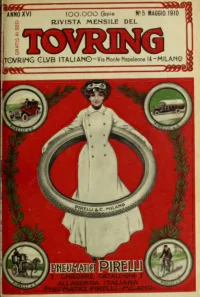
Articles in this issue
- The Touring announces its 23-30 May caravan retracing Garibaldi's Thousand, sailing from Genoa on the 3,200-ton Navigazione Generale Italiana steamer Sicilia to Marsala, then Salemi, Calatafimi, Segesta, Selinunte, Monreale and Palermo with surviving Garibaldini aboard. The 150-lire fare covers passage, board, free carriage of motor cars and bicycles, and separate rail, motor and cycle caravans; entries closed 10 May and G. C. Abba speaks at Salemi, Calatafimi and the Teatro Massimo.
- The Touring's programme for Italy's 1911 jubilee, agreed with the Rome executive committee: a general convegno on 8-10 September, a staged international motor-boat cruise from Turin to Venice, on to Fiumicino and up the Tiber to Rome (25 June-16 July) with a floating exhibition, a motor caravan converging on Rome 17-20 September, and the Festa dei Gonfaloni of the hundred cities on 20 September. It will also press for a Turin-Rome model motor road contested by the provinces.
- Berto Barbarani's lyrical portrait of Verona, written for the city's air contests: the Adige flood that carried away the Ponte Nuovo and the iron replacements that followed, the Roman theatre uncovered beneath Santa Libera, the market comedy of Piazza delle Erbe saved from a Politeama by the painter Angelo Dall'Oca Bianca, the Rengo bell of the Torre dei Lamberti, and the crowds seen from vomitorium XIV of the Arena.
- An argument for open-air schools for delicate children, opening with a tour of Milan classrooms with the clinician Achille De Giovanni and citing dott. Francesco Gatti's report to the Associazione Per la Scuola. It describes the first Waldschule opened at Charlottenburg in 1905 (240 pupils on 23,000 sq m of pine wood, photographed by dott. Ambrogio Bertarelli), the London County Council's Bostal Heath camp, and Milan's own efforts with Giuseppina Pizzigoni.
- Silio Carpani's history of bicycle racing, from informal contests on the high ordinary to the golden age of the tracks with Robecchi, Alaimo, Buni, Ruscelli, Pontecchi and Momo, and the collapse of the velodromes once totalisators and betting bred suspicion. Road racing then settled at 250-300 km, run for the trade with a famous leader shielded by his gregari, and Carpani describes the tactics of the break, the control-point signature and the chase.
- A hygiene column in three notes: De Bellile's report of conjunctivitis, corneal inflammation, stubborn eczema and heart palpitations among wireless-telegraph operators, for whom yellow or orange glasses are advised; Filassics and Sustory's counts of up to 575,000 germs per cubic centimetre on grapes, strawberries and raspberries bought from street sellers; and the unsettled question of whether lake water is drinkable, with temperature readings from Lake Geneva.
- A. Cotronel on the Derby Reale at the Capannelle, won by Saturno of the razza Besnate with Carducci second while the favourites Sambar and Wistavia were beaten, as proof that form on paper is worthless. He blames Italian breeding and the racing societies: worn-out mares sold for a few hundred lire go to stud, two-year-olds are over-raced, and the Derby is run in April over 2,400 m before the colts are consolidated.
- Four notes: the military airship N. 1 bis resuming training flights while two new 4,000 cubic metre dirigibles go to hangars at Venice and Verona; Parliament's 250,000-lire grant and two commemorative stamps for Palermo's 1910 jubilee, with 60 per cent rail reductions; some 20,000 electric vehicles now running in the United States; and the Gazzetta di Venezia's account of Mestre fining the oculist dott. Boldini a week after he passed through.
- Fabio Majnoni reports the seventh Monaco motor-boat meeting of April 1910: a record 118 entries but a thin international field, with Britain taking the Coupe des Nations and the 50 km race, Brasier-Despujols averaging about 74 km/h over the mile, and Italy represented only by the unlucky Spa-Gallinari. He traces the shift from the wedge hull to the skimming sdrucciolatore and hybrid rounded-bow forms, and welcomes builders' enthusiasm for the Touring's 1911 coastal cruise.
- Photographs of the Clément-Bayard II, newly built in France for the army, with the claim that its changes from the Clément-Bayard I are copied from Italian practice: the pointed tail, the stabilising planes of the 1 bis and the Forlanini, the vertical keel plane, and even the gantry layout of the twin propellers.
- A scale plate setting the machines of transport side by side: the Cunard steamer Mauretania (240 m, 70,000 hp) beside the Zeppelin (136 m), the French dirigible Liberté (63 m), a Mallet spherical balloon, a Nord railway locomotive (16.20 m), a Voisin aeroplane (10.50 m), a limousine (4.50 m) and a bicycle (1.80 m) — showing that 132 bicycles would span the liner's beam and that a Zeppelin needs 136 m to lift the 12-15 people a 6 m motor omnibus carries.
- A photographic page on the Nice-Cap Ferrat air cruise: Effimoff's aeroplane falling into the sea, Grade brought down in the Var, the aviator Metrot, Latham and Grade passing over the stands, and Henri Farman carrying a passenger from Étampes to Orléans, crossing the Orléans road at Mondésir before landing.
- A photographic page on the first cross-country flights: Emilio Dubonnet flying a Tellier monoplane with Panhard-Levassor engine from Juvisy to Bagatelle over the Place de la Concorde and embraced by his mother on arrival, alongside Claude Grahame White's first attempt on London-Manchester and Paulhan, who won it.
- A tour of the lower Ferrarese by the Ferrara-Codigoro tramway, past Migliaro, Massafiscaglia and Ponte Galvano, to Codigoro's two pumping stations draining the 50,000-hectare Grande Bonifica with Sulzer machinery costing 1,500,000 lire on 12,000 concrete piles. It goes on to the abbey of Pomposa, the Este castle and forest of Mesola where Tasso stayed, and to Comacchio, a town of 10,000 living by eel fishing and threatened by the projected reclamation.
- News in photographs: the wreckage a cyclone left of a Voisin biplane, a Farman aeroplane and the hangars at the Châlons experimental aviation ground; the Zeppelin II disaster of 23 April at Limburg; the Siemens Schuckert airship hangars at Biesdorf and the British military dirigible destroyed the same day at Aldershot; and the Duke of the Abruzzi, with on. Fradeletto, opening the IX art exhibition in Venice.
- The Rivista's monthly news department, gathering short notes under standing heads that run from Aeronautica and Archeologia — Arte through Automobilismo, Aviazione, Ciclismo, Esplorazione, Ferrovie, Folklore, Fotografia, Geografia, Navigazione, Ponti, Telefonia and Telegrafia to Tramvie and Viabilità.
- The Daily Graphic is fitting out a balloon with a cinematograph to beat the 1,193-mile distance record; the German balloon Pommern was lost in the Baltic on 4 April, drowning three of its four passengers; and on 24 April a gale smashed the Zeppelin II against a rock near Limburg in the Lahn valley and wrecked the new British army airship as it was drawn out of its Aldershot hangar.
- Art notes by prof. O. Bedeschi: a commission has cleared the National Gallery's Velázquez Venus of the attribution to Del Mazo; Corot's Pescatore sotto gli alberi has fetched 400,000 francs from American buyers; King Umberto's Pantheon tomb by the architect Cirilli was unveiled on 14 March; the Uffizi self-portrait collection has been rearranged by Corrado Ricci; and the Rava law stopped a Batoni portrait of Pius VI at the Turin customs for 175 lire.
- A register of new motor services: Cingoli-Macerata and Cingoli-Jesi, the Pistoia mountain route Pracchia-S. Marcello-Fiumalbo-Pievepelago, Belluno-Cadore, Gubbio-Perugia and Perugia-Città della Pieve-Chiusi three days a week, and Alba-Canale-Poirino-Turin for goods and passengers. Kilometric subsidies of 580 lire for nine years are granted for Taranto-Martina Franca and for Piacenza's Capaneto-Gropparello line.
- On the aeroplane trade's margins — machines sold through agents at twelve to thirty thousand lire on perhaps seven thousand lire of engine, fabric and wood — plus Count de Lambert's account of being paralysed with fright above the Eiffel Tower, Dubonnet's 109 km Juvisy-Orléans flight winning La Nature's 10,000-franc prize, Daniel Kinet's 2h 19m passenger record on a Farman, and Paulhan beating Grahame White to the Daily Mail's London-Manchester prize at over 68 km/h.
- A tip for renewing bicycle enamel: since rust on the rims damages tyres and few riders can afford re-nickelling or re-enamelling, warm the rims slightly and rub beeswax over the rusted spots, which combines with the rust and stops it forming again.
- Dr Charcot's Antarctic expedition ended at Punta Arenas on 11 February. In the Pourquoi-Pas? he surveyed Adelaide Island, established that Alexander I Land joins Graham Land, wintered at Petermann Island, coaled at Deception Island, and sailed between 104° 15' and 128° longitude of Paris through water crossed before only by Cook in 1774.
- Railway notes signed by ing. Filippo Tajani: the newly opened 60 km electric Trento-Clés-Malé line in the Tyrol with its 24 km Dermullo-Fondo-Mendel branch; Berlin's international travel exhibition of March-May 1911; the road-going treno libero, a locomotive and two cars costing about a third of horse haulage; and the miniature 0.36 m-gauge estate railways of the Duke of Westminster at Balderston and of Mr Bartholnen at Blakesley Hill.
- Americo Scarlatti on the Whitsun pilgrimage to the Madonna del Divino Amore at Castel di Leva on the via Ardeatina, a church built in 1744. Frascati goes on Easter Monday, Grottaferrata at the Ascension, Marino at Trinity and Genzano the Sunday after — dates fixed to keep rival towns apart — and the return to Rome becomes a carnival of carts, carriages and motor cars smothered in paper roses.
- On magnesium burns: holding the ribbon directly in the hand has given several experimenters deep burns, made worse by caustic magnesia entering the wound, so the metal should be mounted on a support. Treat with cotton wool soaked in equal parts linseed oil and lime water beaten to a thick yellow cream.
- The German-Portuguese boundary agreement in East Africa, signed the previous November, gives Germany about 500 square kilometres more territory and 20 kilometres more coast between the mouth of the Rovuma and Cape Delgado; the joint survey commission was led by Major Schloblach for Germany and Lieutenant Antonio Julio Brito for Portugal.
- Shipping notes largely by Giorgio Molli: the Orient Line's new Australian mail steamers will call at Taranto, not Otranto, which has no suitable harbour; Vickers has sold Italy the submarine-carrying steamer Transporter; White Star's Megantic and Laurentic join the St Lawrence trade with the rebuilt Heliopolis and Cairo; and Great Lakes navigation opened on 29 March, a month earlier than the half-century average.
- Six small colliers of 73.60 by 9.80 metres, 1,852 tons displacement and 1,650 tons capacity, are building at La Seyne to carry Westphalian coal by the Rhine, the North Sea, the Channel and the Seine up to Paris at 9 knots on two 450 hp engines — proof, the writer argues, that a little goodwill would open the Tiber, the Arno and the Po to similar ships.
- Bridge news: Meduna di Livenza has voted its bridge over the Livenza; Vicenza has approved the Povolaro overpass on the Vicenza-Schio line; and the reinforced-concrete bridge at Olginate will run about 100 metres in three 30-metre arches, 6.5 metres wide and 8 metres above low water, for some 350,000 lire.
- The United States government spends 95,000 francs a year maintaining 121 telephones with their overhead lines and submarine cables along the coasts of Long Island, New Jersey, Maryland, Virginia and North Carolina, from south of Hatteras to Cape Cod, to summon lifeboat crews; the service has raised the average of lives saved by 170 a year.
- On the spread of wireless at sea, with Marconi sets preferred by British and Italian ships, De Forest by Americans and French and Slaby-Arco Telefunken by the Germans. The steamer Kleist, only fifty miles from the French mail Chanzy when she was lost off Minorca, worked Marseille, North Foreland and Scheveningen on a 2 kW set — had the Chanzy carried one, the writer notes, there would probably have been no victims.
- Tramway notes: the Mestre-Treviso-S. Artemio electric line has been officially opened; Brescia-Salò starts electric railcar working this month; Bergamo is to get a funicular from Fontanabrolo to S. Vigilio; the Grumo-Casandrino branch near Naples opens shortly; and the Chiasso-Capolago line will continue the Como-Ponte Chiasso.
- A register of new roads: works under way at Duno in Valcuvia and between Zannier and Stregna in Udine, a pro-strada rally at Longi in the province of Palermo, an 80,000-lire grant for the Onno road to Erba Incino station, 370,000 lire for the Dragone-Palagano stretch in Modena province, and approval of the Como-Torno-Careno and Maslianico-Ponte Chiasso roads.
- Book notices headed by L'Italiano a Bruxelles, a pocket volume of about 200 pages combining guides to Brussels, to the Exhibition and to its Italian section, with motoring and cycling notes compiled by the Touring and sold at one lira. Also I Mille from the Società Editrice L'Attualità for the Garibaldi jubilee, Colasanti's Loreto and Occhini's Valle Tiberina in Corrado Ricci's Italia Artistica, Luigi Barzini's Da Pechino a Parigi and Frosali on ordinary roads and their upkeep.
- Minutes of the Touring's council and Direzione: the 1910 budget approved, Bertarelli's proposal for a national correction of the Istituto Geografico Militare's 1:100,000 map accepted with a special commission, ing. Gola named delegate to the Brussels road congress, comm. Evaristo Stefini made president of the hotel-improvement commission, a regional convegno granted to Pescara, and the convention with the Rome 1911 committee ratified together with the Turin-Rome model-road contest jury.
- Latest gifts towards the Touring's road signs, from the municipalities of Fiorenzuola d'Arda, Foiano della Chiana, Rosà, Empoli, Pieve del Cairo, Turin, Arignano, La Spezia, Sondrio, Dolcè and Imola, the Chieti provincial deputation and the Genio Civile of Teramo, bringing the fund to L. 69,593.25; 5,071 signs had been erected by 31 March 1910.
- Lists of newly appointed Touring officers: civil consuls at Lecco, Naples, Teramo, Castellammare di Stabia, Épinal and elsewhere; military consuls in regiments at Brà, Ivrea, Milan, Mondovì, Padua and Piacenza; legal and medical consultants; and the rolls of soci benemeriti (1,653 in all) and of the five-year subscribers.
- The list of members who applied to join between 1 and 31 March 1910, beginning with the life members from Amandola, Antivari and Calascio and running province by province from Alessandria and Ancona to Rome and Turin, and on to Italians abroad at Detroit, New York, Buenos Ayres, São Paulo, Callao and Montevideo.