Rivista Mensile del Touring Club Italiano, Vol 16, No 6
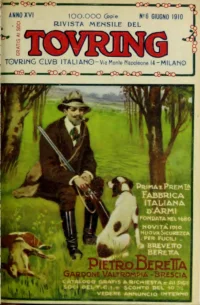
Articles in this issue
- Silio Carpani marks the opening of Italy's river and lake fishing season on 16 June, separating the dreamer-anglers (poets and philosophers who never notice the float) from the true rod-and-reel specialists, and lists illustrious fishermen from Mark Antony on the Nile to Rossini, Verdi, Puccini and the librettist Luigi Illica.
- G. Bedeschi traces the late Edward VII's sporting life: the bull shot at Chillingham Castle in 1872, the bear killed at eight yards near St Petersburg in 1874, otter, elephant and tiger hunts at Beypore and Jeypore during the 1876 India tour, racing at Ascot and Madras, and the Scottish torch dance at Mar Lodge.
- Giuseppe Imbastaro on the maiolica of Castelli near Teramo — Orazio Pompei, the Grue dynasty from Francesco (b. 1594) through Carlantonio and Francesco Antonio, and the Gentile and Cappelletti families — ending with Fedele Cappelletti of Rapino, who has spent thirty years reconstructing their kiln and pigment technique for the coming Rome Exhibition.
- Full-page fashion plate showing assorted hats and hair coverings for lady motorists, plus an outfit for a woman alpinist.
- Sofia Bisi Albini contrasts the American students, German schoolmistresses, Slav journalists and Danish teachers who crowd St Peter's Square each spring — among them an elderly Miss Warley who twice circled the world on ten shillings a day with one small bag — with Italian women, whose immobility she blames on upbringing and on the salaries of teachers and clerks.
- The Touring's Ufficio Informazioni tabulates three road itineraries to the Brussels world exhibition — Turin via the Moncenisio (991 km), Milan via the St Gotthard (964 km) and Trento via the Arlberg (1043 km) — after which Luigi Masetti argues that for a Rome-Brussels record the Simplon route (1670 km, only six customs posts) beats all three.
- Sets a map of Italian tuberculosis mortality — blackest over the industrial provinces of Milan and Como and the Genoese riviera — against the Sanatorio Popolare "Umberto I" at Prasomaso in Valtellina, founded by dott. Francesco Gatti at 1250 m and 146 km from Milan, whose sunshine, rain, fog and temperature records the Touring's doctor compares with Davos, Arosa, Wald and St Beatenberg.
- Assunto Mori surveys map-making before Europe: the Turin museum's Nubian gold-mine papyrus of c. 2000 B.C., fragments of Susa and Babylon, Chinese relief-map bronzes and Mexican cadastral maps, the Eskimo Kalliherna's 1850-51 chart of the Greenland coast drawn aboard the Assistance, Iukaghir pictographs, and the Marshall Islanders' bamboo-and-shell nautical stick charts.
- Prompted by a buzzard outflying Latham's monoplane at a recent air circuit, the article reviews flying squirrels, galeopithecus, bats, flying dragons, flying fish and insects, cites pigeon speeds of 80-125 km/h and the kingfisher's 180 km/h, and argues the aeroplane descends from the kite via Henson (1843) and Wenham (1867) rather than from the bird.
- Guido Vicenzoni on the origins of games: the hoop lamented by Propertius, the kite that measured Pompey's Column at Alexandria in 1798 and prefigured Blériot, the whipped and mechanical tops, the quattro cantoni of the 1700s, the barra blamed for the 1797 Genoa rising, calcio as the true parent of football, and the diabolo brought from China by a missionary around 1700.
- Twenty photographs of the second Giro d'Italia: the leading group crossing Verona, Luigi Ganna in the city, Corlaita's pursuit after Ferrara, Bruschera and Danesi dropped on the Ferrara plain, the climb of the Selligata above Pesaro with Azzini, Petit-Breton and Gaioni, the Naples and Florence finishes, and portraits of Azzini, Dortignacq, Galetti, Albini and Brocco.
- Two-page photographic spread on the Verona air meeting: Cheuret and Duray on Farman biplanes, Kuller on an Antoinette, the Italian Cattaneo on a Blériot, the mid-air collision between Cheuret and Kuller, Duray's crash and the carting away of his wrecked biplane, Paulhan flying over the Arena greeted by his mother, and the Duke of the Abruzzi visiting the hangars.
- Legal and statistical notes: the Paris appeal court clearing M. Vincent of usurping Countess Ducos's registration number, the Aéro-Club de France protest at Oise landowners stringing wires between tall poles to block a dirigible, Lord Lucas's answer to Lord Montagu on British military airships, American output of 200,000-300,000 cars for 1910 and its call on rubber, and London's 1908 traffic count of 11,280 cabs and 3,288 omnibuses.
- Six photographs of De Lesseps's Blériot monoplane being wheeled to the start, leaving the Calais coast, seen from the French beach and from the Calais-Dover steamer, over open sea, and landing.
- Avv. Bortolo Belotti reports the 15 May meeting in Rome with the Public Works ministry on Ettore Sacchi's motoring bill: he welcomes the curb on "contravvenzioni al volo" and lighter fines but opposes the presumption of fault against the motorist, the shift of jurisdiction to the place of the accident, and the 1865 law giving the reporting officer a share of the fine.
- The commission drafting the motor-tax regulation has chosen the formula method over dynamometer tests, adopting HP = 0.0525 nD² for touring cars and 0.035 nD² for lorries; tables show medium and large cars taxed more heavily than under builders' ratings while the most powerful types gain.
- News photographs: Edward VII lying in Westminster Hall, the Whitehaven mine disaster, the aviator Hauvette Michelin killed at the Lyon aerodrome, Wieuczius on an Antoinette over Strasbourg, the auction of Delagrange's wrecked aeroplane in Paris, the Ottoman mission arriving at Milan Central, the launch of the US dreadnought Florida, the King and Queen at Cagliari, and the Quarto commemoration of 5 May 1860.
- Masthead of the magazine's monthly news digest, running from archaeology and motoring through hunting, cycling, railways, folklore and geography to shipping, fishing, tramways and road maintenance.
- Prof. O. Bedeschi notes the disputed provenance of the Anzio statue bought for 400,000 lire in 1877, urges Italian museums to copy the Amis du Louvre, records the Bargello's purchase of a Pierfelici waffle iron by the Foligno goldsmith Francesco di Valeriano, Brera's recovery from London of Girolamo Marchesi's altarpiece taken from the Servi at Pesaro, and the subsiding apse of Pienza cathedral.
- The Tsar's Cup race of 22 June over St Petersburg-Kiev-Moscow has entries from De Dion-Bouton, Benz, Adler, Pipe, Fiat and Isotta Fraschini; and at Modena on 8 May Felice Nazzaro on a Fiat took the world flying-mile record in 40 4/5 s, beating Leonino Da Zara's 41 3/5 s on a Spa.
- Italy's first flying school opens this month at Milan's new Porta Vittoria aerodrome under S.I.A. patronage with a Farman biplane and a Blériot monoplane, supervised by sen. Giuseppe Colombo, Oreste Fraschini, Luigi Origoni, Alberto Pirelli and Aldo Weillschott; and Hauvette Michelin died on 1 May after hitting a pylon at Lyon.
- Blames the disappearance of game on predators rather than hunters, and proposes making a shooting licence conditional on a certificate of predators killed, or rebating the fee — five lire for a fox's head handed in at the town hall — so councils clear foxes, eagles, sparrowhawks, owls and martens at no direct cost.
- An English tip for keeping a bicycle lamp alight in a head wind by wrapping it in muslin; Giovanni Cuniolo's win in the 278-km Coppa Bastogi of 6 May in 10h 37m from Micheletto, Brambilla and Chiodi; the 1910 world championships fixed for the Karreveld track, Brussels, 17-24 July; and Bardonneau's 20-km world record of 28'24" at Roubaix.
- Minister Sacchi has ordered the Rome-Naples direttissima completed within five years, including an underground line from the new Fuorigrotta station through Chiaia; and new French, Belgian and German trains will cut Paris-Berlin to 16h 27m, saving eight and a half hours. Also the Montreux-Glion rack railway and Prof. Belluzzo's turbine locomotive built with the Officine Meccaniche.
- Americo Scarlatti on the decay of Rome's "Girandola" firework display since it left Castel Sant'Angelo — its bronze plate of ten thousand rocket holes, and Princess Margherita watching from the Palazzo Altoviti — and on the feast of St John on 24 June, with its seven-fountain water divination, coloured woollen threads tied to wheat stalks, the Venetian spitting rhyme and the Marsala sibyl's grotto.
- Prof. Albrecht's plot of the north pole's wandering from 1899 to 1908, drawn from six stations on latitude 39°8' N; the jubilee celebrations for Prof. Luigi Hugues at Casale Monferrato on 20 March; and the Bolivia-Peru boundary agreement over Acre, which cedes 30,220 km² to Peru.
- A French experiment reports that replacing clear stable window glass with pale blue drives out flies, horseflies, moths and grubs without harming the horses or requiring the door to be closed.
- The marble ranges of German South-West Africa near Swakopmund — Habib, Karibib, Navachab and Kubas — are solid marble in over a thousand colour grades, quarried at the foot of the hills rather than in high gorges as at Carrara.
- Giorgio Molli's tables show New York leading world export tonnage, Antwerp overtaking London for second place, and of 30,540 registered ships totalling 41.4 million tons only 4.98 million are sailing vessels; plus the two new 259-metre Hamburg-Amerika liners of 40,000 hp carrying 4,800 passengers and 750 crew.
- The Panama canal works keep growing in scale, while Argentina plans a canal from Buenos Aires along the right bank of the Paraná to Rosario to replace the uncertain navigation of the river's branches.
- A "North Sea Fisheries and Shipping Exhibition of Marine Oil Engines" at Great Yarmouth from 29 October to 12 November will show how a 60-hp internal-combustion engine costing £700 can be fitted to a first-class fishing smack worth £500-600.
- A metre-gauge electric tramway is about to be built from Pont Saint Martin up the provincial road to Gressoney St Jean, later extended to Gressoney la Trinité, with overhead wire, bow collector and its main depots at Issime.
- Seventeen provinces from Alessandria and Bologna to Rome and Turin have entered the Touring's "gara d'onore" for a model road between Rome and Turin in 1911, competing for bronze plaques, gold and silver medals and a silver cup given by comm. Guido Ravà-Sforni, with awards also for the engineers and roadmen.
- Monthly register of Italian bridges, motor-bus lines, tramways, trolleybuses, railways and roads: the new Canalbianco bridge between Frassinelle and Villamarzana, motor services from S. Marco in Lamis and Belluno-San Vito, Parma's urban and suburban electric trams, and the sixty-year concession for the Como-Cernobbio-Maslianico line.
- The XVI edition, distributed to 85,000 members, adds passport and personal-firearms rules by country, bans on photography in military zones, hotel-liability notes and an international hotel telegraph code, and lists the 1,000 hotels, 800 garages, 1,000 mechanics, 3,500 consuls, 800 lawyers, 500 doctors and 600 chemists serving members.
- Book notices including Savallo's 2,700-page Guida di Milano e Provincia with 154 colour plans, the 1,400-page Annuario-Dizionario of the motor, marine and aeronautical trades, Laville's Principes d'automobile, Calderara and Banet-Rivet's Manuel de l'Aviateur constructeur, Lowell's Mars et ses canaux and Larousse's La Hollande illustrée.
- List of books presented to the Touring, from Sonzogno's thirty-centesimi Della Casa, Martial and Plato to Taussig's privately printed Retracing the Pioneers from West to East in Automobile, the C.T.C.'s British and Irish Handbook, and German cycle and motor-trade address books.
- New subscriptions to the Touring's signpost fund from the municipalities of Brescia, Saluzzo, Saronno, Castelfranco Veneto, Osnago and others and the provincial deputations of Bologna, Cosenza and Ravenna, bringing the total to L. 71,290.75 and 5,184 signs subscribed by 30 April 1910.
- Masthead of the club's administrative pages, listing new consuls, legal and medical officers, benefactor and five-year members and the month's candidates for admission.
- Newly appointed civil consuls, from Amantea and Bergamo to Copertino, Livraga and Mola di Bari, and abroad at Danbury (Connecticut), Copenhagen and Paterson (New Jersey).
- Military consuls appointed in barracks from the 93rd Infantry at Ancona and the 9th Bersaglieri at Asti to the artillery at Foligno and Vigevano, followed by the club's new legal advisers at Benevento and Sciacca and doctors at Castelbolognese, Cesena, Giarre, Monza and Sassari.
- Ten new benefactor members — among them march. Adolfo Barbi of Rome, ing. Attilio Evangelisti of Bologna and ing. Aristide Sarno of Naples — bringing the total to 1,663.
- Members taking out five-year subscriptions, from Annibale Astraldi at Buenos Aires and J. Brocherel at Aosta to Francesco Gazzano at Mar del Plata and Enrico Uboldi at Buenos Aires.
- Candidates for membership of the T.C.I. who applied between 1 and 31 April 1910, opening with the life members from Asmara, Belluno, Bologna, Buenos Aires, Genoa's "Italia" steamship company, Mexico City, Milan, Montevideo, Palermo's university geography department, Rome, Turin, Trieste and Udine.