Rivista Mensile del Touring Club Italiano, Vol 16, No 9
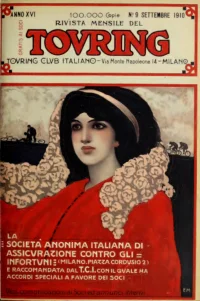
Articles in this issue
- E. Lazzareschi traces the Volto Santo of Lucca from Dante's Malebolge cry «Qui non ha luogo il Santo Volto» through the legend of Nicodemus's cedar crucifix borne by a pilotless ship from Ioppe to Luni, its shrine by Matteo Civitali in S. Martino, and its German offshoot Santa Kümmerniss.
- Alberto De Angelis reviews the works for Rome's Cinquantenario exhibitions: Bazzani's Belle Arti palace at Vigna Cartoni, the archaeological show in the Terme di Diocleziano, the Mostra Etnografica in Piazza d'Armi, Castel Sant'Angelo, the Ponte Flaminio and the 30,000-seat Stadio Nazionale, plus the Touring's motorboat cruise and cyclo-motor rally.
- Alessandro Schiavi treats migration as a form of tourism, from seed dispersal and the lemming and squirrel migrations to the barbarian invasions, then Italian emigration statistics for the United States, Argentina and Brazil, internal seasonal labour movements and the drift to the cities (urbanesimo).
- The 1827 travel diary of the Milanese lawyer Antonio Gabuzzi and the cloth merchant Gian Maria Balleri, who took the mail coach from via Monte Napoleone opposite the future T.C.I. offices to Turin, Chivasso, Sant'Ambrogio and the Mont Cenis on their way to Chambéry.
- The full entry list of 33 machines for Milan's air meeting (Paulhan, Cattaneo, Chavez, Aubrun, Wiencziers, Legagneux and others), technical data for the Farman, Voisin, Sommer, Antoinette, Blériot, Nieuport and Madrigali types and their Gnome, Antoinette, Anzani and E.N.V. engines, with the day-by-day prize programme of 25 September to 2 October 1910 and the 100,000-lire Alpine crossing.
- Giovanni Bedeschi on Italy's leaning towers: Pisa's campanile begun by Bonanno in 1173 and explained by Vasari as ground subsidence, Bologna's Garisenda and Asinelli built by Filippo and Oddo Garisendi about 1109-19, and Rome's Torre delle Milizie at Magnanapoli.
- Photographic plate of engineering works on the new Bassano-Primolano railway: the north portal of the Val Goccia tunnel, the south portal of the second Carpanè tunnel and the «Covolo» and Gallo tunnels.
- Francesco Picco describes the teachers who ride out from Rome along the Nomentana and Prenestina to hut-schools at Farfa, Colle di Fuori, Pantano Borghese and Cerenova, where 934 pupils were taught in the year covered by the Unione femminile nazionale's report.
- At Montecitorio the Public Works minister Sacchi received the T.C.I.'s Roman delegation and Commissione Miglioramento Strade, with deputies Bignami and Montù, ing. Gola, cav. Bonardi and cav. Mercanti, who pressed for fewer level crossings, two-city road names and a national codice stradale.
- The second International Road Congress at the Palais des Académies, 31 July to 10 August 1910, with Italian delegates Gola, Toller, Vandone, Cinque and Tedeschi; resolutions on tar binding, macadam, road foundations, wheel-rim widths and the 25 km/h limit, and the T.C.I.'s exhibit of signposts at the Brussels road show.
- Lessons from the Stockholm-Gothenburg motorboat race for the Yachting Automobile cup, followed by the T.C.I.'s construction rules for the 1911 Venezia-Roma cruise: hulls of at least 9 metres, decked over two thirds, an 8-knot motor, sails, two anchors and provisions for six days.
- Photographic plate of the Paris circuit: Lt. Cammermann circling Moncel on a Farman, Leblanc passing over a train near Amiens and landing at Nancy, Legagneux over Hirson and Aubrun arriving in Paris second.
- News pictures of the month: Francis Joseph at his last great military review, Moisant rounding the Calais semaphore for England, the Usuelli-Müller airship over Turin, Lt. Vivaldi-Pasqua as aviation's first Italian victim, the Zeppelin's polar reconnaissance ship Mainz and the Brussels exhibition after the fire.
- The magazine's classified news department for September 1910, running from Aeronautica and Alpinismo through Archeologia-Arte, Automobilismo, Aviazione, Ciclismo, Ferrovie and Filonautica to Navigazione.
- On 18 August the Usuelli-Borsalino airship, piloted by the Usuelli brothers, left Turin, skimmed the Mole Antonelliana, crossed the city and landed at Stupinigi near the Juventus ground after about half an hour at 200 to 500 metres.
- Alpine notes signed Dott. G. Scotti covering new C.A.I. refuges, painted huts, first ascents in the Albigna-Disgrazia group and an Italian expedition to the Caucasus.
- The Milan section of the C.A.I. plans a refuge in the upper Val Torrone to open up the Pizzi Torroni, helped by the carriage road being built in the valley.
- The Milan C.A.I. section has begun painting refuges to make them more visible, trying it first on the capanna Allievi in Valle di Zocca (Val Masino); the roof should be painted too.
- Dr. Romano Balabio with his brother Antonio and the Calegari brothers made the first ascent of Pizzo Ventina (3250 m) on 2 August; Monte Zocca (3200 m) fell by a new south-west crest on 6 August and Torrone Centrale (3300 m) by the west crest on 8 August.
- The S.U.C.A.I. has adopted blankets sewn into sacks to cut the number needed for students taken into the upper Cogne valley, and recommends the system for alpine refuges.
- Following the C.A.I.'s university station, a similar body founded within the Società Alpinisti Tridentini organised an alpine week from 28 August to 3 September in the Brenta-Presanella-Cevedale groups.
- Cav. Guido Rey, called unanimously to the presidency of the Club Alpino Italiano, has declined the office.
- The Turin section of the C.A.I. has resolved to build a refuge at Turras in the Cesana Torinese valley and has designed another at the Pian delle Mule in Valle Soana.
- The Club Alpino Italiano's congress will be held at the Enza section from 8 to 14 September.
- The C.A.I.'s Stazione Universitaria has begun issuing albums of postcards showing mountains with the ascent line traced and a technical description; the first, fifteen cards of the peaks round the capanna Badile in Val Masino, costs L. 1.65 in aid of the Rifugio Roma.
- The C.A.I. has reconstituted its commission for the study of glaciers with a grant of L. 300.
- A new section of the Club Alpino Italiano has been formed at Aquila.
- The 500-lire Montefiore Levi prize for the C.A.I. section most active during 1909 has been awarded to the Turin section.
- The C.A.I. is building a refuge at the Jumeaux, 2800 m, on the ascent route to the Becca di Guin; it will be finished by September.
- Drs. Vittorio Ronchetti and Gaetano Scotti, with the Val Masino porter Giacomo Mori, explored the Giulchi and Adoi Choc groups of the Caucasus from 30 June to 31 July, collecting place-names and insects and reaching 5300 m on Elbrus.
- Corrado Ricci's proposal to spare the two-storey east loggia of the Palazzetto di Venezia being demolished by architect Pistrucci; the death of the collector Count Gregorio Strogonoff, donor of an ivory relief to the Ravenna cathedra; Angelo Rossini's Via Appia etching; Boni's Palatine excavations funded with 150,000 lire; and electric light in the Terme di Tito.
- The Isat petrol funnel, and the thirteenth Meeting de Provence of 14-15 August with the Coppa Brasier won by Gasté on a Rossel at 156 km/h, with class results for Georges and Naas on motorcycles and Giuppone, Bablot, Fournier and Magne on cars.
- Trials of the Isat funnel, which keeps water out of the petrol tank: twenty drops of water dripped into a demijohn of benzina all stayed behind in the Isat, and a single droplet broken into bubbles was likewise trapped; orders are now filled within two days.
- The Circuit de l'Est ended at Issy-les-Moulineaux on 18 August with Leblanc first over the 809 km in 12h 1m at 67.3 km/h ahead of Aubrun; also Moisant's Amiens-London flight, the Corriere della Sera's 50,000 lire for an all-Italian air circuit, and the death of Lt. Vivaldi-Pasqua whose Farman fell near Civitavecchia.
- Final classification of the stage race «Al mare, ai monti, ai laghi», which ended on 18 August: Ugo Agostoni of Lissone won the amateurs on 55 points from Pietro Fasoli and Eligio Bianco, and Galetti the professionals on 18 points from Pavesi and Aymo.
- Railway notes for the month, from Prussian passenger statistics and the new Livorno-Vado line to track gauges, electrification of the Giovi, the Berne congress, the Valsugana line, telephones on trains and the Djibouti to Addis Ababa railway.
- Prussian statistics for 1908: 1,695,180 first-class journeys at an average of 9.69 marks against 441 million fourth-class at 0.41; a first-class passenger travels 127 km on average and a third-class one only 20.
- Opened to traffic on 4 July, the 31-km Livorno-Vado line with six tunnels totalling 2853 m (the Telegrafo alone 1019 m), stations at Castiglioncello, Ardenza and Livorno Centrale and halts at Quercianella and Antignano, places Livorno on the Rome-Turin trunk route.
- Standard gauge is 1.435 or 1.445 m; the commonest broad gauge, 1.676 m, covers 55,300 km, half of it in India; world-wide 71 per cent of railways are standard, 14.5 per cent broad and 14.5 per cent narrow, Europe's broad-gauge mileage being mostly Russian.
- Electric working over the Giovi is about to open on the 19 km from the Campasso yard to Busalla, with gradients of 35 per thousand, three-phase current at 13,000 volts from a 6000 hp Parson turbine on the Chiappella site, and 380-tonne trains double-headed at 45 km/h.
- The new metre-gauge line through the Calanca valley in the Grisons runs 32 km from Bellinzona by Grono to Mesocco with gradients of 60 per thousand, minimum curves of 80 m and a rise of 619 m, taking two hours 48 minutes.
- The eighth international railway congress, held at Berne 4-16 July: membership has grown from 19 governments and 131 administrations in 1885 to every recognised government and 420 companies with 600,000 km of line; subjects included long tunnels, high-speed steam locomotives and electric traction. The next meets at Berlin in 1915.
- The Bassano-Primolano section of the Valsugana railway has quietly opened, shortening Venice to Trento to 156 km and serving Bassano, Valstagna with the Oliero caves, Carpanè for the Asiago plateau, and beyond the frontier Roncegno, Vetriolo, Levico and Pergine.
- Portable telephones connected to the lineside wire let a train call nearby stations, signal another train's guard or even apply its brakes; the most promising scheme is the wireless telephone of the English engineer Von Kramer of the Brighton Railway.
- From Menelik's 1883 concession and the bankrupt Compagnie Impériale d'Éthiopie to the new Franco-Ethiopian company: 309 km are working from Djibouti to Dire Daoua, and the 484-km extension will cross the Assabat col at 1492 m and reach the capital at 2357 m with 27 stations.
- Motorboating and yachting notes: the Coupe de France won by Gallia II over the German Felca, the Duke of Westminster's hydroplane, regattas in England, Spain and Italy, the Lake Constance meeting and a formula for predicting a launch's speed.
- The Duke of Westminster's new Fauber-type hydroplane reached about 85 km/h on trial but capsized entering harbour, throwing the duke, his pilot and two mechanics into the water; little damaged, it has been shipped to America despite the modest speed from its 100 hp twelve-cylinder engine.
- The British Motor Boat Club's races will be held at Lowestoft and Oulton Broad on 3, 5 and 6 September.
- Spain, driven by its King, has become one of the liveliest yachting countries: San Sebastián saw eight days of racing with 36 events and 84 yachts, the royal Hispania winning the 15-metre class.
- The first important motorboat meeting on Lake Constance: Coeur-Dame, Donnerwetter and Daimler I took the cruiser races and Benz I the racers; Daimler II, a stepped hydroplane, won the 50-km regatta at over 60 km/h and took Carl Lanz's cup with its 10,000-mark prize over 200 km.
- Regattas on the Ligurian riviera at Sturla for the Club Nautico, Chiavari for the Lega Navale and Rapallo for the R.Y.C.I., with a scathing verdict on the national 5.5-metre class, of which fewer than ten were built instead of the eighty expected.
- Three hundred and eighty-nine in all: Germany 111, England 56, Norway 53, France 43, Sweden 31, Spain 23, Denmark 17, Austria 15, Holland 10, Russia and Belgium 9, Italy only 6; by class, 147 six-metres, 88 eight-metres and 33 ten-metres.
- The empirical formula used in North America for handicapping motor launches, with a constant c from 1.30 for full hulls to 1.55 for very fine ones, worked from hull length, engine power and displacement and here reduced to metric form.
- The annual Paris-to-the-sea cruise again ended happily at Trouville, and unusually gained rather than lost entrants as it neared the coast.
- The Touring Club Italiano's five-year contract with the Società Anonima Italiana di Assicurazione contro gli Infortuni of Piazza Cordusio, Milan, offering members individual accident cover including sporting risks, third-party liability, and combined hunting cover, with a free tenth premium on ten-year policies or eight per cent off short ones.
- Shipping notes: the German Levant Linie's four new steamers, the first big motor cargo ship, the loss of the turbine steamer Huallaga, Cunard's Franconia, the dangers of searchlights, the P&O's Maloja and Medina, Thornycroft's Miranda IV, Spitsbergen and an Italian schooner off Newfoundland.
- The German Levant Linie, already running between German ports, Genoa, Naples, the Levant and the Black Sea, has refinanced itself and ordered four large steamers to take the fast Constantinople route from the Austrian Lloyd and the Messageries françaises.
- Blohm & Voss of Hamburg are building for the Amerika Linie not a fast liner but a 9000-tonne cargo boat with two 1500 hp internal-combustion engines giving 12.5 knots, the largest marine explosion engines yet, ahead of the 900 hp Diesels at Le Creusot and the 500 hp of the yacht Lady Evelyn.
- Peru's new Pacific coast service, linked to the Panama and Tehuantepec railways, has lost the 3300-tonne turbine steamer Huallaga to fire in deep water, after its sister ship had already been seized during a short-lived insurrection.
- Cunard launched the 18,000-tonne, 18-knot Franconia on 23 July; after a spell between Liverpool and Boston it will join its sister Laconia on a regular Mediterranean to North America line calling at Naples and perhaps Genoa.
- Admiral Nebogatoff escaped Japanese torpedo boats after Tsushima by forbidding searchlights; at recent British manoeuvres the destroyer Quail, blinded by the Patrol's beam at 700 metres a minute, rammed and sank the fishing vessel Olimpia with the loss of four men.
- The Peninsular will shortly place on the Australian run the twin-screw Maloja and Medina of 12,500 tonnes and 15,000 hp, the largest, fastest and most sumptuous ships passing through the Suez Canal.
- Twenty-five years after Miranda I, Sir John Thornycroft has tried on the Thames a skimming launch about eight metres long which easily reached 30 knots, or 54.5 km/h.
- The international commission for the administration of Spitsbergen, with Swedish, Russian and Norwegian delegates, opened its work at Christiania in early August; its decisions are for the moment reserved.
- The 291-tonne barquentine Richetta M.T., built at Sampierdarena in 1903 of oak, pine and pitch pine, is fitting out at St Nazaire for the Newfoundland cod fishery, but will fly the French flag for the Société la Morue Française.
- Readers' contributions: the amphibious car's American precursor, a new marine engine, and a complaint about missing kilometre signs on the via Emilia.
- Ing. A. Gullini of Venice points out that ing. Ravaillet's amphibious car had a precursor in Oliver Evans's Oruktor Amphibolis, a steam scow on two coupled axles built at Philadelphia in 1804, which drove to the Schuylkill and paddled down it to the Delaware.
- On combining reciprocating engines with a low-pressure turbine, proved by the Otaki and the Laurentic and to reach its fullest form in the Olympic and Titanic, and on a new «Macchina Rotativa Bilanciata» said to save about 25 per cent of fuel.
- Ettore Abbati complains that the via Emilia from the Trebbia to the Enza has almost no direction or distance markings, whereas under Maria Luigia the ducal engineers kept the milestone columns legible, and appeals to senator G. Mariotti to have them restored.
- The subsidy commission met in early August to fund 40 lines covering 1500 km; new or threatened services include Pracchia-Cutigliano-Pievepelago, Bologna-Covigliaio, Conegliano-Cortina, Perugia-Umbertide, Viterbo-Civitavecchia, Pontassieve-Forlì and Moncenisio-Modane.
- The new Venezia-Mestre-Primolano railway has been inaugurated; the Varese-Gavirate-Besozzo-Angera tramway concession was refused in favour of a Masnago-Besozzo project, and the Como-Cernobbio and Monza-Seregno-Meda electric tramways have opened.
- A convention has been drawn up for the communes' shares in a bridge over the Dora Baltea at Saluggia linking the provinces of Turin and Novara, and a concession signed at Turin for a Po bridge in the commune of San Mauro Torinese.
- Foreign papers run columns on the state of Italian roads: in 1908 only about 250 of 140,000 km of ordinary roads were rolled, not one by the state, against more than 2200 km paved in France; the T.C.I.'s competition for a memoir and collection of macadam materials closes on 30 April 1911.
- The Consiglio Superiore dei Lavori Pubblici has approved Camogli's road from the hamlet of Ruta to the station, while the Velletri-Genzano variant in Rome province creeps along and the old road is left abandoned though still in use.
- Announcement and full summary of the T.C.I.'s first aeronautical yearbook, compiled by its national air-tourism commission and sold to members at L. 3.20: technique, records and 1910 events, maps and bibliography, clubs, schools, aerodromes and aircraft owners, customs and transport rules, and Italian and foreign manufacturers.
- Corrections to the Annuario 1910 dell'automobilismo: the F.N. 16-20 HP chassis costs L. 8500 and not L. 850, the Renault prices are restated from L. 5000 to L. 22,000, and Lancellotti of Bologna is Sizaire et Naudin's agent outside Piedmont.
- Official communications from the Touring's management, opening with the seizure of members' badges by Austrian gendarmes at Cervignano.
- After Austrian gendarmes seized T.C.I. badges at Cervignano and cyclists were turned back at the Ponte Caffaro frontier and in the Trentino, director Johnson telegraphed the foreign minister on behalf of 80,000 members demanding reciprocity for Italian tourists in the Venezia Giulia.
- Capt. Giovanni Dho, military consul in the 4th Bersaglieri, took his cyclist company from Turin by Ivrea, Como, Sondrio, Brescia, Udine and Padua back to Turin between 12 July and 3 August, guided by the Touring's Guida delle Strade di Grande Comunicazione and welcomed by consuls along the way; his two letters of thanks are printed.
- The jury of the Ravà-Sforni competition judged the 1909 waymarking monographs favourably, regretted that military restrictions limited the alpine regiments' work and that hotel keepers again contributed nothing, and the Touring has funded a new competition; the first group of routes to be signed runs from Lecco and Calolzio to the Capanna Alpinisti Monzesi and the Resegone.
- The Touring's administrative pages: new and resigning consuls, the signpost fund, new branch offices, members' rules and the lists of new members.
- New civil consuls from Alserio and Antivari in Montenegro to Villafranca Lunigiana and Volpeglino, together with new military consuls, legal advisers and doctors of the T.C.I.
- Consuls resigning their posts, among them Guido Prada at Bellinzona, Giulio Pizzini at Florence, Donato Morelli at Manaos, Giuseppe Bertazzoli at Yokohama and Italo Bosich at Zara.
- New subscriptions carry the signpost fund from L. 73,350.75 to L. 73,897.75, with L. 177 from Giacomo Fossati of Biella and gifts from the Municipi of Vicenza, Recoaro, Annone and Guiglia; 5367 signs had been subscribed by 31 July 1910.
- New branch offices opened at Asmara (consular office), Lipari at the Banco De Pasquale, Pavia, Siena at the Banco Crocini, Udine and Varese at the offices of La Cronaca Prealpina.
- Rules for members: use a separate sheet per subject and always add the membership number, register letters containing money, return the corrected address wrapper when moving, pay L. 0.40 for a duplicate Rivista, send payment with every order, and have the tessera fully filled in before stamping.
- List of new five-year members, from Amatore Albisetti at Damascus and dott. Francesco Alemani of Milan to Carlo Sponza of Pesaro.
- List of members admitted as benemeriti, including Francesco Casalis of Turin, Giovanni Giacomini of Udine and Luigi Salsi of Naples; the total of new members is given as 1693.
- Candidates who applied for membership between 1 and 30 July 1910, listed as life members (among them the Deputazione Provinciale of Caltanissetta and the Ditta G. Ricordi of Milan) and then annual members by province, from Alessandria to Vicenza and on to Eritrea and abroad.