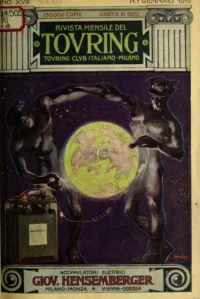
Rivista Mensile del Touring Club Italiano, Vol 18, No 1
Articles in this issue
- L. V. Bertarelli presents the Touring's free members' map of Tripolitania and Cirenaica, engraved on stone by the Istituto Geografico De Agostini at 1:5,000,000 on a Bonne projection with two 1:200,000 insets; 14,000 copies were sent through the War Ministry to the NCOs of Gen. Caneva's expeditionary corps.
- Ing. Giovanni De Simoni traces the Roman military roads radiating from Kars Tarhuna to Ghadamès and Garama in the Fezzan, the Arab camel and the faster mehari, and argues Italy must sink Norton and artesian wells, build roads and railways (perhaps Col. Silvio Negri's double-traction system devised for Eritrea) and use airships and aeroplanes.
- Ing. Paolo Bignami, deputy to Parliament, reports on Tripoli's 40,000 inhabitants and its oasis, Homs beside the ruins of Leptis Magna, Bengasi's salt mountain and Berca barracks and Derna's waterfall, and urges harbours at Tripoli and Bengasi, a naval port at Tobruk or Bomba, and a Touring-led road programme.
- How a dirigible field is laid out: hangars on the windward margin of a clear plain, the hydrogen cylinder shed and generator close by, separate petrol store and fire hydrants, workshops with lathe and forge, and an aerological office tracking pilot balloons by theodolite; illustrated with the Italian military field and its two Bosco-Donadelli hangars.
- Giacomo Boni's documented history of Roman sea power, written for the Touring while the Italian fleet operates off Libya: the Carthaginian treaties, the first duumviri navales of 309 BC, Duilius's boarding grapnels, Lutatius's victory off Trapani in 242 BC, and Agrippa and Augustus at Actium.
- Photographs of the French military aviation competition: Weymann's Nieuport monoplane first, Moineau on a Breguet second and Prévost on a Deperdussin third, together with the Blériot 'aeroberlina'.
- Banner feature on the Touring's first Italian winter-sports station, built at Pontedilegno (1325 m) below the Tonale with the Brescia section of the Club Alpino Italiano; a closing note signed M. R. lists the ski, bobsleigh and skating facilities, the Coppa Pro Valcamonica and the Martinoni cup, and the 160-strong Touring caravan due in February.
- Romolo Putelli descends the Valcamonica from the moraines at Rovato and the Lake of Iseo through Pisogne, Breno, Capodiponte, Cedegolo and Edolo to Pontedilegno under the 3554 m Adamello, praising the valley's art, industry and new winter sports.
- Paolo Monelli of Bologna University describes the S.U.C.A.I. winter meets held since February 1908 below the Cervino, then at the Cenisio, Monte Bianco and the Spluga, and the coming fortnight's accantonamento at Pontedilegno in the Val Camonica.
- Piero Giacosa argues that pleasure rather than necessity is the mother of invention in travel, citing the baggage of the Egyptian architect Ka in the Turin Museum, Roman villeggiatura in Campania and Sicily, and the 70-80 mule trains with which the Counts of Savoy crossed the Alps behind squads of 'marroni' breaking the snow.
- With 98,000 members at press time on 20 December, the Council extends the bronze and silver Centomila medals to recruiters whose forms reach Milan by 31 January 1912 and will draw a large gold medal among the sponsors of January's new members.
- The jury of engineers Beretta, De Simoni, Poggi and Vandone drove over 1,200 km of the Turin-Rome routes in a Zust from Garages Storero: Genoa took the gold plaque and the Ravà-Sforni cup, Massa-Carrara second, Piacenza, Florence, Bologna and Rome third, Pavia, Siena and Arezzo fourth, with a special art object for Perugia's 245 km.
- The road-metal memoir prize went to 'Simplex' by Ing. Carlo Daviso di Charvensod of Cuneo (L.3000), 'Excelsior' from Turin (L.2000) and 'Quod potui feci' by Ing. Giuseppe Tortora of Naples (L.1000); the Stazioni fiorite competition run with the Federazione Italiana dei Consorzi Agrari awaits its jury's awards.
- Picture pages showing a circular rubber mudguard and fast telegram vans in Paris, the Montreuil-Bellay railway bridge collapse of 23 November, the Morane monoplane for Védrines and the folding-wing De Marcay-Moonen, and scenes of the Chinese revolution at Nan-Kin and the Persian parliament at Teheran.
- Programme and terms for the caravan to Pontedilegno and the Passo del Tonale, 8-15 February 1912: two groups of 80 at L.50 and L.60 (L.100 for both), lodging at the Grande Albergo, ski, ski-kjöring, luge, bobsleigh and skating events including the Coppa Martinoni and Coppa del Tonale, directed by Col. Mario Raffa of the 5th Alpini.
- The monthly news department, gathering short reports under Aerologia, Aeronautica, Alpinismo, Automobilismo, Aviazione, Ferrovie e Tramvie, Geografia and Geologia.
- Bjerknes of Christiania renews his 1909 Monaco proposal to measure atmospheric pressure in bars and millibars, now that conversion tables exist, and the International Aerological Commission fixes the 1912 simultaneous sounding-balloon launches for 3-5 January, 11-13 April, 2-4 October and 1-6 July.
- Bienaimé's Picardie II flew 1,700 km from Lamotte-Breuil to near Riga in 16 hours chasing the Coppa Lahn, and Schoelscher 1,100 km from Paris to Moravia; the French dirigible Adjudant Reau raised the altitude record to 2,150 m, and Germany bought Zeppelin X.
- Details of the S.U.C.A.I. accantonamento at Pontedilegno from 27 December 1911 to 9 January 1912, its ski school under Mario De Benedetti, the two Sucai bobsleigh teams from Pavia and the Milan Politecnico, Zanchi's skeleton entry, and avalanche experiments following Ing. Lino Castellazzi's rules.
- The professional schools for mechanics and chauffeurs at Milan and Turin open their 1912 courses on 3 and 9 January; their leaving diploma, like those of Rome and Bologna, exempts holders from the driving examination required by art. 20 of the motor-vehicle regulations.
- The Marcay-Moonen monoplane with pivoting, variable-incidence wings was tested at Issy-les-Moulineaux; the Imperial Aero Club of Russia plans a St Petersburg-Paris contest; Prévost reached 3,000 m with a passenger on a Deperdussin at Courcy; and Dangy's compressed-air parachute was dropped at Saint-Cyr.
- The Journal des Transports reports a Tripoli-Homs line opened on 1 June 1911, which war correspondents are invited to verify; New Jersey trams fit driver's mirrors; the Delaware and Hudson takes six 200-tonne Mallet locomotives; and sanded catch sidings are spreading to stop runaway trains.
- The International Geographical Congress is put off from Rome in October to next spring, and the census of 10 June 1911 gives Italy 34,680,653 present inhabitants, with Naples (723,208), Milan, Rome and Turin heading the thirteen communes above 100,000.
- Abundant fossil remains of Elephas meridionalis found by the Marquis of Cerralbo in the alluvium of the Jalon river in Spain, associated with pre-Chellean human industry, give the first certain case of men living alongside that elephant species.
- The Italian embassy palace in Paris, illustrated in the September 1910 issue, was restored and decorated by Ing. Edmondo Saujust di Teulada with his sons Giovanni and Stefano, not by Ing. Marchese Mainoni d'Intignano as the newspapers reported.
- The T.C.I.'s new pocket yearbook of some 250 pages, 200 illustrations and 24 plates, with a cover by the painter Malerba, covers skating, ski, bobsleigh, skeleton, luge and snowshoes; L.6, reduced to L.3 for members, completing the Enciclopedia turistica.
- The Pretore of Cavallermaggiore holds the speeding prosecution of driver Attali Giovanni and owner Ambrosetti Giovanni on the Cavallermaggiore-Cuneo road void, because art. 60 requires the Prefecture to notify the report to the accused within eight days of its date.
- Council business: 16 gold and 221 silver medals awarded to exhibitors at the Touring's Albergo Modello in Turin, the bicycle-customs dispute with the Touring Club de France and the Swiss club, the Foreign Ministry's invitation to lead landscape and monument protection, the Gara d'onore trophies, the Aero Club d'Italia statute and the 1912 L.I.A.T. congress at Vienna.
- Minutes of the jury that met at the Turin exhibition on 16 November 1911 under Ing. Evaristo Stefini, with Pasquale Negri, Lorenzo Bertolini, Giovanni Bobba, Giuseppe Coda, Luigi Guercio and Dr Neri, which visited every stand before settling the awards.
- Large-format copies of the hundred-thousand-member medal were sent to ministers and public bodies; the replies quoted include Giolitti, Di San Giuliano, Tedesco, Spingardi, Sacchi, Leonardi-Cattolica and Gen. Pollio of the army staff.
- Members who ask for the binding cover for the 1911 volume of the Rivista will be sent the separately printed index at the same time, on writing the word 'Indice' beside their address.
- New Touring consuls appointed at Alfedena, Asti (California), Bari, Brindisi, Catania, Genoa, Novara, Piacenza and other towns, with new medical consuls at Foligno, Nonantola and Rho, followed by the list of resignations.
- Alphabetical roll of members who paid five years' subscription in advance (L.30, or L.40 abroad) and receive the special silver-and-enamel badge together with all the club's free publications for the five years.
- Members who each recruited five new associates between 1 June and 31 December 1911, from Anfuso of Catania and Avalle of Turin to Lt Gallassi at Tripoli and Massarotti at Buenos Ayres.
- Bianchi of Budrio, Massarotti of Buenos Ayres, Vivaldi of Livorno and Zerbo of Quarona Sesia each brought in ten new members; gold medals go to Bonardelli of Saluzzo, Mauprivez of Milan and Tucci of Penne.
- Roll of those who applied to join the T.C.I. between 1 and 30 November 1911, listing life members by town and then annual members province by province, from Alessandria to Vicenza and on to Switzerland, Africa and the Americas.