Rivista Mensile del Touring Club Italiano, Vol 18, No 10
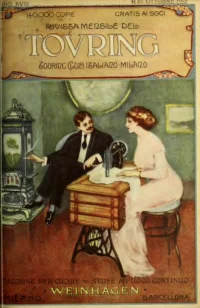
Articles in this issue
- L. V. Bertarelli returns to his 1908 attack on Val d'Aosta hotel-keeping, arguing that Courmayeur, Gressoney and Cogne lose visitors to Chamonix and the Valais because Italy has built no carriage road or rack railway to viewpoints such as the Hoheslicht above Gressoney or the Colle d'Olen. Illustrated with Vittorio Sella photographs of Monte Rosa, the Lyskamm and Monte Bianco from the Colle del Gigante.
- Silio Carpani links the October celebrations of the Poverello to touring in Umbria, reading the Cantico delle creature and the sermon to the birds as the founding text of a traveller's love of landscape. Illustrated with Cimabue's vault frescoes in the upper church of S. Francesco at Assisi.
- Comandante G. Roncagli, secretary of the Società Geografica Italiana, reviews De Filippi's account of the Duke of the Abruzzi's Karakoram expedition: Vittorio Sella's photogrammetric panoramas, the march from Srinagar through Scardu and Askoley to the Baltoro, the failed attempts on K2 (8611 m) by the Savoia saddle, and the record 7498 m reached on Bride Peak.
- Enrico Molè traces postal travel from Herodotus and Rome's cursus publicus with its mutationes and mansiones, through the nuncii organised by the Visconti and Sforza at Milan, to the red-coated postiglione of the diligence era, and finds its last two survivors in the Alpine procaccia and the African camel driver.
- Cap. Raffaele Perfetti surveys military aviation after the Italian airmen's work in Tripolitania and Cirenaica: Legagneux's 5680 m altitude and Védrines' 170 km/h records, Capt. Dorand's 'aeroplano laboratorio' and Col. Estienne's railway-truck resistance tests at Vincennes, French mobile workshop lorries, and the L. 25,000 cost of an army machine plus a 10,000-franc spare engine.
- Photographs sent by lieutenant Toccolini showing how communications were organised in the newly conquered Libyan territory: the port of Zuara five days after the landing, ascari of the Garioni division arriving, the field post office, and lorries carrying ammunition to the troops during the fighting.
- Results of the Touring's competition for a river landing stage, announced in the Rivista of August 1911: ten projects judged, first prize L. 1000 to naval engineers Luigi Bresciani and Mario Ortalda for a self-levelling articulated pontoon, second L. 500 to Pericle Ferretti and Pietro Bertoglio, third L. 250 to the brothers Antonio and Giovanni Vinca of Venice, with a special diploma to ing. Corbellini.
- The Italian navy has bought a Curtiss flying machine that did well at the Monaco meeting and entrusted it to Capitano di Corvetta Scelsi, commander of the military airship squadron in Libya, who has now also taken his pilot's certificate.
- War photographs from Libya and Turkey: Zuara, Arab huts burned by the Turks in their retreat from Misrata, the 27th Bersaglieri battalion's camp in the Zuara oasis and its counter-attack at Abd-es-Samad, the first supply lorries from Sidi-Said, and a cavalry patrol during the Constantinople mutiny.
- September brought a revival of racing: Léon Georget again won the 24-hour Bol d'Or in Paris, Ganna took the 600-kilometre road race with Galetti second, and Kramer is world sprint champion.
- French motor sport still flourishing on light cars and voiturettes: Boillot's Peugeot won the big-car class at Boulogne at 167 km/h, Goux on Peugeot took the first prize in the Sarthe voiturette race and Zuccarelli the Grand Prix de France on Lion-Peugeot.
- Progress on members' free publications: the Bari and Iglesias sheets of the Carta d'Italia are in the post, followed by Sassari and Cagliari, Tempio Pausania and Foggia, Trento and Lecce; the second edition of the Annuario Generale went out in September and the Lazio regional guide ships at the end of October, with the Emilia volume still in compilation.
- The Rivista's standing alphabetical news round-up, running from Aereologia and Aeronautica through Alpinismo, Automobilismo, Aviazione, Ciclismo, Ferrovie and Geografia to Geologia and Strade.
- The Touring publishes prof. Pericle Gamba's report on the simultaneous pilot-balloon launches made from ten stations — Cuneo, Ferrara, Lesa, Milano, Modena, Moncalieri, Pavia, Roma, Udine and Verona — founded by the Pavia aerological observatory, with plates plotting the trajectories against European pressure charts.
- Austrian, Belgian, French, British and German kite-flyers competed at Spa from 18 to 25 August for 15,000 francs in prizes across trials of lifting kites, panoramic photography, military and scientific kites and line-carrying life-saving apparatus; no Italian took part, which the Rivista blames on ignorance of the instrument at home.
- Airship notes: the Hergesell-Zeppelin polar preparations at Spitsbergen and the excursion flights of the Victoria-Louise from Hamburg.
- The preparatory expedition for airship exploration of the Arctic planned by professor Hergesell and count Zeppelin has returned to Spitsbergen, to the bay of Hebelthoft on the north-west of the island, where the base for future flights will be installed.
- The excursion airship Victoria-Louise flew Hamburg-Sylt-Kiel-Hamburg, 490 km in 8 hours 40 minutes with twelve passengers, and Hamburg to Frankfurt-am-Main with twenty-five aboard, covering some 6000 km in twenty-four voyages from Hamburg.
- The season's work of the student alpinists of the SUCAI in the Cadore.
- The SUCAI's Tendopoli tent-city in the upper Comelico gathered Italy's best roped parties over a little-known corner of the Dolomites to untangle contradictory place names and complete the toponymy, and local interests have asked for the survey to continue next year.
- Motoring notes: the Touring's three agricultural machinery competitions for 1913, the Grand Prix de France and Coupe de la Sarthe results, the Turin school for mechanics and drivers, and new motor-bus lines.
- Full rules for three competitions the Touring is running for 1913 with the Federazione Italiana dei Consorzi Agrari and Parma's Cattedra Ambulante d'Agricoltura for the Verdi centenary: an international contest for motor ploughing apparatus, a national contest for petrol and paraffin engines, and an international one for heavy-oil engines, entries to Via Monte Napoleone 14, Milan.
- An accelerated forty-day course was inaugurated on 1 October at the school in via Balbis 1, Turin, with programmes supplied by the school's direction.
- New motor-bus services: Lagonegro-Sapri and Scurano-Traversetolo about to open, Tivoli-S. Vito-Olevano Romano tested, and running lines including Venaria Reale-Fiano, Terni-Cascia and Piandelagotti-Castelnuovo Garfagnana.
- Flying notes: Germany's rapid growth in brevetted pilots and aeroplane factories, and Moorhouse's Channel crossing with two passengers.
- German brevetted pilots rose from 43 at the end of 1910 to 146 in early 1912 and 250 by 1 July, about a hundred of them military; Johannisthal is the chief of Berlin's aerodromes and Albatros, Rumpler, Euler, Aviatik and Fokker are among some twenty manufacturers.
- The English aviator Moorhouse crossed the Channel on a Bréguet fitted with a 100 HP Salmson engine, carrying his wife and a friend aboard.
- A mechanical argument for using the free wheel to economise the rider's legs on level ground.
- A technical argument that on the flat, at 14-16 km an hour with an ordinary gear, a rider should take four pedal strokes and then freewheel for two rather than pedal continuously, saving a third of the wasted work of lifting and rotating the legs — the equivalent of fitting a higher gear.
- Railway notes: radio-controlled braking, world mileage statistics, wireless time signals to stations, the largest American locomotive, cheaper faster third class, and the new lines in Libya.
- An English inventor's system using electric waves to work signals and stop trains that pass them was tested on the Birmingham-Stratford line under prof. Silvanus Thompson: a goods train and a following express, and later two trains running head-on, were both halted by one key in the signal cabin without the crews' help.
- World railway mileage passed a million kilometres at 31 December 1910, reaching 1,030,014 km — 333,848 in Europe and 526,382 in America. Belgium is the densest network and Turkey the poorest; Italy's 16,900 km cost an average L. 404,024 a kilometre, more than any European country except England, France and Belgium.
- The Paris Observatory's twice-daily time signal from the Eiffel Tower, picked up by a 250-franc receiver installed at St-Quentin telegraph office 154 km away by the Chemins de Fer du Nord, lets a station regulate its own and neighbouring clocks — a cheap way of keeping a whole network in step.
- The Atchison, Topeka and Santa Fe has built three articulated double locomotives with a single superheated boiler and oil-fired firebox that develop 50,000 kg of tractive effort — enough for a 10,000-tonne train — weigh 227 tonnes alone and 340 with tender, and run tender-first over the Arizona mountains so the driver can see the line.
- Third class is now admitted to express trains almost everywhere. In France over thirty years journey times fell about 40 per cent and fares more than 50: the 7391 km of express-served lines cost 850 francs in 1877 but only 317 francs and 116 hours by third class in 1907, and third-class travellers rose from 694 per 1000 in 1889 to 756 in 1907.
- The Bivio Fornaci-Tagiura section (12.6 km) was finished on 30 July and Gargaresh-Zanzur (8.7 km) in early September, so services now run on Tripoli-Ainzara, Tripoli-Gargaresh-Zanzur and Tripoli-Tagiura; Tagiura station has two 20-vehicle loops and three new masonry blocks housing 90 railway staff.
- The Consiglio Superiore dei Lavori Pubblici has approved the Locarno-Fondotoce concession with a maximum subsidy of L. 10,000, the first section of the Lercara-Bivona line was opened by on. Finocchiaro-Aprile, and the Bergamo to S. Vigilio funicular — 600 metres at a gradient under 21 per cent — is now working.
- Geographical notes: prof. Erian Ulsen's Norwegian mission crossing Siberia from Omsk to the Jenissei, Musil identifying the biblical Sinai with the volcano Kalal-Bedr, the Boas-Sergi controversy over immigrants' changing skull shape, the Museo Raimondi opened at Lima, colonel Caputo's survey work at Derna and Bengasi, and the 1:200,000 map of Morocco.
- Geological notes on ocean depths, potash deposits and the supposed subsidence of the Atlantic coasts.
- The German survey ship Planet has sounded 9780 metres in a Pacific trench about 70 km north of Mindanao, the greatest depth yet known, beating the 9635 metres found by the American ship Nero south of the Marianas in 1901.
- Germany's near-monopoly of potash from the Stassfurt beds near Magdeburg, producing over five million tonnes a year for fertiliser and chemicals, is challenged by a newly found deposit in the Mohave desert of California estimated at 10 million tonnes — enough for thirty years of United States demand.
- Johnson has re-examined one by one the proofs advanced for the sinking of the European and American Atlantic coasts and concludes that none is conclusive, a result agreeing with recent work on the Mediterranean coasts.
- Road notes: the nearly finished carriage road from Porto Ceresio station to the Cantine, which cuts about 4 km off the route via Cuasso al Piano; the opening of the Bellano-Taceno road cut in the rock above the Pioverna gorge, linking the Valsassina to the Lario; and the Valle Bronda consortile road classified as provincial in Cuneo.
- Reviews of ing. Pompeo Bresadola's 'Strade urbane e provinciali e loro pavimentazione' (Hoepli), dedicated to the Touring; Riedler's 'Essais d'Automobiles'; Fendrich's 'Les Sports de la Neige'; Guédon's 'Les transports automobiles'; the Touring Club de France's 'Memento de Tourisme Fluvial'; Aynard's 'Londres, Hampton-Court et Windsor'; and a Paravia map of the Mediterranean, Aegean and northern Tripolitania.
- Books presented to the Touring's library, among them the Calendario Generale del Regno d'Italia for 1912, the Annuario Militare, the Deutscher Radfahrer Bund's Handbuch 1912, the Touring Club de Belgique's Annuaire, Boisard's 'Un tour en Corse' and Bertacchi's Club Alpino lecture 'Luci e ombre dei monti'.
- The draw among members who introduced at least one new member in July gave the gold medal to Mauro Carminati of Milan and silver medals to Angelo Gandini of Rome and Ettore Cabiati of Turin, drawn before the Sindaci.
- Council business: the Director General to sit on the Finance Ministry commission designing the metal bicycle-tax plate; a national road-metal testing laboratory deferred over its finances; the Venice office to pass from Gondrand to the 'Pro Venezia'; a monograph on aeronautical cartography approved from capitano Piazza's and prof. De Agostini's papers; condolences to the Unione Velocipedistica Italiana on president Carlo Cavanenghi's death; 120,000 Corsica sheets ordered from De Agostini.
- Members paying five years' subscription in advance (L. 30, L. 40 from abroad) and receiving the silver-and-enamel badge, from Bahia Blanca, Bucarest and the Isola di Kos to Tobruk, Tripoli and Rosario Santa Fè.
- Members who introduced ten new members and receive the silver medal, including Carlo Bianchi of Vedano Olona, Domenico Brunetta of Shanghai, Antonio Dall'Ara of Zanzur and Pericle Paniotti of Chioggia.
- Gold medals for a hundred introductions to ing. Alfredo Barucco of Sturla, Guglielmo Colonna of Turin, Luigi Steffenoni of S. Giovanni Lupatoto and Ugo Vecchi of Modena.
- Candidates for membership of the T. C. I. who applied between 1 and 31 August 1912, listed as life members and then province by province, from Alessandria d'Egitto, Asuncion and Buenos Aires through the Italian provinces to Somalia, Cirenaica, Tripolitania and abroad.