Rivista Mensile del Touring Club Italiano, Vol 18, No 3
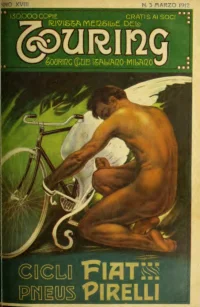
Articles in this issue
- Ing. Giovanni De-Simoni surveys the water of Italy's new Libyan provinces — the seasonal uadian, the wells of the Tagiura oasis and the Gefara coastal strip, the scorching three-day ghebli — and urges reforestation and artesian drilling on the French model of the Igharghar and Rhir basins in the Algerian Sahara.
- Piero Barbèra follows the book as the greatest of travellers, from the chained codices of the Biblioteca Mediceo-Laurenziana to the patriots smuggling banned volumes printed at Capolago and Lausanne past the Bisbino into Lombardy, and on to the guidebooks of Roth, Klein, Baedeker, Murray, Treves and the Touring Club.
- Display heading opening the Touring's winter-tourism reports for 1912, arguing that the seed the club sowed at Madesimo is now bearing fruit across the Italian Alps.
- Report on the second winter sports week at Madesimo and Campodolcino, 6-14 January, run by the Società « Pro Chiavenna » and the Ski Club « Valle Spluga »: forty runners contested the first Coppa Carducci, won by the Escursionisti Milanesi ahead of the Ski Club di Milano and Ski Club Valle Spluga.
- Account of the Touring's Second Winter Tourism Week at Ponte di Legno, 5-15 February 1912, organised with the Brescia section of the Club Alpino through Martinoni, Oldofredi and the deputy Tovini, and supported by the V Reggimento Alpini and the Guardie di Finanza; eleven ski teams competed and Italy held its first bobsleigh championships.
- Full results from Ponte di Legno: Ten. Nasalli Rocca won the officers' ski race and led the 5° Alpini patrol to the Coppa Tonale, the Ski Club di Pontedilegno took the Coppa Martinoni in 2h10'28", Mora won the Targa Militare, and Crespi and Bocchi took the Coppa Adamello and the Corriere della Sera bobsleigh cup.
- Nine-photograph plate by Mariani and Bresatini showing the Società Escursionisti Milanesi team, the start of the officers' race, Dott. Moldenhauer starting Ten. Pozzo, the Ski Club Valdostano squad and Ten. Nasalli Rocca's 5° Alpini patrol winning the Coppa Tonale.
- Maggiore medico Dott. T. Sironi traces the Red Cross from Ferdinando Palasciano, Florence Nightingale and Henri Dunant through the 1864 Geneva Convention to the Russo-Japanese war, and details Italian relief in Eritrea, the Messina earthquake, the Sicilian sulphur mines and Tripolitania, including the « Alfonso Litta » river ambulance in the Milan darsena.
- Survey of the aero-engines shown at the recent Paris exhibition beside the established Rep, Renault, Gnome, Labor-Aviation, Salmson and Chenu types: the rotary two-stroke Helium, the Aviator verticals of 70, 100 and 150 hp, the flat-twin Oerlikon 50 hp, the counter-rotating Ligez, the Italian L.U.C.T., the ovoid Salmson, and the new Pierrard, Aiglon and Eclair.
- L. V. Bertarelli reports the first flowered-railway-station competition run by the Touring with the Federazione Italiana dei Consorzi Agrari, quoting the juror Giuseppe Roda on San Remo, Bordighera, Nervi, Bolzano, Pistoia, Vercelli, Santhià and Salbertrand among the 151 entrants, who shared 2000 lire in prizes and free chemical fertilisers.
- Attilio De-Marchi sets Italy's Libyan war beside Rome's African campaigns: Regulus routed by the Spartan Xanthippus, Scipio's sailing from Lilybaeum, the war with Jugurtha as Sallust told it, Tacfarinas's revolt, and the Third Augustan Legion at Lambaesis with Hadrian's order of the day cut in stone.
- Carlo Zupi describes the Calabrian sanctuary founded in 1435 by Francesco d'Alessio and enlarged with money from Giacomo di Tarsia, sacked by Dragut-Rais in July 1555, rebuilt with Spinelli and Isabella di Toledo funds and consecrated in 1716 by bishop Perimezzi, with its silver bust and reliquaries, the saint's cell, the lime kiln and the trout basin.
- Photographic plate of the Italian campaign in Tripolitania, with views taken at Ain Zara and a squadron of Esploratori.
- Eight photographs by Cav. A. Mercanti of the Cyrenaica front: the eighth battery's first gun pushed into the trench, dismounted native cavalry at the redoubt, Arab horsemen advancing on the enemy oasis, the 149 siege battery laid on the Turkish camp, blockhouse B and the small market at Sidi Helsein.
- Four photographs of athletics in the German army — the sprint, two climbing exercises and hurdling over obstacles.
- Two photographs from a horse-drawn journey across Italy, showing the travellers' carriage and a halt in open countryside.
- Standing head for the technical and trade section, given over this month to the new Spa 12-15 HP chassis from Turin.
- Description of the new 1912 Spa chassis built at Turin under cav. Matteo Ceirano: a true monobloc of 70 mm bore by 120 mm stroke giving over 20 effective hp and more than 65 km/h, a two-jet carburettor, a patented spherical pressed-steel rear axle and disc clutch; the piece closes with the camions and 15-20 HP cars Spa supplied to the government for Tripoli and Derna.
- Notice convening the Touring's ordinary general meeting for Sunday 31 March 1912 at the Salone dell'Istituto dei Ciechi, via Vivaio 7, Milan, to hear the 1911 accounts and elect eight councillors — among them Colombo, Mangiagalli and Mangili — and three auditors.
- Auditors Camillo Magnocavallo, G. B. Rocca and Gino Turrini report on the 1911 accounts: Rocca replaces the resigning founder-auditor Attilio Soffredi, 40,000 lire is set aside against the falling Rendita Italiana, and income exceeded budget while costs per member fell.
- The Touring's balance sheet at 31 December 1911: 521,040 lire of Rendita Italiana plus railway and Naples city bonds, membership of 95,153 (90,154 annual and 4,999 life), 584,380 lire of subscriptions, and 776,477 lire carried to the social patrimony.
- The Council's official communications for the month, covering appointments, the customs carnet, nautical tourism, competition prizes and membership figures.
- Dott. rag. G. B. Rocca is confirmed in place of the resigning auditor rag. Attilio Soffredi, who had served since the club's foundation; the appointment goes to the next assembly for ratification.
- The Touring names its representatives on the renewed Comitato Centrale V. C. A., including ing. Alberto Riva as delegate to the presidency, cav. Arturo Mercanti as secretary, senator conte Federico Bettoni, gen. Chiarla and ten. col. Maggiorotti.
- The Council welcomes the Paris conference's adoption of the binational triptyque and the carnet de passage en douane — descended from the T. C. I.'s own proposed international circulation booklet approved by minister Millerand — and will press the Italian government to assent; a line-by-line Italian translation is to be printed for customs offices.
- The nautical tourism commission closes the experimental phase of the Concorso Segnalazioni Fluviali and approves a new 1912 volume of the illustrated waterway guides, Il naviglio della Martesana, its distribution shared with the Comitato di Milano per la Navigazione Interna.
- The existing recruitment awards are confirmed: a small silver medal for 10 members introduced, a large silver medal for 50 and a gold medal for 100, plus a silver medal for a new member signed up together with the Carta d'Italia block.
- The Council notes the letter from the competition's executive commission announcing that the flowered-stations prizes have been awarded.
- Delegates to the mid-February conference at Genoa on international through-carriage services are to receive the second group of the Guidine Ferroviarie, covering the Milano-Genova, Genova-Spezia and Genova-Ventimiglia lines.
- Membership at 15 February shows renewals coming in very rapidly and new subscriptions still rising.
- A special club badge is to be struck for the members of the Roman Delegation.
- The members' concession on the Como-Brunate funicular lapsed on 31 December 1911.
- New consular medical and legal appointments, including doctors at Ascoli Piceno, Bari, Como, Piacenza and San Sepolcro and lawyers at Mantova and Modena.
- Consuls, doctors and lawyers leaving office, among them Werner at Basel, Biaggi at Erd, Ramella at Oropa and, by death, Dattilo at Novoli and Cannizzo Rosso at Partinico.
- List of candidates for T. C. I. membership who applied between 1 and 31 December 1911, life members first — from Acireale, Buenos Ayres, Callao, Lima and Punta Arenas to Milan, Turin and Venice — followed by the annual members by province.