Rivista Mensile del Touring Club Italiano, Vol 18, No 5
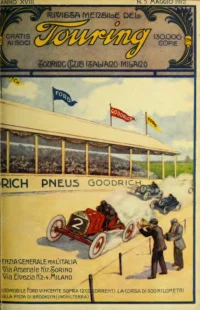
Articles in this issue
- The Touring announces the Lega Aerea Nazionale, founded under its auspices and revealed after the annual assembly held in Milan on 31 March 1912, to keep Italian public opinion abreast of aviation following its use over Libya.
- A stage-by-stage touring itinerary of the Tripolitanian interior — the Homs–Misda–Gersa–Mesurata quadrilateral, the Tarhuna and Garian plateaux, Jefren, Zintan and Giado — describing troglodyte dwellings, the Roman caravanserais and farms of the Limes Tripolitanus, the necropolis of Gersa, and the return from Mesurata by Navigazione Generale Italiana steamer.
- A personal friend commemorates Giovanni Pascoli, recalling the villa and vineyard at Castelvecchio, his sister Maria, his prodigious Latin carmina and the poemetto Italy, and Pascoli's own remark that Carducci had enjoyed the greater poetic fortune.
- A history of May festivities from the Greek rites of Apollo through the Florentine calendimaggio — including the 1304 collapse of the Ponte alla Carraia under the crowd watching a Last Judgement pageant — the Este cavalcades at Ferrara, and the Toulouse legend of Clemenza Isaura.
- A full-page photographic plate of the smuggling routes used by Turco-Arabs across the Tunisian border into Tripolitania, with views of the European quarter of Gabès, a general panorama of Djerba and Casr Medenine.
- Captain Piazza describes the almost clandestine departure of Italy's first military airmen for Libya aboard the Sannio, San Giorgio and Enrichetta, and insists on naming his fellow pilots Moizo, Gavotti, Roberti, Cannonieri, Di Palma and Falchi; his aerial reconnaissance photographs of caravan tracks and Turkish positions are reproduced and annotated.
- The Venice international art biennale, whose jury included the painters Beppe Ciardi, Carena and Carozzi and the sculptors Dazzi and Trentacoste, with an extended appreciation of the Lombard mountain landscapist Giuseppe Carozzi and his canvases Ottobre (Savoia), La via all'Alpe and Fra l'eriche ed i mirtilli.
- The International Sporting Club's April motorboat regattas at Monaco, tracing the swing to stepped hydroplanes from Panhard-Levassor's 57.324 km to the Brasier Despujols at 73.152 km in 1910, and describing the Tyreless's twin propellers and outsized rudders and the Thornycroft/Saunders Columbine.
- A survey of the aircraft and engines proliferating since the Italo-Turkish war: the Belgian Bésa monoplane by Gérard and Salmon with trapezoidal wings and 60 HP Anzani, the Besson canard shown at Paris, Panhard, Vermorel and Chenu motors, and the first seaplanes built for the Monaco contest.
- Prompted by the loss of the Titanic, a review of earlier disasters at sea: the destruction of the Spanish treasure fleet in Vigo Bay in 1702, the ramming of the Grosser Kurfürst by the König Wilhelm which sank her in five minutes with 300 dead and only 27 saved, and the French steamer Oncle Joseph of the Valéry line.
- Two pages of news photographs: the opening of the Viggiù electric tramway and of the new Pontelagoscuro bridge, Captain Piazza, Italian troops, schools and redoubts at Garian and Derna, projectile-dropping trials from aeroplanes at Mourmelon, and an Anglo-French hockey match at Boulogne.
- The magazine's technical and trade notes department, this month covering light traction accumulators, the 1912 Hupmobile and an engine-driven tyre pump.
- A technical assessment of Giovanni Hensemberger's light Faure-type traction cells (Milan, Monza, Vienna and Odessa) rated at 28 watt-hours per kilogramme and 250–300 discharges, tested over 10,000 km by the F.R.A.M. electric-car company, with more than 120,000 elements lighting State Railway carriages.
- The 1912 Hupmobile: a 32 HP long-stroke monobloc car with Bosch magneto, Zenith carburettor, disc clutch and cardan transmission, offered in Italy at L. 6800 through the general agency in Via Nazionale 4, Rome.
- A tyre pump that screws into a spark-plug seating and inflates tyres from the running engine in two or three minutes; it carries a pressure gauge, weighs barely two kilos and replaces the heavy compressed-air bottle.
- Minutes of the Touring's annual meeting: Johnson's opening salute to the troops in Libya, Goldmann elected chairman, Vigliardi Paravia's report on the hundred-thousandth member and the million-lira patrimony, the Carta d'Italia toponymy commission under General Porro, and the rival Luporini, Crepaldi and Ravizza motions on statute reform and the italianising of sporting terms.
- Membership stood at 102,096 on 15 April 1912 (92,054 annual, 4,707 five-year, 5,335 life); the Touring urges recruitment and lists the 1912 free publications — the Tripolitania map, eight new Carta d'Italia sheets, the Lazio and Emilia regional guides, Il bosco contro il torrente and the wholly redesigned Annuario Generale.
- The scale of propaganda awards: a small silver medal for 10 new members, a large silver for 50 and a gold for 100, with a separate Carta d'Italia silver medal for a recruit who also buys the 44-sheet block at L. 22.
- The Touring's monthly news digest, arranged by subject from aerology and aeronautics to railways, geography, hygiene, shipping and roads.
- A large-scale hail-suppression installation in the Vienne département of France has also all but eliminated lightning strikes, promising a first aerial defence along the routes future airships will follow.
- German plans for a great military air port at Hamburg with an all-iron hangar for two Zeppelins or six Parsevals, luminous red signalling balloons from the Lane firm of Aix-la-Chapelle, and the rigid Spiess airship built by the Société Zodiac with two 120 HP motors and four propellers.
- Beutler won the Monaco Rally on a 16 HP Berliet, covering the 1700 km from Berlin in 58 hours at a 30 km/h average, and Dreux headed the Automobile Club de Seine-et-Oise mudguard competition ahead of Omelie and Neron-Bristol.
- New motor services and state aid: Faenza–Tredozio inaugurated, the Cascia–Leonessa–Marmore line extended to Terni station, and a kilometric subsidy of L. 506 granted for Genova–Torriglia–Ottone–Bobbio.
- A promoting committee formed for a Cascia–Monteleone–Leonessa–Marmore service with a L. 31,000 annual subsidy and L. 25 popular shares, plus new services from Imola to Fontana Elice, San Marco in Lamis to San Severo, and Sestri Levante to Velva, Varese Ligure and Borgotaro.
- Cobioni set the world 300 km record at Vizzola Ticino on 28 March, flying 330 km in 3h 5m 30s on a Caproni monoplane with 50 HP Anzani; French output for 1911 reached 1350 aeroplanes and 2,600,000 km flown; and the German North-West circuit from Bremen to Hamburg was fixed for June.
- The Naples Metropolitana conceded to a French company — an 8 km twin-track urban line from Mergellina-Piedigrotta to the Circumvesuviana with 15 stations and lifts up to 150 m, plus branches to Camaldoli and Agnano — the Niesen funicular's record 1642 m rise, and a colonial track-laying record of 10.5 km in 13 hours on the Baro–Kano line.
- The Ferrara–Pontelagoscuro electric tramway officially opened with a three-span reinforced-concrete underpass at Ferrara station; the Asti–Chivasso standard-gauge line planned with a Po bridge and a 3000 m tunnel at Brozolo; and openings at Varese–Azzate, Como–Cernobbio and Porto Empedocle–Siculiana.
- The X Italian Geographical Congress fixed for Rome in spring 1913; Colonel Eugenio Caputo's Istituto Geografico Militare mission surveying the Tripoli oasis at 1:25,000; Bingham's discoveries near Cuzco and his ascent of the 6950 m Coropuna; and the scientific results of Scott's Antarctic expedition carried home by the Terra Nova.
- Professor G. Mercalli's history of the Vesuvius Observatory, from Melloni's building of 1841–47 and his dismissal for liberal opinions, through Palmieri's directorship and discovery of helium, to the 50,000-lira grant Mercalli obtained to restore the near-uninhabitable building.
- A signed note on healthy carriers of infectious bacilli — 15 to 30 per cent of Milanese schoolchildren harbouring diphtheria bacilli, cholera and typhoid carriers among the apparently well, four fifths of them women — arguing that general hygiene and vaccination are the only practical defence.
- The twelfth International Navigation Congress opens in Philadelphia on the 23rd under the honorary presidency of the President of the United States, with Italian rapporteurs including Professor Valentini of Padua for inland navigation and Professor Luiggi of Rome for maritime navigation.
- Road notes — land donated at Modigliana for the Faenza road, the Salmour–Fossano works completed, L. 10,000 for the Pulfero–Cividale national road — and the Touring's new blue-and-white enamelled sign, 1.00 by 0.70 m, summarising the wheel-rim width rules of the Royal Decree of 26 March 1911 that take effect in 1913.
- Reviews of the Guida Savallo 1912 to Milan with its six-colour ward map, the Almanach Hachette, Schiomativi's six-language illustrated technical vocabulary of motor vehicles, Ventoux-Duclaux and Robert's Bases et méthodes d'études aérotechniques, and Neuberg's yearbook of the automobile and motorboat industry.
- Books presented to the Touring library, among them the Istituto Coloniale Italiano's study of Eritrean forestry, Paul Langhaus's 1:3,500,000 map of Tripolitania, Arnold Lunn's Alpine Ski Club guide to the Bernese Oberland, De Maurizi's monograph on the Valle Vigezzo and the Norske Turistforening yearbook for 1911.
- The Pretore Urbano of Turin acquitted the cyclist Angelo Fossati, who tied his bicycle-tax plate on with string after the Treasury's locking device failed — a witness testified to some 1200 complaints out of 60,000 plates issued in Turin — and the editors contrast this with the Como magistrate's opposite ruling of 27 February 1912 in the Wild motoring case.
- The Touring's official announcements to members for May 1912.
- 1911 members still await the Nice and Taranto sheets of the Carta d'Italia; 1912 members will receive eight sheets in four blocks (Foggia and Bari, Iglesias and Cagliari, Sassari and Tempio Pausania, Trento and Lecce), the Lazio and Emilia guides, and Il bosco contro il torrente and the Annuario Generale at some 2000–3000 copies a working day.
- New member concessions: 20 per cent off season tickets at the Stabilimento Bagni Terme in Milan, 50 per cent on ordinary return fares on the Monte Generoso railway, and 50 per cent from 1 June on the Varese–Sacro Monte and Varese–Campo dei Fiori tramway and funicular.
- Appointments of consuls, medical and legal officers — Valente as capo console at Bari, new consuls at Acqui, Barletta, Bergamo, Chiavenna, Corato, La Maddalena and Mogadishu — together with the list of resigning and deceased consuls.
- Members who recruited ten new adherents and receive the silver medal of merit, from Bicelli of Milan and Genova Esperanto to Tortorici at Tobruk and Roccatagliata at Buenos Aires.
- Rodolfo Malgarini of Medole is the sole member awarded the gold medal, given for a hundred new memberships.
- The roll of members who brought in five new adherents between 1 June 1911 and 31 January 1912 and so earned the commemorative silver medal of the Hundred Thousand.
- The names of candidates who applied for membership of the Touring Club Italiano between 1 and 31 March 1912, listed by province and then by country for foreign applicants from Trieste and Gorizia to Cairo, Shanghai, Chicago and Havana.