Rivista Mensile del Touring Club Italiano, Vol 21, No 5
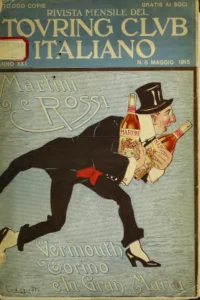
Articles in this issue
- Enrico Mercatali surveys Friuli from the Carnia and the Pontebbana road through Udine, Cividale, Aquileia, Tolmezzo and Palmanova, its history from the Lombard duchy and the Patriarchate to the 1420 submission to Venice and the resistance of Osoppo in 1848, and the Slovene 'Slavia' of the S. Pietro al Natisone valleys that guards the Pùlfero pass; photographs largely supplied by Dr Italo Belli.
- Paolo Revelli covers the sea's physical geography — the Gibraltar sill, the 4404 m deep in the Ionian off Cape Matapàn, currents and tides from Gabès to Venice — then its history from Minoan Crete and Halbherr's excavations through Venice, Genoa, Pisa and Amalfi to the 1915 contest between Britain, Germany, Austria and Italy over Trieste, Valona and the Dodecanese.
- Prof. Pericle Gamba explains reversing thermometers (Negretti & Zambra 1878, improved by Richter, on the Magnaghi frame), water-sampling bottles and the Bull-Dog, Belknap-Sigsbee and Léger sounding gear used aboard Prince Albert of Monaco's Princesse Alice, citing the 9636 m sounding off Guam and 3731 m in the Tyrrhenian.
- An appeal for the formula 'ogni socio presenti un nuovo socio': the Touring is about to pass 150,000 members having taken over 30,000 new ones for 1915, and every recruiter is given the similoro-and-enamel badge.
- Cesare Casamorata walks the Mugnone from Pratolino — Boccaccio's Schifanoia and the Calandrino novella — past the Conventino della Maddalena, the Ponte del Calderaio and the Ponte alla Badia between Villa Salviati and the Badia Fiesolana, down to the Ponte Rosso, the Fortezza da Basso and the Cascine.
- Luigi Pironti defends the flat Po countryside against the fashionable cult of the mountain, following its seasons from March to October along the white roads and citing Bertarelli's remark that tourist taste is turning from the paean to the elegy; illustrated with paintings by Eugenio Gignous and Giuseppe Grondona.
- Maggiore Eugenio Massa describes the Borgotaro–Campi–Varese Ligure–Sestri Levante road over the Cento Croci pass (1053 m), its gradients, bridges over the Taro and Vara and Touring warning posts, excursions to Monte Penna (1735) and the Gottero (1640), and the landing beaches of Sestri Levante and Chiavari.
- Renzo Boccardi walks Val Formazza from Fondovalle through Chiesa, Valdo, Canza, Riale, Morasco and Bettelmatt, praising its stone-and-larch houses and German-speaking valligiani, and urges the Brigata degli Amici della Valle Formazza to rescue them before the new carriage road arrives.
- Gioacchino Mancini describes the 2234 m Roman emissary of Lake Albano, the cryptoporticus of Domitian's villa surviving in Villa Barberini, the castrum of the II Legio Parthica with its five-naved cistern, the amphitheatre newly excavated under Giuseppe Del Pinto and Angiolo Pasqui, the so-called tomb of Aruns, and the Via Appia embankment at Ariccia.
- Dott. Marcello Sègre traces rubber from Hancock's 1820 patent and Macintosh's waterproofs to Goodyear's vulcanisation, contrasts Amazon siringueiros tapping wild Hevea for 'para' with the Malayan and Ceylon plantations (65,000 tons in 1914), and notes the 1910 boom at 35 lire a kilo and Britain's declaring caoutchouc absolute contraband of war.
- Mario Ferrigni on Florence's Ascension Day cricket festival at the Cascine — the caged-cricket trade, cockroaches passed off on the unwary, how to tell a singing male — and a tour of the park with the dead Quercione, the Maharajah of Kolhapur's Indian shrine at the Indiano, the fonte di Narciso and the 1791 Palazzo.
- The Rivista's trade and technical notes department, given over this month to a page of photographs of SPA motor-coach services.
- Photographs of SPA motor-coaches working the Desenzano–Salò line on Lake Garda and the Soverato–Fabrizia line in the province of Catanzaro.
- Founding subscribers 798–816 to the Touring's new Milan headquarters, among them Comm. Ing. Amilcare Robbiani and Giuseppe Terzoni of Soresina, Ing. Pietro Zoncada of Milan and the Provincia di Trapani, with emigrant members at Buenos Aires, Rosario, Mendoza, Córdoba and S. Paulo; each receives a bronze commemorative plaque.
- The Touring's monthly news roundup, covering this month alpinism, railways, geography, roads and miscellany.
- Mountaineering notes: the State Railways' new rules on carrying skis, and the founding of the Amici della SUCAI.
- A Ferrovie dello Stato circular still refuses to carry skis as ordinary luggage and requires a separate consignment for each pair; winter resorts and ski clubs are urged to protest before the season is ruined.
- A new supporter category of the SUCAI at 5 lire a year or 100 for life, backed by Marchesa Sandrina Medici del Vascello Rossi, Pavia's rector Egidio Gorra, avv. Eliseo Porro and Guido Rey, run from the Direzione Generale at Monza.
- Railway notes for May 1915, reporting progress on the direct Bergamo–Milan line.
- The Consiglio Superiore dei Lavori Pubblici has ruled the new direttissima between Bergamo and Milan eligible for state subsidy, which the local committee hopes will reach the maximum requested.
- Geographical notes on illiteracy among immigrants to the United States, the naming of Italy's colonies and the productive area of Switzerland.
- The New York Evening Post summarises Dr Winthrop Talbot's figures on illiterate immigrants since 1889: 0.6% among Scandinavians and 8.4% among Chinese arrivals, against 63.4% from Portugal and over 30% among Russians, Romanians, Bulgarians and Serbs.
- The Società Africana d'Italia in Naples votes that indigenous place-names be kept on colonial maps, Greco-Roman forms such as Cirene, Tolemaide and Sirte being preferred only where they already exist, with new Somali settlements free to take national or scientific names.
- Of Switzerland's 4,130,000 hectares 72.5% is productive field, pasture and forest; lakes take nearly 14% of the total area, and 42 of the Lago Maggiore's 212 sq km are Swiss.
- Road notes: the new carriage road from Perledo-Varenna on Lake Como up to Esino, the fate of the 1916 international road congress, and the burnt Ponte della Pianta between Ferrara and Ravenna.
- Colonel Crosby argues in the American Good Roads that the congress set for Munich in 1916 must be postponed, and proposes the United States take it over at Washington or New York.
- Miscellaneous notes, this month Robert Donald on the newspaper of the future.
- Robert Donald tells the York journalists' congress that papers will travel by aeroplane and electric train, reporters will file by radio-telephone, and a 'spoken' paper will be piped into the home like gas and read by gramophone in voices matched to each section.
- The Touring's official announcements for May 1915.
- Board minutes covering the Volontari Ciclisti appeal, undischarged Belgian triptyques, compulsory motor insurance, the Stazioni Fiorite competition, ski carriage on the railways and concrete road-paving trials.
- The board agrees to insert a propaganda leaflet and enrolment form for the Corpo Nazionale Volontari Ciclisti Automobilisti in the Milan copies of the Rivista, mobilisation having stripped its battalions of all 1st- and 2nd-category men.
- The board notes with satisfaction that the Aero Club d'Italia has enrolled among the founding subscribers to the new headquarters.
- Letters to the Automobile Club Royal de Belgique come back marked 'Non ammesse', leaving eight triptyques undischarged and the Touring liable to Italian customs for 480 lire; it will write to the German governor of Brussels and petition the Finance Ministry to suspend payment.
- Because of the war the Touring suspends its triptyque service with all clubs of the Association Internationale des Automobile Clubs Reconnus, and drops its request that the Italian government recognise the L.I.A.T.'s carnet de passages en douane.
- The Automobile Club d'Italia's campaign for compulsory third-party and chauffeur insurance is opposed by the Touring's legal office on grounds of the motorist's freedom; the question goes to Consigliere on. avv. Belotti for an opinion.
- The 1914 flowered-stations competition accounts are approved, with gilt-silver, silver and bronze medals and diplomas for station masters, the Touring meeting the excess if the Federazione dei Consorzi Agrari does not contribute, plus a special award to the architect Roda for drafting the jury's reports.
- The Touring will petition the State Railways directly against rules ending the grouped consignment of skis as luggage, acting alongside the Club Alpino Italiano.
- The membership account already shows the effect of the early issue and collection of interest on members in arrears.
- Ing. Magistretti reports on American and Canadian cement-concrete paving and proposes a Touring publication plus wear and impact trials with the Società Italiana Cementi e Calci Idrauliche of Bergamo, ready for the national road congress at Naples in October.
- Fotografia Helios of the Fratelli Muzio in Milan will supply two membership-card photographs for 0.40 lire and 50% off other orders; the Armeria Baldi in Florence gives members 10% off guns, ammunition and sporting goods on production of the card.
- The book column, reviewing the Touring's own Annuario Generale 1915, Sebastiano Crinò's Conferenze di geografia economica and Palmiro Premoli's Nomenclatore Scolastico.
- The 1915 yearbook, a reprint corrected to December 1914, runs to nearly 800 pages in five parts and lists some 10,000 communes and localities with population, altitude, distance from the provincial capital and Touring services; members are asked to send corrections on the inserted form.
- Books presented to the library, including the Associazione Nazionale per i Congressi di Navigazione's papers on inland navigation in the Po valley, the Comitato Glaciologico's bulletin, thirteen Ministero delle Colonie monographs on Tripolitania, Cirenaica and Somalia, and the German England und die Sperrung der See.
- Appointments to and resignations from the Touring's network of consuls and honorary doctors.
- New consuls at Alzano Maggiore, Arbus, Boves, Carpi, Gerosa Val Brembilla, Losanna, Manfredonia, Merg, Messina, Mornese, Napoli, Nola, Parma, Riardo, Roma, Sulmona, Vallo della Lucania, Verona and Vico Garganico.
- New honorary doctors appointed at Amelia, Aosta, Bitonto, Cagli, Castelfranco Veneto, Cinigiano, Mantova, Nicastro, Pisa, Poggibonsi, Roma, Siracusa, Trecate, Treviso and Valbrona.
- Consuls leaving office at Chieti (ten. Alessandro De Sarno) and Demonte (dott. Giulio Zerbini).
- Honorary doctors leaving office at Demonte, Montiglio, Napoli and Strambino.
- Members who have brought in ten new subscriptions and so earn the artistic silver medal, listed by town from Adria and Alessandria through Asmara, Bengasi and Comeglians to Viterbo.
- Members reaching a hundred new subscriptions and the gold medal: prof. Luigi Mecheri of Belluno, not. Adolfo Patriarca of Novara and Luigi Grea of Roma.
- Members taking the five-year subscription, listed by town from Alessandria, Asmara and Buenos Aires to Torino, Venezia and Verona.
- Candidates for membership who applied between 1 and 31 March 1915, given first as life then as annual members and arranged by province, colony and foreign country, from Asmara and Tripoli to Buenos Aires, Valparaíso and Pekino.
- Membership stands at 139,345 annual members (136,454 at 31 March plus 2,891 new in April) and 7,762 life members, a total of 147,107.