Vol 4, No 11
189818 articles18 imagesItalian
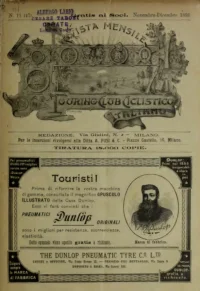
Articles in this issue
- Treasurer-General Riccardo Venegoni reminds every active member that, under Article 18 of the Statute, membership renewal is due before 15 January 1899, payable to the Direzione Generale at Via Giulini 2, Milan, in cash by registered letter, postal money order, or postal giro.
- Minutes of three Council sittings (31 October, 9 and 16 November 1898) chaired by Director General Johnson: confirming Bertarelli as the Belgian Touring Club's delegate and naming Zoebroeck the T.C.C.I.'s delegate to it, weighing a Belgian proposal for standardised road-hazard signage, planning a banquet for the club's 4th anniversary, accepting and then re-electing on the spot Rome Capo Console Attilio Brunialti after the whole Roman consular corps resigned, noting the advanced state of the Umbria and Emilia guides and a forthcoming free Central Italy map (Liguria, Emilia, Tuscany, Romagna) from the Istituto Geografico Militare of Florence, and approving Turin Capo Console Capponi Trenca's plan for a 1900 "Gita Ciclistica Nazionale Italiana a Parigi" jointly with the Touring Club de France.
- Full reprint of the club's founding Statute as approved by the membership vote of 1 July and 10 September 1897: Article 1 records the club's founding in Milan on 8 November 1894; the following articles set out its road-safety and touring aims, the lifetime (100 lire) and ordinary (5 lire plus 2 lire entry fee) membership categories, admission, resignation and expulsion procedures, and the terms under which whole cycling societies of at least 25 members may affiliate en bloc.
- Reprinted from the Rivista Militare Svizzera, Swiss Touring Club council member C. C. Bastard describes the club's new four-sheet 1:250,000 road map replacing the old 1866-69 "Carta delle Tappe," produced with Colonel Lochmann of the Federal Topographical Institute and the Fratelli Kummerly firm of Bern, colour-coding gradients (yellow up to 4%, green 4-7%, black over 7%) from more than 600 sheets of Swiss, Italian, Austrian, German and French survey maps.
- Reports that the T.C.F.'s new relief fund for injured or sick road-menders (cantonieri) and their widows and children has drawn generous support, with 5-lire subscribing members, 100-lire founding members and 500-lire benefactor members each receiving a special card, and that in just over a month the fund had taken in about 3,000 lire and paid out roughly 1,000 lire.
- Comfort-Section head A. C. Marelli, noting the club's affiliated hotels and restaurants now number over a thousand, reminds proprietors to send their Libretto di Legittimazione for year-end review by the Sezione Comfort or a local consul, posted in an open envelope under a 20-centesimo stamp so it can quickly be returned.
- Announces a special photograph tariff arranged with the Milan firm G. B. Ganzini for the picture required on the new 1899 membership card, 1 lira per print for orders under ten, 1.25 lire for two prints with one mounted on card, and notes that Antonio Bressan's Studio Artistico in Venice (Calle Minetti) grants members the same discount.
- Summarises the law of 22 July 1897 imposing, from 1 January 1898, an annual bicycle tax of 10 lire for single-rider machines, 15 lire for multi-rider machines and 20 lire for motor-driven ones, replacing all municipal cycling taxes, with the proceeds split between the State treasury and the municipalities and disputes over assessment routed through the Giunta municipale and then the Giunta provinciale amministrativa.
- Extracts the safety regulation requiring every bicycle to carry a working brake, an audible warning device and, after dark, a lit lamp near the front wheel, plus a metal plate showing the registering commune and a distinguishing number, and bans riding more than two abreast, releasing both hands or feet at once, racing in town streets, or cutting across marching soldiers, processions or funerals.
- Conditions pour l'importation temporaire des Vélocipèdes sans dépôt de caution. (opens in a new tab)Reprints, in French, German and English for members crossing borders with their machines, the official customs procedure for duty-free temporary import of bicycles, presenting an identity card with photograph to obtain a Laissez-passer and a lead counter-seal, showing the machine and document again on leaving to have the seal removed, and keeping the re-export certificate as the only proof Customs will accept, with a separate, stricter procedure for Switzerland effective 1 January 1899 requiring the club's own recognition booklet.
- Council resolutions of 6, 14 and 21 December 1898: records consular resignations across Italy, including fifteen in Rome alone, promotes Guglielmo Romiti to Capo Console at Pisa and reconfirms Attilio Brunialti at Rome, appoints new consuls from Arzignano to Valeggio sul Mincio and Budapest, and notes the death of Schio consul Carlo Tebaldi; signed by deputy Capo Console Generale O. Gorla.
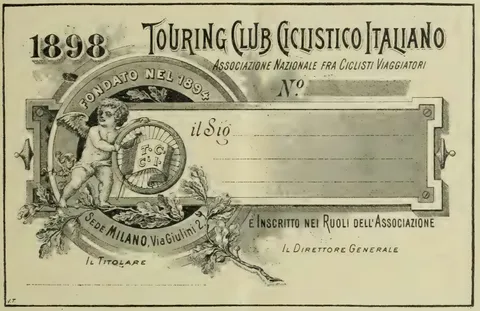
- Explains that the 1899 membership card is sent only to members paid up on their 6-lire renewal or 8-lire new registration, that the office will keep an exact log and no longer issue duplicates except for proven loss or damage (50-centesimo fee), and describes the new book-style card wallet, sold to members at 50 centesimi, with a passe-partout photo pocket and a second pocket for customs papers, rail tickets and the printed border-crossing rules.
- Warns that from 1 January 1899, by order of the Swiss Customs Directorate, no member may bring a bicycle into Switzerland without a special recognition booklet bearing a photograph under an embossed dry stamp, obtainable in advance from the Direzione Generale in Milan for 50 centesimi, and separately asks members to write their name, address and both card numbers clearly in every letter to the office.
- Surveys the club's free annual publications for members from 1895 through 1898, including the 1897 Lazio and Veneto regional guides and the 1898 Piedmont guide (three volumes, 804 pages, 827 road profiles), yearbooks, road-profile monographs and Istituto Geografico Militare maps, and previews the forthcoming Guida dell'Umbria and a new Central Italy map spanning the latitudes of Florence and Rome.
- Price list, with a 50% member discount, for the club's 36 published road profiles (from the Spluga and Sempione passes to Castrovillari-Lagonegro) at 1-2 lire each, its Lombardy, Lazio, Veneto and Piedmont regional guides, its 1896-98 yearbooks, and its Veneto and Piedmont-Lombardy-Liguria maps at 2.50 lire, plus bundled discounts for new 1899 members catching up on back publications.
- Price list of items sold at the Milan office, the 1-lira club badge, a 30-centesimo bicycle pennant, a 2.60-lire hotel plaque, enamelled silver or gold cufflinks and lapel pins from 2 to 35 lire, plus the new, smaller "Distintivo Mignon" badge at 1.50 lire (2 lire gilt, for consular office-holders) and aluminium or silver name-plates for bicycles, orders accepted only when prepaid.
- Numbered roll of the club's 51 life members as of November 1898, including G. B. Pirelli, Princess Ines Hercolani of Bologna, Luigi Vittorio Bertarelli, Director General Federico Johnson, cycle manufacturer Edoardo Bianchi, and Prince Enrico di Borbone, Conte de' Bardi.
- Lists a handful of new candidates from Genoa, Rome, Siracusa and Torino opting to join for the rest of 1898, bringing that year's total to 16,948, followed by a much longer province-by-province roll of applicants opting straight into 1899 membership, from Alessandria to Vicenza plus Trieste, Ala, Trento and Zara, bringing the 1899 total to 333 by 20 December 1898.
Images in this issue 18 pictures from 32 pages
Illustrations 6
 (opens in a new tab)
 Tessera del Touring Club Ciclistico Italiano  (opens in a new tab)
 Stemma del Touring Club Ciclistico Italiano  (opens in a new tab)
 Stemma del Touring Club Ciclistico Italiano 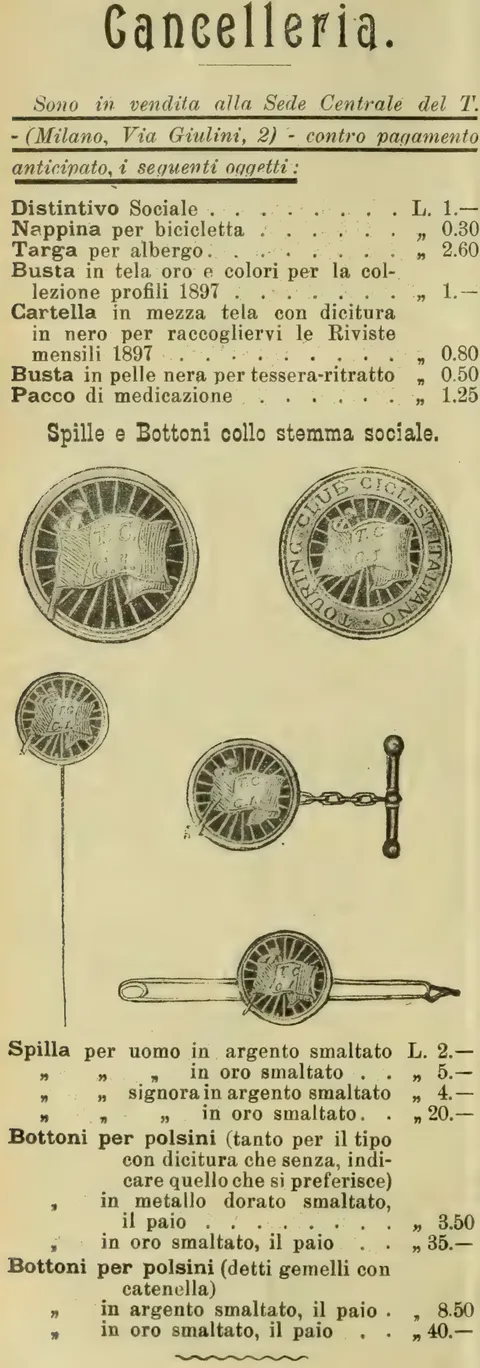 (opens in a new tab)
 Spille e Bottoni collo Stemma Sociale 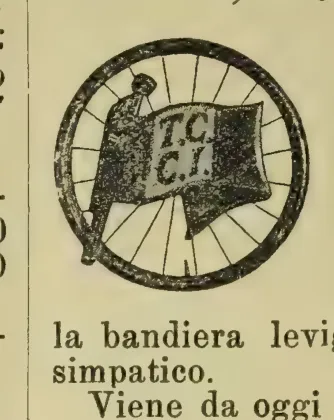 (opens in a new tab)
 Distintivo Mignon 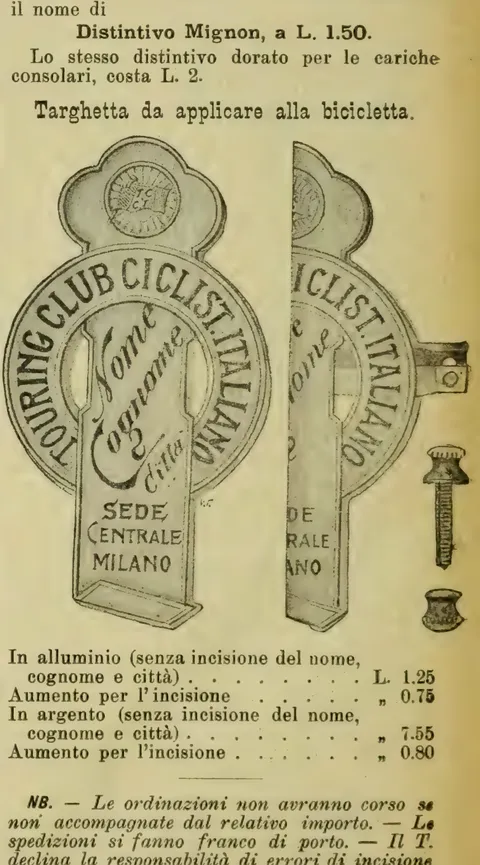 (opens in a new tab)
 Targhetta da applicare alla Bicicletta
Mastheads 1
 (opens in a new tab)
 Rivista Mensile del Touring Club Ciclistico Italiano
11 advertisements
 (opens in a new tab)
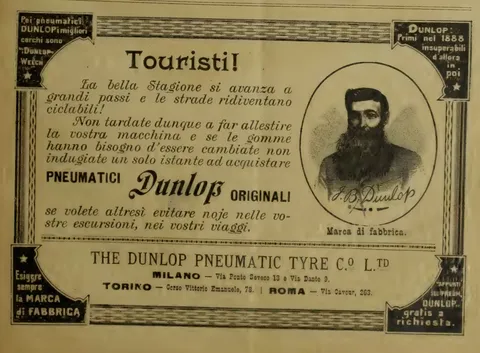
 Touristi! Pneumatici Dunlop 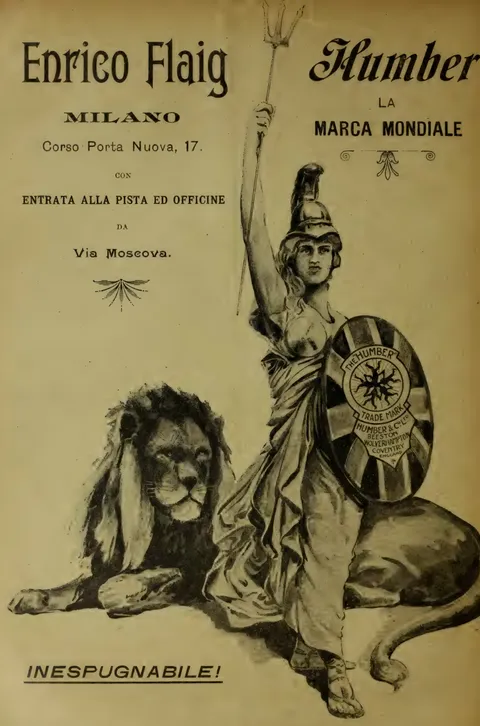 (opens in a new tab)
 Humber, La Marca Mondiale  (opens in a new tab)
 Pneumatici Marca Leone 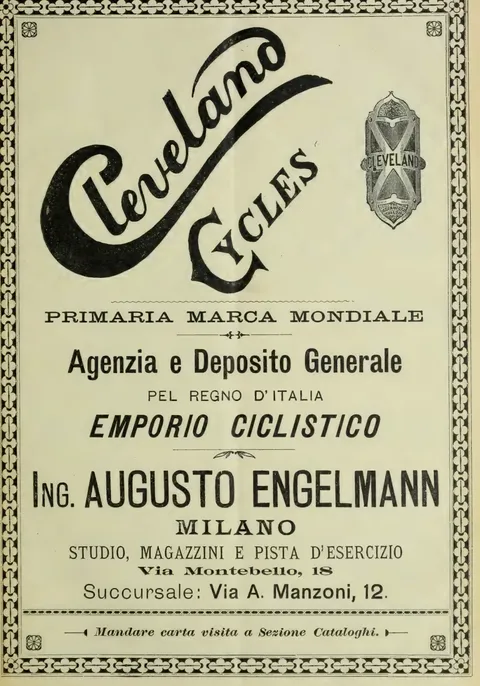 (opens in a new tab)
 1899 Cleveland Cycles 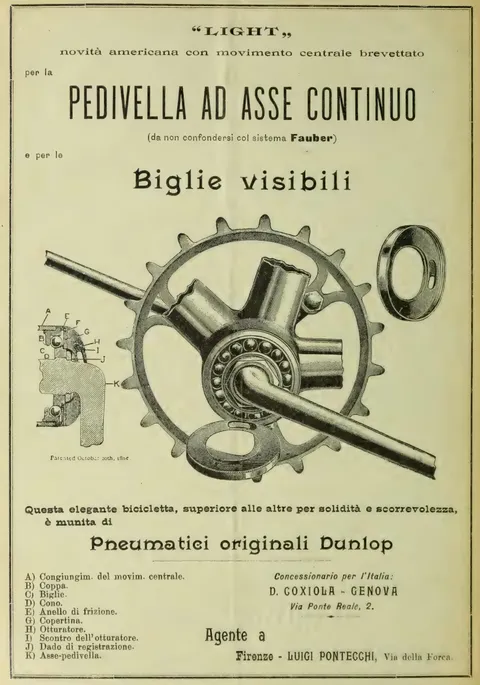 (opens in a new tab)
 "Light", Pedivella ad Asse Continuo e Biglie Visibili 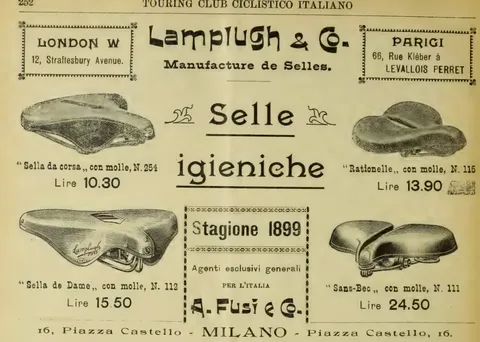 (opens in a new tab)
 Selle igieniche Lamplugh & Co. 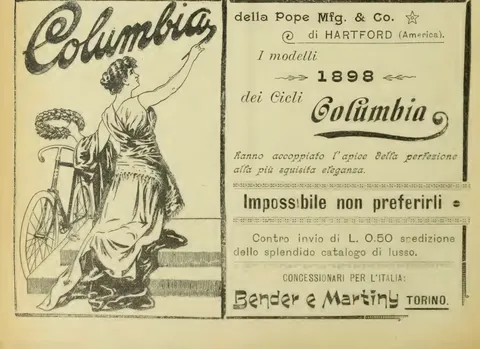 (opens in a new tab)
 Cicli Columbia, modelli 1898 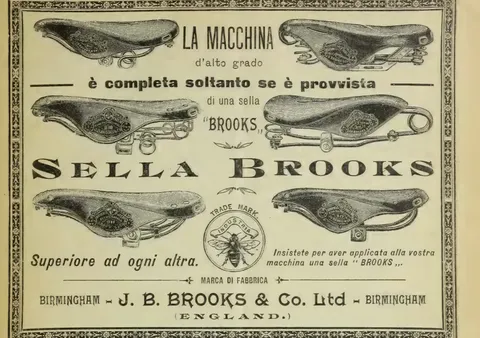 (opens in a new tab)
 Sella Brooks 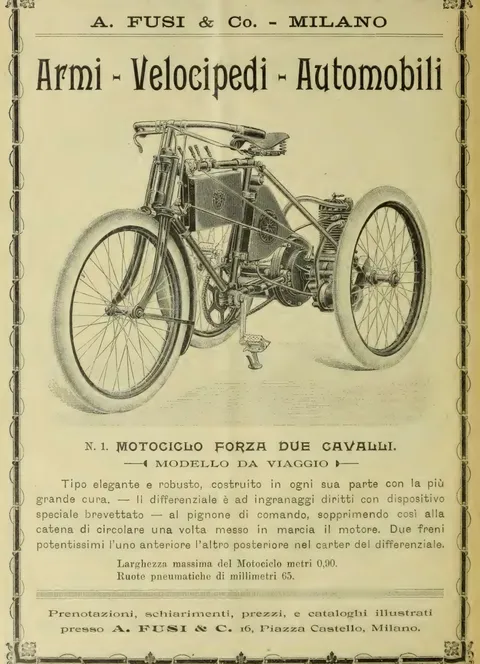 (opens in a new tab)
 A. Fusi & Co., Armi, Velocipedi, Automobili 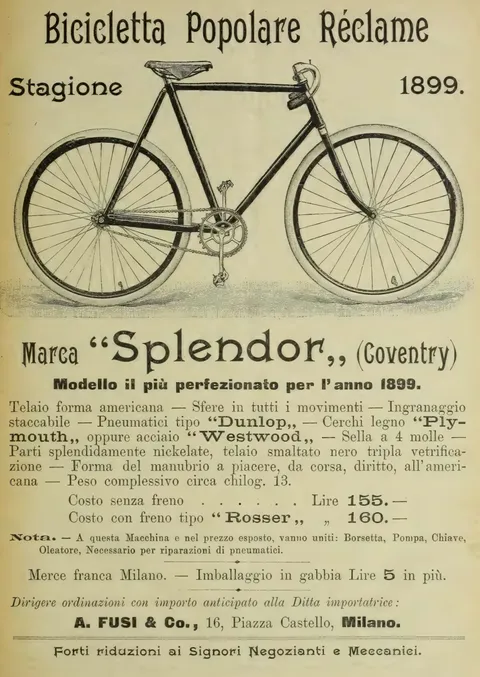 (opens in a new tab)
 Bicicletta Popolare Réclame, Marca Splendor 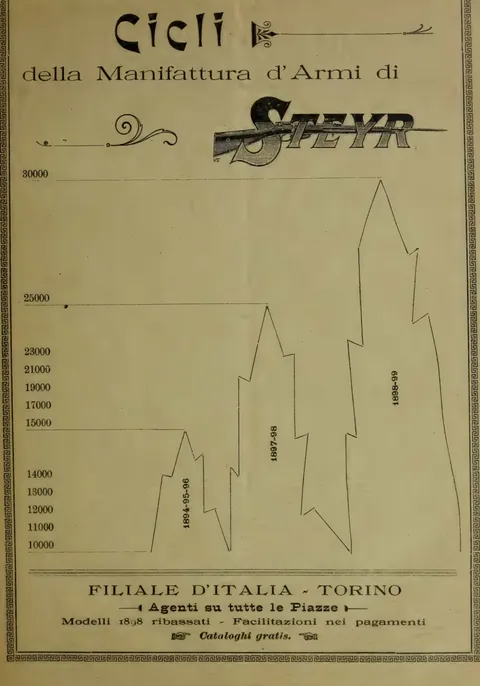 (opens in a new tab)
 Cicli Steyr