Vol 1, No 1
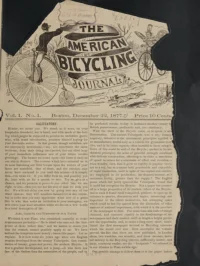
Articles in this issue
- The editors' opening address for the first number, saluting the reader with the claim "you need us" and, under the sub-head "Aims, Objects and Purposes of our Paper," tracing how the English press followed the bicycle's development out of the velocipede until London alone supported two weeklies, a monthly and three annuals devoted to bicycling.
- A beginner's manual for the high bicycle: take a small machine on a slightly downhill road with a friend holding the backbone, let the pedals carry the feet until balance comes unconsciously, then dismount and go home to think it over before perfecting the balance on the step and mounting. Continues on the following page with directions for dismounting, the use of the foot rests down hill, and sparing use of the brake.
- Reprinted from the Massachusetts Ploughman of Oct. 20, 1877: the English have replaced wood and cast iron with steel and enlarged the driving wheel to about 4 1/2 feet with a rubber tire, giving rides such as 205 miles in twenty-two hours, and the machines cost eleven to sixteen guineas in London, or $80 to $125 landed here, which American shops might undercut at about $75 for a 52-inch wheel.
- Levi Earnshaw's touring narrative through Newcastle-under-Lyme, Trentham, Stone, Stafford and Wolverhampton, where he rode the track round the lake at the Molineux Grounds and put up at Dan Rudge's "Tiger" Inn, then on by West Bromwich and Birmingham to Coventry, Nuneaton, Hinckley, Derby, Matlock, Chatsworth, Bakewell, Buxton and Whaley Bridge.
- W. A. S. of the Kingston B. C. (from the London Bicycle Journal) describes a seventy-mile day run from the "Griffin" at Surbiton, two hours' struggle against a south-east gale to the top of Reigate Hill, dinner at the "George" at Crawley, a rider coming a "cropper" descending Leith Hill "legs over handles," and shandy gaff at the "Talbot" at Ripley.
- A reprint from the Evening Express noting that the English machines shown at the Centennial Exhibition have since sold in numbers and are now on sale in all the principal American cities, and predicting that an American champion rider and American mechanics will emerge to improve on the English "Excelsiors."
- The London Telegraph and Field's report of the first grand meet, at Hampton Court and Bushey Park, where 463 club riders mustered, 156 from the London Bicycle Club under Mr. Inwards and Mr. Tegetmeier, 80 Pickwicks, 60 Surrey, 50 Temple, 30 Wanderers and 25 West Kent under the Rt. Hon. R. Lowe, M.P., with unattached riders bringing the total past 500.
- A letter to the Boston Globe (Nov. 9, 1877) signed "Fifty Inch," thanking the paper for its friendly article and reporting that the writer's own machine is one of some fifty ordered from England by a Boston importing firm, which has since sent for three times as many more.
- A Boston Globe survey (Nov. 4, 1877) of the English cycling annuals, clubs and manufactories, describing how the old "bone-shakers" and "timber-trucks" gave way to wire-spoked steel wheels on a machine of little over forty pounds, and counting fewer than half a dozen bicycles in the Boston vicinity, ridden by a busy lawyer, a photographer on a fifty-four inch, and a third man on too large a machine.
- The Journal's leading editorial for Dec. 22, 1877, tracing the machine from the 1818 Paris hobby horse of "Baron du Brais" and its London vogue under Johnson the Long Acre coach maker, through the multi-wheeled "polycycle" and the 1869 velocipede craze, to M. Michaux's enlarged driving wheel and M. Magee's all-metal machine, perfected at last by the English.
- From the Boston Advertiser of June 21, 1877: the velocipede of 1867 compared to a primitive locomotive against the light all-metal machine with its five-foot driving wheel, with sketches of the bicyclists rolling through London's West End, the regular Saturday run down to Brighton, and a prediction that American college men will bring the fashion home from Oxford.
- A Boston Daily Advertiser letter answering the correspondent "Constant Driver," flatly denying that bicycles on the public roads are a nuisance or dangerous and comparing the objection to the farmers who opposed the locomotive, and reporting that one London firm sold sixty thousand machines last year with demand still ahead of supply.
- A letter to the Editor of the Herald describing a Saturday "meet" of the "London Allshire Bicycle Club" on Clapham Common, 48 machines told off by fours to the bugle, the plain grey reefer-and-Scotch-cap uniform, the run out to the King George's Inn and the bicyclist's tea of dry toast, boiled eggs and Souchong. It closes by urging Americans to organize, the nucleus of the Boston Bicycle Club being already formed.
- An October day-run of forty miles from Leominster home to Boston on a 52-inch "Special Challenge" made by Singer & Co. of Coventry, by North Lancaster, Bolton, Stow, North Sudbury, Concord, Lincoln, Weston and Waltham in four hours five minutes' running time, with sample English road itineraries (London to Bath, Edinburgh and Cambridge) and tables of the quickest professional times by J. Keen and D. Stanton and amateur times by W. Taylerson and the Hon. I. K. Falconer.
- Three letters: "Arthur and I" on a first road run of a little over six miles from Milton Lower Mills to Savin Hill in thirty-five minutes on a 56-inch "Paragon" and a 50-inch "Ariel"; Cunningham, Heath & Co. announcing a book of signatures opened for the proposed Boston Bicycle Club; and "Oberon" asking how English racing tracks are built, answered by the editor with a specification of twigs and cinders.
- Short news paragraphs: Yale and Harvard are said to be making "bicycular" preparations for next year; thanks to B. Clegg of the London Bicycling News and the secretaries of the London and Sunderland clubs; Keen beat Stanton by 48 seconds for the fifty-mile championship of the world at the Agricultural Hall, Islington, in 3h 17m 22s; and the Oxford and Cambridge clubs have adopted "Tyro," "Timid toddlers," "Wary wobblers" and "Go it gracefuls" for the stages of skill.