Vol 1, No 11
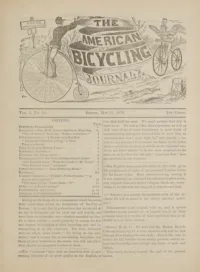
Articles in this issue
- The pictorial masthead and date line of Vol. I, No. 11 (Boston, May 11, 1878, Ten Cents) over the opening leader squibs: riding on the footpath must be resisted within the boundaries of the City of Boston; the "Crimson" claims an American firm is now making bicycles as good as the English at less than half the cost, which the editor doubts when the whole State cannot number two hundred machines; and "Bravo! B. Bi. C." on the Boston Bicycle Club's projected three hundred mile tour to and through New Hampshire, starting toward the end of the month.
- Reported from the English "Bicycling Times": at the close of the West Kent Bicycle Club's races at the Crystal Palace, Mr. E. C. Foreman announces that the club president, the Rt. Hon. Robert Lowe, M. P., will distribute the prizes, and Lowe claims to be an "ante-bicyclist" who rode a "dandy horse" in the reign of George the Fourth and beat the mail in a mile race. He commends the bicycle as the best possible antidote against the gout, warns against riding at speed in crowded streets, praises the "Safety Bicycle" of Messrs. Singer & Co. of Coventry, and asks that one of the parks be opened for bicyclists to practise in. The editor notes that sixteen London papers sent representatives to the races.
- Reprinted from the "Boston Advertiser" on the change in public taste toward innocent rather than brutal athletics, the crusade for physical culture led by the author of "Saints and Their Bodies," the Pittsburgh divine who hired a professional sparrer for a boxing class among the clergy, and Dr. Bowditch's showing that pupils in the higher Boston schools beat English public-school boys of the same age in height and weight. It ends with a gentleman of seventy who manages the ticklish bicycle, and the sentence the editor quotes on page 1: "Nature's own remedy for countless evils of our artificial life will be found in her cheery out-door activities."
- A contribution signed "New Bicyclist", a boy of about seventeen, not strong, taking his 52-inch "Grout's Tension" out for the fifth time on the hot forenoon of May 3d. He rests under a tree with the machine laid by the gutter while a facetious countryman drives past in a light wagon remarking "That's the best place yet for that," and rides home to argue that even an unpractised rider can have a good time on a bicycle in spite of the heat.
- A poem in two parts credited to "R. W. E. assisted by J. G. D.", an Emersonian pastiche opening "Bicyclic knights I often spy, / On horse uncarnate riding by", Lusty Juventus circling and Oldster's legs revivified, the wheel's two cycles turning to the cadence of the whirling world. Part II rises to the axis of the wheels you steer being the axis of the sphere; it continues on page 5.
- The Boston Bicycle Club's eighth club run, Saturday May 4th, leaving Trinity church at 3.10 P. M. direct for Quincy, where the whole vicinity turned out to meet them at the Robinson House. Long runs of thirty to fifty miles, and one of seventy-two, are becoming popular, and three or four B. Bi. C. members start next week for Walpole, N. H., returning by way of Rochester, about three hundred miles in six days. A further note welcomes Cunningham & Co.'s engagement of Mr. Harrison, just arrived from Coventry after years in bicycle manufacture, and of Prof. Booth, "Champion of America," as riding-school teacher.
- Corrects the photographers' initials given under this head in the last issue: the correct name is W. Loring Clark & Co., 352 Washington Street, Boston. The editor, having now been taken himself, offers readers a cabinet photograph of him mounted on his 53-inch "Coventry Champion Roadster" for fifty cents, and jokes that the Boston Post Office has made ample arrangements for the rush.
- Humorous clippings: a Josh Billings saying about the man who came for advice but had more to offer than to ask for; the ballad of Seth, who came home from mackerelling to find Sarah Ann had found another man and went to cut live oak down in Floriday; the French peasant lad who insists nothing is impossible "but a stick with one end" and that at Chartres you will see it; and a Commercial Advertiser squib on colored camp meetings held near poultry shows.
- The Journal's own London correspondent, writing April 16th, 1878, on the Easter tours: the "Temple" four days' trip by Winchester, Southampton, Portsmouth and Brighton, the "Pickwick" to Cambridge, Dunstable, Tring, Aylesbury and Oxford, the "Surrey" to Worthing and Salisbury, and the "Wanderers" week in Normandy and France. At the Bicycle Union's third meeting on Thursday April 4th, seventeen clubs and twenty-three delegates rejected the racing sub-committee's wording and carried three propositions defining professional and amateur, abolishing the old "mechanic, artisan and laborer" clause; R. R. Mackinnon had a walk over in the A. A. C. four-mile amateur championship, and the Hampton Court Meet Committee will publish an official programme.
- From the "London Bicycling Times": a defence of bicycling as the noblest of modern pastimes, likening the rider's spurt against a road rival to the exultation of a railway passenger whose train inch by inch outstrips the one running parallel. It argues the sport is safe if carried on without foolhardy bravado and is uniquely free of the cruelty that other sports require, no writhing worm, fear-struck fox or hare, or quivering pigeon. It continues on page 7 and closes with the squib on the skittish young bicycle that shied against the curb-stone.
- "C." answers "Nemo's" account in the last issue of the run from Fitchburg to Boston, taking up the charge of having recommended the route. He describes three trips of his own: a July run ended by a spill on road-bed ploughed up by ignorant road-menders, with a farmer calling out "What do you pay a week for keeping that 'ere colt?", then rain and the cars from Maynard to Waltham; an October run written up in the "Boston Advertiser" as "Forty Miles in Four Hours"; and a November run from Leominster to Brookline made to the minute in four hours' saddle time, his moustache coated with ice at Stow.
- The leading editorial, written while the Boston Aldermen still have the regulation of bicycle riding under advisement, appending five rules for riders: the bicycle is a carriage under the general term vehicle (Department of Justice at Washington); no carriage of burden or pleasure on any footpath or sidewalk (Stat. and Ord. p. 788, Sec. 50); no two vehicles nearer than ten feet; no vehicle driven foul of any person, the last three carrying twenty-dollar penalties, and the Massachusetts statute to turn out to the right on meeting and to the left on passing. It runs on to page 9 with paragraphs on the three hundred odd patents obstructing American bicycle manufacture and on the English proposal for a "Touring Club" drawn from existing clubs.
- Directs attention to Simmons & Son's advertisement in this number, a complete price list of everything in their line needed by the fraternity, and urges readers who want the Journal to become self-supporting to patronise the merchants who advertise in it, with an invitation to tradesmen to take the special low rates offered to permanent advertisers.
- The letters department for this number, opening with "Primitive Pedestrianism" from "Pedestrophile" and "A Gentle Bicyclophobe" from "Bohemian." It continues on page 11 with an unheaded letter signed "Pro Bono Cyclo," complaining that the "Old South" performances, "Revolutionary" Relics, the "Spinning" Bee, and now the Potter at his "Wheel", should say "Bicycle" outright, and one signed "D." arguing that the proper formations are "bicyclophiles" and "bicyclophobes" and recalling the velocipedoverbimaniacs of 1869 who derived "velocipede" from three languages to mean "much-horse-afoot."
- "Pedestrophile" holds that driving round in a carriage is the stupidest way of seeking recreation and quotes an eminent physician on the deadening, stupifying effect of the carriage riding his rounds oblige him to do. He recommends walking and the saddle, closing with two cures by simple prescription, the late Chief Justice Parsons, given over to consumption, told by his mother to throw away his medicines and ride the old mare, and a dyspeptic ordered out of doors from morning till night. The editor breaks in with "[A bicycle is better. Ed.]"
- "Bohemian" refuses to be bullied by the correspondent "Mill-dam," insisting his controversy is with the editor alone, then yields his space to a lady friend's racy protest against the bicycle. She would rather meet an earthquake than a man mounted on one, since an earthquake cannot be dodged while a bicycle always dodges the same way you do, and signs off that if she were a man she would be tempted to say "Bang the bicycle." The letter runs over to page 11 and is to be continued in the next number.
- A story from "Chambers' Journal" about the shaftmen of the collieries. During a severe frost the guiders in shaft A of the coal-pit at N… ice up, the two cages crash together in the narrow passing point with a small boy aboard the ascending one, and the shaftman Johnson descends shaft B, enters through the brattice-work and slides forty feet down what proves to be the bight of the slack rope. Swinging himself from side to side over a gulf some four hundred feet deep, he catches a cross-beam and clambers out; the boy is rescued unhurt.
- Notice of a grand six days' test of endurance between professional bicyclists and horsemen in England next week, riding from six in the morning till eleven at night. The greatest distance takes $1000 in gold and a solid silver cup worth $850, with $500 divided between the second, third and fourth men, $50 each to the next two if they ride not less than nine hundred miles, and $25 in expenses to any rider who lasts three of the six days. Stanton, the champion, will be among some dozen of the first riders in England.
- Short replies running over to page 13: to "Viator," on De Noille's card and why he does not take up Booth's challenge instead of issuing new ones, with the prediction that no professional bicycle racing will be seen this season until gate money warrants a money prize; to "H. R." of Pittsburgh; to "All Bright" of Coventry, referred to Everett & Son, 17 Royal Exchange, London, the Journal's sole agents for Great Britain, or ten shillings for a year from No. 1; and to "A Friend" of Philadelphia, that the Boston Bicycle Club abandoned the trip on reports of bad roads, not distance, "It is absurd to call ninety-six miles a 'long run.'"