Vol 1, No 14
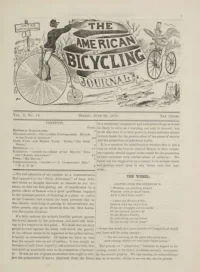
Articles in this issue
- Unheaded front-page leader squibs under the pictorial masthead of Vol. I, No. 14 (Boston, June 22, 1878), calling attention to a communication in the "Daily Advertiser" of June 20th on the first glaring act of interference by a Boston police officer with a gentleman bicycling on the Common, endorsing the writer's protest against the brutal assault and suggesting that the bicycle clubs of Boston appeal to the courts in their corporate capacity. A closing paragraph dismisses "a poor parody of Campbell" sent in by a reader ("'Tis the morning of life gives bicyclical lore") and complains that the parody business in regard to bicycling is overdone in the secular papers.
- Short poem "adapted from the German by D.", printed in the right-hand editorial column, in which the questioner asks the rider whither he goes on whirling wheel as if a thief he were, and the wheelman answers that he flies from the struggle and strife of the narrow street, stained with his city's dust, to the Road's felicity and away from the moody toil of town.
- London correspondent's letter of 27 May 1878 on the great Hampton Court Meet of 18 May, where about 1,480 riders from 75 clubs paraded the seven-and-a-half-mile round led by the Pickwick Club. Also reports White's 150-mile ride against Leon on horseback, and the Bicycle Union championships at Stamford Bridge, won by the Hon. J. Keith Falconer (two-mile) and A. A. Weir (twenty-five mile).
- Reprinted from the (London) "Bicycling News" and signed CLANSMAN of Inverness, N. B.: a description of the roads of Inverness and Ross shires as a fair sample of Highland touring ground, arguing that the deep-rooted idea that the roads are as steep as the mountains and as rough as the water-runs is wrong, that country and turnpike roads are kept in first-class condition and inns every few miles are comfortable and moderate in charge. Quotes Collin's geography of Inverness-shire that upwards of eight hundred miles of road were made between 1804 and 1820 and that the county now has about a thousand miles, and reports that the two Inverness clubs of last year have not revived for want of co-operation though clubs have been established at Elgin and Forres.
- Chronicle of the Suffolk Bicycle Club's first short season, whose enterprise the editor warns will make the B. Bi. C. guard its laurels next Fall: 16 April to Salem and back by Charlestown, Chelsea and Lynn, returning through Linden, Malden, Medford and Cambridge; 18 April Cambridge to Linden; 19 April to Scituate through Hingham and Cohasset, 2hrs 38min each way; 20 April through Dorchester, Mattapan, Jamaica Plain, Chestnut Hill and Brookline; and 22 April from Boston to Newport via Stoughton and Fall River in a little over ten hours' running time. Followed by notes that Lowell bicyclists are talking of forming a club and a jibe at an English maker's price list boasting of the "absence of all complicating neatness, strength, durability, correct fitting and workmanship."
- Poem by Laura M. Taylor in three stanzas urging that Life be woven from sunshine and moral truth and that overthrow is Life's stern law which none can evade, printed with the editor's admission that he has made a "solemn quest" for its meaning without success but prints it "pour encourage Laura" because it inculcates caution in young bicyclers.
- Editorial announcement that the present number completes the first phase in the Journal's existence: instead of appearing every alternate Saturday it will now be issued irregularly as bicyclic matter accumulates, its date advertised in the preceding Monday's "Boston Daily Advertiser" and "Evening Transcript." Volume one will still be completed on 22 December, subscribers will receive their papers until that date whether the issue be daily, weekly or monthly, new subscriptions will date from No. 1 with back numbers forwarded, and readers, some hundreds in Massachusetts alone, are urged to become honorary agents, since the cost of starting and maintaining the paper has been quite heavy.
- Leader on the class of newspaper correspondents who turn every trifling annoyance into a public grievance, occasioned by a letter to the "Boston Daily Advertiser" signed *** whose steady horse wheeled round on Milton Hill when "a tall man on a tall bicycle came spinning along," and who proposed that conspicuous corners carry signs reading "Public road, dangerous on account of bicycles." The editor answers with the stable-keeper's assurance to Mr. Pickwick before the ride to Dingley Dell, and reprints the Advertiser's reply of 18 June 1878 pointing out that some horses are frightened by hay-carts, that drivers do worse than frighten horses, one, the driver of a tandem team on Beacon street in Brookline, tried to run the writer down, and that scarcely one horse in a hundred is now disturbed by a bicycle.
- Letter signed RIDER describes a policeman assaulting a young man riding carefully on Boston Common, throwing him to the ground and nearly arresting him until bystanders' indignation stopped it. Six English court cases of assaults on cyclists are appended, including Peter Mullins's seven years' penal servitude for robbing Mr. Henry Stowe after knocking him off his bicycle.
- Comic poem by "Jagy Torlton", reprinted from the "Weekly Post", every stanza closing on the refrain "My Bicycle", the rider regards himself high on his "nag forty pound of mostly iron", jokes that Hans Breitmann and Schnitzerlein gave up the ghost for want of one, and boasts that while Russia eats rotten Turkey and John Bull stews, the wheelmen have a better kind of meet.
- Letter from "AMOS" of Boston, dated 30 May 1878, under the heading "A Co-operative Idea": he suggests that the Boston Bicycle Club join the Christian Union Athletic Club in leasing ground among the unoccupied fields on the Back Bay, laying a track, sodding the centre and erecting a pavilion; asks the Journal to state from time to time the lowest cost of a useful machine (the editor answers $75 to $150 according to size of wheel); and denounces the error-strewn athletic reporting of the Boston daily press, instancing the "Herald" on the Y. M. C. A. Rowing Club meeting in Music Hall. Followed by "B. A. D. D." of Boston, 10 June, with a conundrum on the difference between an icicle and a bicycle.