Vol 1, No 15
Articles in this issue
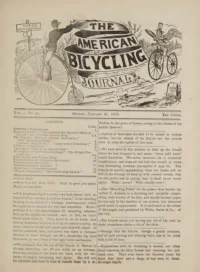
- Headless front-page squibs set under the pictorial masthead and the "Boston, January 25, 1879" dateline, alongside the contents box. They answer a Chicago contemporary on the rarity of a handsome leg, estimate that Boston's bicycles are already taking $5 a week from the horse-car lines, and notice Arthur C. Andrew's four-hand piano piece the "Bicycling Polka," published by White, Smith & Co. and dedicated to the editor.
- Hymn parody signed "S. E. Ven" addressing "Cyclus from thence, that art the best, thou true and living wheel." The senior forswears the sidewalk for the street, keeps "the limits of my shank the bounds unto my wheel," and remounts after casual falls to ride for exercise.
- The journal's standing English department, running across pages 2 and 3 in blackletter. It carries the London Bicycle Club's hundred-mile medal race, the Agricultural Hall six days' race, the Scottish amateur championship on the Linlithgow Road, the Cambridge University Bicycle Club's 250 members and a Plymouth man's £3.10.0 tour of Guernsey, Jersey, Brittany and Normandy.
- F. E. Appleyard covered Cleveland Bridge, Bath to the ninth milestone beyond Hounslow, an exact hundred miles, in 7h 18m 55s actual time (6h 38m 55s riding) on 10 June 1878, taking the enamelled medal ahead of Thorn, Coleman, Butler and Dalton from 31 starters. The account, reprinted from the London "Bicycling Times," records Coleman's early lead, Bridges upset at Devizes, Appleyard's cramp at Knowl Hill and the champagne and seltzer W. A. Smith fetched at Maidenhead.
- Short verse by "T. W. O." asking only for "my bicycle of quiet, my horse of health to walk upon," a tin of lubrication and hose and breeches, and looking for more "paceful pilgrims" who have cast off their nags of leg.
- The bicycle handicap at the annual field sports on Jarvis Field, Cambridge, 2 November 1878: W. D. Swan from scratch caught C. P. Parker (15 yards) and beat R. C. Sturgis (50 yards) by half a wheel in 3.49, then took the second heat and the race in 4.07. The track was too soft for bicycling, and the paper urges Harvard to organise a club and lay a cinder path.
- Round-up of the 1878 State and county fair races that are displacing the horse trot: Framingham (Middlesex South, $350 in prizes; W. R. Pitman five miles in 21.38, H. E. Parkhurst two miles in 8.40), the Maine State Fair at Portland, Bridgewater, Concord, Attleboro' and Taunton, where Parkhurst won a cup in 3.21 1-2.
- Mr. Burnham, a veteran of the velocipede days now living in Portland, Me., rode his old machine to the Boston Bicycle Club's Saturday meet in front of Trinity Church on 2 November 1878. Needing a friendly lamp post to mount, he was invited by Acting Captain Pope to join the run to West Roxbury and was left behind over the Milldam.
- Hymn parody from the Boston Post, "Bicycling bloods go forth to war, Hygeia's crown to gain", saluting the lawyer who "rode forty miles upon the fly," the "twelve valiant saints" of the chosen club whose hope is the Hub, and the mobile band who met the Briton's burnished steel.
- Mr. Haydock the pedestrian calls at the office about a "Herald" announcement offering any walker one mile to the rider's three over not less than 500 miles, proceeds to the Young Men's Christian Union unless the walker won $1000. The editor holds the terms all in the pedestrian's favour, since eight or nine laps to the mile in any Boston hall would make the rider dizzy, and urges Haydock to become the challenging party.
- Two members of the Boston Bicycle Club ran across the State in October 1878, during the elections, and canvassed every town, village and hamlet on the political question of the day, the astonished villagers answering willingly.
- Two Boston Club men circling the Chestnut Hill Reservoir one Sunday noon in November decided to run on to Providence, riding through Newton, West Roxbury, Dedham, Norwood, Walpole, Foxborough, Mansfield, Attleborough, Seekonk and Pawtucket to the Narragansett Hotel, about forty-four miles by cyclometer, in five hours' saddle time, and returned by rail. From the Transcript.
- Letter signed "Moderate Bicyclist" by "One of the 'Unattached'," printed unabridged at the editor's insistence, describing a thirty-seven-mile ride from Boston on a 50-inch Duplex Irish Roadster by Milton Hill, East Milton, West Quincy, Braintree, Holbrook, Brockton, Campello, West Bridgewater and Raynham. It complains of the gamins of upper Harrison Avenue throwing granite at riders, praises farmhouse milk and the City Hotel at the Taunton "Green," and asks why Taunton, which makes everything from a tack to a locomotive, makes no bicycles.
- The journal's racing department for this number, given over entirely to the New York Athletic Club's second annual winter meeting.
- Two-mile bicycle heats at the club's winter meeting in Gilmore's Garden on the 3rd and 4th: W. R. Pitman of Boston won the first heat on a "Columbia" in 10.58 from P. Van Nest; W. M. Wright took the second in 11.05 1-4 on a French bicycle by Meyer, riding clean over the fallen W. Addison and machine, and the final in 9.54 from Joseph Lafon. Lafon then protested that Wright had once ridden against David Stanton, and the club sustained it, adjudging Wright a professional and giving Lafon first prize and Pitman second.
- Editorial on the paper's temporary suspension and erratic appearance, revoking its earlier promise about closing volume one and substituting completion at the twenty-sixth number, whatever the dates, all subscribers to be served until then, with back numbers supplied except No. 12, which is out of print. It argues the bicycle is now so established that "nothing can kill it," and that a tour from Maine to Mexico will one day be an accomplished fact.
- Late note that the New York Athletic Club committee has sustained Lafon's protest against W. M. Wright, adjudged him a professional and denied him the prize. Lacking the reasons, the editor reserves judgement but calls the action, as far as the facts are known, totally uncalled for and unjustifiable.
- The Boston Bicycle Club's eleventh business meeting at Vossler's, 19 Hawley Street, reports thirty-two members, sixteen runs of ten to twenty-five miles and a vote for an anniversary dinner; Geo. R. Agassiz won both club races, the second from Chestnut Hill to Wellesley in 1h 46m 45s. Also the Suffolk Club at forty members with A. D. Chandler offered the presidency, the East Milton gathering to greet W. M. Wright, the San Francisco club's petition to the Golden Gate Park commissioners, only three bicycles in all Bermuda, and a welcome to the new Montreal Bicycle Club.
- A partial alphabetical list, running on to page 11, of nearly two hundred and fifty American bicyclers with their addresses, Agassiz, Oliver Ames, the Cunninghams, Albert A. Pope, W. R. Pitman, J. Lafon, W. M. Wright and others from Boston to San Francisco, Denver, Louisville and Salina, Kansas. Asterisks mark Boston Bicycle Club members; the Pope Manufacturing Co. and Cunningham & Co. helped compile it.
- The paper's professional-racing department, in blackletter, carrying John Keen's Wolverhampton championship win, the new ice race-course at Lillie Bridge on which Keen is seeking a trial of speed, and his June match against the walker W. Perkins at Brompton, won easily by 200 yards.
- At the Christmas sports on the Molineux Grounds, Wolverhampton, before upwards of a thousand spectators on a thawing, mud-covered track, John Keen of London, "Happy Jack", spurted past to take the inside position inside the first fifty yards and beat Walter Phillips of Wolverhampton by about seven yards in three minutes ten seconds. Keen rode a fifty-six inch of his own manufacture, Phillips a fifty-five inch double hollow fork racer by Hillman & Herbert of Coventry.
- Readers' letters for this number, running on to page 12, where an unheaded letter signed "Jack Easy" warns riders away from the one hotel at Bridgewater, Mass., and its surly landlord, praising instead the druggist next door.
- H. S. Owen writes that the capital's long, well-paved concreted avenues make it the first city in the country for riding, traces the bicycle's arrival there, first shown by a Frenchman two years ago, then an English machine ridden by a resident, and rates the Pope Manufacturing Company's "Columbia," the "Practical American Roadster," best because its machine-made parts can be duplicated by post. A club is contemplated as soon as spring opens.
- Editorial replies in blackletter: "Geo. W." of Jacksonville and some twenty others are declined advice on which machine is best, being referred to the Pope Manufacturing Company and Cunningham & Co. in the advertising columns and to the paper's Purchasing Agency; "Videx" of Chicago is given Chas. Howard's address at 14 St. Bride Street, London; and there are notes to correspondents in Buffalo, Hartford, Marcellus, Mich., Rochester, Minn., Philadelphia and London.
- Trade article on bicycle manufacture as a new American industry, continuing to page 13. It describes the Pope Manufacturing Company's "Columbia" (87 Summer St., Boston), spider wheels, V felloes, solid red rubber tires, hollow steel backbone, modelled on the Duplex Excelsior and machine-burnished, and Cunningham & Co.'s "Harvard," made to their specification by Bayliss, Thomas & Co. of Coventry with socket steering, detachable cranks and dust-proof bearings, and shipped in pieces so that twenty-five machines fill the space five once took.
- Parody of Addison's Cato, "Addison with additions", on the pleasing hope and fond desire of riding set against "this secret dread and inward horror of falling in the mud," with the soul starting back at nasty croppers.
- Three-line squib signed "D." advising the man ill-served by Fortune's wheel and seeking some surer "dear Gazelle" to cheer up, step up and try the bicycle.
- Responding to letters from distant readers, the journal withdraws its refusal and offers to act as purchasing agent from the Boston agents, examining any machine, ensuring it is in perfect order and properly packed, for a five-dollar fee. The order form is printed in full, addressed to 178 Devonshire Street; the paper still declines to say which make is best, as that would be unjust to its advertising patrons.