Vol 1, No 18
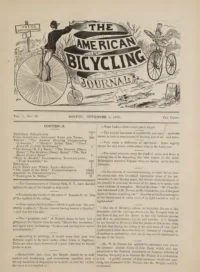
Articles in this issue
- Unheaded front-page squibs beneath the pictorial masthead of Vol. 1, No. 18: the Central Park commissioners in New York have decided against the bicycle, while Brooklyn allows riders the Prospect Park foot-paths and the city drives outside 10 a.m. to 4 p.m. after 4,000 club miles without an accident. A closing note reports W. R. Pitman's amateur status referred to the National Association of Amateur Athletes of America.
- Numbered list of the twenty-two American and Canadian clubs in order of foundation, from the Boston Bicycle Club (1) to the Cleveland Bicycle Club (22), including San Francisco, Montreal, Bangor and Capitol. Entrance fees, subscriptions, colours, badges, uniforms, headquarters and officers are given for the Fitchburg, Worcester, Harvard, Brockton, Brooklyn, Germantown, Chicago, Detroit and Cleveland clubs.
- Standing blackletter department carrying the season's run reports, opening with the Boston and Massachusetts clubs' two-day excursion to Northboro' and continuing on page 3 with the Brooklyn Bicycle Club's run up the Hudson.
- Some thirty-five Boston and Massachusetts Bicycle Club men rode from Walnut avenue on 24 October through Roxbury, Brookline, Newton, Needham, Wellesley, Natick and South Framingham to Northboro', then next day by Berlin, Bolton, Stowe, Sudbury and Wayland to Waltham and Boston. Etherington, Cann and Terront rode part of the first day, Notman photographed the column at Wellesley, and E. C. Hodges of the Boston club acted as captain.
- From notes by T. Hood Muir, captain of the Brooklyn Bicycle Club: the party went by boat to Motthaven, strayed onto the old Boston post road, then ran via Jerome Park and Kingsbridge to Yonkers, Irvington, Sing Sing and Cruger's, 44 1/4 cyclometer miles in all, before taking the train back to New York.
- At the fourth annual championship meeting of the National Association of Amateur Athletics at the New York Athletic Club grounds, Mott Haven, on 20 September, L. H. Johnson of the Essex Bicycle Club won the two-mile championship in 7 minutes 22 seconds. Pomeroy of the Manhattan Athletic Club was second by 80 yards, E. P. Sharpe of the Suffolk Club third and W. M. Wright fourth.
- Providence's first amateur bicycle race, two miles at the Park Gardens on 7 July, drew Anthony, Parker, Johnson, Richmond and Thurber. Fifteen-year-old Thurber trailed Anthony and burst past him on the last half-lap to win in 8 minutes 33 seconds, Richmond third after a heavy fall.
- Races under the Providence Bicycle Club at the Park Garden on 2 September, arranged by E. C. Churchill and judged by E. W. Pope, A. G. Carpenter and Frank W. Weston, editor of this journal. Sharp won the two-mile and, by a few inches from Johnson, the one-mile; Holman took the one-sixth-mile slow race and a cameo ring.
- Bicycle racing before some twenty-five thousand people at the New Jersey Agricultural Society's State Fair on 19 September, under Essex Bicycling Club patronage. Harrison won the free-to-all professional two miles and $100 purse in 7.42 3/4 from Belard and Parsons; Pomeroy won the amateur mile in 3.24 from Fields and Holman.
- Held in the Park at Danvers, Mass., on 25 September under the Salem Bicycle Club. M. T. Morse of Beverly took the one-mile gold medal in 3m. 10s. from Packard and Murphy of Salem; W. O. Faulkner of Lynn won the two-mile gold medal in 10m. 12s. after E. H. Porter withdrew with a loose rear tire.
- The mile bicycle race on the third day of the Brockton Agricultural Fair, 23 October, for a silver ice pitcher, opera glasses and a clock. F. H. Johnson of Brockton won in two straight heats (3.38 and 3.36) over Marshall, Washburn, Gilman and Severance on a track good for trotting but wretched for the bicycle.
- The County Fair at Hamilton Park on 2 October offered literary works as bicycle prizes and charged a three-dollar entrance fee, and drew not a single entry. The riders present instead got up two half-mile scratch races, won by R. C. Wander of Hartford and by C. P. Wurts, jr., of New Haven in 1.36.
- Two-stanza comic hymn subtitled “(The Tutelary Angel.)”, saluting the bicycle whose “steely beams with fancy play” outshine Aurora, and closing “Io Pæans let us sing / To the bright pedalian king.”
- Standing blackletter department on the professional side of the sport, covering the arrival of the Anglo-French team at the Pope Manufacturing Company's Boston warerooms and Harry Etherington's two letters of challenge and race announcement.
- Harry Etherington, the English ex-champion Cann and the French champion Terront have made their headquarters at the Pope Manufacturing Company, 87 Summer street, Boston, with Keen and Stanton still detained in England. Etherington's circular to American professionals advertises a 100-mile handicap at the Huntington avenue tent on 1 November and a six-day race from 3 November with $2,000 in prizes on a ten-foot plank track of eight laps to the mile.
- Writing from the Parker House, Boston, on 28 October, the team's manager and proprietor of the London Bicycling Times challenges any American team or rider to meet Keen, Stanton, Cann and Terront at any distance from one mile to three thousand for $500 to $2,000, offering starts of 75 to 200 miles in a six days' race or a match against men on horses. Without an answer, he writes, the team will “bid adieu to this country.”
- Standing blackletter department of English news, reprinted chiefly from the Bicycling Times: the Kensington Tricycle Club's fifty-mile championship and, on page 7, a Bavarian railway train beaten from Würzburg to Kaiserslautern by a bicycle.
- The Kensington Tricycle Club's championship of 10 October, Kew Bridge to Blackwater and back, with a full list of starters and machines (“Premier,” “Excelsior,” “Salvo,” “Flying Eagle”). Derkinderen won in 4h. 55m. on Hillman and Herbert's new 60lb. rotary “Premier” with ball bearings, Corbett second and Rucker third on a 120lb. machine; Etherington stopped at Virginia Water with a loose treadle and no spanner.
- Progress on Boston's proposed bicycle track has slowed during the excitement over the English professionals' visit, though a large amount of stock is engaged and subscription books will open shortly. The Beacon Park scheme is temporarily abandoned, the Boston Athletic Association contenting itself with laying out the ground inside the trotting track for lacrosse, foot-ball and cricket.
- The Kankakee (Ill.) Gazette's comic account of Ped. Durham, owner of the first bicycle brought into the town, a 48-inch front wheel with a 16-inch trailer “like a tin pan on a dog's tail”, and of his learning to dismount backwards and over the handles before he learned to ride.
- Reprinted from the Bicycling Times (Eng.): a student of Würzburg university wagered he could beat the train to Kaiserslautern on his bicycle and so outstripped the locomotive that he greeted its passengers on arrival. The editor adds that bicycle out-riders may yet precede all railroad trains to look out for dangers ahead.
- Sub-headed “The Essex Club Scores Another Victory,” a two-mile race at the Elizabeth (N. J.) Athletic Club's annual sports on 18 October between L. H. Johnson, captain of the Essex Bicycle Club, and J. Faley, an Englishman lately arrived. The pair spurted and led alternately until Johnson came away on the last lap, winning in 7m. 19 2-5 sec.
- Leading editorial of Boston, 1 November 1879, holding that the Anglo-Franco contest will give professional bicycling its first real exposition in this city, and that no professional contest should occur except under the auspices of an amateur club, as here, where the Boston and Massachusetts clubs supply the handicappers and judges. A closing paragraph reports the Terront–Cann 100-mile race postponed because a Back Bay gale made it impossible to pitch the mammoth tent.
- Ten bicyclers riding in South Abington or Brockton on Sunday 20 July passed an Irishman whose horse shied and broke his buggy's whippletree; when they refused his demand for $100 he gave the whole party into custody for violating the Sabbath. Each rider was fined $10 and costs, and all have appealed.
- Blackletter club department: the Salem Bicycle Club with Lynn men and J. R. Dyer of the Massachusetts Club rode thirty-four miles to Medford and back on 30 October; the Boston Bicycle Club held its seventeenth meeting at Vossler's on 6 October; a second two days' run is planned in Essex county; and the Howard Bicycle Club's fall races are fixed for Jarvis Field on 8 November.
- A long and belated notice of “The American Bicycler; a Manual for the observer, the learner, and the expert” by Charles E. Pratt (Houghton, Osgood & Co., Boston, 75 cents). The reviewer lists its dozen chapters from “Historical Sketch…Velocipedes” to “Bicycle Literature,” praises its twenty engravings, and notes its century of velocipede history from the first machine of 1779.
- Eight-line verse signed “By D.” in which the bicycle is the sun of the stable and its riders the planets that “all grow bright / With borrowed light, / And shine as he goes round.”
- Blackletter letters department: a Philadelphia Club meeting in Horticultural Hall on the Park Commissioners' grant of riding on Belmont avenue and the East Park until 1 December; Fred H. Browne on the dozen-member Chicago Bicycle Club and its thirty-five miles of boulevards; D. K. Trimmer of York, Pa., declaring the “York Bicycle Club” a myth invented by a sub-editor; and “Sandy” on the Stowe-through-Sudbury road. Continued on page 12 with Wm. R. Lovell on the Worcester Club's meet at Westboro' and the Essex club secretary's complaint that the Mott Haven championship went unreported.
- The Providence Bicycle Club and Brown University athletes' fall meeting at Park Garden on 29 October. R. L. Lippitt led throughout to win the ten-mile gold challenge medal, value $50, given by Jesse Howard, in 42 minutes 59 1/4 seconds from Churchill; the mile and half-mile were postponed for darkness, but Cann, Terront and Etherington gave exhibition spins in the northerly gale.
- Blackletter editorial replies to G. P. of Germantown, H. R. of Worcester (the thumb brake preferred, but the grip-brake more powerful and best used with the finger alone), J. W. K. of Rochester, I. R. of Racine, T. H. M. of Brooklyn and A. E. W. of Northboro'. Continued on page 13 with replies to C. A. B. of Salem and H. W. K. of Newark.
- The Capitol Bicycle Club escorted its president Max Hausmann and sub-captain Dr. H. M. Scholey out of Washington on 2 October for a ride to Boston, by Baltimore, Havre de Grace, Wilmington, Chester, Philadelphia, Bristol, Trenton, Harlingen, Scotch Plains, New York, Stamford, Bridgeport and New Haven. The doctor's backbone and spring and Hausmann's crank all broke in turn, Mr. Fairfield of the Columbia Bicycle Factory at Hartford making the repairs, and Scholey finished alone at Charles street on 15 October.