Vol 1, No 2
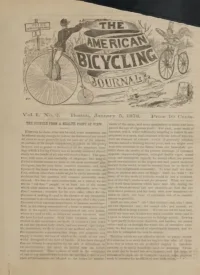
Articles in this issue
- The leading article for the second number argues that crowded-city men need an out-door recreation combining relaxation with utility, and dismisses walking, horse-keeping, base ball and rowing in turn before declaring "THESE MEN ARE BICYCLISTS" and "THIS MACHINE IS THE BICYCLE." It answers the charge that the machine injures its rider by pointing to the old velocipede's "kick out" propulsion as the real culprit and to the bicycle's adoption by the medical profession in rural England. Continues on page 2.
- The first instalment of a standing department promising a description of at least one practical bicycle route per issue and inviting concise, accurate road reports from riders. Route No. 1 runs Boston to Quincy, Mass., via Milton, eleven miles: from the asphalt at the north end of Columbus Ave. by Chester Park, Albany Street and Dorchester Street to Washington Street, down Codman's Hill to Milton Lower Mills, over the Neponset bridge and Milton Hill to East Milton and the "Robertson House," with the finest scenery in the state from Mt. Bowdoin and Milton Hills.
- The editor apologises for the imperfections of the first number: misplaced type in the "notices" on page eight, the failure to credit the Advertiser with the communication signed "C.," the omission of Cunningham, Heath & Co.'s address at the foot of their club notification, and a garbled correction on page thirteen that should have read "This is an incorrect estimate."
- A note on the snowless, hard-roaded, bracing winter that has ushered in the advent of the bicycle under the happiest auspices, followed by a Sunday Herald sketch of two "oldest inhabitants" on a Boston & Albany train outbidding one another with recollections of ploughing, maple sugar, pear blossom and ripe melons in the Januaries of 1838, 1827, 1820, 1809 and 1789.
- The Journal reprints in full the bicycle controversy that opened in the Boston Transcript on Dec. 17, 1877, beginning with "Young Man Afraid of his Bicycle," who calls the machine dangerous and useless on hills, frozen ruts, snow or a head wind, and blames a broken ankle, a broken arm, a broken leg and a weakness of the kidneys on two acquaintances' riding in France. Continues on pages 6, 7, 10 and 11 with the replies of "Jupiter," "Duplex Excelsior," "Pro Bono" and "Iron Horse."
- The standing letters department, opened with a note that the Journal ventilates all pros and cons but does not identify itself with any opinion expressed. "Ixion" describes a run home from Natick, Mass. on Dec. 4th: C. on his 52-inch "Challenge" drawing figures of eight before nearly two hundred people at the station, Ixion on a 50-inch "Ariel," the pair rolling through Wellesley, Grantville and the Newtons to Chestnut Hill Reservoir, and a little over twenty miles covered in two hours and twenty minutes.
- "Vulcanite" ridicules a painted sign near the Boylston Market advertising a "Bicycle Club" that turns out to be one man, an ex-champion rider from England with a gold medal to show, still mounted on rattle-and-thump machines; and complains that the newly opened velocipede track at the skating rink has been fitted with the same ancient relics rather than noiseless rubber-shod bicycles. (The heading is printed "PURLIC" for PUBLIC.)
- Editorial replies to "Dodo" (take the train from Liverpool to Holyhead and ride the 260 miles to London by Bangor, Llangollen, Birmingham and Wolverhampton), to "Puzzled" (the word is of Greek derivation and should be pronounced BI-CY-CLING), and to correspondents at Amherst, N.H. and Milford; with notes that the bicycle is now used in Australia and India and has appeared in the streets of Cape Town, and a limerick on Miss De Glace from the Lampoon.
- The standing department in which communications, news, queries and other matter from "our English cousins" are solicited and promised the editors' best attention.
- P. C. Robertson's Scottish tour from Musselburgh across the battlefield of Pinkie and through Dalkeith to Eskbank, where W. F. joined him on a 48-inch "Gentleman" with a knapsack framed above the back wheel; over the Moorfoot hills to Innerleithen and Traquair, a snapped brake cord on Robertson's 54-inch "Rudder Excelsior" above an unfenced precipice at sixteen miles an hour, a night at the Tushielaw Inn, then Selkirk by Sir Walter Scott's monument, Galashiels, Stow and Dalkeith back to Musselburgh. (The heading is printed "ETTBICKDALE" for Ettrickdale.)
- An editorial on the bicyclist's costume: no long coat tails to catch in the spokes, no trouser leg to foul the crank, no brimmed hat; the whole uniform of one colour, drab or grey to hide dust, so that the Boston Bicycle Club's rumoured blue black is judged a mistake. It prescribes a short pocketed jacket buttoning close at the throat, breeches or knickerbockers with long thick stockings, well-fitting thick-soled shoes, a "Glengarry" Scotch cap in preference to the English "Polo" pattern, and chamois-lined drawers with a rubbing down after a spin.
- Quotes Dr. O. W. Holmes's description of walking as "a perpetual falling with a perpetual self-recovery" to reassure beginners that they have already mastered a very similar difficulty with far less strength than they now possess, and counsels cautious, intelligent beginning and perseverance without haste.
- A squib offering the dictionaries, which have not yet taken up the Journal's principal word, a definition of it: "Bicycle,…A two-wheeled bird without feathers."
- A humorous paragraph urging every young man who wishes to live long without growing old to ride the bicycle, and every elderly man to ride it and grow younger with each revolving year, citing a rider who began about twelve months since at forty-nine and is now, in spite of the lying almanac, only thirty-five.
- From the Sunday Herald: Chas. A. Booth, champion velocipede rider of the world, is settled in Boston as a constable and ready to defend his title. Born in England, he gave trick-riding exhibitions at the Cirque Napoleon as the velocipedian Ducrow, beat Johnson, Mayo, Hood, Mischaux, Palmer and Wright at Agricultural Hall, London, and won a £200 match riding 52 miles in under eight hours on a 65-pound velocipede. The Journal adds Prof. de Koiell of New York's reported $250-a-side challenge and Booth's offer to ride five miles for $500 or $1000, and wishes Keen would meet him.
- A Transcript correspondent signing "C." answers "Young Man Afraid of his Duplex Excelsior Bicycle" with a challenge: he will ride from the depot at Fitchburg along the great highroad to the crossing of Charles and Beacon streets in Boston between breakfast and lunch and be back at his duties in the afternoon, while "Young Afraid" walks the same course all day, physicians examining both before and after; any gentleman driving a horse over the route is to be allowed a quarter of an hour's start out of sympathy for the animals.
- "C." closes the Transcript correspondence: "Young Afraid" has not been heard from and is therefore debarred from the columns, so the writer assumes his apology to the community and his gratitude for the encouragement received, and excuses the physicians, veterinary surgeons and horses. An editorial footnote answers the claim of debarment with "*This we never promised."
- Two bicyclists who have ridden some eighty miles of proverbial Cornish hills from Bodmin reach Fowey and the "Blue Lion," where over Leekey pasty, clotted cream and cider they inveigle a retired sea captain into a yarn about Askim, a Newfoundland dog aboard the John Joy of Newburyport under Captain Butler. Askim called the watch by biting late hands in the calf, went aloft through the lubber's hole to dive from the main yard, and howled on the half hour to foretell bad weather, saving the ship's sticks off the River Plate. Adapted from Hunt's Yachting Magazine and continued on page 13.