Vol 1, No 3
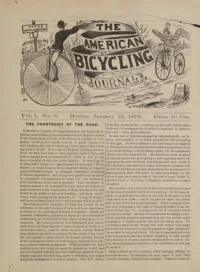
Articles in this issue
- Leading editorial arguing that American riders should take the English experience as a set of guide boards: keep off the sidewalk, keep to the right of opposing traffic but pass overtaken travellers on the left, take the centre of the road only when riding fast, speak kindly to horses and dismount for nervous ones, and use a bell or whistle only when occasion calls for it.
- Closing instalment of an English touring narrative: after six hundred and eighty miles in thirteen days the party reaches Southampton and dines aboard Bangs's forty-ton cutter "Eva," where the skipper, who knows Askim of Fowey from No. 2, tells how the ship Delhi Clinton, bound Liverpool to New York in July 1848, picked a Newfoundland dog named "Bosen" off a spar in mid-Atlantic. Continued on the seventh page.
- Standing blackletter department in which communications, news and queries from "our English cousins" are solicited; it opens with Frank Fowler's London-to-Scarborough run.
- Frank Fowler's day-by-day ride of 240 miles on a 50-inch Ariel, reprinted from London Bicycling News: from the "Brecknock Arms," Camden-road, by Barnet, Biggleswade, Stilton, Wansford, Stamford, Grantham, Newark, Doncaster and Wentbridge to York, Malton and Scarborough, with road surfaces, recommended inns, hat-throwing village boys, a broken spoke in a Yorkshire ditch and an officious constable near Tadcaster.
- Editorial replies: to Lindley Murray on whether the coined word should be "bicyclist" or "bicycler"; to Union, N.H. on English club rules and the hoped-for formation of the Boston Bicycling Club; to Xeres, N.Y. on the unlikelihood of tempting the champion John Keen from London; and to Rapid Transit, Va., referred to Cunningham, Heath & Co.
- A privileged friend, an Englishman twenty years in America, comments on the American Home extract printed on page five: he agrees the American physique has improved, but blames the utilitarian layout of roads, the division of land into small estates and the absence of England's legally protected field footpaths for the weaker American appetite for out-door life.
- Letter to the Boston Globe signed J. G. D. claiming that Longfellow's "Keramos" began as verses on bicycling, "Turn, turn my wheel!... An iron Centaur, we ride the land", calling for someone to produce the first bicyclic poem, and inviting Dr. Holmes to write a second chapter to his magazine article "The Human Wheel, Its Spokes and Felloes."
- Trade notice that the American Bicycling Journal can be had through the New England News Company, Court street, Boston and all New England newsdealers, while the American News Company of New York City fills dealers' orders throughout the United States and Canada.
- Editorial answering the question still asked in Boston whether the modern bicycle is "practicable," quoting a Boston Advertiser report of a rider who covered nearly 1,600 miles in six months over Massachusetts and New Hampshire roads, 388,000 front-wheel revolutions by Thompson's cyclometer and thirty cents total running expense, and recalling his beating the four-horse coach from New Ipswich to Mason Village by five minutes.
- Editorial commending Mr. Chas. A. Booth's challenge for a trial of speed and endurance, printed in another column, while deprecating contests of "trick riding" as a species of exercise for which the modern bicycle is not fitted.
- New standing department promising a description of at least one practical bicycle route in every issue, and inviting riders to contribute road descriptions that are concise and accurate.
- Boston route from the asphalte at the north end of Columbus avenue to Milton Lower Mills as per Route No. 1, then by Adams, Codman and Minot Streets to Neponset, over the wooden bridge to Atlantic and Squantum Streets and Squantum point, 10 3-4 miles to the Old Squantum House, with two or three dismounts past Squantum Heights and a rutty Minot St.
- From the London Sportsman: the One Mile Bicycle Handicap at the Molineux Grounds, Wolverhampton on Thursday, Dec. 27th, given heat by heat, Sankey, Webster, Whitehouse, Favell, Agnew, Smith, Patrick, Jameson, Bradley Keen, Leeming, Phillips, Best and Gibberd, in which A. Patrick beat the champion John Keen from scratch by fifteen yards, Bradley Keen of London taking the final and the first prize of about $200.
- Report of the five-mile match at Gilmore's Garden, New York, between champion William de Noielle and Professor William Miller's unknown, Charles Dusenbury, for $300 and the championship of America; de Noielle rode a 56-inch copy of John Keen's "Eclipse" and was awarded the race by the judges after Dusenbury passed him, a foul ensued and de Noielle took a bad fall on the soft clay track.
- Reprint urging Columbia, Harvard, Yale and Princeton to follow Oxford and Cambridge in taking up bicycle racing, noting that experts cover a mile in 3.30 and that Sir John Keith Falecner and Sir Henry Wyndham are classed as the fastest riders in England outside the professional champions Keen and Stanton.
- Letter from Dr. W. M. Whittaker of Valentia, Kerry, Ireland, dated Jan 2d, 1878, in reply to a Boston physician: after two years and three months and many hundreds of miles he has never known hernia, hemorrhoids, varicose veins, heart disease or spinal affection to arise from bicycling, and advises moderation, a broad belt, total abstinence from alcohol while riding and a limit of thirty to forty miles a day.
- From the London Bicycling Journal: a debate on the 26th ult. at the "St. Mary's Institute and Reading Room," Woolwich, the Hon. and Rev. A. Anson presiding, on the motion "That Bicycling is the best form of Recreation"; Mr. C. Hartley of the Kent Bicycle Club spoke for it and described a four-day tour through Kent, but the motion was lost six votes to seventeen, Hartley being the only bicyclist present.
- Standing department opened to correspondents so that all pros and cons may be ventilated, the editors not identifying themselves with the opinions expressed; this number carries "Romance's" letter and "A Growler's" protest at the Journal calling the winter of 1877 glorious, and continues on the sixth page with letters signed D. and Jagy.
- Letter signed ROMANCE: riding noiselessly up on a buggy that was taking an erratic course, the writer offered help to a young man whose left arm seemed disabled, only to find him and a young lady in the Fejee Island position of "rubbing noses", proof, he suggests, that the "Young man afraid of his Duplex Excelsior Bicycle" has at least one valid reason for his timidity.
- T. Wilkinson's winter tour, reprinted from London Bicycling News, on a machine made by Sparrow: Avignon to Marseilles, then Toulon, Hyeres, Cuers, Cannes, Monaco, San Remo, Alassio, Genoa and Sestri Levante, plagued by mud, new stones and hail; he notes a Lyons paper's claim that M. Marius Ferdinand rode Marseilles to Lyons, 225 English miles, in 12 hours, and recommends a bag fitted in the front wheel for luggage.