Vol 1, No 4
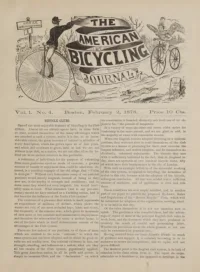
Articles in this issue
- Leading editorial arguing that the club system made yachting and the other national pastimes flourish, and noting that England already has upwards of two hundred bicycle clubs, fifty of them with headquarters in London. It welcomes the imminent "Boston Bicycle" Club, whose proposed by-laws are printed in this number, and urges American clubs to keep ultimate federation in view, common bugle calls and whistle signals, and hospitality to duly authenticated members of other clubs.
- The editor announces a subscription premium: an imported English bicycle of any make, costing up to one hundred and twenty-five dollars as per the January price list of Cunningham, Heath & Co., for every hundred prepaid subscriptions brought in by one person before the first of May. Those bringing more than twenty subscriptions get a draft on C., H. & Co. for one-fourth of the amount toward a machine.
- A comic double limerick reprinted from the Boston Globe of January 15th about a "hasty young man" whose bicycle is treating him "hash" and who threatens to fling it away for a tricycle. It is signed with the initials O. W. H., an authorship the editor says he ventures to doubt.
- The paper opens its columns to correspondents, disclaiming any identification with the opinions printed. The first contribution is a broad dialect letter signed "Jack Salty," a sailor just in from sea who complains of being hocussed and shanghaied aboard one of "them bisickly floppercedes," running onto a cobble-stone reef and fetching up in hospital with a broken leg.
- Editorial replies to three readers: "Fellow Bicyclist" of London, told the bicycle movement is still in its infancy in Boston and that there is as yet no opening for a bicycle maker; C. W. L. of New York, pointed to Central Park and the coach route to Pelham Manor; and T. C. W. of Norfolk, Va., told that roadsters carry brakes and rubber tyres lasting about four years, and that foot rests and leg guards are fitted as standard.
- A new standing department heading under which communications, news and queries from "our English cousins" are solicited and promised the paper's best attention.
- T. H. L. of the W.B.C., reprinted from the London Bicycle Journal, rides his 56-inch bicycle from Richmond, Surrey to the 1876 Derby by a new route chosen to dodge the traffic, through Kingston and Leatherhead to Walton-on-the-Hill. Along the way he runs the gauntlet of an Irish family's tandem donkey-and-pony coster's barrow and is chased across a field by a warlike bull.
- G. T. Clough's account, from the London Bicycle Journal, of leaving Stratford at midnight on a 52-inch machine and riding by Epping, Bishop's Stortford, Newport, Newmarket and Thetford to Norwich (112 miles) and back. He was joined near Six Mile Bottom by his old fellow-traveller Mr. J. Bonnick, and reached his 200th mile at Potter Street at 11 p.m. to the minute.
- Race news taken from the Boston Globe of January 21st: William de Noielle and ex-champion William E. Harding matched at three and five miles for $200 each and the championship of America at Gilmore's Garden, the winner to go on to Boston to meet Charles Booth; John Keen matched over twenty miles against any two of Mr. C. Bastien's London trotting horses at Lillie Bridge; and David Stanton arranging to ride 1000 miles in 144 hours for a wager of £500 a side from February 10.
- A column of short paragraphs: the ingenious wooden bicycle at the riding school, no reply yet to Booth's challenge, only six good bicycling days in the thirty-one of January '78, a plea for the Quincy selectmen to smooth the roads, and a jibe at the Harper's Weekly artist who drew the bicycle race. It also reports that the "Boston Bicycle Club" is to be followed by Harvard College, and recalls a party of thirty-one riding Brighton to Horley and back in 1874.
- A letter to the Boston Transcript, signed "Importer," settling that paper's query whether a bicycle is a machine or a vehicle for customs purposes. Collector Simmons had charged the forty-five per cent steel duty on one of the first bicycles imported; on appeal, Treasury Secretary John Sherman reversed him and fixed thirty-five per cent for the whole nation, on the ground that Webster and Worcester define a carriage as any vehicle on wheels.
- Editorial on fitting the wheel to the rider, warning the newly-fledged rider past "timid toddler" and "wary wobbler" against the largest machine his toe-ends can reach. It contrasts two riders setting out from the north end of Columbus Avenue, gives a crank-heel-and-knee test for a perfect fit, discusses the curve of the saddle spring and "close built" machines, and distinguishes the choice for touring, road racing and the cinder path.
- The full proposed By-Laws, Rules and Regulations of the club, printed for adoption at its organisation meeting. They cover the officers (President, Captain, Senior and Junior Sub-Captains, Secretary-Treasurer, three Guides and three Buglers), a five-dollar entrance fee and twenty-five cents a week dues, road rules based on those of the Cambridge University Bicycle Club, a bugle and whistle code drawn from U.S. Army Cavalry Tactics, an annual championship race from Fitchburg to Boston for a silver trophy, and a grey uniform with blue Glengarry cap.