Vol 1, No 5
Articles in this issue
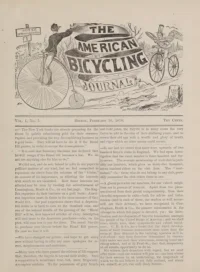
- Front-page notes under the pictorial masthead of Vol. I, No. 5 (Boston, February 16, 1878): the Journal breaks its rule against politics to quote the Boston "Globe" on the Bland silver bill, warning that a depreciated dollar will raise the price of imported English machines and that readers should buy before it passes. Also corrects the number of English bicycle clubs to 347, and regrets the removal of Cunningham, Heath & Co. from 178 Devonshire Street to 22 Pearl Street.
- Racing department: John Daniel, the "Welch bicycling postman," beaten by 150 yards by Phillips of Wolverhampton over ten miles at Llanelly on January 15th; results still awaited of Stanton's 1000 miles in six days at the Agricultural Hall and Keen's twenty-mile race against two trotters (one the celebrated "Lady Moscow") at Brompton. John Keen offers an unknown six miles start in a hundred-mile race for $250 a side at Lillie Bridge, and Professor John H. Carroll challenges Professor Booth for $100 at Beethoven Hall on February 20th.
- The Journal's English department, carrying a letter from its own London correspondent dated January 22nd: the Stanley Club's bicycle "bee" at the Athenaeum, Camden Rd., debating "The best mode of carrying luggage" (Dring, Visick, Rucker, Cunningham of the Temple, F. M. Williams), the hoped-for establishment of the Bicycle Union, Phillips's ten-mile win over John Daniel at Llanelly in 37 min. 9 sec. for £25 a side, and John Keen's unsatisfactory match against second-rate trotting horses at Lillie Bridge.
- Reprints a paragraph from the Secretary of the Tower Hamlets Bicycle Club of London reporting that the first two numbers of the American Bicycling Journal were laid on the club-room table and much admired by the members. The editor accepts the compliment with a self-deprecating anecdote about a schoolboy whipped for an offence he had not committed.
- A rider signing "W. A. S. (M. A. B. C.)", reprinted from London Bicycling News, describes a three-man tour taken from Manchester by train to Chester and then ridden through Wrexham, Ruabon, Llangollen, Corwen, Cerrig-y-Druidion, Bettws-y-Coed, Colwyn, Abergele, St. Asaph, Holywell, Mold and Chester back to Manchester. The machines were two 52 in. "Challenge" (Special) fitted with Carter's brake and a 50 in. "Coventry Machinists'."
- Announces that fourteen gentlemen met at 178 Devonshire Street and organised the club, the pioneer bicycle club of the United States, electing George B. Woodward president, Thatcher Goddard captain, Edward Preble and Arthur Stedman sub-captains and H. S. Mann secretary and treasurer, with Harold Williams, J. L. Curtis and W. R. Whitney on the committee. Closes with the Boston "Transcript's" notice of the growing trade in machines.
- Boston road routes taken from "Rider" in the Boston Transcript, prefaced by advice on maps (sheet No. 55 of the State Atlas, mounted by White & King), on not riding too far at first, and on dismounting for nervous horses, with a court ruling that new modes of locomotion are perfectly admissible. Routes III to X are measured from City Hall: Chestnut Hill Reservoir (12 3-8 and 16 3-8 miles), Concord, South Framingham, Arlington via Belmont and Newton, Lexington via Waltham, round the city of Newton, and Fitchburg to Boston (46 miles).
- Editorial introduction to a composite drinking song sent in by a rider who has been in a rhyming vein for the whole year he has ridden the bicycle, producing some forty published pieces. The best parts are lifted from a long piece in Ritson's Select Collection, attributed by some to Beaumont of Beaumont & Fletcher.
- The poem itself, subtitled "Old English style; mostly by Jagy Torltan," whose stanzas praise the effect of a pot of good ale on plowman, aged clerk, poet and British soldier. The Journal offers it as marking the limit of alcoholic stimulus it approves for bicyclists, preferring the pump or the cow for habitual drinking.
- Reprinted from the Boston Globe of January 27th: the collapse of the 1869 velocipede fever, M. Michaux's enlargement of the driving wheel and M. Magee's all-metal frame, the English perfection of the machine, and its everyday use by London merchants, clerks and doctors. Describes the new importing house of Cunningham, Heath & Co. at 22 Pearl Street, drawing from Singer & Co., Bayliss Thomas, Hillman & Herbert, Hydes & Wigfull, Haynes & Jeffries and other English makers; continued on page 10.
- Leader surveying the reference works: the American Cyclopaedia (1876) and Knight's Mechanical Dictionary treat the machine only under "Velocipede" and draw no distinction from the old one, while General J. G. Barnard's article in Johnson's New Universal Cyclopaedia (1878) explains self-balancing by analogy with balancing a pole. The editor doubts him, arguing that once in motion the gyroscope or "Mechanical Paradox" principle mainly holds machine and rider up, and invites readers who understand the question to write in.
- Notice of "The Bicycle" for 1878, the fourth annual number of the London yearbook, containing a full record of the past year's amateur and professional riding, a compiled list of the London and provincial clubs, practicable routes in England and on the continent, and a bicycling diary. Published at 23 Warwick Lane, London, price one shilling, and commended to riders on both sides of the Atlantic.
- From the Transcript: what is believed to be the first tricycle in the country has arrived from England consigned to Cunningham, Heath & Co. and is on exhibition at the Bicycle Riding School, 22 Pearl Street. About a third heavier than the bicycle, it has been ridden by English ladies fifty miles in five hours and is recommended for ladies, for gentlemen who will not mount the two-wheeled steed, and for invalids.
- A Transcript squib scolding the able-bodied man who crouches in a fetid street car rather than walk two or three miles, and praising winter walking as a cure for cold feet, a better "nervine" than medicine and better than a drug store's stock of bitters for the appetite and complexion.
- Prints a letter from New York City addressed to the Editor of the Scientific American, sent to the Journal for insertion, rebuking that paper's "we think it doubtful" answer to "G. O. A." on whether a practical bicycle exists. Six numbered points assert that twenty miles on a good road is child's play, that the machine is generally adopted in England, and that England supports three weeklies, two monthlies and several annuals while America has this fortnightly. Signed "The Writer."
- A correspondent signing "D." reports that a long-standing varicose swelling behind his knee disappeared after he took to the bicycle. "Tourist Newton" is advised about customs duty on a machine bought and used in England and referred to Mr. Thomas of Bayliss Thomas & Co., captain of the Redditch Club, and told the Boston Bicycle Club's organisation meeting is imminent; further replies go to the Hon. Secretaries of the "Buckingham" and Tower Hamlets clubs and to "C. H., London."
- A narrative "extracted expressly for the American Bicycling Journal, from an unpublished book of travels," for whose strict accuracy the editor will not vouch. The narrator and Musgrave unpack their 56-inch machines at Man-tin and ride south along the Wall at about eight miles an hour, shooting pheasants from the saddle with the spaniels Eneas and Dido in attendance, then survive a headlong descent of a near-sheer declivity and a leap across a thirty-foot breach. To be continued.
- The paper's clipping column, launched here now that "a title at once descriptive and appropriate" has been found for it, with paragraphs lifted from the Wheeling Leader, the St. Louis Journal, Boston Society and the Globe, and an English paper's claim that "damn" is a corruption of the French "dame."