Vol 1, No 6
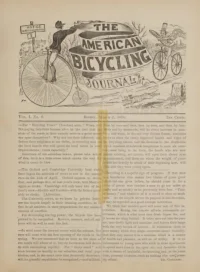
Articles in this issue
- Front-page notes under the pictorial masthead of Vol. I, No. 6 (Boston, March 2, 1878): the London "Bicycling Times" asking when tax-paying bicyclists will influence their local boards to spend local taxes on the roads; the Oxford and Cambridge crews training for the April 13th boat race (Marriott, Hockin and Gurdon named) and using the bicycle for staying power; and a closing reflection signed Dr. Goddard, predicting that riders will multiply by tens and thousands, that statistics will show a fallen death-rate, and that the bicycle draws men out of the liquor shop into God's light and sunshine.
- The racing department: John Keen has had an easy time beating two trotting horses at the Agricultural Hall, London, though "our correspondent" reports such matches are looked on as suspicious; Chas. A. Booth, "Champion bicyclist of America," has had no opportunity to substantiate his title because New York professionals are afraid and Boston men dare not; Booth's remarkable time at the skating rink on Washington's birthday goes uncertified for distance; and an international championship match is provoking discussion among the English professionals. Also notes the steamships "Anglia" (Anchor Line) and "Palestine" (Warren Line) bringing English bicycles to Cunningham, Heath & Co., and "wheel talk" at Vassar and Wellesley.
- The Boston Bicycle Club's second meeting, February 18th, President Woodward in the chair: Mr. Mann resigns as Secretary and Treasurer over business engagements and Mr. Frank W. Weston is elected in his place, and the By-laws printed in No. 4 of the Journal are substantially adopted after protracted debate. Also reports that "Harvard" will not organize its club till spring, urges a cinder path inside the trotting parks, and recalls Dr. Goddard's ten-year-old quotation of Henry Ward Beecher on the "coming man" riding to church.
- A long comic poem subtitled "A PLEA FOR ITS ADOPTION," signed BELLA ROTA and running over onto page 3, daring the scoffer in headlong internal rhyme to stop talking of "vehicular toys," to "Mount your safe tricycle, or better your bicycle!" and to try it a week before throwing it up.
- Mr. Edward Preble, senior sub-captain of the Boston Bicycle Club, leaves New York per the White Star S.S. "Germanic" for Liverpool, bound for a tour through the Holy Land and then a bicycle tour through the lanes and roads of Old England; his club expects him back in July.
- A letter to the London "Bicycling News" signed VELOCIPEDIST describing a sixty-mile day from Newport, Isle of Wight, by Wootton Bridge and Ryde, then across to Southsea and on through Portsmouth, Cosham, Havant, Emsworth, Chichester, Arundel, Sompting, Lancing and Shoreham to Brighton, the writer on a bicycle and his companion on a tricycle, with the Aquarium and the "Devil's Dyke" taken in before the ride back. Followed by a reprinted note from Wm. Greaves reporting some 300 miles on a tricycle since October 5th at 7 to 10 miles an hour, hills such as Falmer Hill near Lewes included.
- Reprinted from the London "Bicycling News": the London Bicycle Club's first annual Road Medal competition over 100 miles from Bath to Brentford Railway Bridge on Monday, May 21st, 1877, with twenty-four starters away at 7.32 a.m. against a hard north-east wind. C. Walmesley led from the hill out of Marlborough and finished in 8 hr. 23 min. 30 sec., followed by E. Tegetmeier, A. D. Butler, F. Godlee and M. D. Rucker; eleven men beat ten hours, A. H. Garvey missing a medal as the eleventh. Followed by W. A. Smith's letter to the same paper defending his measurement of the course as 108 miles from Hyde Park Corner to the Guildhall at Bath.
- Comic verse in five stanzas railing at the habitual whistler, who unlike Bangs with his horn of brass or Dingleby with his flageolet keeps no set hour, whistles on long after honest folks have gone to bed, and deserves the vultures' feathers and the poet's tar.
- A short dialect poem in the voice of a Chinese laundryman complaining of all-day washing for one rupee, of "dampoor ricee, dampoor tea," of having no money for smoke or drink, and of the "Paddee" he must contend with in this country.
- A six-line squib after the nursery rhyme, signed "D.": "It is a little wheel / All of rubber and steel, / With a big one, rather fickle, on afor'ard... And when it is bad, it is horrid!"
- The Journal's English department, carrying a letter from its own London correspondent dated February 4th: John Keen has signed articles for a 100-mile match in which he gives six miles start to an unnamed opponent supposed to be D. Stanton, whose thousand-mile affair begins on the 25th; the Hon. I. G. N. Keith-Falconer of Cambridge, who gave up racing for "conscience sake" after Moody and Sankey's visit, has twice beaten the amateur champion W. Wyndham and taken second in the Theological Tripos with the Hebrew prize; and a meeting of the projectors of the "Bicycle Union" is called for the 16th inst.
- A Boston "Advertiser" piece contrasting Americans' fear of being seen taking outdoor exercise with English habit, citing the Rt. Hon. Robert Lowe, ex-chancellor of the exchequer, as a noted rider, and reporting that of 185 Cambridge undergraduates gaining honours ninety are well-known athletes. Foremost among the bicyclists is the Hon. I. G. N. Keith-Falconer, second son of the earl of Kintore and vice-president of the Cambridge University bicycle club (the Hon. J. Plunkett president); Mr. E. Thornton of Trinity, an American, took honours in the mathematical tripos and won both the five- and ten-mile races in December 1876.
- Reprinted from the "Tower Hamlets Independent" of Sept. 1st, 1877: a reporter joins the club's Saturday afternoon run from its head-quarters, "The Queen's Hotel" facing Hackney Common, out to Abridge twelve miles from London, by Hackney Marshes and the White Hart bridge, Leyton, Epping Forest, Assembly-row, the Eagle at Snaresbrook, Woodford Bridge and Chigwell. Describes the club's drill of numbering off and mounting one by one, tea at the White Hart, and the assembly call thundered out for the 7.30 homeward start by the club bugler, Mr. H. Jolly.
- The leading editorial for March 2, 1878, distinguishing gymnastics, the violent training that Plato and Galen already saw ages acrobats, pugilists and pantomimists prematurely, from calisthenics, "beauty and strength," whose ideal light and portable apparatus is the velocipede. Announces that for the ladies' sake the paper covers tricycling as well, then argues over pages 9 and 10 that the middle-aged man of sedentary business living five to twenty miles out would save fare and years of life by riding in, that a "pedomotive" velocipede express and postal-carrier service would pay, and that the cycles bear directly on the "Rapid Transit" problem in New York and Boston.
- Despite its heading, a column of thanks to the Journal's contemporaries: the Boston Evening "Transcript" for introducing the paper to its myriad readers, the Boston "Globe" for having done more for bicycling than any other two papers, and the Chicago "Standard," which wonders why bicycling has not been adopted in Chicago, "Give us one year, then ask us again."
- The Journal's readers' letters department for this number, opening with "The Fools of the Road." from a novice rider and continuing on page 11 with "A Point to be Made." from a correspondent signing himself "Bohemian."
- A letter signed "A BICYCLE RIDER": having been given the Rules of the road pretty exhaustively, he asks the editor to spare space for the Fools, men who drive with their reins hanging loose over their horses' backs, who take fright themselves or grow so interested in a bicycle that they forget their horses, and who leave spirited horses standing unfastened at house doors and garden gates.
- A rambling letter from a self-described "Bohemian" of nearly fifty who is not yet a rider but has serious thoughts of becoming one. He disclaims "physical culture" pursued for its own sake, declares civilization a fraud of tailors, dressmakers, fashion and Mrs. Grundy, professes love for bohemian artists and penny-a-liners, and then runs out of space before making his point, promising it next time; the editor calls on him to make good the "to be continued in our next."
- Short editorial replies: "H. A. E., Nahant" is told that all the good makes are good and that if he can ride a bicycle a tricycle would never content him; "Would-be Bicyclist, Baltimore" gets only "Pshaw!"; "J. S. D., Chicago" is told to have U. K. P. inquire and become interested. Replies to "Club Member" and "Benedict" are crowded out until the next number.
- The concluding instalment (headed "CONCLUDED") of the serial begun in the previous number: after about 120 miles the sound wall breaks off into rubbish, so the narrator and Musgrave retrace their route through a boulder-choked pass toward Kashgar, where Musgrave fires at what he takes for a kid and brings down an old Chinese woman. Seized by the villagers and threatened with being sawn in two, he revives her with Holloway's pills and a mustard plaster that lifts the shot off her tough skin, and the pair escape by offering to teach the villagers to ride, then simply pedalling away at fifteen miles an hour and covering 75 miles into Kashgar by sunset.
- The paper's humorous miscellany: a quatrain on the doctor's three faces, an angel's when first sought, the devil's less terrible than his when he seeks his fee, a "Hawkeye" squib lamenting that the toiling millions can no longer console themselves that their rich neighbours will never get to heaven, and a pun about an African traveller at a sovereign's obsequies who saw "the largest box of black-king he ever saw."