Vol 1, No 7
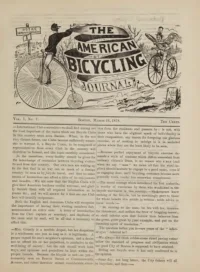
Articles in this issue
- The Journal disputes the twenty miles in 59 min. 57 sec. credited to Chas. A. Booth at the Boston Skating Rink on Saturday March 2d (Frank Moran scorer, E. K. Page timekeeper), pointing out that the short-lapped rink cannot beat John Keen's 1:05:34 at Lillie Bridge, Brompton, and urging a surveyed course. Notes also the pedestrian W. E. Harding's offer to ride anyone from twenty-five to one hundred miles for $100 to $500 a side, and "Happy Jack" Keen's puzzlement at the American crop of challenges.
- Chas. A. Booth writes from Boston, March 1st, 1878, disclaiming the distances the Boston papers attached to his rink riding: he rode ten laps in 2.38 1/4, twenty in 5.39 and two hundred and four laps in an hour, but the Rink measures only 150 by 125 feet and he will claim no record until a surveyor's voucher exists.
- The Boston Bicycle Club's third meeting at 178 Devonshire street on Monday March 4th settled the uniform, worked on the by-laws and elected Mr. F. W. Weston acting captain; the fourth meeting, on the 11th, fixed the next club run for Saturday March 16th, meeting at three o'clock on Boylston street opposite the new Trinity church.
- The Journal's own reporter describes the first meet and run of the first bicycle club formed in America: fourteen machines lined up on Boylston street opposite Trinity church at three o'clock on March 9th, Professor Pitman arriving by tricycle and giving an exhibition on a borrowed bicycle, and the club riding in Indian file up Dartmouth street and over the bridge.
- Under the sub-head "Put up or shut up," the Journal reports Booth's impatience with "cheap" talk from the so-called professionals, and quotes the Boston Advertiser of March 11th in which he offers to ride any of the entrants for the New York championship medal at one to a hundred miles, but wants a champion medal and a purse of $1000 rather than gate-money.
- Reprinted from the Boston Transcript: a correspondent signing himself "Young Man Fond of the Game" complains that the paper gives columns to bicycle riding while turning a cold shoulder on base ball, and the Transcript's editor replies that bicycling is new and was attacked as dangerous, whereas base ball in its latest form gives a livelihood to a score of experts.
- Verses "adapted to the bicycle by Jagy Torlton" from Dr. Oliver Wendell Holmes's "Treadmill Song" and taken from the Boston Globe, urging walking men to mount the "noble steed" and go rotiform like planets in the sky.
- The Journal reprints a passage by the Rev. R. Laird Collier arguing that pleasure and recreation are not sinful, offering it to those Bostonians who identify gloom with true religion and who would frown on the bicyclist's hours of unalloyed happiness.
- A letter subtitled "About Bicycles and Riders…Racing, Amateur and Professional" from Fredrick Striffler, Hon. Sec. and Captain of the Middleton Zephyr Bicycle Club near Manchester, England, welcoming the new journal, advising hollow spokes and forks, praising John Keen's times and warning America to settle the amateur-professional question early; an editorial note describes Striffler's mile gauge, which records English, German, Irish or French miles.
- The text of the Constitution of the Bicycle Union of England, printed as a model for New England clubs: securing the rights of bicyclists on the roads, watching legislation, negotiating railway carriage tariffs, framing racing rules and an amateur championship, with representation of one delegate per twenty-five members and a capitation charge of one shilling for the first year.
- Jagy Torlton's note to the editor of the Boston Transcript introducing the "rotatory verses" that follow, whose eminent author is said to have viewed the "narrow-gauge horse" with one Twain the day after the Maga-Whittier festival of last December.
- A parody of Emerson signed "BY R. W. E." and reprinted from the Boston Transcript, calling New England to answer Old, mocking Menu, Plato, Plutarch, Cato and the Sphinx for never bestriding a bicycle, and asking whether the prophets rode best.
- The Journal's own London correspondent writes on February 18th, 1878 of mud-bound roads and a drying south-west breeze, gives the London Bicycle Club's annual mileages (G. P. Coleman 5,002 miles, captain M. D. Rucker 4,320, eight others over 3,000), and reports the first general meeting of the Bicycle Union, chaired by Mr. G. F. Cobb, M.A. of the Cambridge University Bicycle Club, with twenty-seven clubs represented.
- A tour narrative from the London Bicycling Times, signed "G. L. H., C. C. & D. B. C.": from Cheltenham over the downs through Winchcombe, Broadway, Campden, Stratford-on-Avon, Warwick and Kenilworth to Coventry, followed by a day inspecting the bicycle works, Singer's new Alma street premises (to be the largest bicycle works in the world), Hillman and Herbert's "Premier" and its new two-seat tricycle, Dedicoat's Pegasus Works, the Coventry Machinists Co. and the "Ariel" works of Haynes & Jefferis with its seven-foot machine.
- A department of short paragraphs: correspondents report that Chicago has miles of macadamized roads fit for bicycling and that St. Louis is only just hearing of the machine, Washington's birthday gave riders a chance to polish their steeds, and a "Cycler" consults an astrologer who shows him the Derby of 1900 run by men on horses made of steel.
- A tribute to the old town of Marblehead, its Abbot Hall and its local paper the "Marblehead Messenger," whose columns circulate as far as Boston; the Journal is glad the Marbleheaders are waking to the bicycle and reprints the Messenger's own appeal for the first machine in the town.
- The leading editorial on luggage for bicycle touring, drawing on a public debate held by the Stanley Bicycle Club of London: the "multum in parvo" or M.I.P. bag under the saddle, the wheel bag wound round the front axle (impossible on a hundred-spoke Keen Eclipse), the valise carried across the handles, and the pannier double valise used on early Coventry Machinist machines; the editor describes his own satchel and M.I.P. kit down to the razor, felt slippers and "G. B. D." briarwood pipe.
- The readers' letter department for this number, carrying a single long contribution signed "Jack Easy" and closing with the Journal's toast to the B. B. C.
- "Jack Easy" describes his last ride of the season, on Saturday January 19th: his idle "Coventry Champion," the mob of small boys from the Frog Pond shouting "Here's two ferlosserpeeds," the ride with Ned over the Milldam, Brookline avenue, Heath, Centre, Green, Washington and Seaver streets past the Consumptive's Home, and a brush with a light buggy on Washington street, Dorchester, just under thirteen miles at eight to nine miles an hour.
- Replies to "J. L. C." and "Slow and Sure" of San Francisco (the front wheel brake is preferred to any cord brake, no "cheap" machine is worth its price, and buy at once), to "Club-Member" of Middlesex, England (send a letter of introduction to Frank W. Weston, Sec'y Boston Bicycle Club), and to "Benedict" of Newton (a lady on a tricycle beside a gentleman on a bicycle is no unknown thing in England).
- A doleful tale headed "On a Bicycle," taken from an 1869 number of "Every Saturday" and originally from Cassell's Magazine, in which a timid literary man smuggles his new velocipede out at night, is challenged twice by police-constable John Dorhead, crashes at the foot of a hill and resolves to make a present of the machine to the critic who cut up his last book.
- A column of borrowed humour: the Lampoon's exchange between Deacon Norwood and a small boy about the man with hope and no faith, a Burdette letter on lunch-counter sandwiches as deadly weapons, and a sketch of the young man who could "drink or let it alone" and found his pocket-book twenty-three blocks away.