Vol 1, No 8
Articles in this issue
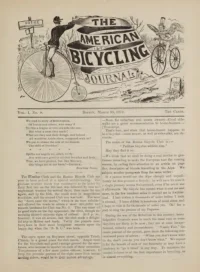
- The front page of Vol. I, No. 8 (Boston, March 30, 1878): verse from the Bicycling Times signed "Druidæ" ("True, we have pinions, but, like Mercury, / Our wings are at our heels!") followed by the editor's paragraphs, the Weather Clerk's understanding with the Boston Bicycle Club, whose first three runs of the season on the 9th, 16th and 23rd each caught fine roads; the open space on Boylston street opposite Trinity Church as a grand place for club meets if a few more police kept the juvenile sight-seers back; the club motto "Pedibus bicyclus addidit alas"; and a pointer to the article on page five describing bicycle travelling in the Alps.
- David Stanton, the English long-distance champion, completed the feat at Agricultural Hall, Islington, on Saturday March 2d, riding a boarded track of two hundred and thirty-six yards at seven and a half laps to the mile; the London Bicycle Journal computed his actual distance at one thousand and five miles, twelve hundred yards. A table gives his time in the saddle and including stoppages at every fifty miles, the thousand standing at 71h 28m 38s in the saddle and 137h 5m 33s including stoppages.
- The Boston Bicycle Club's second run, Saturday March 16th, met on Boylston street opposite Trinity church and took twenty riders by Beacon street, Chester Park, Columbus Avenue and Dorchester to Milton, not one of them taking the train home; the third run on March 23d was delayed while Mr. Drew photographed the club in line. Also: the bicycle movement at Harvard moves slowly toward a College Club and a possible Cambridge v. Cambridge match, and the Nantasket hotel proprietors and the manager of Downer Landing are said to be contemplating prizes, with a caution about the strict line between amateur and professional.
- A follow-up to the article on page four, quoting a letter from Chatham signed "Velocipede" in the Scientific American (No. 13): a rider of about one hundred and forty pounds who covered fifty-two miles in a day in seven and a half hours' running time, and who reckons the forty-two inch wheel carries him one hundred and twenty-six inches to a step against thirty-three inches walking. The editor interjects "[Not nearly as much. ED.A.B.J.]" and concludes the paper has been in entire ignorance of the whole subject.
- The Journal deflates the Boston papers' "splurge" over W. R. Pitman's forty-three-mile ride home from Haverhill on his "Stanley": upwards of a thousand people saw him start at 12.30 P. M., thirty miles of the road were so rough that "Ride a yard and walk a mile" was about all he could do, he was joined by another rider beyond Medford, and he reached the Hotel Brunswick at 6.10 P. M. A letter signed "Open Air Forever," printed with it, condemns the Haverhill route as hilly, rocky and sandy and appeals to bicyclists to restore the good old-fashioned country inn, recalling Dr. Peabody of Andover, who left a fire burning and his door unlocked for night travellers.
- The editor prints together, "as a sort of bicycle of imbecility, or span of jackasses," a letter to the Scientific American signed "Jno. B." arguing that a velocipede costs more power than walking and that a man would do better to drag it horse-fashion, and a burlesque signed "Jagy" applying the identical logic to railroads and rail-cars. The editorial reply asks whether there is a new disease to be called Bicyclophobia, and whether the Scientific American has the first sulky symptoms of it.
- A set of verses reprinted from the Philadelphia Bulletin on the pleasures of the rink, "Timid tyros creeping, / Sticking close to shore" and "No one heeds a tumble, / Rolling round the rink", carrying the editor's footnote, "Can the writer have been to Pearl Street?", a nod to the riding school at 22 Pearl Street, Boston.
- Dr. Goddard's medical case for the bicycle: he contrasts the pale, flat-chested clerk or student with the man who has cultivated his physique, argues that unworked parts of the organism degenerate, and holds bicycling superior to skating, horseback riding, base ball or rowing because its benefit is not local but develops every muscle, straightens the shoulders and expands the chest. He cites one of the country's best lung specialists, who rides two hours a day and prescribes the machine to his patients as a preventive of consumption.
- An extract from "A Month's Bicycling Tour through Belgium, Northern Germany, Switzerland and France," running as a series in the Bicycling Times, comparing the three ways of seeing Switzerland: the voiturier's carriage at about thirty-five miles a day, walking, and the bicycle, which covers twice the carriage's distance and costs nothing, the writer reckoning that the ground he covered would have cost £21 by two-horse carriage or £14 by one-horse, besides two more days on the road.
- The Journal's own London correspondent, writing March 1st, 1878, with Stanton four days into his thousand-mile ride at the Agricultural Hall (172, 168, 164 and 162 miles, 666 in all) and doubters expecting him to break down under the eternal spinning round; the Stanley Club's discussion on "Bearings, Springs, Lamps and Bells"; and Mr. Cobb, President of the Bicycle Union, replying in print to critics of its first general meeting. The writer commends the Journal's remarks on bicycle clubs and hopes American clubs will steer clear of the rocks the metropolitan clubs have grounded on.
- From the London Sporting Life: before some ten thousand spectators Keen, attended by his trainer old Harry Andrews, rode twenty miles, one hundred and ten laps of a five-and-a-half-lap track, against four relay opponents taking five miles each. He beat A. Patrick by six yards, caught Phillips after the latter's premature spurt in the tenth mile, led Rawson home by ten yards and Meere by about fifteen, finishing in 1h 6m 23 3-5s, with George W. Atkinson of the Sporting Life as judge and timekeeper and Frank White as starter.
- Four comparative feats, the horseback ones taken from the Referee: Captain Mulcaster's London to York ride of August 1873, whose mare drank twelve bottles of wine en route and took 40h 35m for 195 1/4 miles (his rival Walker's horse died at Tadcaster); Stanley Thorpe of the Pickwick Bicycle Club over the same course in 22h 30m in June 1876; Mr. Crockett's hundred miles on a grey mare in twelve hours in 1793; and Charles Walmesley of the London Bicycle Club, a hundred miles on the Bath road in 8h 23 1/2m in May 1877, after which he strolled off to watch his distanced competitors arrive.
- Notice of the English pamphlet "Bicycles of the Year 1877" by Harry Hewitt Griffin of the London Athletic Club and Wanderers' Bicycle Club, published at the Bazaar office, 170 Strand, a guide to the principal makes written from personal examination. Its statistics of the English trade are quoted: more than a hundred makers, the chief centres London, Coventry, Birmingham, Wolverhampton and Sheffield, some firms employing a hundred and fifty men, and nine large Coventry houses employing a thousand workmen who turn out six to eight hundred machines a week.
- A parody in three quatrains from the Transcript, headed "Tennyson plus J. G. D.": "How lightly whirls the bicycle! / How fiery-like you fly! / Go, get you one; this ticklish wheel / Be taught before you try," ending "There, take it, take my bicycle / And break your neck thereby."
- A sketch signed "C.": finding the Centennial Exhibition at Philadelphia nearly deserted a year after the crowds, the writer discovers an exhibit of seven bicycles, leaves his overcoat with the attendant and rides the grand aisle, through the Brazilian arcades, under the entrance to Spain, off in Bengal and on to old China, winding round alternate pillars past lofty cases and mirrors until he had "condensed a year into a day."
- The leading editorial for March 30, 1878, digesting a lecture reported in the English Mechanic and given at the Grimsby Mechanics' Institute by Mr. Breary, hon. sec. of the Aeronautical Society: the balloon is useless except for waftage, flight is mainly mechanical rather than a matter of levity, a gnat is three million times lighter than the Australian crane but has a hundred and forty times more surface in proportion, and as to balance, "with the example of the Bicycle, the question of balance would not present much difficulty." The editor is content to wheel an airy flight five feet from the ground.
- Singer & Co., the sewing machine and bicycle makers of Coventry, write to the Bicycling Times in answer to "50 in. Roadster," defending spokes secured by nipples and locknuts: the spoke's strength is that of the wire rather than the thread, and wheels without nippled spokes are often difficult or impossible to repair. They add that a wheel's strength lies chiefly in the condition and strength of the felloe, then the number of spokes and the workman's skill, buckling comes from a defective felloe, not from thin spokes.
- The Journal culls from half a dozen numbers of the Bicycling Times the English debate over Sunday riding: Mr. T. H. Holding, the touring champion, condemns Sunday riding for pleasure and club runs and is backed by correspondents who think it lowers riders in the public eye, while others answer that a quiet ride is no worse than a Sunday walk, that fifty miles to visit a friend beats the same journey by train, and that riders under their officers and in uniform carry their own guarantee of good behaviour.
- A letter signed "Fore-handed" asking where the Boston Club will hold its races, and whether one of the trotting parks would not make a good course and be worth the Club's looking up.
- "Bohemian" answers the editor's dig at the non-appearance of his promised second letter, observing that an undeserved indignity degrades the bestower more than the bestowee, "it is more cursed to kick than to be kicked", and insisting that his promise to make his point "in my next" did not mean "in our next," so that whether he ever makes it depends on whether this is printed.
- Replies to "B. L. La Fayette" on keeping the amateur and professional lines strict and offering no money prizes to amateurs; to "Collegian" about the Cambridge newsdealer Richardson; to "New Bicyclist," that a gentleman raises his hat to a lady whether mounted on bicycle or horseback; to "Captain Rand, D. B. C."; to "Puzzled Also" of St. Louis on the Scientific American; to "Scribe" of the Highlands, who is told the Boston to Newport run will surely take place; to "Inquirer" of Lowell, correcting the Herald's account of the Milton run; and a tart answer to "Doubtful" of Marblehead.
- A sea yarn reprinted from Hunt's Yachting Magazine: an old sailor's tale of his shipmate "Duck" Beach, born to luck, who went overboard after the young widow when a slack main brace flung her over the rail off the Isaacs, swam some six hours with her to an uninhabited Bahama kay, was taken off by a wrecking schooner to Nassau, and turned up two years later in New Orleans in long-shore toggery, married to the widow and the million dollars left by the old man he and the narrator had sewn up in canvas off the Tortugas. Continues to page 12.
- The humour column, opening with "Slight Mistake at a Christening", the clergyman who has forgotten the date asks "this is the…ah…the thirtieth, I believe?" and the fond mother, thinking of her family, answers "this is only the eleventh." Then a small boy's endless catechism about the engine, from the Keokuk Constitution; the Burlington Hawkeye's confessed lie that half an hour's piano practice a day brings on paralysis in eight months; and the Vallejo Chronicle on the etiquette writer who ruled that "the lady should walk inside the gentleman."