The Bearings, Vol 11, No 4
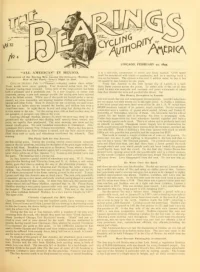
Articles in this issue
- F. Ed Spoonek reports on the All America racing team's 4,000-mile winter tour through Texas and Mexico, covering races at San Antonio, Laredo, and San Luis Potosi; highlights include Harry Maddox's 2:06 paced mile, Callahan's multiple state records, and Jimmie Levy's night in a Mexican jail after police arrested him and 'Monk Sunburn' Jacobs following a street brawl.
- A Minneapolis correspondent reports record pre-season bicycle inquiries in the Twin Cities; the newly formed Minneapolis Cycle Club Ltd. limits membership to riders capable of a sub-3-minute mile, and long-distance champion A. A. Hansen recently rode a century in 7 hours flat on a snow track and plans a 24-hour world record attempt later in the season.
- A detailed account of Wilbur Edwards' 1:34 2/5 mile record at Livermore, California, paced by a 73.5-pound Rambler quadruplet manned by four Garden City Cyclers of San Jose; three engineers certified the course at fourteen inches over the mile and Edwards rode a 16-pound No. 10 Rambler.
- Editor Barrett reviews the 14th LAW National Assembly outcomes: Asbury Park won the 1895 national meet, A. C. Willison was elected president, the Negro membership amendment was withdrawn by Jaquish, Secretary Bassett's salary was preserved intact, and Raymond's proposal to charge sanction fees was adopted.
- The editorial attacks anti-bicycle legislation in Chicago (Alderman Ballard's bicycle tax defeated in committee, with the Evening Post calling it a favor to street-car corporations) and Kansas (a bill compelling cyclists to dismount for horse teams), and ridicules the Farm, Field, and Fireside's prediction that cycling is a fad that will die when wheel prices reach $25.
- Barrett argues that Chicago, not New York, deserves priority in the annual cycle trade show calendar, since Chicago's warmer climate causes the western trade season to open earlier, and the Windy City's volume of agents and business outweighs New York's advantage of having Madison Square Garden.
- Barrett hails George D. Gideon of Philadelphia as Howard Raymond's successor on the Racing Board, reports the humiliating defeat of A. A. Billingsley of Illinois at the National Assembly (95 to 47 against him), and notes Raymond's final act: suspending 18 racing men including Murphy, Butler, McDuffie, and Ganse who struck at Madison Square Garden last Thanksgiving.
- A Boston correspondent reports that the Massachusetts Bicycle Club's amendment to admit women lost by just two votes (71 for, 39 against, needing 73 for passage), and that actor Nat Goodwin was observed at the Columbia riding school quietly speaking to and patting a new bicycle before mounting it, explaining he always introduces himself to a new mount as he would to a horse.
- The column quotes the Western Horseman dismissing cycling as a temporary fad like roller skating, arguing that high-grade horses will always remain fashionable for those who can afford them while bicycles will become too cheap to be desirable.
- Full multi-session dispatch from New York covering the 14th LAW National Assembly: President Luscomb's retirement address on membership losses, Treasurer Brewster's report showing the League reduced its debt from $8,543 to $2,315, Secretary Bassett's humorous report on a net loss of 10,839 members, committee reports on highways and racing, Asbury Park's 81-63 victory over Boston for the 1895 meet, election of Willison, Perkins, Morrison, and Mergenthaler to office, and debates on constitutional amendments and the League Bulletin question.
- St. Louis wheelmen and the Vehicle Owners' Association met with Mayor Walbridge to press for improved street cleaning; City Solicitor Marshall advised new legislation would be needed, but the mayor pledged to encourage better streets and the committee secured agreement on marking sprinkling inspectors' buggies.
- Cleveland lady riders are reviving plans for a women's cycling club after a failed attempt last season, while Wm. A. Skinkle, president of the Century Road Club of America, advocates fire brick for cycle paths as cheaper and more durable than cement.
- Secretary Bassett returned to Chicago to pack up and move the LAW headquarters to Boston; he confirmed that Sterling Elliott will publish the official League Bulletin, with the League paying 25 cents per member per year under Elliott's proposed plan.
- The Associated Cycling Clubs' committee—Fanning, Roth, Clark, and Gardiner—interviewed members of the Chicago judiciary committee and received assurances that Alderman Ballard's bicycle tax ordinance would be shelved by being placed on file, with most aldermen confirming opposition.
- The Lincoln Cycling Club formally opened its new clubhouse last Saturday night packed with members and friends; the evening's featured event was the Century Road Club presenting its banner to the LCC for having the greatest number of centuries ridden.
- The Milwaukee Wheelmen are planning their July 4 road race with a new 'ten time prizes' feature to reward fast finishers regardless of placing; the Ripon wheelmen are funding a pre-state-meet tournament by touring small Wisconsin towns with a minstrel show, and Milwaukee's Andrae Cycle Riding Academy has opened for young ladies exclusively.
- Edward A. Jones of the Excelsior Machine Co. issued a circular claiming his 'Squashometer' tested Spaulding balls at the Chicago Cycle Show, but A. G. Crosby's sworn affidavit (supported by two further affidavits) reveals Jones unknowingly tested Excelsior's own balls presented to him as competitor brands, as Crosby had refused to supply Spaulding samples.
- The Philadelphia Bicycle Club, organized in 1879, held its 16th annual meeting with three charter members present, electing William Uhler as president, Horace A. Blakeston as secretary-treasurer, and Valentine Morris as captain.
- A comic narrative describes how Henry Crowther of Boston ('Ariel' of Bicycling World) was persuaded by Billy Herrick to drink a mysterious cocktail at Delmonico's after the New York cycle show and made rash bets of suits of clothes against John C. Bowe and Joe Goodman that Boston would get the 1895 LAW national meet—which Asbury Park won 81-63, leaving Crowther to pay.
- H. C. Martin of Buffalo writes to correct a report that he was dissatisfied with his Decoration Day road races as advertising vehicles; he states the races are given solely to popularize cycling and any discontinuance of his fourth annual event would be only for lack of time to give it proper attention.
- New York trade news includes the Metropolitan Bicycling Co. opening at Sixtieth Street and the Boulevard under a board including Col. Pope to rival the Michaux Cycle Club, Percy Snyder retiring from the cycle trade, George Coffin ordering Humber racers for Class A, and H. A. Lozier's new Toledo factory laying 900,000 bricks in two winter weeks with lumber rushed by special train from Michigan forests.
- Theo. F. Merseles of the Western Wheel Works' eastern branch received an extraordinary financial statement from a Pennsylvania agency applicant listing personal assets down to 'twenty-five chickens at 25 cents per piece,' one cat worth 10 cents, and 'one pair overalls full of holes'—the agency was not awarded.
- A correspondent reports that cycling in New Orleans is sluggish due to miserable stone-paved streets (only St. Charles Avenue being suitable), public sentiment hostile to women riders, and the Crescent Wheelmen's clubhouse reportedly for sale; three dealers—E. C. Fenner (Rambler, Victor, Waverley), Ed C. Stoddard (Columbia), and L. J. Godbery (Phoenix, Cleveland)—split limited trade.
- A profile of W. H. Crosby and the Spaulding Machine Screw Co. of Buffalo, whose Kensington plant turns out stampings, pedals, and bicycle specialties at full capacity; expanding trade has necessitated new wings and an office building, and Crosby is credited with making the company a leader in bicycle components.
- London correspondent 'Will o' the Wisp' reports on the petroleum bicycle's impracticality under England's red-flag locomotive laws, the shift toward 3/8-inch block chains for racing machines, the ongoing amateur definition debate, the Turner Tire Co.'s liquidation, and J. K. Starley & Co. of Coventry working at record production pace.
- The first annual Philadelphia Cycle Show, organized by Charles Werner at 211-213 North Broad Street, opened to several hundred visitors with separate stands for Triangle, Monarch, Niagara, Excelsior, Winton, and the debut American bicycle from the American Sewing Machine Co.; motor bicycles are expected later in the week and a '94 bargain department is also featured.
- An earlier Philadelphia trade report covers Davis J. Hoopes opening as Keating agent at 1217 Filbert Street, Jacob Rech & Sons busy with Sterling and Liberty deliveries at Eighth and Girard, Garden & Brewster selling Victor and Crescent lines since January, and Wright, Walker & Co. relocating to a new 150-foot-deep store at 923 Arch Street.
- An unnamed industry insider tells The Bearings that most manufacturers wildly overstate their output; the reticent Eclipse Company is cited as genuinely large, running 60 machines daily toward 80 per day and roughly 2,000 per month, guided by Col. Pope's policy of never disclosing figures, and the source estimates only a handful of U.S. makers genuinely turn out 10,000 high-grade wheels per year.
- Albert Buchner of the Rush Street Cycle House in Chicago will produce his Buchner Special for 1895—a graceful 17-pound machine—and will also build tandems; an accompanying illustration shows J. B. Farmer of the Irving Park C. C. on a 16-pound model.
- E. T. Turney of Chicago has designed a dial-based pace indicator for any bicycle that uses a rubber friction disk against the wheel spokes to show the rider's exact speed from a 4-minute to a 1:30 gait; it retails at $5 from Turney, Clark & Co. at the Masonic Temple and has been certified accurate by Norton H. Van Sicklen.
- Reprinted from the Mansfield Daily Shield, this history of the Shelby Steel Tube Co. describes how Capt. D. L. Cockley founded the firm in 1890 after a company representative disguised himself as a workman to gain access to English tube-drawing factories; using Swedish steel billets from Sandviken, the Shelby plant now covers eight acres, employs 300 workers, and is the world's largest maker of cold-drawn seamless steel bicycle tubing.
- Brief trade notes from Asheville, San Diego, Washington D.C., Binghamton, Hartford, Buffalo, and other cities; also includes news that L. E. Hickok has resigned from Pope Mfg. Co. to join Stephens & Hickok as exclusive Columbia agents for southern California, and that the Bidwell-Tinkham Cycle Co. has leased the Berkeley Athletic Club gymnasium in New York for a private instruction hall with an 18-lap practice track.
- A Bearings staff member tested the Gilliam saddle from the Gilliam Mfg. Co. of Canton, Ohio, and found it among the easiest saddles he had ever ridden; the Model 18 weighs 14 ounces and features a narrow frame, a 2.5-inch plug in the tubing, and a take-up adjustment in the front of the saddle.